
So, what exactly is a white-label chatbot platform? Think of it as a fully-built, ready-to-go AI chatbot solution that an agency can put its own brand on and sell to clients as if it were its own. It lets marketing, SEO, and web design agencies offer powerful conversational AI services without the headache and massive expense of developing the software themselves.
The Agency Growth Engine You Haven't Tapped Into
If you run an agency, your day is a constant juggling act. You’re spinning plates—managing a dozen different client needs, proving ROI for every dollar spent, and somehow staying on top of the latest tech trends. And all of this has to happen while you're trying to grow the business profitably.
Adding a new service usually means hiring new people, which eats into your margins and just makes things more complicated.
This is where a white-label chatbot platform can completely change your business. It’s not just another piece of software in your toolkit; it's a strategic move that lets you offer a high-demand AI service under your own brand. Imagine being able to deploy smart, 24/7 sales and support bots for your clients in a few hours, not months.
A Fresh, Scalable Revenue Stream
The hunger for conversational AI isn't just growing—it's exploding. The global chatbot market hit $7.76 billion in 2024 and is on track to reach a staggering $32.45 billion by 2031. Businesses are actively looking for skilled partners to help them implement these tools, which has cracked open a massive opportunity for agencies ready to step up.
By going with a white-label model, you plug directly into this booming market. You can build out a brand-new, recurring revenue stream with really healthy profit margins. But you’re not just reselling a tool. You’re delivering a fully managed, branded service that solves real, painful problems for your clients, like:
- Lead Capture: Automatically engaging website visitors and turning them into qualified leads around the clock.
- Customer Support: Instantly answering common questions and freeing up your client's team to handle more complex problems.
- Client Onboarding: Interactively guiding new customers through those crucial first steps.
Think of it like this: you're adding a new, hyper-efficient team member to every client's account. This team member works 24/7, never takes a sick day, and consistently delivers results you can actually measure. That's the kind of value you can bring to the table with a white-label chatbot service.
It's More Than Just Another Tool
At the end of the day, this is all about empowering your agency to deliver more tangible value. A big part of boosting both your own efficiency and your client's success is using tools that can automate content creation, especially in a fast-moving field like conversational marketing.
Offering this kind of service positions you as an forward-thinking partner. It strengthens client relationships because you can show them clear, undeniable ROI. Most importantly, it gives you a way to scale your agency's revenue without having to scale your headcount at the same rate. This guide is your roadmap to making it happen.
Understanding the White Label Chatbot Model
Let's start with a simple analogy. Imagine a top-tier coffee roaster that produces incredible beans but doesn't have its own cafes. Instead, they supply their premium beans to local coffee shops all over the city.
Each coffee shop takes those beans, grinds them, and puts them into bags with their own unique logo and branding. They sell it as their signature blend. To the customer, that coffee is a special creation from their favorite local spot, not from the original roaster they've never heard of.
A white label chatbot platform works exactly the same way. The platform provider is the roaster—they’ve built a powerful, sophisticated AI engine. Your agency is the local cafe. You take this powerful tech, wrap it in your client’s branding, and offer it as a custom-built solution.
Your Brand, Front and Center
This approach is worlds apart from the other options out there. Most off-the-shelf chatbots slap their own branding on your client's website, often with a "Powered by" logo that’s basically a free ad for someone else. On the flip side, building a custom chatbot from scratch is wildly expensive and takes ages, requiring a whole team of specialized developers.
The white label model gives you the perfect middle ground. You get the power of a ready-made solution without compromising your client's brand.
A true white label platform lets you completely rebrand the software as your own. The original developer’s name and logo vanish, leaving behind a chatbot that looks and feels like it’s your agency's proprietary technology.
The Agency Advantage
For any agency that serves clients, this is a game-changer. It allows web studios, marketing consultants, and other firms to present themselves as AI experts without the headache of building the tech themselves. The best platforms offer total white-labeling, including custom domains, unique logos, and branded client dashboards. You can scale from 10,000 conversations per month to enterprise-level demand, all while keeping your agency's brand in the spotlight. You can explore more about how agencies use this model for growth on socialintents.com.
This model unlocks a few key strategic benefits that set the stage for real growth and profitability:
- Launch at Speed: You can get a fully functional, branded chatbot live for a client in a matter of days, not months. This speed means you start delivering value almost instantly.
- Massive Cost Savings: You completely skip the huge research and development costs of building an AI platform from the ground up, which can easily climb into the hundreds of thousands of dollars.
- Flawless Brand Integration: The chatbot you deliver will blend perfectly with each client's website and brand identity, creating a professional and polished user experience.
In the end, the white label model lets you focus on what you're best at—serving clients and growing your agency—while relying on a powerful, proven technology backbone. It’s a much smarter way to scale your services and add a new, highly profitable revenue stream.
Decoding the Must-Have Platform Features
Picking a white-label chatbot platform isn't just about finding a tool that works. It's about choosing a partner whose tech will directly shape your agency's efficiency, profit margins, and—most importantly—your clients' happiness. The truth is, not all platforms are built with an agency's unique world in mind, so you have to be laser-focused on the right features.
These aren't just items on a checklist. They're the core functions that let you deliver a premium, branded service that can grow right alongside your client list. Let's break down the non-negotiables that separate a basic tool from a genuine agency growth engine.
Client-Specific Knowledge and Precision
The single most critical feature of any chatbot worth its salt is the ability to learn and speak for each of your clients individually. A generic, one-size-fits-all AI is worse than useless; it's a liability. You need a platform that can build and maintain a separate, walled-off "brain" for every single client you manage.
This means the chatbot for a local accounting firm will only answer questions using that firm's tax guides and service pages. It won't ever get confused and start spouting marketing advice from the e-commerce brand you signed last week. This is all about training the AI on your client's own data.
- Website Crawling: The platform should be able to scan a client's website on its own, building a solid knowledge base in just a few minutes.
- Document Uploads: You need to be able to feed it more specific information by uploading files like PDFs, Word docs, and company handbooks.
- Manual Inputs: For ultimate control, you'll want the ability to add specific Q&A pairs to nail the responses for the most common customer questions.
For agencies, this all comes down to simplifying how you gather and structure information for each client. Having tools for robust knowledge base creation is essential. It’s what ensures every chatbot interaction is accurate, on-brand, and actually helpful.
True White-Label Customization
The term "white label" gets thrown around a lot, but for an agency, it has to mean something absolute. Real white-labeling means every last trace of the platform provider is gone, letting your agency's brand shine. This is how you position the service as your own proprietary solution.
Don't just glance at this during your evaluation; really dig in. Slapping your logo on a dashboard isn't enough.
A genuine white label chatbot platform empowers you to present a completely seamless brand experience. When your client logs into their dashboard or their customers interact with the chatbot, the only brand they should see is yours or your client's.
Here are the key customization features to demand:
- Custom Domains: Hosting the chatbot and client dashboards on your own domain (like
chat.youragency.com) is a deal-breaker. - Complete Brand Removal: Look for an explicit promise of no "Powered by" links or third-party logos. Anywhere.
- Widget Styling: You need deep control over the chat widget's colors, fonts, and positioning to make it blend perfectly with each client's website.
This concept map shows exactly how the white-label model stacks up against off-the-shelf tools or building something from scratch.
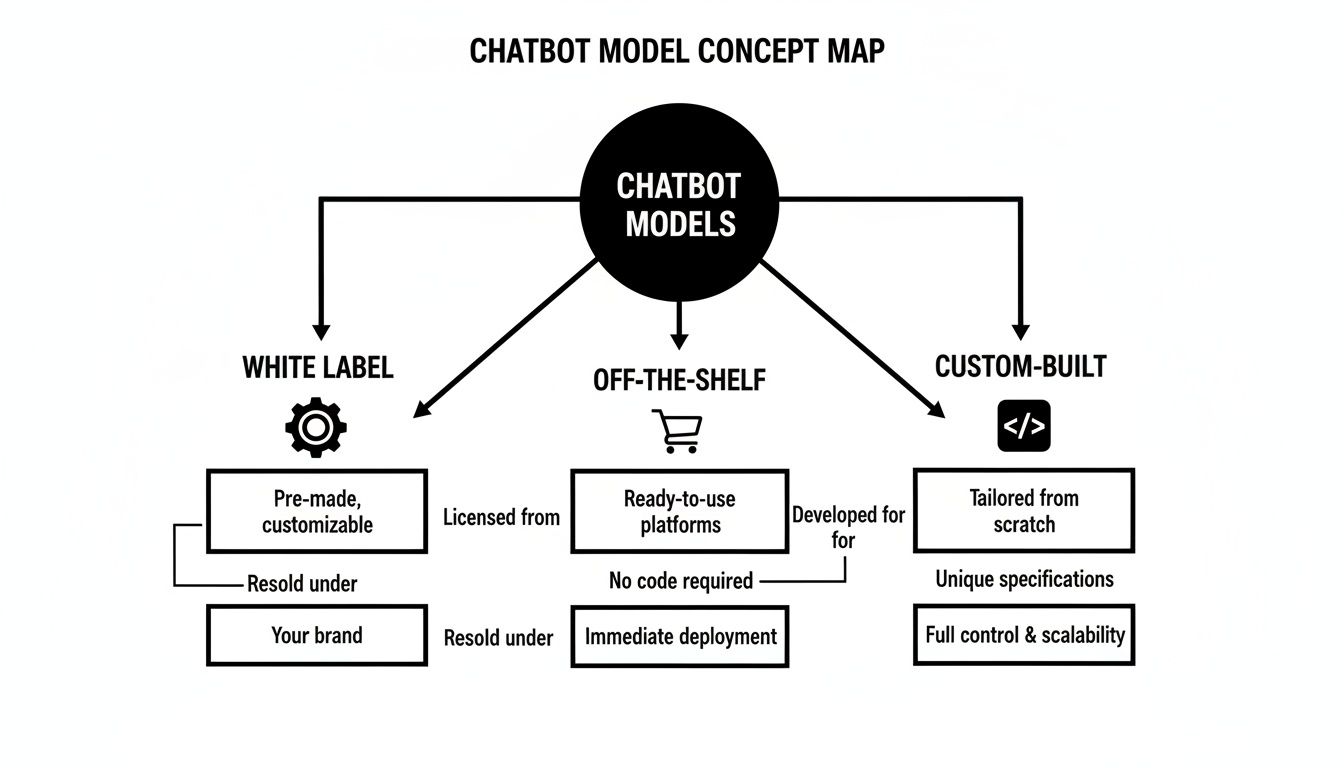
As you can see, the white-label route gives you that sweet spot of branding control and speed—a massive advantage for any agency.
To help you vet potential platforms, here’s a quick checklist of the core features you should be looking for and why they are so important.
Core Platform Features Agency Checklist
| Feature | Why It Matters for Your Agency | Example Application |
|---|---|---|
| Client-Specific RAG | Prevents data crossover and ensures each bot is an expert on one client only. | The bot for a dental clinic only uses the clinic’s service pages and FAQs, never mixing it up with your real estate client. |
| Full White-Labeling | Lets you sell the service under your brand, increasing perceived value and client loyalty. | Your client logs into portal.youragency.com to see their bot's performance, with your logo and colors everywhere. |
| Site Crawling & Doc Upload | Drastically cuts down on manual setup time, allowing you to onboard clients faster. | You onboard a new law firm by simply crawling their website and uploading their top 10 case study PDFs. |
| Custom Chat Widgets | Guarantees the chatbot looks like a native part of your client's website, not a tacked-on tool. | You match the chat widget's font and color scheme perfectly to your client’s new branding guidelines. |
| CRM/Zapier Integration | Automates lead delivery, saving you and your client manual work while speeding up their sales process. | A lead captured in the chat is automatically added as a new contact in the client’s HubSpot account. |
| Centralized Dashboard | Allows you to manage dozens of client accounts from a single login, making your operations scalable. | You can check the performance of 15 different client bots in under 10 minutes without logging out once. |
| Actionable Analytics | Provides the data you need to prove ROI and make smart decisions about improving bot performance. | You show your client a report that the bot handled 250 queries and generated 30 leads last month. |
This table acts as a scorecard. If a platform you're considering has gaps in these areas, it's a major red flag for its suitability for agency use.
Effortless Management and Lead Generation
A platform built for agency life has to make managing tons of clients easy. A centralized dashboard is non-negotiable. It lets you hop between client accounts, check performance, and make tweaks without the headache of logging in and out of a dozen different places. This is the secret to scaling your service without scaling your team.
Beyond that, the chatbot can't just be a passive helper; it needs to be an active part of your client's sales funnel. The best platforms have features baked in to turn conversations into actual leads. This means you can build forms right into the chat to grab a visitor's name, email, or phone number when the moment is right.
Actionable Analytics and Reporting
At the end of the day, you can't prove your worth without good data. A powerful analytics suite is another must-have. You need to track the key performance indicators (KPIs) that your clients actually care about so you can show them a clear return on their investment.
Look for dashboards that give you a quick, clear view of:
- Total Conversations: The sheer volume of interactions the bot is handling for them.
- Leads Captured: The number of qualified leads the chatbot has generated.
- Frequently Asked Questions: Goldmine insights into what customers are really asking, which can help shape your client's entire content strategy.
- Conversation Logs: The ability to review actual chats to spot where the knowledge base can be improved.
These features, when combined, elevate a simple chatbot into a full-blown service that delivers real business results, cementing your status as a vital strategic partner.
Your Step-By-Step Client Deployment Workflow
Alright, let's move from theory to practice. Getting a chatbot live and actually helping your client is where the real value kicks in. Having a repeatable deployment workflow is the secret to getting results fast and making a great first impression. This process turns what could be a messy technical project into a straightforward service anyone on your team can handle.
Think of it like a pre-flight checklist. Every step is there for a reason, designed to make sure the launch is smooth and successful. When you follow this sequence, you're not guessing—you're building a polished, high-performing AI agent every single time.
This structured approach is one of the biggest perks of using a solid white-label chatbot platform. It takes client onboarding from a weeks-long headache to a quick, efficient win.
Step 1: Instant AI Agent Onboarding
The whole process starts with a single, surprisingly simple action. Forget spending hours trying to build a bot from scratch. All you need to get started is one piece of information: your client’s website.
You just plug their URL into the platform, and the intelligent crawlers take over. They automatically scan the entire site, absorbing the content, understanding the structure, and learning the context of the business. This creates the first version of the AI agent. It’s not a blank slate; it’s a functional bot that already knows the basics, ready for you to start refining in just a few minutes.
- Action: Enter the client's main website URL into your agency dashboard.
- Result: An AI agent is immediately created and trained using the public website content.
- Benefit: You just cut the initial setup time by over 90% compared to doing it all manually.
Step 2: Curating the Knowledge Base
The initial web crawl gives you a great foundation, but real expertise comes from the inside scoop. Now it's time to upload the internal documents and specific information that isn't on the public website.
This is like handing a new hire the company training manuals. By adding files like product catalogs, internal FAQs, service agreements, or detailed spec sheets, you’re giving the AI the knowledge it needs to answer specific, nuanced questions with total confidence. A deep knowledge base is what turns a generic chatbot into a true brand expert.
Think of the AI's knowledge as a pyramid. The website crawl builds the wide, stable base. Uploading specific documents adds the supportive middle layers. And fine-tuning with manual Q&As creates the sharp, precise peak.
Step 3: Perfecting Brand Alignment
Okay, the bot is smart. Now it needs to look and sound the part. This step is all about making sure its appearance and personality are a perfect match for your client’s brand. A true white-label platform gives you the keys to customize everything, creating a seamless experience that feels like a natural part of the client's website.
This goes way beyond just slapping on a logo. You need to get into the details and style every element to match their brand guide.
- Apply Logos and Colors: Upload the client's logo and use their exact hex codes to match the chat widget's colors to their brand palette.
- Customize Greetings: Craft custom welcome messages and conversation starters that capture the brand's unique voice and tone.
- Adjust Widget Behavior: Tweak the widget's position on the page and set up proactive messages that feel helpful, not annoying.
Step 4: Configuring Lead Capture
A good chatbot doesn't just answer questions—it's a lead-generation machine working around the clock. The next critical step is setting it up to identify visitors who are ready to talk business and capture their information for the sales team.
Most modern platforms let you build simple forms that pop up right in the chat based on what a user is asking. For example, if someone asks about pricing or requests a demo, the bot can automatically ask for their name, email, and phone number. That info then gets sent straight into your client’s CRM. Easy.
Step 5: Internal Testing and Launch
Before you unleash the bot on the public, one last round of internal testing is essential to ensure a perfect debut. The best platforms will give you a private staging link so you and your client can kick the tires in a safe environment. This is your chance to ask it tough questions, try to break it, and fine-tune any awkward responses.
Once everyone gives the thumbs-up, the final launch is incredibly simple. The platform will give you a small snippet of code to add to the client's website header. That's it. The fully trained, branded, and tested chatbot is now live, ready to engage customers and start delivering results.
Choosing the Right Platform and Pricing Model
Picking the right partner is the single most important decision you'll make when you start offering chatbot services. This isn't just about a features list; it’s about finding a platform that fits your agency's business model, lets you grow without penalizing you, and makes profitability a sure thing. The wrong choice can quickly become a headache, eating into your margins and frustrating your team and your clients.
Think of it like choosing the engine for a race car. You need something built for performance and endurance, not just a standard engine that happens to fit. A white label chatbot platform needs the right architecture and pricing to fuel your agency's ambitions from the get-go.
Evaluating Platforms Through an Agency Lens
While it's tempting to get lost in a sea of features, agencies need to look at platforms through three core lenses that directly impact how you run your business and make money: scalability, management, and integrations.
- True Scalability: Does the platform's pricing actually encourage you to add more clients? Look for plans that give you unlimited chatbots or sub-accounts under one subscription. This is the secret sauce to growing your revenue while keeping your costs flat.
- Easy Multi-Client Management: A platform built for agencies has to have a central dashboard. Being able to jump between all your client accounts from a single login isn't a "nice-to-have"—it's essential for staying efficient as you scale.
- Seamless Integrations: The chatbot has to play nice with the tools your clients already depend on, like their CRM or email marketing software. Platforms with solid native integrations or support for tools like Zapier will save you countless hours you’d otherwise spend on custom coding.
The best platform isn't the one with the most bells and whistles. It's the one that makes it dead simple for you to deliver, manage, and prove the value of your chatbot service to every single one of your clients.
Demystifying Common Pricing Models
Trying to compare pricing can feel like navigating a maze, but most models fall into a few distinct buckets. Getting a handle on them is key to figuring out your costs and, more importantly, your potential profit.
1. Flat-Fee Subscription (The Agency Favorite)
This is almost always the most profitable route for an agency. You pay one predictable fee, monthly or annually, and in return, you can create and manage chatbots for multiple clients—often an unlimited number. This structure lets you stack new clients on top of a fixed cost, which means your margins get bigger with every new sale.
2. Per-Bot or Per-Agent Pricing
With this model, your costs go up every time you add a new client or chatbot. It might seem affordable when you're just starting, but it ties your expenses directly to your growth, which puts a ceiling on how much you can make from each client.
3. Usage-Based Pricing
Here, you're charged based on metrics like the number of conversations or messages. This can be a wild card. It makes it tough to offer fixed-price packages to your clients because one busy month for a client could suddenly blow up your own costs.
For most agencies, a flat-fee subscription is the clear winner. It offers predictability and profitability, turning the platform into a high-margin revenue machine.
How to Calculate Your Profitability
Agencies are jumping on the white-label chatbot train for a simple reason: the numbers just work. The pricing is often designed for agency success, whether you're looking at a developer-centric tool like Botpress or a user-friendly option like Tidio. Some platforms even have usage-based models that scale to help you hit 60-70% margins. The return on investment can be huge, with chatbots proving to be up to 97% cheaper than human agents. You can dive deeper into the chatbot market and its impact on businesses on masterofcode.com.
Let's run some simple math on a flat-fee model to see how this plays out:
- Platform Cost: You sign up for an agency plan at $299/month.
- Your Service Price: You sell your managed chatbot service to clients for $150/month each.
- Break-Even Point: You only need two clients to completely cover your software costs.
- Scaling Profit: Once you have 10 clients, your monthly revenue hits $1,500. Subtract your $299 platform fee, and you're looking at $1,201 in pure profit every month.
This back-of-the-napkin calculation shows the power of the white-label model. Your main cost is locked in, allowing you to grow your client base and revenue without your expenses growing alongside them. This is the kind of financial clarity that lets you build a truly sustainable and profitable service offering.
How to Measure Success and Prove Client ROI

At the end of the day, clients don't pay for fancy features; they pay for results. After you’ve rolled out a branded chatbot for them, the real work begins: proving it’s making a tangible impact on their business. The key is to shift the conversation from technical specs to measurable outcomes. This is how you build trust, justify your fees, and show your agency is an essential partner.
It means looking past vanity metrics like "total chats" and zeroing in on the key performance indicators (KPIs) that actually matter to your client's bottom line. A good white label chatbot platform will have an analytics dashboard that makes this easy, giving you the data you need to build reports that scream ROI.
Core Metrics That Matter to Clients
When you're putting together a performance report, every single number should tell a story. A story about how the chatbot is making the client's business more profitable or more efficient. If you frame your reports around these three areas, you'll paint a complete picture of success.
- Lead Generation and Sales Impact: This is the big one—the most direct way to show a financial return. You need to focus on metrics that prove the chatbot is feeding their sales pipeline.
- Support Efficiency and Cost Reduction: This is all about highlighting how the AI agent is buying back time for the client's team by fielding all those repetitive questions automatically.
- User Engagement and Insights: Here, you'll show how the chatbot is not only improving the customer experience but also gathering priceless data that can inform bigger business decisions.
Think of your client report as a value statement. It should clearly answer the question, "What has this service done for my business this month?" By connecting every metric back to a core business goal, you transform the chatbot from a website gadget into a critical performance tool.
Building a Compelling ROI Report
A great report is more than just a data dump. It’s a narrative. It guides your client from the chatbot’s day-to-day activity straight to the business results they care about. Always lead with the most impressive outcomes so even a busy client can see the value in a quick glance.
Make sure your report always includes these essential KPIs:
- Leads Generated: This is your headline number—the total count of qualified contacts captured by the bot. Example: "The chatbot captured 45 qualified leads for your sales team this quarter."
- Conversion Rate: This is the percentage of conversations that turned into a lead. It’s a powerful metric that shows how effective your chatbot's scripts and logic are. Example: "8% of all chat sessions resulted in a new lead, exceeding our initial goal of 5%."
- Support Tickets Deflected: Show the sheer volume of common questions the chatbot handled without needing a human. This is a direct line to time and money saved. Example: "The AI agent successfully resolved 350 routine support queries, freeing up an estimated 20 hours of your support team's time."
- Top User Questions: This is pure gold. A simple list of the most common questions gives clients incredible insight into what their customers really want to know. Example: "The top query was 'What is your return policy?', indicating a need for a more prominent link on your homepage."
When you track and present this data consistently, you create a powerful feedback loop. You’re not just proving the chatbot’s current value; you’re spotting opportunities to make it even smarter and more effective down the road.
Frequently Asked Questions
It's natural to have questions when you're looking at bringing a new AI service into your agency. This isn't just another tool; it's a strategic move. Let's tackle some of the most common questions we hear from agencies evaluating a white label chatbot platform.
What Does "True" White Label Actually Mean?
A true white label platform goes way beyond just letting you slap your logo on something. It means the original software provider becomes completely invisible.
Think of it this way: there should be absolutely no "Powered by" links, no third-party branding on the client dashboard, and you should be able to host the entire service on your own custom domain. When your client logs in or sees the chatbot on their site, the only brand they ever encounter is yours. This is what lets you present the technology as a core part of your agency's unique offerings, building trust and justifying a higher price point.
How Quickly Can I Get a Chatbot Live for a Client?
This is where modern platforms really shine. Forget about long, drawn-out development cycles. You can take a new client from kickoff to a fully trained, branded, and functioning chatbot on their website in a matter of hours, maybe a day or two at most.
The whole process is built for agency speed:
- Instant Training: The AI gets its initial smarts by crawling the client's website, a process that usually takes just a few minutes.
- Fast Customization: Tweaking brand colors, uploading logos, and setting up custom welcome messages is all done through a simple interface. No coding required.
- Easy Deployment: Getting the bot live is as simple as copying and pasting a small snippet of code into the client's website header.
Do I Need a Developer to Run This Service?
Absolutely not. The best white label platforms are built specifically for agency folks—account managers, project coordinators, and strategists—not developers. You'll find intuitive, visual dashboards that let you build conversation flows, style the chat widget, and manage all your client accounts without touching a line of code.
Sure, having a technical person on hand can be useful for complex, custom integrations down the road. But for the day-to-day work of onboarding clients and refining the AI's knowledge, your current team has everything they need. This makes it an incredibly scalable service to roll out.
The goal here is to give your agency the power to offer a sophisticated AI service without the overhead of hiring a dedicated AI team. The platform does all the heavy technical lifting, letting you focus on client strategy and delivering results.
This model opens the door for agencies of any size to step into the AI arena and create new, predictable revenue streams with the team they already have.
Ready to offer a powerful, client-trained AI service under your own brand? BizSage gives you all the tools you need to deploy, manage, and scale intelligent chatbots for your entire client roster. Start your journey with BizSage today.