
When you first plug in an AI chatbot, the benefits show up almost immediately. You’re getting 24/7 automated support that cuts down operational costs and, frankly, makes customers happier by giving them instant, consistent answers. This isn’t just software; it’s a tireless virtual team member handling all the repetitive stuff, freeing up your human agents for the tough problems.
The Immediate Impact of AI Chatbots on Business
Think of an AI chatbot less like a new tool and more like a strategic hire. It’s built to tackle the classic growing pain: how to scale support without your payroll exploding. By automating conversations and common tasks, it delivers value from day one for your business and a much smoother ride for your customers. It’s your new first line of defense, ready to handle the bulk of routine questions, day or night.
This automation means your team is no longer stuck in a loop, answering the same questions again and again. Instead of spending their day on password resets or “where’s my order?” inquiries, your best people can apply their skills to high-value work that actually requires a human brain—things like solving tricky issues or building real customer relationships.
The Core Pillars of Chatbot Value
So, where does the real value come from? It all boils down to three key areas: getting more efficient, making customers happier, and adding tangible value to your bottom line.
- Improved Efficiency: A single chatbot can juggle hundreds of conversations at once, deflecting common support tickets and lightening the load for your human team.
- Enhanced Satisfaction: Customers get the answers they need, right when they need them. No more waiting on hold, just quick help that always reflects your brand’s voice.
- Direct Business Value: By taking over routine tasks and smoothing out the customer journey, chatbots don’t just save money—they can actively help with lead generation and sales.
This is how those pieces fit together to create real momentum for your business.
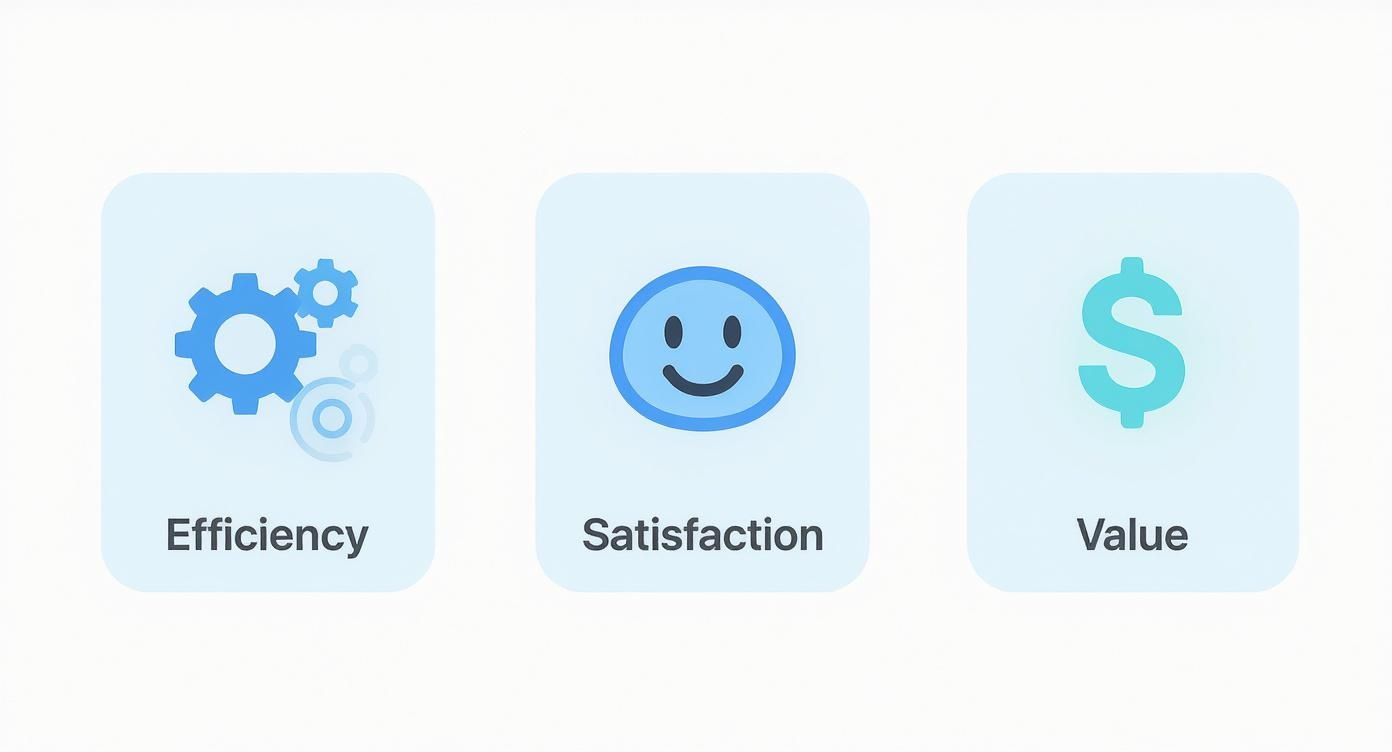
As you can see, the gains in efficiency directly fuel higher customer satisfaction. That satisfaction, in turn, drives real financial value and a solid return on your investment. It’s a powerful cycle where smart automation improves your bottom line.
By immediately resolving common questions, an AI chatbot empowers your team to focus on what truly matters—solving complex problems and building lasting customer loyalty.
This isn’t just about managing your current workload better. It’s about creating a system that lets you scale your entire operation without having to constantly expand the size of your support team.
To give you a clearer picture, here’s a quick summary of how these advantages play out across your business.
Key Benefits of AI Chatbots at a Glance
| Benefit Category | Primary Business Impact | Example Metric |
|---|---|---|
| Operational Efficiency | Reduces the manual workload on human support agents. | 40-60% reduction in ticket volume. |
| Customer Experience | Provides instant, 24/7 answers to common questions. | 90% of inquiries resolved instantly. |
| Cost Savings | Lowers the cost per interaction and reduces hiring needs. | 30% decrease in customer support costs. |
| Scalability | Handles fluctuating query volumes without a drop in service. | 100% availability during peak hours. |
| Data & Insights | Gathers valuable data on customer needs and pain points. | Identification of top 5 customer issues. |
This table neatly lays out the ripple effect of implementing an AI chatbot—what starts as a simple efficiency gain quickly turns into measurable improvements across the board.
Be There 24/7 and Unlock Major Cost Savings
Think about your business for a second. Is it a 9-to-5 storefront, or is it an always-on digital concierge? For your customers, the answer matters. AI chatbots make that 24/7 availability a reality, offering instant, around-the-clock support to anyone, anywhere, in any time zone.
This isn’t just a nice-to-have feature; it’s a fundamental shift in the customer experience. People expect help the moment they need it, not hours or days later. Whether it’s midnight on a Tuesday or the middle of a holiday weekend, an AI agent is always there to answer questions, track orders, or provide information. That kind of reliability builds serious trust.

Unlocking Serious Financial Gains
While a better customer experience is great, let’s talk about the real game-changer: the direct impact on your bottom line. The cost savings from AI chatbots are tangible and come from slashing operational expenses.
Think about the costs of hiring, training, and paying a large customer service team. A chatbot dramatically reduces that overhead. A single AI agent can manage hundreds of conversations at once—a feat that would require a small army of human agents. This lets you scale your support without scaling your payroll.
There’s a reason the global AI chatbot market is set to explode from $8.3 billion in 2024 to a staggering $47 billion by 2029. Businesses are catching on to the massive savings and predictable ROI. You can dig deeper into the growing AI chatbot market on thunderbit.com.
How Ticket Deflection Supercharges Efficiency
One of the key mechanisms behind these savings is ticket deflection. It’s essentially an intelligent filter for your support queue. The chatbot intercepts all the common, repetitive questions and resolves them instantly, so they never become a support ticket for a human to deal with.
This automated first line of defense is perfect for handling the usual suspects:
- “What’s your return policy?”
- “Where’s my order?”
- “How do I reset my password?”
By deflecting these routine queries, AI chatbots free up your human agents to focus on the complex, high-value problems where their expertise and empathy truly shine.
This isn’t just about cutting costs; it’s about making your entire support operation smarter. Your team gets to work on more engaging, challenging issues, and customers get lightning-fast answers to their simple questions. It’s a win-win that creates a more efficient, cost-effective system for everyone.
Elevate Your Customer Experience and Brand Voice
Let’s move beyond the operational wins for a second. One of the biggest impacts an AI chatbot has is on how your customers actually feel about your brand. It fundamentally changes the support experience from “please hold” to “problem solved.” No more elevator music, just fast, correct answers right when they’re needed.
This kind of instant support really shifts perceptions. When people know they can get a quick fix anytime, day or night, they start to trust you more. It’s not just a nice-to-have anymore; 88% of people have used a chatbot in the last year. Your customers are already there, and frankly, they’re starting to expect it.
Maintain a Perfect Brand Voice Every Time
Consistency is everything when it comes to brand identity. Your human agents are fantastic, but they’re human—their tone and style can vary. A chatbot, on the other hand, is a blank slate you get to program.
You decide its personality. Is it friendly and informal? Buttoned-up and professional? A little bit witty? Once you define it, the chatbot sticks to the script, every single time. This guarantees every customer gets the same on-brand, high-quality experience without any risk of an “off day.” You’ve essentially created your most reliable brand ambassador, and it works 24/7.
An AI chatbot doesn’t just answer questions; it embodies your brand’s voice, ensuring every customer interaction is a perfect reflection of your company’s values and personality.
Having that much control over your messaging does wonders for brand recognition. It builds a predictable and trustworthy relationship with your customers over the long haul.
Deliver True Personalization at Scale
Today’s customers expect you to know them. AI chatbots are brilliant at this because they can tap into your customer data to create genuinely personalized conversations. By hooking into your CRM or other internal systems, the bot can see a customer’s history and preferences to give them help that’s actually helpful.
This unlocks a level of service that makes every customer feel like you get them. Instead of making them repeat their life story every time they reach out, the chatbot already has the context it needs.
Imagine what that makes possible:
- Recommending products based on what a customer has bought or looked at before.
- Greeting a returning visitor by name and referencing their last interaction.
- Proactively sharing an order update before the customer even thinks to ask.
This isn’t just about being efficient. It’s about making each person feel seen and valued, which is the real secret to building loyalty. Tools like BizSage are designed for this, helping you turn all that company knowledge you already have into personalized, on-brand conversations.
Turn Customer Conversations into Actionable Insights
Let’s talk about one of the most overlooked superpowers of a good AI chatbot: its ability to act as a data-gathering machine. Beyond just answering questions, every single chat—every query, complaint, and bit of praise—is a goldmine of business intelligence just waiting to be tapped.
Think of your chatbot as a 24/7 focus group that you don’t have to pay by the hour. It’s constantly collecting raw, unfiltered feedback straight from your customers, giving you a real-time pulse on what they really think and what they’re struggling with. This isn’t just about providing support; it’s about understanding the “why” behind their questions.
From Raw Data to Smarter Decisions
When you start analyzing these conversation logs, you can shift from simply reacting to problems to proactively improving your business. By spotting the recurring themes and patterns in what people are asking, you can uncover critical insights that would otherwise stay buried in one-off support tickets.
For example, are dozens of customers asking the chatbot how to use a specific feature? That’s not just a support query. It’s a massive red flag telling you that your user interface or documentation is falling short. This kind of direct feedback loop is incredibly valuable for making smart, informed decisions.
An AI chatbot transforms thousands of individual conversations into a unified voice of the customer, providing clear, actionable feedback to guide product development, marketing, and overall business strategy.
This data-driven approach helps you find and fix the small points of friction before they snowball into major issues that cause customers to leave.
How Conversations Fuel Business Actions
The real magic happens when you connect these insights to other parts of your business. It’s about grounding your strategy in what customers are actually telling you, not what you think they need.
Here’s how that plays out in the real world:
- Common Questions: If users keep asking about your pricing plans, your pricing page is probably confusing. That’s a clear signal to redesign it for clarity.
- Product Feature Gaps: When customers ask, “Can your software do X?” and the answer is no, they’re literally handing you their feature requests. That’s direct input for your product roadmap.
- Website Navigation Issues: Do conversations often start with “I can’t find…”? You likely have a user experience problem on your website that needs fixing.
- Unclear Marketing Messages: Constant questions about your return policy or shipping times suggest your marketing copy isn’t doing its job. You can use that feedback to make it more direct and informative.
This process draws a straight line from a simple customer chat to a meaningful business improvement. The table below breaks down exactly how that works.
From Conversation to Insight: How Chatbots Generate Actionable Data
This table breaks down the types of data AI chatbots collect and illustrates how businesses can use these insights to make strategic improvements.
| Data Type Collected | Business Insight Gained | Potential Business Action |
|---|---|---|
| Frequently Asked Questions | The current help center is missing key information or is hard to navigate. | Update knowledge base articles and improve the search function on your website. |
| User Pain Points | A specific feature in your product is confusing or not working as expected. | Prioritize a bug fix or create a new tutorial video explaining the feature. |
| Pre-Sale Inquiries | Prospective customers are consistently hesitant about a particular aspect of your offer. | Refine marketing messaging on landing pages to address this concern proactively. |
Ultimately, a chatbot doesn’t just solve problems for your customers—it surfaces problems for your business, giving you the data you need to build a better product and a stronger company.
See How Real Businesses Win with AI Chatbots
It’s one thing to talk about benefits in theory, but it’s another to see them in action. The real “aha!” moment comes when you see how AI chatbots are delivering actual, measurable results for businesses right now. Across every industry, companies are putting this technology to work solving tangible problems and turning abstract ideas into bottom-line wins.
Let’s get practical. By looking at a few specific scenarios, you can start to picture how an AI assistant could tackle your own unique challenges.
E-commerce Automation and Sales Growth
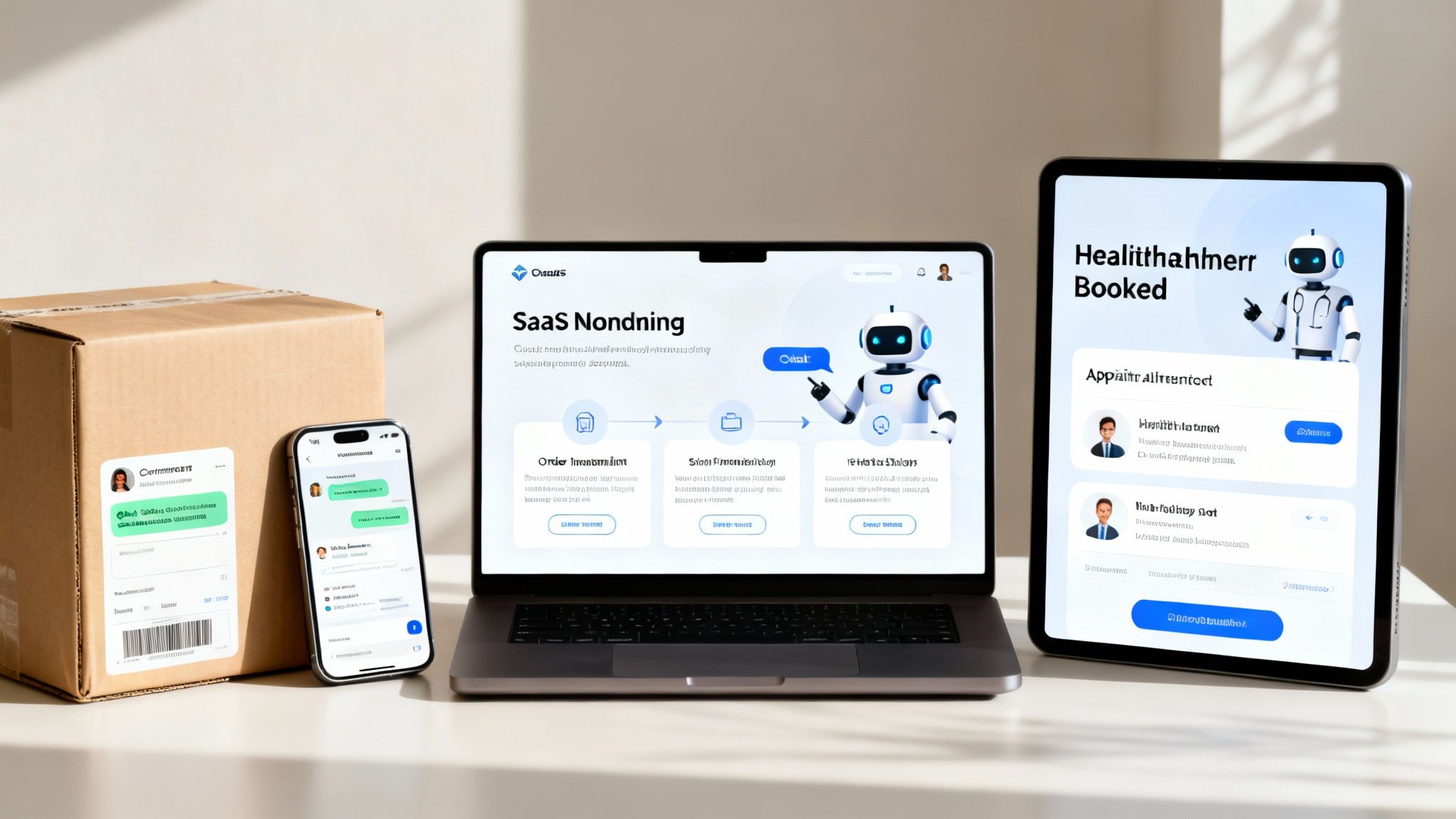
Imagine an online store that’s finally taking off. The problem? They’re drowning in “Where is my order?” emails. Instead of hiring more staff, they deploy an AI chatbot linked directly to their shipping system. Suddenly, those repetitive questions are answered instantly, day or night. This frees up the human team to handle the tricky stuff—complex returns, detailed product questions, and upset customers.
But the bot is more than just a glorified package tracker. It also becomes a powerful sales tool. It can:
- Suggest products that pair well with what a customer is already looking at, just like a helpful shop assistant.
- Flag special offers or alert a shopper that an item in their cart is almost out of stock, encouraging them to complete the purchase.
- Handle pre-sale questions about sizing, materials, or shipping policies, smoothing out the path to checkout.
The impact is twofold: a huge drop in routine support tickets and a real increase in average order value. The chatbot isn’t just a cost-saver; it’s a revenue-generator.
Streamlining SaaS User Onboarding
For any software company, the first few minutes a new user spends with their product are make-or-break. If it’s confusing, they’ll leave and never come back. An AI chatbot can act as a personal tour guide, helping customers get started without having to file a support ticket and wait.
A well-trained chatbot becomes an on-demand expert, providing instant answers to setup questions and guiding users to key features, drastically reducing the time it takes for them to find value in the product.
This approach does more than just boost user activation rates; it builds confidence from the very beginning. It also deflects all those simple, repetitive questions that typically flood support queues after a big product launch or update.
The sheer speed at which people have adopted these tools shows they’re here to stay. By 2025, AI tools, including chatbots, reached 378 million people globally, adding a staggering 64 million new users in just one year. This isn’t just a niche trend—it shows that customers are ready for this and are already embracing it. You can learn more about the growth of AI adoption at Netguru.
How to Implement Your First AI Chatbot
Ready to put an AI chatbot to work for your business? Getting one up and running is probably much simpler than you think. It’s less about wrestling with complicated code and more about having a clear plan and preparing your resources.
The first step is always choosing the right platform. You need a solution that fits your team’s skills and business goals. Does it connect easily with the tools you already use, like your CRM or help desk? Can you actually track its performance with solid analytics? A no-code platform like BizSage is a great place to start, as it lets you build and launch in minutes.
A Simple Framework for Your First Chatbot
Once you have your platform, the actual implementation boils down to a pretty straightforward, four-step process. Following this framework ensures you build something that solves a real problem right away, which is key for a successful launch.
- Pinpoint Your Primary Goal: You can’t solve every problem at once, so don’t even try. Pick one specific, high-impact area to start with. Is your main goal to handle common support questions, qualify new sales leads, or maybe guide new users through onboarding? Focusing on a single objective keeps the project manageable and clear.
- Organize Your Knowledge Base: A chatbot is only as good as the information it can access. Pull together all of your existing content—FAQs, help center articles, product guides, and even key website pages. This content becomes the brain of your chatbot, giving it the raw material it needs to find accurate answers.
A well-prepared knowledge base is the foundation of an effective AI chatbot. It ensures your bot can deliver consistent and trustworthy information, building customer confidence with every interaction.
- Design Intuitive Conversation Flows: Put yourself in your customers’ shoes. What are the first things they usually ask? Sketch out the most common conversation paths that will get them to an answer without any fuss. The goal is to make talking to the bot feel helpful and natural, not like navigating a frustrating phone menu.
- Test, Launch, and Improve: Before you unleash your bot on the world, have your team test it thoroughly. Ask it the easy questions, the hard ones, and the weird ones to see where the gaps are. Once it’s live, pay close attention to the analytics. The data will show you exactly what’s working and what isn’t, giving you a clear roadmap for making it even better over time.
Common Questions About AI Chatbots
Even with all the obvious upsides, it’s smart to have questions before plugging any new technology into your business. People often worry about the cost, the learning curve, and how a bot will mesh with their existing support team. The good news is that today’s chatbot platforms were designed to solve these exact problems.
For instance, a lot of people worry that a chatbot will sound, well, robotic. But modern AI is designed to soak up your specific brand voice. This ensures every conversation is not just helpful but also feels like it’s coming from your company, creating a consistent and reliable experience for every user.
Another big hurdle for many is the fear of a long, technical setup. The thought of needing developers and months of work is daunting. Thankfully, no-code solutions have changed the game. You can now train an AI on your existing content—your website, your help docs—and have it live in minutes.
Will Customers Actually Use It?
This is the big one, isn’t it? The data here is pretty clear: absolutely. People are getting more and more comfortable with AI in their daily lives.
In fact, a whopping 88% of people have chatted with a bot in the last year, and 35% use AI tools every single day. Customers aren’t just tolerating this technology; they’re actively using it to get fast answers.
This isn’t just a local trend, either. Global attitudes are shifting. In major markets like China and Indonesia, over 80% of people now see AI services as more helpful than harmful. This growing trust signals a worldwide move towards embracing AI for everyday support. You can dive deeper into the numbers in the global AI perception in the Stanford HAI report.
Do Chatbots Replace Human Agents?
This is probably the most common myth out there. The goal of a chatbot isn’t to replace your team—it’s to make them better. Think of it as a tool that handles all the repetitive, high-volume questions, freeing up your human agents to tackle the complex issues where their skills really shine.
A chatbot is like a tireless front-line filter. It handles the easy stuff so your expert human team can focus on the conversations that actually require empathy and creative problem-solving.
This kind of teamwork makes your whole support system run smoother. Your team deals with less burnout from answering the same questions over and over, and your customers get their answers faster. It’s a win-win.
Ready to see how an AI chatbot can answer your customers’ questions 24/7? With BizSage, you can turn your company knowledge into on-brand answers in minutes. Start your free trial at https://bizsage.io and see the benefits for yourself.
Article created using Outrank