

Picking the right pricing model for your marketing agency isn't just about the numbers—it's about defining your value, managing client relationships, and building a scalable business. The best agencies I've seen don't just stick one price tag on everything. They strategically choose a model that fits the client, the project, and their own growth goals.
Think of your pricing structure as the foundation of every client partnership. It sets the tone for everything that follows.
How to Choose the Right Agency Pricing Model
This is one of those decisions that can make or break an agency. Get it right, and you're paid fairly for the incredible results you drive. Get it wrong, and you're battling scope creep, unprofitable work, and endless client friction.
The secret is realizing that there's no single "best" model. A simple website build for a local bakery demands a different financial setup than a multi-year SEO campaign for an e-commerce giant. Your pricing strategy is a direct reflection of your agency's confidence and how you communicate your worth. It’s the first real test of the partnership.
Foundational Pricing Structures
Before we get into fancy hybrid models, let's nail down the basics. Each of the core pricing structures has its place, and understanding them is non-negotiable.
- Hourly and Retainer Models: These are all about predictability. They offer a steady rhythm of service delivery for the client and reliable revenue for you.
- Project-Based Pricing: This is your go-to for work with a clear finish line. Think website design, a branding package, or a one-off content campaign.
- Performance and Value-Based Models: Here's where you directly tie your paycheck to the business results you create. It's high-risk, high-reward, and aligns your goals perfectly with the client's.
As agencies grow, many also look at different ways to deliver services, which naturally influences pricing. For instance, partnering with a white label provider for SEO can open up new revenue streams, and understanding the different white label pricing strategies is key to making that model work profitably.
For brand new agencies or simpler projects, this decision tree offers a great starting point.
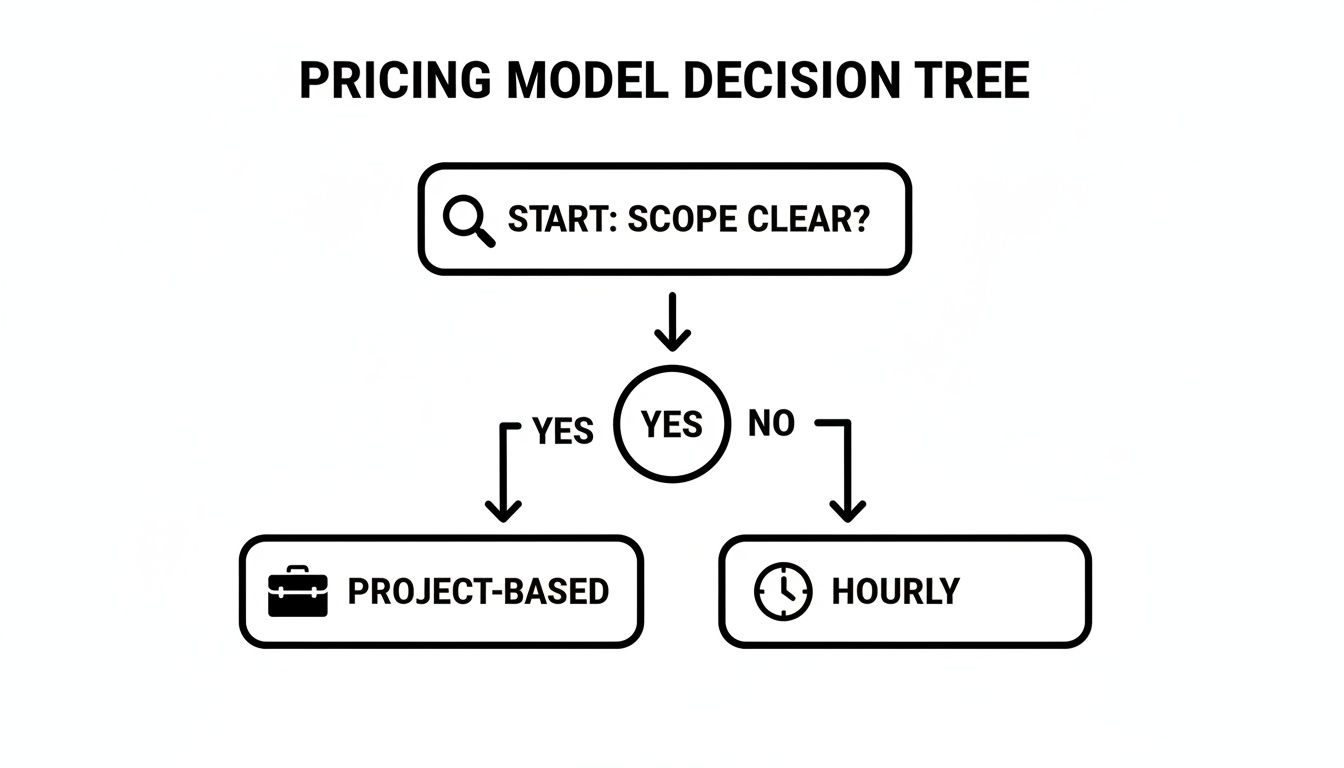
It boils things down to one simple question: is the scope crystal clear? If yes, a project-based fee makes sense. If the scope is fuzzy or likely to change, hourly billing protects you. This guide will build on this simple idea and explore the more advanced options you'll need as you grow.
Hourly vs. Retainer: The Classic Agency Pricing Models
Let’s start with the two models that have been the bread and butter of the agency world for decades: charging by the hour and the monthly retainer. They're the most established ways to bill for services, and while they might seem simple, there's a real art to getting them right for both you and your clients.
Think of an hourly rate like calling a plumber. You pay for the time they spend fixing the leak, whether it’s a quick 30-minute job or a complex, multi-hour ordeal. It's direct, it's transparent, but the final bill can be a surprise if unexpected issues pop up behind the wall.
A retainer, on the other hand, is more like having a property manager on call. You pay a predictable monthly fee, and in return, you get peace of mind knowing someone is consistently looking after your investment. It’s less about a single transaction and more about an ongoing, strategic partnership.
Getting Your Hourly Rate Right
Charging by the hour is often the go-to for its simplicity. You work an hour, you bill an hour. This approach is perfect for projects with a fuzzy scope, one-off consulting sessions, or ongoing maintenance where the workload can fluctuate.
But here’s where a lot of agencies trip up: they set a rate that barely covers their team's salaries. A profitable hourly rate has to account for everything. We’re talking software subscriptions, rent, insurance, marketing—all the hidden costs of running a business. Just covering payroll is a fast track to going out of business.
So, how do you land on a number that actually builds your business? You have to work backward from your costs.
- Tally Your Total Costs: Add up all your monthly operational expenses (rent, software, utilities, etc.) and your team’s salaries.
- Figure Out Your Billable Hours: Be realistic here. A full-time employee isn't billable for 40 hours a week. After you account for holidays, internal meetings, and administrative work, you’re often looking at around 1,600 billable hours per person, per year.
- Calculate Your Break-Even Rate: Divide your total monthly costs by your total monthly billable hours. This is the absolute minimum you have to charge just to keep the lights on.
- Add Your Profit Margin: Now, add a healthy profit margin (think 20-40%) to that break-even number. That’s your final client-facing hourly rate.
A word of caution: The biggest problem with the hourly model is that it rewards inefficiency. The longer something takes, the more you get paid. This can create a weird tension with clients and, if not managed carefully, can start to erode trust.
Building a Bulletproof Retainer Model
The retainer is a beautiful thing. For agencies, it creates predictable, recurring revenue that makes it so much easier to plan your finances and staff your team effectively. It smooths out the cash flow rollercoaster.
Clients love the predictability, too. They get a fixed, budgetable expense every month and a dedicated partner who’s deeply plugged into their business. This is how you move from being just another vendor to becoming an indispensable part of their team.
The whole thing falls apart, though, without a rock-solid scope of work. If that scope is vague, you’re signing up for "scope creep"—that slow, painful process where client requests keep expanding until you’re doing twice the work for the same fee, crushing your profit margins.
The Different Flavors of Retainers
Not all retainers work the same way. You’ll want to pick a structure that makes sense for the kind of work you do.
- Fixed-Scope Retainer: This is the classic. The client pays a flat fee for a specific list of deliverables each month. For example, a $5,000/month SEO retainer might get them keyword research, four new blog posts, on-page technical fixes, and one monthly performance report. Simple and clear.
- Points-Based Retainer: This model adds a layer of flexibility. A client buys a block of "points" each month, which they can "spend" from a menu of services that have different point values. This gives them control while ensuring you’re compensated for everything you do.
These models are still incredibly common for a reason. You'll see hourly rates for specialized agency work anywhere from $75 to over $200, while retainers for comprehensive support often run from $2,500 to $7,000+ per month. Where you fall on that spectrum depends on your team's expertise and the depth of services you're providing. To see how you stack up, it's worth checking out the latest B2B agency pricing trends at FreshContentSociety.com to make sure your numbers are competitive.
Pricing for Outcomes with Project and Value-Based Models
If you’re tired of trading time for money, let's talk about pricing for outcomes. This is where the game really changes. Your agency's fee gets tied directly to the deliverables you produce or, even better, the actual business results you generate. The whole conversation shifts from hours worked to value created.

These models are your ticket to being seen as a strategic partner, not just another vendor punching a clock. Project-based pricing brings much-needed clarity and predictability, while value-based pricing is the true north for strategic alignment.
Scoping for Success with Project-Based Pricing
Think of project-based pricing (often called a "fixed fee") like hiring a contractor to build a deck. You agree on the design, the materials, and the final price before a single nail is hammered. It's perfect for work with a clear beginning and end.
This model is a natural fit for deliverables like:
- A complete website overhaul
- A new brand identity and style guide
- A three-month content marketing launch campaign
- Building out a complex marketing automation sequence
The absolute key to making money here is bulletproof scoping. Seriously, if you underestimate the time or resources needed, your margins will vanish into thin air. You have to map out every single phase—from discovery and strategy to design, development, revisions, and launch. A classic rookie mistake is forgetting to build in a cushion for those inevitable client "can we just add…" requests or unexpected tech glitches.
Here's a pro tip: Always add a 15-20% contingency buffer into your project cost calculation. This simple step protects your profit from the scope creep and unforeseen problems that always seem to pop up.
For one-off jobs like a new website or a big social media campaign, this model lets you set a fixed fee for a custom scope, which almost always leads to better profit margins than just billing by the hour. When done right, you can see margins in the 30-40% range. If you want to dig deeper, you can find a detailed pricing model breakdown on ManyRequests.com that shows how other agencies structure these kinds of deals.
The Art of Value-Based Pricing
For many top-tier agencies, this is the holy grail. With value-based pricing, you stop thinking about your costs or the hours you put in. Instead, you price your work based on the tangible, dollars-and-cents value you deliver to the client's business.
This requires a complete mental reset. You're no longer selling your time; you're selling a specific, measurable business outcome.
Imagine this: your SEO strategy is projected to generate an extra $500,000 in annual revenue for an e-commerce client. Suddenly, a fee of $50,000 (10%) doesn't just sound reasonable—it sounds like a brilliant investment. The conversation shifts from "Why does this cost so much?" to "When can we start?"
Making the Value-Based Model Work
Pulling this off means having a totally different kind of conversation with your clients, starting from the very first discovery call. You have to dig deep to uncover their real business goals and the financial metrics that actually matter to their bottom line.
- Find the Core Business Goal: What's the one thing they really want? More qualified leads? A higher customer lifetime value? To steal market share from a competitor?
- Quantify the Value: Work with them to put a dollar figure on that outcome. For example, what is one qualified lead actually worth to their sales team over its lifetime?
- Propose a Fee Based on That Value: Frame your price as a percentage of the value you're confident you can create. This takes guts, a track record of success, and hard data from past wins to back up your claims.
Look, this model isn't for every agency or every client. It demands a high level of trust, proven expertise, and the ability to track and report on the metrics that prove your impact. But when you get it right, it’s easily one of the most profitable and rewarding ways to price your services.
Driving Results with Performance-Based Pricing
Let's shift gears and talk about a model that puts your money where your mouth is: performance-based pricing. This is where your agency’s paycheck is directly tied to your client’s success. When they win, you win. Simple as that. You stop billing for hours clocked or tasks completed and start charging for real, measurable outcomes.

This is the very definition of a high-risk, high-reward strategy. It’s definitely not for the faint of heart, but when you pull it off, it can be wildly profitable and build an unshakeable bond with your clients. You're no longer just a vendor; you're a true growth partner with skin in the game.
How Performance-Based Models Are Structured
This isn't a one-size-fits-all formula. It’s more like a family of approaches, with each one tethered to a different key performance indicator (KPI). The right structure really depends on what your agency can directly influence and what truly moves the needle for your client's business.
Here are a few popular ways to set it up:
- Cost-Per-Lead (CPL): You get paid a flat fee for every single qualified lead you generate. This is a go-to for PPC and content marketing campaigns where the main goal is to flood the sales pipeline with new opportunities.
- Cost-Per-Acquisition (CPA): This model takes things one step further. You only get paid when one of your leads actually becomes a paying customer. It’s a serious test of your ability to drive not just interest, but bottom-line sales.
- Revenue Share: With this one, your agency takes a percentage of the revenue that comes directly from your marketing efforts. This is the gold standard for e-commerce and SaaS clients where you can trace a dollar spent on a campaign to a dollar earned with crystal-clear attribution.
This results-first approach has become a big hit with B2B digital agencies, particularly those serving the SaaS world. Industry data shows that pure Cost-Per-Lead models average around $237 per qualified lead, while revenue share arrangements typically fall between 5-15% of the revenue you generate. But these models demand meticulous management, as arguments over lead quality or attribution windows can pop up. You can dig into a deeper analysis of these performance-based B2B agency pricing trends over at SaaS Hero.
Navigating the Risks and Challenges
While the potential payoff is huge, performance-based marketing agency pricing models are littered with landmines. A lot of your success can hinge on factors that are completely out of your hands, turning this model into a very calculated gamble.
The single biggest challenge? The client's own internal processes. You could be a lead-generating machine, sending over hundreds of perfect prospects. But if their sales team is slow on the follow-up or their process is clunky, those leads will die on the vine. Under a CPA model, that means you did your job flawlessly and still get paid nothing.
This model requires an almost invasive level of transparency and trust. You need deep access to your client's analytics, CRM, and sales data to track performance accurately. Without it, you’re flying blind.
Setting Yourself Up for Success
If you're going to make performance-based pricing work, you have to be obsessive about setting clear terms and having the right systems in place from day one.
- Define Everything in the Contract: Your agreement needs to spell out, in no uncertain terms, what counts as a "qualified lead" or an "acquisition." What's the criteria? What's the attribution window? Leave absolutely no room for interpretation.
- Ensure Bulletproof Tracking: You need an airtight tracking system that both you and your client trust implicitly. This could mean a combination of UTM parameters, call tracking software, and dedicated landing pages—whatever it takes to prove your impact without a shadow of a doubt.
- Vet Your Clients Ruthlessly: This model isn't a good fit for every client. Only partner with businesses that have a proven, effective sales process and are genuinely willing to collaborate. A weak sales team will sink your campaign every single time.
When it's all said and done, performance-based pricing is an incredibly powerful tool for confident agencies with a track record to back it up. It erases any questions about your value and cements your role as a true partner in growth.
Creating Flexibility with Hybrid and Custom Models
Let’s be honest: the best marketing agency pricing models are almost never pulled straight off a shelf. Sticking to a single, rigid structure often means you’re either leaving money on the table or frustrating a client whose needs don’t quite fit the mold. This is precisely why savvy agencies turn to hybrid and custom models.
Think of it less like choosing a pre-set menu and more like building the perfect meal à la carte. You can combine the stability of a retainer with the exciting potential of a performance bonus. This flexibility lets you build a pricing structure that feels tailor-made, minimizing risk for everyone while maximizing the rewards of a successful partnership.
This approach is about more than just billing; it's about designing an agreement that truly aligns with a client's specific goals, budget, and comfort with risk. It’s how you shift from being just another vendor to becoming an indispensable partner.
Combining Models for Mutual Benefit
Creating a hybrid pricing model isn't about inventing something from scratch. It's about intelligently combining the models we've already discussed to cover your costs while directly tying your success to the client's. This sends a powerful message: you're confident enough to put some skin in the game, but you're also a smart business that needs to protect its bottom line.
Here are a few of the most popular and effective combinations I've seen work time and again:
Retainer + Performance Bonus: This is the crowd-pleaser, and for good reason. You get a fixed monthly retainer that covers your team's core work and keeps the lights on. Then, you add a bonus that kicks in when you smash specific KPIs, like hitting a certain number of qualified leads or a revenue target. It keeps your cash flow predictable while giving your team a serious incentive to knock it out of the park.
Project Fee + Hourly for Overages: This one is your best defense against the dreaded scope creep. You quote a flat fee for a project with a crystal-clear scope. Anything that falls outside that initial agreement—extra revisions, new feature requests—gets billed at a pre-approved hourly rate. It’s a simple, fair way to keep projects on budget and on schedule.
Retainer + Project Fees: This is perfect for long-term clients. They might have you on a retainer for the day-to-day grind of SEO and content creation. But when a big initiative like a complete website overhaul comes up, you treat it as a separate, one-time project with its own fixed price. This keeps the ongoing relationship smooth while allowing you to price larger, distinct efforts appropriately.
The Power of Productized Services
Another smart way to offer custom-feeling solutions is by creating productized services. This isn't a hybrid model in the traditional sense, but rather a way of packaging a common, high-value service into a fixed-scope, fixed-price offering that’s incredibly easy for a client to say "yes" to.
For instance, you could offer a "SEO Foundation Package" for a flat $5,000. This isn't a vague promise of "better SEO"; it's a concrete deliverable that might include:
- A complete technical audit of their website
- In-depth keyword research for their top 20 pages
- Full on-page optimization for all core service pages
- A professionally built-out and optimized Google Business Profile
This approach dramatically simplifies your sales process. Clients know exactly what they're getting and exactly what it costs. It’s an ideal entry point for businesses that aren't quite ready for a monthly retainer but desperately need your expertise to solve a specific, painful problem.
By blending different pricing philosophies, you create a more resilient and client-centric business model. It communicates that you're not just a service provider; you're a strategic partner invested in finding the best way to work together.
Ultimately, mastering hybrid and custom pricing is an exercise in strategic creativity. It's your chance to design a financial relationship that aligns incentives, builds deep trust, and sets the stage for a profitable, long-term partnership.
Here’s a quick breakdown of how some popular hybrid models stack up, highlighting the benefits for both sides of the table.
Comparing Popular Hybrid Pricing Models
| Hybrid Model | Structure | Agency Benefit | Client Benefit |
|---|---|---|---|
| Retainer + Performance | A fixed monthly fee covers ongoing work, with bonuses tied to hitting pre-defined KPIs (e.g., lead volume, sales). | Guarantees predictable baseline revenue while offering a significant upside for achieving great results. | Ensures the agency is focused on outcomes, not just activities. The base fee is predictable for budgeting. |
| Project Fee + Hourly | A flat rate for a clearly defined project scope. Any work outside that scope is billed at an hourly rate. | Protects against scope creep and ensures all work is compensated. Makes project profitability easier to forecast. | Provides cost certainty for the core project while offering the flexibility to add tasks as needed. |
| Retainer + Project Fees | An ongoing monthly retainer for routine services, with separate, fixed-fee quotes for large, one-off projects. | Secures a stable, long-term client relationship while allowing for high-margin, one-time projects. | Simplifies budgeting for both ongoing marketing and major initiatives. Works with a trusted partner for big projects. |
| Value-Based + Retainer | A base retainer for operational costs, with a primary fee structure based on the perceived or actual value delivered. | Allows the agency to capture a share of the significant value it creates, leading to higher profitability. | The price is directly linked to the business value they receive, making the investment easier to justify. |
As you can see, each combination strikes a different balance between security and upside. The right choice always comes down to the specific client, the project goals, and the level of trust you've established.
How to Implement and Communicate Your Pricing
Picking the right pricing model is a huge step, but it’s only half the job. The real make-or-break moment comes when you have to package, present, and actually talk about that price with a potential client. How you handle this conversation will directly affect your closing rate, your agency's profitability, and the kind of clients you end up working with.
This isn’t about just handing over a price tag. It's about framing your fee as a smart investment in their company's future, not just another expense on their P&L. To do that, you need a solid proposal, crystal-clear contracts, and the confidence to steer the conversation away from cost and toward value.

Building Proposals That Sell Value
Think of your proposal as your single most important sales tool. Too many agencies make the mistake of turning it into a glorified price list, focusing only on a checklist of deliverables and their costs. A proposal that actually wins business tells a compelling story, one that casts your agency as the hero who can solve the client’s biggest problems.
Always lead with their goals, not your services. This shows you were paying attention and truly get what they're trying to accomplish. After you’ve established that understanding, you can then connect your services directly to those goals, drawing a clear line from your work to their desired outcome.
Here’s a simple structure that just plain works:
- The Client's Challenge: Kick things off by summarizing their current situation and the specific hurdles they're facing.
- The Proposed Solution: Lay out your high-level strategy and explain how it tackles those challenges head-on.
- Scope of Work & Deliverables: Get specific. Clearly list what you’ll do, including key timelines and milestones.
- The Investment: Present your fee as an "investment," connecting the cost to the immense value you're about to deliver.
- Projected ROI: If you have the data, include some realistic projections. Show them the potential return on their investment in black and white.
Structuring Tiered Packages Effectively
Offering a few different pricing tiers is a brilliant psychological move. It gives prospects a sense of control and shifts their internal question from "Should I hire them?" to "Which of these options is right for me?" That small change can do wonders for your conversion rate.
When you're building out your packages, it helps to see what others are doing. For instance, you can examine a company's pricing page to get a feel for how different tiers can be used to nudge customers toward the best-value option.
The secret to great tiers is the "Goldilocks" principle. You create one basic package (a little too small), one premium package (a little too pricey), and a middle option that’s priced just right. You'll find that most clients—often more than 60%—will naturally gravitate to that middle tier.
Just make sure the value jump between each tier is obvious. A client should immediately see why it’s worth investing more for the next level up, whether it’s for more services, faster delivery, or deeper reporting.
Discussing Price with Confidence
Alright, now for the part that makes most people sweat: talking about money.
Don’t be timid. State your price clearly, confidently, and then stop talking. Seriously. The first person to speak after the number is on the table is usually the one who loses leverage. Give the client a moment to process it.
If they push back, your first move shouldn't be to offer a discount. Instead, get curious. Ask questions to figure out what’s really behind their hesitation. Is it a genuine budget constraint, or have you not yet fully demonstrated the value?
Your job is to anchor the conversation back to the investment and the potential return. Remind them of the cost of not taking action. This reframes the entire discussion from a simple expense to a critical business opportunity, paving the way for a healthy, long-term partnership.
Answering Your Toughest Agency Pricing Questions
Figuring out your pricing always brings up a few tricky, persistent questions. Let's be honest, getting this stuff right is what separates agencies that thrive from those that just scrape by. So, let’s get into the nitty-gritty and tackle the questions I hear most often.
What’s the Best Pricing Model for a Brand New Agency?
When you're just starting out, keep it simple. Your main goals are to get your footing and build a solid reputation, not to craft a pricing model worthy of a Harvard Business School case study.
For one-off tasks or small consulting gigs, the hourly model is your friend. It's straightforward and ensures you're paid for every minute you work. For something more defined, like building a small website or running a three-month social media campaign, a simple project-based fee works beautifully. These approaches let you learn exactly how long things take without risking your profitability.
Once you have a few successful projects under your belt and feel more confident, it's time to introduce a monthly retainer. That predictable, recurring revenue is the lifeblood of any growing agency. I’d strongly advise holding off on performance-based deals until you have rock-solid case studies and the tools to track every single metric flawlessly.
How Do I Tell an Existing Client I’m Raising My Prices?
This is the conversation every agency owner dreads, but it's a sign of a healthy, growing business. The trick is to frame it as a reflection of the increased value you provide, not just an arbitrary hike.
Here's how to do it without losing a great client:
- Give Them a Heads-Up: Don't spring it on them. Provide at least 60-90 days' notice so they can adjust their budgets accordingly. It’s a professional courtesy that goes a long way.
- Lead with Your Wins: Before you even mention the new rate, remind them of the value you've delivered. Put together a quick summary of the ROI, key achievements, and growth you've driven for them.
- Justify the Change: Briefly explain why your rates are changing. Maybe you’ve invested in new software that improves reporting, hired a specialist to bolster their strategy, or your team has earned new certifications. Connect the price increase directly to benefits for them.
Look, great clients—the ones who truly see you as a partner—will get it. They understand that as your expertise grows, your pricing has to evolve, too. If someone walks away over a fair price adjustment, they were probably shopping on price alone, and that’s not a foundation for a lasting partnership.
How Should I Handle Pushback on My Pricing?
When a potential client says, "That's more than we expected," your first instinct might be to slash the price. Don't do it. A price objection is actually a golden opportunity to dig deeper and reinforce your value proposition.
Instead of caving, get curious. Ask questions to understand the root of the hesitation. Is it a genuine cash flow problem, or do they just not yet see how your services will solve their much more expensive problem?
Your job is to shift the conversation from cost to outcome. Remind them of the ROI you can deliver and the painful cost of not fixing their issue. If it truly is a budget limitation, you can offer a scaled-down version of the project that fits their number. This way, you meet their budget without devaluing the quality of your core work.
Ready to prove your agency's value and capture more leads? BizSage lets you deploy client-trained AI chat agents that deliver answers from your client's actual business content. Turn conversations into conversions and show clients the tangible results of your work. Learn more at https://bizsage.io.