
Boosting your team's productivity isn't about cracking a whip or tracking every minute. It’s about creating an environment where people can do their best work with the least amount of friction. We're going to break down how to build that system, focusing on three core pillars: setting crystal-clear goals, refining your daily workflows, and using smart automation to your advantage.
Think of it this way: true productivity isn’t about working harder; it’s about working smarter. This guide will walk you through creating a practical roadmap, turning productivity from a vague wish into an achievable outcome of smart, intentional design.
Building a Rock-Solid Foundation for Team Productivity
Productivity doesn't just magically appear. It grows from a well-designed work environment where efficiency is baked into every process, not just bolted on as an afterthought. For small teams and startups, where every minute and dollar counts, getting this foundation right from the start is absolutely critical.
We need to move past generic advice and look at productivity as an interconnected system of goals, processes, and technology. This approach helps us avoid the classic trap of treating symptoms—like constantly missed deadlines or team burnout—instead of fixing the real problems. When your team has a clear direction, smooth workflows, and the right tools, they can finally focus their energy on the high-impact work that actually moves the needle.
The Three Pillars of a Productive Startup
A truly productive team operates on a simple but incredibly powerful framework. Each pillar supports the others, creating a positive loop of clarity, efficiency, and innovation.
- Clear Goals: This is your team’s North Star. When everyone knows exactly what they're working toward and, more importantly, why it matters, their daily tasks suddenly have purpose.
- Streamlined Workflows: These are the repeatable systems your team uses to get things done. By optimizing them, you cut out friction, reduce wasted effort, and speed up everything from product launches to customer support.
- Strategic Automation: This is your secret weapon. Automating repetitive, low-value tasks frees up your team's time and brainpower for creative problem-solving and strategic thinking—the stuff humans do best.
This flow shows how clear goals inform your workflows, which then opens the door for powerful automation.
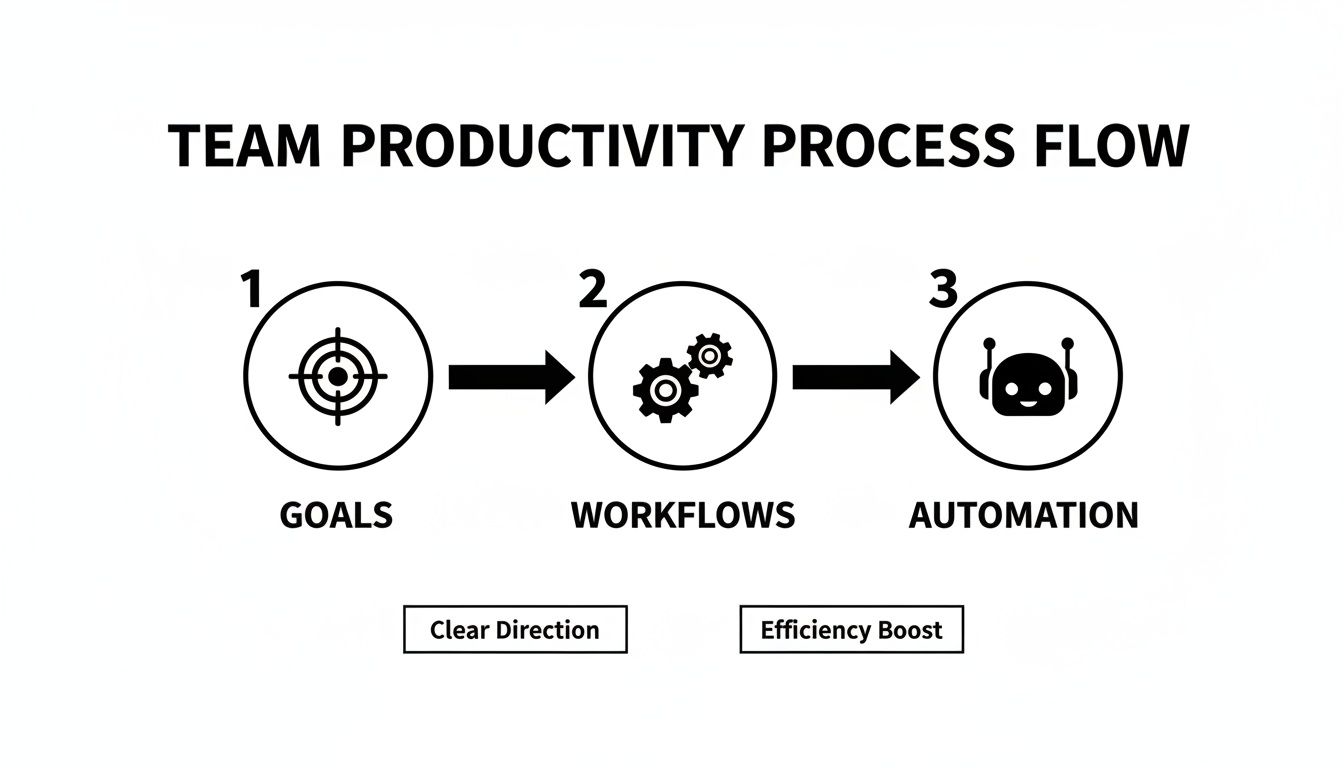
As you can see, each element builds on the last. You can't automate a chaotic process, and you can't build a good process without a clear goal. This is how you create sustainable, long-term productivity.
To give you a quick snapshot, here’s how these core strategies fit together to create a high-performance team.
Key Pillars of Startup Productivity
| Strategy Pillar | Primary Goal | Key Action |
|---|---|---|
| Clear Goals & Metrics | Align the entire team on a shared "North Star" mission. | Set specific, measurable OKRs or SMART goals for every team and project. |
| Streamlined Processes | Eliminate friction, wasted time, and unnecessary steps. | Document key workflows and actively seek out bottlenecks to remove. |
| Smart Communication | Reduce distractions and enable focused, deep work. | Prioritize async communication channels and define when to use real-time meetings. |
| Efficient Onboarding | Get new hires up to speed and contributing value faster. | Create a structured, self-serve onboarding process with checklists and resources. |
| Strategic Automation | Free up human talent for high-value, creative work. | Identify and automate repetitive tasks in marketing, sales, and operations. |
| Measure & Iterate | Continuously improve by making data-informed decisions. | Regularly review key productivity metrics and gather team feedback. |
By focusing on these pillars, you create a system that not only works but also improves over time.
The Critical Role of Smart Communication
Holding all of this together is smart, intentional communication. In a fast-moving startup, constant "quick questions" and notifications are productivity's worst enemy. This is where leaning into a different way of talking comes in.
The reality is that asynchronous communication enhances team productivity by cutting down on those constant interruptions. It creates space for people to concentrate and get into a state of deep work, all without sacrificing the collaboration needed to keep projects moving forward.
Drive Performance with Clear Goals and Metrics
A team without a clear destination is just spinning its wheels. You can be busy, but busy doesn't always equal productive. Before you can improve your team's productivity, you have to define what "productive" actually looks like for your startup. It all starts with setting a clear, shared destination everyone can work toward.
When people understand the ‘why’ behind their daily grind, their work suddenly has meaning. This direct line between individual effort and the company's success is what truly fuels motivation and a sense of ownership. It's the difference between a group of people just checking off tasks and a unified team pushing for a common goal.

This sense of purpose is a massive performance booster. The scary reality is that only about 21% of employees worldwide feel engaged at work. That disengagement isn't just a morale problem; it costs the global economy an estimated $438 billion in lost productivity. It's a huge, untapped opportunity for any team that gets it right. You can dig into more of these eye-opening employee productivity statistics yourself.
From Vague Ideas to Actionable OKRs
So, how do you turn a big, ambitious vision into something your team can actually execute on? For startups, the Objectives and Key Results (OKRs) framework is a game-changer. It’s a simple, powerful way to break down your high-level goals into measurable milestones without getting bogged down in rigid, overly detailed plans.
Here's the basic idea:
- Objective: This is your big, inspiring goal. It’s qualitative and answers the question, "Where are we going?"
- Key Results: These are the specific, quantifiable outcomes that prove you've actually achieved your objective. They answer, "How do we know we got there?"
Let's put this into a real-world context. Imagine you're running the marketing team for a SaaS startup. Simply saying "we need to grow" is useless. An OKR makes it concrete.
Objective: Significantly Boost Qualified Lead Flow This Quarter
- Key Result 1: Generate 500 new Marketing Qualified Leads (MQLs) from organic search.
- Key Result 2: Increase the conversion rate on our demo request landing page by 20%.
- Key Result 3: Launch three new lead-nurturing email sequences to re-engage our cold leads.
Suddenly, everyone has a clear scorecard. The content writer knows their blog posts need to attract traffic that converts. The developer knows that A/B testing the landing page is a top priority. The email marketer has a specific mission to build out those new sequences. It connects everyone's work to a tangible outcome.
Making Metrics Visible and Accessible
Setting goals is the easy part. The real magic happens when you track your progress openly and consistently. You don't need fancy, expensive software for this, especially in the early days. A simple, shared dashboard in Google Sheets, Notion, or whatever project management tool you already use can work perfectly.
The trick is to weave these metrics into your team’s weekly rhythm. A quick review during your check-in meetings keeps everyone aligned and laser-focused on the numbers that actually move the needle.
A few tips I've learned for making this stick:
- Keep it simple. Don't track everything. Focus on a handful of critical metrics, otherwise you'll just create noise and confusion.
- Assign ownership. Every Key Result needs a clear owner who is responsible for tracking it and reporting back to the team.
- Celebrate the small wins. When you hit a milestone, call it out. Acknowledging progress builds momentum and keeps everyone's energy high.
By setting clear goals and making progress visible, you create a powerful feedback loop of focus, accountability, and achievement. This is the bedrock of any high-performing team.
Clear the Path: Streamline Your Workflows and Squash Bottlenecks
With clear goals locked in, it's time to look at how your team actually gets things done. Inefficient processes are the silent killers of productivity. They create tiny points of friction and wasted effort that stack up, day after day, until your team is wading through mud just to complete simple tasks.
The goal here isn't to micromanage every click and keystroke. It's to clear the roadblocks so your team can move faster and with a lot less frustration.
A great place to start is a simple workflow audit. Pick a core process your team does all the time—like publishing a blog post, handling a customer support ticket, or onboarding a new client. Get the team members who actually do the work in a room (or a call) and map out every single step, from A to Z.
Ask the hard questions: Where do we always get stuck? Which of these steps feel pointless? Where do handoffs consistently break down? This exercise is almost guaranteed to expose the bottlenecks and weird workarounds that have become part of the daily routine. For a more structured approach, you can explore some practical business process improvement techniques that offer proven frameworks for this kind of analysis.
Create a Single Source of Truth
Nothing grinds a startup to a halt faster than information chaos. When crucial files are buried in old email threads, project updates live in a dozen different Slack channels, and decisions are scattered across random Google Docs, your team is spending more time hunting for information than actually working.
It's a massive, hidden time suck.
That's why establishing a single source of truth for all your work is non-negotiable. This is what tools like Asana, Trello, or Monday.com were built for.
- Centralized Task Management: Every task gets an owner, a due date, and all the context and files it needs to get done—all in one spot.
- Visible Project Status: Anyone, at any time, can see exactly where a project stands. No more shoulder taps or "Hey, what's the latest on X?" messages.
- Clear Communication Trails: All conversations about a specific task happen on that task. This creates a permanent, searchable record that anyone can reference later.
This one change gives your team back hours of precious focus time every week.
Reclaim Your Calendar from Bad Meetings
Meetings have become the default solution for everything, but they are incredibly expensive. An eight-person, one-hour meeting isn't a one-hour meeting; it's an eight-hour chunk of your company's most valuable resource: your team's time. We have to start treating meetings as a last resort, not a first step.
This is even more critical for remote or hybrid teams. While working from home can add productive time—some studies show remote employees gain about 29 extra minutes of work per day—those gains are wiped out by a culture of constant interruptions. Research shows that the average office worker is interrupted every three minutes and needs over 20 minutes to get back into a state of deep focus. You can dig into more of these stats in this insightful report on workplace productivity.
The Golden Rule for Meetings: No agenda, no meeting. Simple as that. If you can't write down the purpose and the desired outcome beforehand, the meeting shouldn't happen. Default to an asynchronous update in your project tool or a shared document instead.
By auditing your workflows, creating a central hub for your work, and getting ruthless about your meeting culture, you remove the friction that slows good teams down. You're building an operating system where getting things done efficiently is just the default way of working.
Put Repetitive Tasks on Autopilot with Automation and AI

For a small, scrappy team, technology is the ultimate unfair advantage. Once you've streamlined your workflows, automation and AI are the rocket fuel. These tools aren't just for big corporations anymore; they are accessible, practical solutions that can take over the grunt work, freeing up your team's most valuable asset: their brainpower.
Every team has those small, tedious tasks that seem minor in the moment but secretly eat up hours every week. Think about manually creating a new project in your system every time a client signs on, or the soul-crushing copy-and-paste job between spreadsheets. These are prime candidates for automation.
Start with Simple Workflow Automation
You don't need a massive, complex system to get started. Simple, no-code platforms can act as the glue between the apps you already use, creating automated "recipes" that save time and kill human error.
Here are a few ideas to get you thinking:
- Connect your inbox to your project manager: Use a tool like Zapier to automatically create a new task in Asana or Trello whenever an email with a specific subject line (like "New Client Project") lands in your inbox.
- Automate social media sharing: Set up a simple workflow so that every time a new blog post goes live on your website, it's automatically pushed to all your company's social media channels.
- Streamline lead management: When a new lead fills out a form on your site, automatically add them to your CRM and kick off your welcome email sequence.
These little automations really do add up. They hand your team back precious minutes throughout the day, which can be reinvested into strategy, creativity, and actually talking to customers.
Don't just take my word for it. Recent workforce surveys show that 54% of workers have used AI, and a whopping three-quarters of them said it boosted their productivity and work quality. For daily users, that number jumps to 90%. On average, automation can save employees 3.6 hours per week. You can dig into more of these powerful employee productivity statistics and trends to see the full picture.
Give Your Team a Central "Company Brain"
While workflow automation handles specific, predictable tasks, there's another, deeper productivity killer: "information hunting." How often is your team’s focus shattered by simple questions like, "Where's the latest sales deck?" or "What's our official policy on X?"
This is where a tool like an AI-powered knowledge agent becomes a game-changer. I'm talking about tools like BizSage, which act as a central hub for all your company knowledge. It can instantly answer questions by pulling from your internal documents, policies, wikis, and project files.
The idea is simple: you connect all your scattered sources of information—Google Docs, PDFs, website content—into a single, searchable brain.
Instead of tapping a coworker on the shoulder (or pinging them on Slack), a team member can just ask the AI and get an immediate, accurate answer. This one change can wipe out countless micro-distractions that pull people out of deep work. It’s not about replacing people; it’s about giving them an intelligent assistant that handles the information retrieval so they can stay focused on solving the big problems.
Optimize Onboarding and Continuous Training
Productive teams are built, not just hired. The way you bring new people into the fold has a direct, and often dramatic, impact on how quickly they start delivering real value. A disorganized, slow ramp-up is a massive productivity killer, leaving the new hire feeling lost and their teammates frustrated.
If you’re serious about boosting team productivity, you have to stop treating onboarding as a box-ticking exercise. It's a strategic process. Just mapping out a new hire's first 30 days gives them a clear path forward, rather than leaving them to figure out a maze of new tools, people, and unwritten rules on their own.
Design a High-Impact 30-Day Plan
The whole point of a solid onboarding plan is to get new hires making meaningful contributions as soon as possible—ideally within their first week. This isn't about throwing them in the deep end; it's about providing structure so they can build momentum and confidence from day one.
A good 30-day plan should be a mix of activities that build both skills and relationships:
- Clear First-Month Goals: Give them achievable objectives. For a new engineer, this might be shipping a small, low-risk bug fix. For someone in marketing, it could be launching a single ad for a small campaign.
- Assign a Buddy (Not a Boss): Pair them with an experienced teammate who isn't their direct manager. This gives them a go-to person for the "silly" questions they're afraid to ask their boss, which helps them learn the ropes and feel like part of the team much faster.
- Consistent Check-ins: Schedule quick, regular meetings to see how they're doing, answer questions, and offer feedback. This simple step prevents them from feeling isolated and spinning their wheels.
The biggest hurdle for most new hires? The fear of interrupting someone busy. They’ll waste hours digging for information or, even worse, guess and make a costly mistake. Helping them find answers on their own is one of the most powerful things you can do for productivity.
Empower New Hires with an AI Knowledge Agent
This is where a centralized knowledge base, supercharged with an AI agent, becomes your secret weapon. Instead of tapping a senior developer on the shoulder to ask how the deployment process works, a new hire can simply ask an AI like BizSage and get an instant, accurate answer.
This self-service approach is a total game-changer. It gives the new employee the tools to be proactive and resourceful, which is incredibly empowering. At the same time, it frees up your senior people from answering the same questions over and over again. That's a direct productivity win for everyone involved.
Foster a Culture of Continuous Learning
Great training doesn’t just stop after the first month. Skills get stale, and processes change. You have to weave learning directly into your company's DNA to keep your team sharp. This doesn't require a huge budget for formal programs, either.
Informal learning can be incredibly effective. Encourage team members to host quick skill-sharing sessions on a new tool they've mastered. Set up casual lunch-and-learns to chat about new industry trends. This kind of ongoing development ensures your team stays adaptable and that your productivity gains aren't just a flash in the pan.
Measure and Iterate Your Productivity Systems
Look, improving your team's productivity isn't some project you can just check off a list. It’s a continuous loop, an ongoing process of tweaking and refining. The best teams I've worked with treat their internal processes like a product they're shipping—they constantly test, gather feedback, and iterate.
This final step is about embedding that mindset deep into your culture. It's the shift from simply "setting up a system" to building a true "operating system" for your team, one that grows and adapts right alongside you. To get this right, you need to look at two different kinds of information to see the whole picture.
Combine Hard Data with Human Feedback
Numbers tell you what is happening, but talking to your team tells you why. You absolutely need both to make smart calls. Start with the objective metrics you can pull from your existing tools, but don't let the story end there.
-
Quantitative Metrics: Take a look at your project cycle times in a tool like Asana or Trello. Are tasks moving through the pipeline faster or slower than last month? What's your team's weekly task completion rate? These numbers give you a clear, unbiased baseline.
-
Qualitative Feedback: This is where the gold is. In your weekly check-ins or retrospectives, stop asking generic questions. Instead of "What did you do this week?" try asking, "What was the most frustrating part of that process?" or "Where did we get bogged down on this project?"
Marrying these two prevents you from optimizing for the wrong thing. For example, your cycle times might look fantastic on a chart, but if your team is quietly burning out to hit those numbers, the system is broken. We're aiming for sustainable productivity, not just a few heroic sprints.
I see so many teams fall into the trap of only measuring output. Real productivity is about achieving better outcomes with less friction. When you create an environment where people feel safe to point out what’s broken—without fear of blame—you unlock the entire team’s ability to solve problems.
Create a Culture of Experimentation
Once you start gathering this feedback, you give your team the power to actually improve how they work. Encourage them to try small experiments. Test a new automation. Question that old process that everyone follows but nobody really understands anymore.
This flips the script entirely. Your team goes from being passive followers of a system to active architects of their own success. Suddenly, inefficiencies aren't just frustrating roadblocks; they're opportunities to make things better. That sense of ownership is the real engine behind long-term productivity and innovation.
By constantly measuring and iterating, you build a system that doesn't just perform—it learns. And that's a powerful competitive advantage.
Got Questions? We've Got Answers
We hear a lot of the same questions from startup leaders and small teams trying to get more done without burning out. Let's tackle a few of the most common ones.
Where Do We Even Start if We Have No Budget?
This is a great question because it forces you to focus on what really matters. Forget expensive software for a minute. The biggest wins often come from changes that cost absolutely nothing.
Start by getting ridiculously clear on your goals. Open a shared Google Doc and define what success looks like for this quarter. Then, grab a whiteboard (or a free tool like Miro) and map out a core workflow. You'll be amazed at the obvious bottlenecks that jump out once you visualize the process.
Another free, high-impact change is to fix your communication habits. A simple rule like "no agenda, no meeting" can reclaim hours each week. These early steps are all about discipline and clarity, not cash.
How Can We Measure Productivity Without Becoming Micromanagers?
This is a critical distinction. The goal is to measure progress, not presence. Forget tracking hours or counting clicks—that’s a one-way ticket to a culture of distrust.
Instead, focus entirely on outcomes. Tie your measurements directly back to the key results you already set. Are you actually moving the needle on things that matter to the business?
Look at metrics that reflect real impact, like:
- Project Completion Rates: Are we shipping on time?
- Client Satisfaction (CSAT) Scores: Are customers happy with what we're shipping?
- Qualified Leads Generated: Is marketing producing results that sales can actually use?
When you measure this way, you're holding the team accountable for results, not their process. You empower them to figure out the how, which builds ownership and kills the need for micromanagement.
The secret is to give your team a clear destination and the right tools for the journey, then let them drive. Measuring productivity is simply checking the map to see how close you are to that destination, not critiquing their every turn.
Is AI Actually Useful for a Team That Isn't Super Techy?
Absolutely, and this is a common misconception. The best modern AI tools are built for everyone, not just engineers. Think of them less as complex coding platforms and more as super-smart assistants.
A company knowledge agent, for instance, is basically a private search engine for your business. If you can use Google, you can use it. There’s no special training required to ask, "What's our Q4 marketing budget?" and get an instant answer.
Similarly, simple automation tools have drag-and-drop interfaces that let you connect the apps you already use every day. You can set up a rule that automatically saves attachments from Gmail to a specific Dropbox folder, freeing up your team for work that actually requires a brain.
Stop losing time to repetitive questions and information hunting. BizSage turns all your company knowledge into an AI-powered agent that provides instant, accurate answers to your team and customers, 24/7. Learn more at BizSage.io