
When it comes to your agency’s bottom line, nothing moves the needle quite like client satisfaction. It's built on a foundation of clear communication, rock-solid service delivery, and, most importantly, consistently proving your worth. Shifting from a reactive, ticket-based mindset to a truly client-centric approach is how agencies boost retention, increase referrals, and create sustainable growth.
Why Client Satisfaction Is Your Agency's Growth Engine
Let's be clear: client satisfaction isn't some fluffy, "nice-to-have" metric. It's the engine that powers a successful agency. Happy clients don't just stick around; they become your best salespeople, shouting your praises through referrals and testimonials.
In a crowded market, standout service is what separates the good agencies from the great ones. It builds a reputation that pulls in high-value clients and cements your role as an indispensable partner, not just another vendor.
This focus kicks off a powerful growth cycle:
- Reduced Client Churn: Happy clients aren't looking for a reason to leave. This creates the stable, predictable revenue every agency owner dreams of.
- Increased Lifetime Value (LTV): Clients who trust you are far more open to expanding services, whether it's an upsell or a cross-sell.
- Organic Lead Generation: Word-of-mouth from a genuinely impressed client is the most powerful and cost-effective marketing you can get.
The Financial Impact of Client-Centric Service
Putting the client experience first isn't just about good vibes; it shows up directly on your P&L. The numbers don't lie. Customer-obsessed organizations report a staggering 41% faster revenue growth and 49% faster profit growth than their competitors.
A truly client-focused model can boost your annual revenue by up to 8% while cutting service costs by 10-15%. For an agency, where even a 14-percentage-point jump in annual retention can translate to hundreds of thousands in revenue, this is a no-brainer.
For agencies looking to really level up their relationships, it’s worth exploring some proven strategies for how to improve customer satisfaction for a deeper playbook. This is about moving beyond just checking off tasks and building a true partnership that clients want to invest in for the long haul.
To understand how these concepts directly influence your agency's health, let's break down the key levers and their impact.
Key Client Satisfaction Levers and Their Agency Impact
| Satisfaction Lever | Primary Benefit | Key Agency KPI Impacted |
|---|---|---|
| Flawless Onboarding | Sets clear expectations and builds early trust. | Client Churn Rate (first 90 days) |
| Proactive Communication | Prevents misunderstandings and shows you're invested. | Net Promoter Score (NPS) |
| Consistent Service Delivery | Builds reliability and proves your agency's competence. | Client Lifetime Value (LTV) |
| Meaningful Reporting | Demonstrates ROI and ties your work to client goals. | Retention Rate & Upsell Revenue |
| Active Feedback Loops | Makes clients feel heard and uncovers improvement areas. | Client Satisfaction (CSAT) Score |
Ultimately, a focus on these areas ensures you're not just providing a service, but delivering an experience that consistently reinforces your value.
Key Takeaway: Viewing client satisfaction as a growth strategy, rather than a support function, aligns your entire agency around the activities that generate the most value—both for your clients and your bottom line.
In the end, every process—from that initial kickoff call to your monthly performance report—should be designed to answer one simple question for the client: "Am I getting the value I'm paying for?" When that answer is a resounding "yes," your agency doesn't just survive; it thrives.
Master the First Impression with a Flawless Onboarding
The moment a client signs the contract, the clock starts ticking. All the promises you made in the sales process are now on the line. A clunky, disorganized, or confusing start doesn't just create a bit of friction; it actively eats away at the trust you worked so hard to build.
You really only get one shot to prove your agency is as buttoned-up and professional as you claimed. Nailing the onboarding process instills immediate confidence and sets a positive, collaborative tone for the entire relationship. It’s how you turn a nervous new client into an excited partner, ready to get to work.
Ultimately, getting this right directly fuels your agency's growth. Happy clients stick around, spend more, and tell their friends.
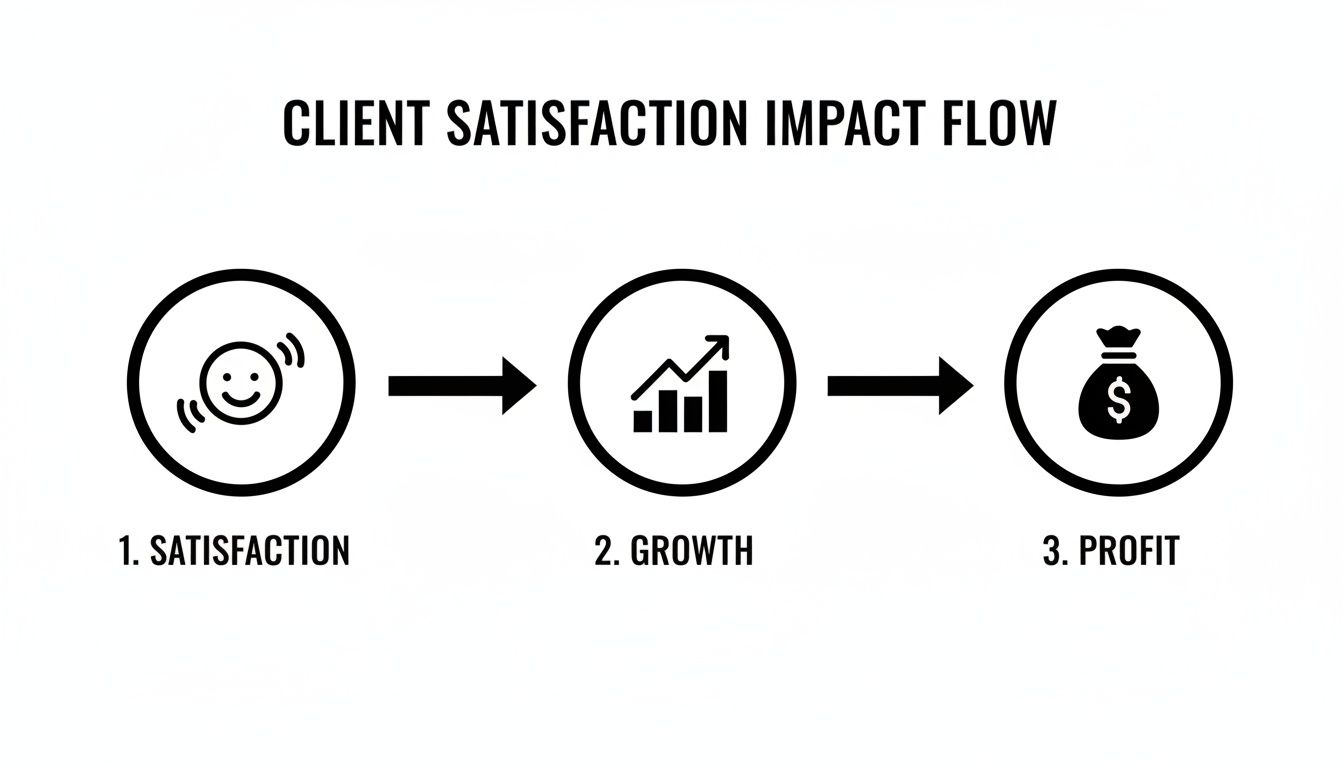
This isn't just a nice-to-have. As the visual shows, a satisfied client is the first domino to fall in a chain reaction that leads straight to business growth and a healthier bottom line.
Set the Stage with a Killer Kickoff Deck
Your kickoff meeting is the first real post-sale interaction, and it needs to be more than just a casual meet-and-greet. A solid kickoff deck is your best tool for getting everyone on the same page and showing you have a plan. Think of it less as a presentation and more as the foundational charter for the entire partnership.
Your deck should spell out every important detail. This is no time for vague promises. The goal is to have the client leave that meeting feeling completely clear on the path forward and confident that they're in capable hands.
A truly effective kickoff deck must include:
- Project Goals & KPIs: Circle back to the core business objectives and define exactly how you'll both measure success.
- Scope of Work: Clearly list every single deliverable and service. This is your best defense against scope creep down the road.
- Key Timelines: Provide a high-level project roadmap. Laying out the major milestones for the first 30, 60, and 90 days is a must.
- Team Introductions: Put faces to names. Introduce the key players from your agency, what their roles are, and how to reach them.
- Communication Plan: Define the rules of engagement. Settle on meeting cadences, primary points of contact, and which channels to use for what.
A well-structured kickoff leaves no room for assumptions. It tells the client, 'We've heard you, we understand your goals, and here is our precise plan to achieve them.' This single act of clarity can prevent countless future misunderstandings.
Define How You'll Communicate (And Stick to It)
Ambiguity is the enemy of a happy client relationship. From day one, you have to set crystal-clear expectations for how, when, and where you'll communicate. It might seem like a small detail, but this structure creates a sense of predictability that clients secretly crave.
Outline the purpose of each channel you use. For instance, maybe Slack is for quick, informal questions, while email is reserved for formal documentation and approvals. A project management tool like Asana or Monday.com can handle all task-specific updates. This simple step prevents important messages from getting lost in the shuffle.
Next, give them a roadmap for the initial ramp-up period. This helps manage their anticipation and shows them you're making steady progress right out of the gate.
A Sample 90-Day Onboarding Framework
- Days 1-30: This phase is all about discovery, audits, and foundational setup. You'll be gaining access to accounts, conducting stakeholder interviews, and finalizing the strategic plan.
- Days 31-60: Now you shift into execution. Initial campaigns or project tasks begin, the strategy gets implemented, and you start gathering early performance data.
- Days 61-90: Time to deliver the first major performance report. This is your chance to analyze initial results, share key learnings, and map out strategic adjustments for the next quarter.
Having a documented system like this immediately builds a massive amount of trust.
Modernize Your Onboarding with 24/7 Support
Imagine a new client needs to double-check the project scope or find their account manager's email at 10 PM on a Sunday. Instead of sending an email and waiting, they get the answer instantly. This is the power of a modern, tech-enabled onboarding experience.
For example, a web design agency could use a tool like BizSage to create a custom AI agent for a new client. The agent is trained only on that client's specific documents: the kickoff deck, the SOW, and the communication plan.
This client-trained agent can then be embedded directly into their private client portal. Suddenly, the client can ask questions anytime and get immediate, accurate answers drawn from their own project materials. This isn't just about being more efficient; it's about delivering a premium, self-service experience that shows your agency is truly ahead of the curve from the moment they sign on.
Building Proactive Communication and Reporting Cadences

In the agency world, silence is never golden. When clients don't hear from you, their minds don't automatically go to, "Wow, things must be going great." They assume the worst. A communication black hole is one of the fastest ways to have a client start shopping for your replacement, as they fill that silence with doubt.
This is why you have to get ahead of it. A proactive communication and reporting cadence is absolutely non-negotiable for a healthy partnership. It’s not about sending more emails—it’s about creating a predictable rhythm that builds trust and keeps everyone on the same page. When you nail this, communication shifts from a reactive chore to a strategic asset for keeping clients happy.
Structuring Your Weekly Updates
The weekly update is your most frequent and, arguably, most important touchpoint. This isn't a massive, detailed report. Think of it more as a quick, scannable pulse check that shows the account is getting consistent attention and that things are moving forward. It’s the simplest way to prevent small questions from snowballing into big anxieties.
A solid weekly update is brief and hits three key areas:
- What We Got Done: A few bullet points summarizing the main tasks you knocked out. This is your tangible proof of progress.
- What’s Next: A quick look at the immediate priorities for the coming week, showing you’re always thinking ahead.
- Any Roadblocks or Needs: This part is critical. It's your chance to flag anything you need from the client to prevent delays.
This simple format—often just a quick email every Friday afternoon—is a masterclass in accountability. It’s a small effort that pays massive dividends in client confidence.
Key Insight: A consistent weekly update completely eliminates the dreaded "just checking in" email from clients. It puts you in the driver's seat of the relationship, reinforcing your role as a proactive partner, not just a reactive service provider.
Crafting Monthly Performance Reports That Tell a Story
If weekly updates are about progress, monthly reports are about performance. Here, you have to move beyond just listing activities and start connecting the dots between your work and their business results. The biggest mistake I see agencies make is dumping a bunch of data from their tools into a PDF and calling it a day.
A truly valuable report tells a story. It should always start with a high-level summary that immediately answers the client's biggest question: "Are we on track to hit our goals?" Use charts and graphs to make the data easy to scan, but don't forget the human element—add written analysis that explains what the numbers actually mean for their business.
Here’s a simple structure for a report that actually adds value:
- Executive Summary: A short paragraph hitting the month's key wins, challenges, and overall progress toward the main KPIs.
- Performance vs. Goals: Show the primary KPIs and how they’re tracking against the goals you set or against previous periods.
- Key Learnings & Insights: What did the data teach you this month? Did a specific campaign knock it out of the park? Was there an unexpected trend?
- Strategic Recommendations for Next Month: Based on those insights, what are you going to do next? Outline the specific actions you plan to take to either double down on what’s working or fix what isn’t.
This approach transforms the report from a boring historical document into a forward-looking strategic tool—a powerful way to keep clients engaged and satisfied.
The Power of Quarterly Business Reviews
The Quarterly Business Review (QBR) is your chance to zoom out. This isn’t a report walkthrough; it’s a high-level, strategic meeting where you get to focus on the big picture. It’s where you reinforce the value of the partnership, realign on long-term goals, and show how your agency contributes beyond the day-to-day grind.
Make the QBR agenda collaborative. Before the meeting, ask the client what they want to discuss. This ensures the conversation is relevant to them and turns them into an active participant in the planning process. A well-run QBR deepens the relationship and solidifies your agency's role as an indispensable partner.
Automating Routine Questions to Free Up Strategic Time
Think about how much time your account managers spend answering the same questions over and over. "What was our traffic last month?" "Where can I find that report again?" While these are fair questions, they pull your team away from the high-value strategic work that actually drives client success.
This is a perfect spot for a tool like BizSage to make a real difference. You can create a client-trained AI agent that provides instant, 24/7 answers to these common questions. By training it on your project data and reports, the agent can handle the basics, freeing up your team to focus on interpreting results and planning the next big move.
This isn’t about replacing your team; it’s about making them more effective. When an AI handles the routine stuff, your account managers have more bandwidth for the proactive, strategic conversations that stop churn in its tracks and build truly satisfied, long-term clients.
Scaling Personalized Support with Client-Trained AI

As an agency owner, you've probably felt this tension. You built your reputation on incredible, hands-on service, which is why you’re growing. But with every new client, it gets a little harder to maintain that personal touch. The math just doesn't work. You can't be everywhere at once, and you can't hire account managers faster than you sign clients without destroying your margins.
This is exactly where smart technology stops being a buzzword and becomes a real competitive edge. Using client-trained AI lets you deliver instant, personalized support at scale. It’s the key to solving the growth paradox without letting your service quality slip.
From Generic Bots to Client-Specific Experts
Let's be clear: this isn't about deploying a generic chatbot that just parrots a one-size-fits-all script. We all know how frustrating those can be. The real magic happens when you create a unique, dedicated AI agent for each and every client, trained exclusively on their business and your work for them.
Think about that for a second. A client-trained AI agent is built from the ground up using that client's own data as its brain. This could include:
- Their website content and product information
- The kickoff decks and strategy docs you created for them
- Their specific Statement of Work (SOW) and project timelines
- Every monthly performance report and historical data point
When you feed an agent this kind of proprietary knowledge, you create a digital expert that knows the client’s project as well as your own team. It can give answers with precision and context, not just generic guesses. It's a fundamental shift in how you can think about client service.
Key Takeaway: A client-trained AI doesn't replace your team. It becomes an extension of it—a tireless, 24/7 specialist that handles a client’s informational needs instantly, freeing up your human experts for high-value strategic work.
Real-World Scenarios in Action
So, how does this actually play out and improve client satisfaction? Let's get practical.
Imagine your web design agency just launched a new site for a retail client. It’s 11 PM, and their marketing manager can't remember the exact steps to update a product description in the CMS. Instead of firing off a frustrated email and waiting until morning, they ask their dedicated AI agent, "How do I edit a product description?" They get an immediate, accurate answer pulled straight from the training documentation you provided. Problem solved.
Or picture an SEO agency. A client logs into their dashboard on a Saturday morning, sees a dip in organic traffic, and starts to panic. They can immediately ask their agent, "Why did organic traffic drop last week?" The agent, trained on your latest report, can explain, "A Google algorithm update on Tuesday impacted rankings industry-wide. We are monitoring the situation and will have a full analysis in Monday's report."
That level of instant, accurate reassurance is incredibly powerful. Your support model transforms from a reactive cost center into a proactive tool for building confidence and showing value, day or night.
Meeting Modern Client Expectations
The reality is, clients today expect immediate and seamless support. This isn't just a "nice-to-have"; it's the standard. In fact, companies with omnichannel customer service strategies report 23 times higher customer satisfaction rates compared to those stuck with single-channel support. With 80% of consumers wanting consistent support on any channel and 90% expecting an instant response, agencies have to be available wherever and whenever questions pop up. You can discover more insights about these customer service benchmarks to see just how high the bar is.
This is where a platform like BizSage can be a game-changer. You can embed a white-labeled chat widget right on a client’s private portal or project dashboard. You're meeting them where they already are, providing a consistent and branded support experience that feels like a natural part of your service. It delivers the smart, instant answers modern clients demand, directly boosting satisfaction and making your partnership feel even stronger.
The Strategic Advantage of Scalable Personalization
At the end of the day, the goal is to make every client feel like they're your only client. Client-trained AI gives you a practical way to achieve this, even as your agency grows. By automating the delivery of personalized information, you create a far more efficient and responsive agency.
Here’s what this system unlocks:
- Drastically Reduce Response Times: Clients no longer have to wait hours (or days) for answers to common questions.
- Increase Team Capacity: Your account managers are freed from repetitive inquiries, allowing them to focus on strategy, analysis, and proactive outreach that moves the needle.
- Enhance the Client Experience: You're delivering a premium, modern support experience that constantly reinforces the value of your partnership.
By turning each client's unique knowledge base into an interactive, on-demand resource, you aren't just answering questions faster. You're fundamentally improving how to improve client satisfaction by building a more resilient, scalable, and client-centric agency.
Connecting Your Work to Measurable Business Outcomes
At the end of the day, clients don’t renew retainers because your team was busy. They renew because you delivered results they can see, measure, and take to their leadership team. This is the final, and most crucial, piece of the puzzle. It shifts the entire relationship from a cost center to a value-driving investment.
Your daily tasks—the campaigns you run, the content you create, the optimizations you make—are just the means to an end. The real goal is to consistently and clearly connect that work to the business outcomes your client actually cares about. This means moving the conversation from "what we did" to "what we achieved for you."
Defining KPIs That Actually Matter
Proving your value starts long before the first report goes out. It begins during onboarding, where you need to sit down with the client and hammer out meaningful key performance indicators (KPIs) that tie directly to their business goals. Vague metrics like "brand awareness" or "engagement" just won't cut it.
You have to push for concrete, quantifiable targets. For example, instead of just tracking website traffic, track the conversion rate of that traffic. Don't just measure social media likes; measure the number of qualified leads generated from your social campaigns.
To get this right, you really need to be able to show how your efforts lead to revenue. Exploring methods for unlocking true ROI with multi-touch attribution is key. This level of detail ensures you and your client are speaking the same language from day one.
Examples of Strong vs. Weak KPIs
| Weak KPI (Activity-Based) | Strong KPI (Outcome-Based) |
|---|---|
| Increase Website Traffic | Generate 25% more marketing-qualified leads (MQLs) from organic traffic |
| Grow Email List | Achieve a 15% conversion rate from email nurture sequences to demo requests |
| Post on Social Media Daily | Drive $10,000 in attributed sales from social media campaigns |
| Redesign the Homepage | Improve homepage lead form submission rate from 2% to 4% |
By establishing these outcome-focused KPIs upfront, every report and every conversation is framed around the numbers that directly impact their bottom line.
Turning Conversations into Conversions
Proving your value shouldn't be limited to a formal monthly report. With the right tools, you can demonstrate ROI in near real-time, turning standard support interactions into tangible business results. This is where a client-trained AI agent becomes more than just a Q&A tool—it becomes a lead generation engine.
Think about this real-world scenario. A digital marketing agency embeds a BizSage chat agent on their client's website. The agent is fully trained on the client's product specs, case studies, and pricing.
A prospect lands on the site and asks the agent, "Do you integrate with Salesforce?" The agent instantly confirms that they do. But it doesn't stop there. It follows up with, "That's a popular integration for teams like yours. Would you like to see a quick demo of how it works?"
If the user says yes, the agent triggers a lead capture form right there in the chat, collecting the prospect's name, email, and company. This new lead then automatically pops up on a simple Kanban board inside the client's dashboard.
This isn't just a conversation; it's a conversion. The agency can now point to a specific lead—a tangible business outcome—that was generated directly through the technology they implemented. This provides undeniable proof of value that goes far beyond a simple traffic report.
Visualizing the Wins
When you present these results, how you visualize the data is just as important as the data itself. Forget about dense spreadsheets and endless tables of numbers. The goal is to make your impact instantly understandable.
A simple Kanban board showing the status of leads generated by your efforts is incredibly powerful. You can create columns like "New Lead," "Contacted," "Demo Scheduled," and "Closed Won." This visual pipeline gives the client a clear, at-a-glance view of the new business your agency is driving.
This approach completely changes your reporting. You're no longer just showing charts that go up and to the right; you're showing the names of real prospects moving through their sales funnel because of your work. It makes your agency’s contribution tangible, making that monthly retainer a very easy decision to approve.
Answering Your Questions About Client Satisfaction
Whenever agencies start a real push to improve client satisfaction, the same questions always come up. Leaders want to know what actually works in the real world, what pitfalls to sidestep, and how to track success without drowning their teams in busywork. Let's tackle the big ones.
How Do I Measure Client Satisfaction Effectively?
You need a mix of hard data and real human feedback. Leaning too heavily on one or the other will give you a skewed picture of how things are really going. The goal is to see both what clients are saying and what they're doing.
First, get a baseline with Net Promoter Score (NPS). A quarterly NPS survey is a fantastic, high-level benchmark for client loyalty. It’s just one simple question: "On a scale of 0-10, how likely are you to recommend our agency?" But the answer speaks volumes about their overall feeling toward you.
For more immediate feedback, use Customer Satisfaction (CSAT) scores. These are perfect for right after a big project milestone or after your team resolves a support ticket. It gives you a quick pulse check on specific interactions.
But surveys alone aren't enough. You have to tie that feedback to the metrics that actually drive your agency's growth:
- Client Retention Rate: This is the ultimate proof. Are clients sticking around year after year?
- Expansion Revenue: Are happy clients buying more? Look at how much you're earning from upsells and new services with your existing roster.
- Referral Rate: How many warm, qualified leads are your current clients sending your way?
Looking at these things together gives you the full story, moving beyond just sentiment to see the real-world impact of your efforts.
What Is the Biggest Mistake Agencies Make with Client Communication?
Easy—being reactive. So many agencies fall into the trap of waiting for the client to ask for an update or, even worse, for a problem to pop up before they communicate. When you do that, you're basically forcing your client to manage you, which creates a ton of unnecessary anxiety for them.
The best agencies are relentlessly proactive. They build trust by setting a predictable rhythm for communication and sticking to it. Think a quick email recap every Friday and a formal performance report on the first of every month. It’s not about sending more emails; it’s about being consistent.
The real pros know that proactive communication also means delivering bad news fast. They don't shy away from challenges. Instead, they get on the front foot, explain what's happening, and present a clear plan to fix it. That kind of transparency can turn a potential disaster into a moment that actually strengthens the client's trust in you.
A proactive agency is always a step ahead. A reactive one is always a step behind.
Can I Use AI Without Losing the Personal Touch?
Of course. In fact, if you do it right, AI is what enables a more personal touch. It works by freeing up your team from the mundane tasks so they can focus on what people do best: thinking strategically, showing empathy, and building relationships.
The trick is automating the right things.
Think about the low-value, repetitive questions that clog up your account managers' inboxes. A client asking, "What was our organic traffic last month?" should get an immediate, accurate answer from an AI agent that knows their data inside and out. That's a huge time-saver.
This efficiency gives your account manager the bandwidth to call that same client and talk through a new strategic opportunity they've uncovered. The AI handles the "what," which frees up your team to provide the "so what" and the "what's next."
This isn't about replacing people. It's about combining AI efficiency with human expertise to create a client experience that feels both incredibly responsive and deeply strategic.
Ready to scale personalized client support and prove your agency's value in real-time? BizSage provides the tools you need to deploy client-trained AI agents that deliver instant answers and capture qualified leads.
Discover how BizSage can help you improve client satisfaction today