
In a world of constant digital noise, how you communicate with clients is your greatest competitive advantage. Exceptional service isn't a bonus, it's the baseline. Misunderstandings cost time, erode trust, and can ultimately lose business. Mastering client communication isn't just about being polite; it's a strategic framework for building loyalty, anticipating needs, and turning satisfied customers into vocal advocates.
Effective communication is the foundation of any successful business relationship. It directly impacts client retention, project success, and your company's reputation. When done right, it streamlines workflows, prevents scope creep, and ensures everyone is aligned toward the same goals. Neglecting these skills leads to friction, missed deadlines, and a revolving door of clients who feel misunderstood or undervalued. This is why developing a robust set of client communication best practices is not optional, it's essential for sustainable growth.
This guide moves beyond generic advice to provide a definitive list of the most impactful strategies. For a comprehensive guide detailing specific strategies and techniques, explore these essential 8 Client Communication Best Practices to further strengthen your approach. Each point in our list is packed with actionable steps, real-world examples, and a unique look at how AI tools like BizSage can streamline these efforts, allowing you to deliver exceptional, consistent service at scale. Let’s dive into the practices that will transform your client interactions from transactional to transformational.
1. Active Listening and Empathetic Engagement
Effective client communication starts not with speaking, but with listening. Active listening is the practice of fully concentrating on what a client is saying, absorbing their message, and understanding the context and intent behind their words. It's about hearing the unspoken needs, frustrations, and goals that often lie beneath the surface-level conversation. When combined with empathy, this practice transforms a transactional interaction into a relational one, making clients feel genuinely heard, valued, and understood.

This foundational skill is a cornerstone of exceptional service. For instance, Zappos empowers its customer service representatives to spend as much time as needed on a call, focusing on solving the customer’s problem rather than minimizing call duration. This approach builds legendary loyalty. Similarly, luxury brands like Ritz-Carlton train staff to anticipate needs by actively listening to guest comments, both direct and indirect. This elevates the customer experience and fosters a strong, positive connection.
How to Implement Active Listening
To integrate this into your client communication best practices, focus on developing specific habits within your team.
- Minimize Distractions: When on a call or in a meeting, close unnecessary tabs and put your phone away. Give the client your undivided attention.
- Paraphrase and Summarize: After the client shares a point, repeat it back in your own words. For example, "So, if I'm understanding correctly, the main issue is the delay in reporting, which is affecting your team's weekly planning." This confirms you've understood and gives them a chance to clarify.
- Ask Open-Ended Questions: Instead of "Is this a problem?" ask "How is this affecting your workflow?" This encourages detailed responses over simple yes-or-no answers.
- Acknowledge Emotions: Use phrases like, "I can see why that would be frustrating," or "That sounds like a challenging situation." This validates their feelings and builds rapport.
BizSage AI in Action: An AI agent from BizSage can be trained to analyze client emails or support chat transcripts for emotional sentiment and key phrases. It can then flag conversations that require a more empathetic, human touch or provide your team with a summary of the client's emotional state and primary concerns before they even pick up the phone. This pre-briefing allows your team to engage with immediate understanding and empathy.
2. Clear and Transparent Communication
Clarity and transparency are the twin pillars of trust in any client relationship. Clear communication means conveying information in straightforward, jargon-free language that clients can easily understand. Transparency involves being honest and upfront about project scope, timelines, pricing, and potential challenges. Together, these practices prevent misunderstandings, manage expectations effectively, and build a foundation of credibility that can weather any storm.

This approach is crucial for building long-term partnerships. For instance, the project management tool Basecamp champions clear communication by design, keeping all project-related discussions in one place to avoid confusion. Similarly, Buffer famously operates with radical transparency, publicly sharing everything from salaries to revenue figures. This builds immense trust not just with their team but also with their customers, who see them as an honest and accountable partner. In healthcare, the "teach-back" method ensures patients understand their treatment plans, a critical form of clear communication.
How to Implement Clear and Transparent Communication
To make this one of your core client communication best practices, focus on building clarity and honesty into every interaction.
- Avoid Jargon: If you must use a technical term, explain it immediately. For example, "We'll be implementing an SLA, which is a Service Level Agreement that defines our response time commitments."
- Outline Scope Clearly: Provide detailed written proposals that specify what is included and, just as importantly, what is not included in your service.
- Be Proactive About Challenges: If a potential risk or delay arises, communicate it to the client immediately along with a proposed solution. Don't wait for them to ask.
- Summarize Key Discussions: After a meeting or important call, send a follow-up email summarizing the key decisions, action items, and next steps to ensure everyone is on the same page.
BizSage AI in Action: A BizSage agent can be configured to act as a "Clarity Checker." Before sending a client proposal or project update, your team can run the text through the AI. It can automatically identify and flag industry jargon, ambiguous phrases, or undefined acronyms, suggesting simpler, clearer alternatives to ensure your message is easily understood by any stakeholder, regardless of their technical expertise.
3. Regular Progress Updates and Proactive Communication
One of the most powerful client communication best practices is shifting from a reactive to a proactive stance. Instead of waiting for a client to ask for an update, proactive communication involves sharing regular progress reports, status checks, and relevant information unprompted. This simple act prevents client anxiety, manages expectations effectively, and demonstrates a deep commitment to their success. It transforms the relationship from a vendor-client dynamic to a true partnership, where the client feels confident and in the loop at all times.
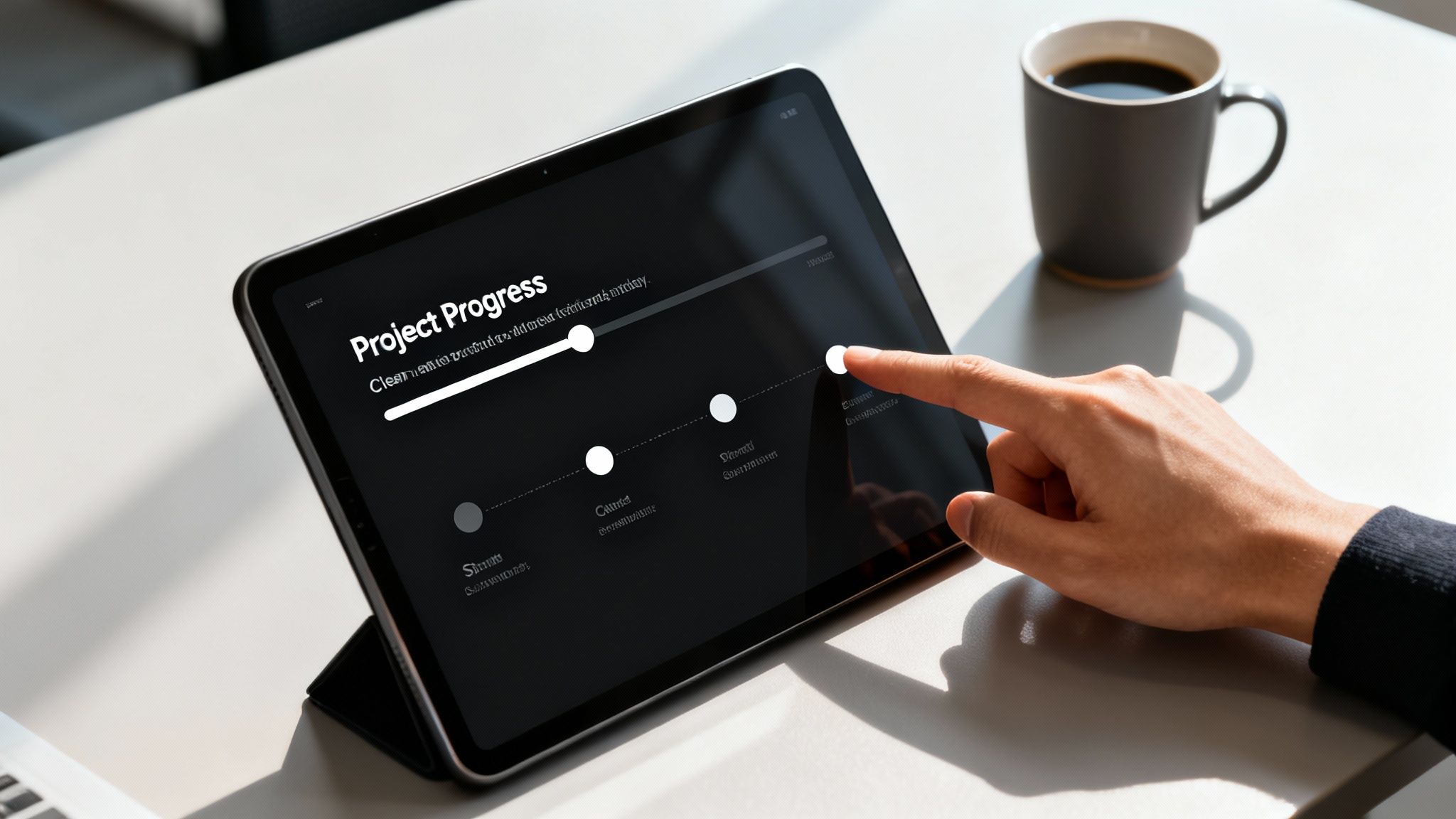
This approach is a hallmark of highly organized and client-centric businesses. Agile development teams, for example, hold sprint reviews to demo progress and gather feedback, while construction companies often provide weekly progress photos to keep homeowners engaged. Similarly, consulting firms use scheduled steering committee meetings to report on milestones and align on next steps, ensuring there are no surprises. In every case, this transparency builds immense trust and minimizes friction.
How to Implement Proactive Communication
To build this practice into your workflow, you need to systematize how and when you share information.
- Establish a Cadence: At the project outset, agree on a communication schedule. This could be a weekly summary email, a bi-weekly call, or a monthly report, tailored to the project's complexity and length.
- Use Project Management Tools: Grant clients access to a shared project management tool like Asana, Trello, or a client portal. This provides real-time transparency into tasks and progress.
- Balance Wins and Challenges: Your updates should be honest. Highlight accomplishments and completed milestones, but also be upfront about potential risks or roadblocks you've identified, along with your plan to address them.
- Schedule Check-in Calls: Don't rely solely on email. Scheduling regular, brief calls allows for a more personal connection and provides an opportunity for clients to ask questions in real-time.
BizSage AI in Action: A BizSage agent can be configured to automate routine updates. By integrating with your project management software, it can automatically generate and send a weekly "Project Snapshot" email to clients, summarizing completed tasks, upcoming milestones, and any items awaiting their feedback. This ensures consistent communication without adding to your team's manual workload.
4. Personalized and Customized Communication
Moving beyond generic templates and one-size-fits-all messaging is crucial for building deep, lasting client relationships. Personalized communication involves tailoring your style, frequency, and content to individual client preferences and needs. This practice demonstrates that you see your clients as unique partners, not just account numbers, making them feel respected and valued. It's about adapting to their world, whether that means using their industry-specific language or communicating through their preferred channels.
This level of detail is a hallmark of premium service. Think of how Northwestern Mutual tailors financial advice presentations to an individual's specific life goals, not just their assets. Similarly, Amazon's success is partly built on its powerful recommendation engine, which personalizes the user experience and communications. This approach proves that understanding and adapting to the individual is a powerful driver of loyalty and one of the most effective client communication best practices.
How to Implement Personalized Communication
Integrating personalization requires a system for gathering, storing, and acting on client-specific information.
- Create Client Preference Profiles: From the start, document communication preferences like preferred channel (email, phone, Slack), meeting frequency, and reporting style.
- Use Industry-Specific Language: Take the time to learn the terminology, acronyms, and key challenges of your client's industry. This builds credibility and shows you've done your homework.
- Track Key Details: Use your CRM to note personal details shared in conversation, like their team members' names, key project milestones, or even their favorite coffee shop.
- Tailor Reporting: Don't send a generic dashboard. Customize reports and updates to focus on the specific KPIs and metrics that matter most to that particular client's goals.
BizSage AI in Action: A BizSage agent can be connected to your CRM to create dynamic client profiles. Before a call, the AI can generate a "Client Snapshot" for your team member, summarizing recent interactions, noting their communication style (e.g., "prefers brief, bulleted emails"), highlighting their key business objectives, and even recalling personal details mentioned in previous conversations. This equips your team to deliver a highly personalized experience every time.
5. Two-Way Dialogue and Feedback Solicitation
True client communication isn't a monologue; it's a dynamic, two-way conversation. This best practice involves proactively creating channels for clients to share their thoughts, concerns, and suggestions. By consistently soliciting feedback, you transform the relationship from a simple service transaction into a collaborative partnership. This approach demonstrates that you value your client's perspective, leading to stronger loyalty, better service delivery, and continuous improvement.
This principle is a core driver of success for many leading companies. Google, for instance, heavily integrates user feedback into its product development cycles, turning client insights into tangible features. Similarly, B2B software companies often establish Customer Advisory Boards to gather structured input from key clients, ensuring their product roadmap aligns with market needs. These feedback loops are crucial for staying relevant and client-centric in a competitive landscape.
How to Implement a Two-Way Dialogue
Building a culture of feedback requires intentional processes and accessible tools. Here’s how to make it a central part of your client communication best practices.
- Schedule Regular Check-ins: Don't wait for a project to end. Proactively ask, "How are we doing?" during regular calls or dedicated quarterly reviews.
- Offer Multiple Feedback Channels: Provide various ways for clients to share their thoughts, such as simple pulse surveys, formal Net Promoter Score (NPS) campaigns, or an always-on feedback portal on your website.
- Make it Easy to Respond: Keep surveys short and to the point. Respect your clients' time by removing any unnecessary barriers to providing input.
- Close the Loop: This is the most critical step. Acknowledge the feedback and, more importantly, report back on what actions you took as a result. If a suggestion can't be implemented, explain the reasoning transparently.
BizSage AI in Action: Deploy a BizSage agent to automate the feedback collection process. The AI can be configured to send out post-interaction surveys, analyze responses for sentiment and key themes, and even proactively ask for feedback within a support chat once an issue is resolved. This ensures you consistently capture valuable insights at key touchpoints without adding manual work for your team.
6. Multi-Channel Communication Strategy
Today's clients expect to connect with businesses on their own terms, using the channels they prefer. A multi-channel communication strategy involves being present and responsive across various platforms, including email, phone, video calls, live chat, and social media. This approach ensures clients can reach you through their most comfortable method, which is crucial for building accessibility and trust. It’s about meeting clients where they are, rather than forcing them into a single, rigid communication pipeline.

This strategy is a cornerstone of modern customer experience. For example, Apple offers a seamless omnichannel support system where a customer can start a query via chat, escalate to a phone call, and then book an in-store appointment without ever having to repeat themselves. Similarly, major airlines use social media, their app, email, and phone lines to manage customer inquiries, ensuring accessibility during critical travel situations. This flexibility is key to maintaining a positive client relationship, especially when addressing urgent needs.
How to Implement a Multi-Channel Strategy
Integrating multiple channels effectively requires a clear plan to maintain consistency and efficiency.
- Audit Client Preferences: Survey your clients or analyze past interactions to determine which channels they use most for different types of communication (e.g., email for formal requests, chat for quick questions).
- Establish Channel-Specific SLAs: Set and communicate clear response time expectations for each channel. A live chat query should be answered in minutes, while an email might have a 24-hour turnaround.
- Ensure Message Consistency: Your brand voice, tone, and the information provided should be consistent across all platforms. A client should receive the same answer whether they ask via email or social media.
- Designate Channels for Purpose: Use specific channels for their strengths. Reserve phone or video calls for complex or sensitive discussions, use email for detailed documentation, and leverage chat for immediate, simple support.
BizSage AI in Action: A BizSage AI agent can be deployed across multiple channels like your website chat, Facebook Messenger, and even as an initial email responder. It can provide instant answers to common questions 24/7, regardless of the platform. For complex issues, the agent can collect initial information and seamlessly hand the conversation over to a human team member, complete with a full transcript, ensuring a smooth transition and demonstrating excellent client communication best practices.
7. Responsive and Timely Communication
In a fast-paced business world, responsiveness is a form of respect. Communicating in a timely manner shows clients that you value their time, prioritize their concerns, and are actively engaged in their success. This practice involves setting clear expectations for response times and consistently meeting or exceeding them, which builds a foundation of reliability and trust. It’s particularly vital when managing urgent issues, preventing small problems from escalating and reinforcing your commitment to their business.
This principle is a cornerstone of modern customer service. Amazon’s 24-hour response commitment, for example, sets a clear standard that customers rely on. Similarly, top-tier tech support services often use a tiered system, guaranteeing a faster response for more critical issues, which demonstrates an understanding of the client's operational priorities. This level of responsiveness makes clients feel secure and supported, knowing help is available when they need it most.
How to Implement Responsive Communication
Integrating timely responses into your client communication best practices requires clear protocols and the right tools to support your team.
- Set Transparent Expectations: Clearly state your standard response times (e.g., within 24 business hours) in your service-level agreements (SLAs) or client onboarding materials.
- Use Automated Acknowledgments: Implement an auto-reply for emails or support tickets that confirms receipt and reiterates your expected response time. This simple step manages expectations from the very first moment.
- Establish Escalation Procedures: Create a clear pathway for urgent issues to be flagged and addressed by senior team members immediately, ensuring critical problems don't get stuck in a queue. To ensure your client follow-ups are both timely and effective, consider implementing intelligent strategies for your email communications by using smart sales follow-up email templates.
- Monitor Response Time Metrics: Track metrics like first response time (FRT) and average resolution time to identify bottlenecks and recognize high-performing team members.
BizSage AI in Action: A BizSage AI agent can be configured to manage incoming client queries across multiple channels. The agent can provide instant, automated acknowledgments, categorize inquiries by urgency, and even answer common questions immediately. For complex or urgent issues, it can automatically route the ticket to the appropriate human expert and notify them via Slack or Teams, significantly reducing your first response time and ensuring no client is left waiting.
8. Documentation and Record-Keeping
Thorough documentation is the silent partner in all successful client relationships. It involves creating and maintaining comprehensive records of all communications, decisions, agreements, and key milestones. This practice moves beyond simple note-taking; it establishes a single source of truth that provides clarity, ensures accountability, and creates continuity through staff changes or project handoffs. Proper record-keeping prevents misunderstandings, protects both your business and the client, and ensures that critical details never fall through the cracks.
This meticulous approach is standard practice in high-stakes industries for a reason. Law firms maintain exhaustive client files to build cases and ensure compliance, while financial services firms document every transaction to meet strict regulatory requirements. In project management, platforms like Asana or Jira automatically create a historical record of tasks, comments, and approvals, providing a clear audit trail that is invaluable for resolving disputes or analyzing project performance. This commitment to documentation is a core component of professional client communication best practices.
How to Implement Documentation and Record-Keeping
To build a reliable system for documentation, focus on creating consistent, accessible, and secure processes.
- Centralize Your Records: Use a CRM or a dedicated project management tool to store all client-related information. This prevents data from being siloed in individual inboxes or local drives.
- Summarize Verbal Agreements: After any phone call or meeting where decisions are made, send a follow-up email summarizing the key points, action items, and responsible parties. Ask the client to confirm its accuracy.
- Establish a Standard Format: Create templates for meeting notes, project briefs, and client reports. Ensure every entry includes the date, participants, key decisions, and next steps.
- Implement Access Controls: Organize files logically and use permission settings to ensure that sensitive information is only accessible to authorized personnel, maintaining client confidentiality.
BizSage AI in Action: A BizSage AI agent can automate a significant portion of your record-keeping. It can be configured to automatically transcribe and summarize video calls, pulling out key decisions and action items. The AI can then create a draft follow-up email based on the summary and even log the entire interaction in your CRM under the correct client record, ensuring no detail is ever missed.
9. Conflict Resolution and Difficult Conversation Management
Disagreements and complaints are inevitable in any business relationship. The key to preserving and even strengthening client trust lies in how you manage these difficult conversations. Skillfully handling conflict involves staying calm, actively listening to the client's concerns, acknowledging their emotions, and collaboratively working toward a fair solution. This approach transforms a potentially negative interaction into an opportunity to demonstrate your commitment and professionalism, reinforcing the client’s confidence in your partnership.
This principle is a core part of many legendary customer service models. JetBlue, for instance, has earned praise for its transparent and proactive communication during service failures, addressing customer frustration head-on. Similarly, Zappos empowers its team to turn negative experiences into "wow" stories by focusing entirely on resolution, not blame. These companies understand that effective conflict management is a critical client communication best practice that builds long-term loyalty.
How to Implement Conflict Resolution
Integrating this skill requires a structured approach and specific training for your client-facing teams.
- Listen Without Defensiveness: The first step is always to listen. Let the client share their entire perspective without interruption. Train your team to set aside the instinct to defend or correct immediately.
- Acknowledge and Validate Feelings: Use empathetic phrases to show you understand their emotional state. For example, "I can see why you're so frustrated by this delay; it has a direct impact on your launch." This de-escalates tension.
- Collaborate on Solutions: Instead of dictating a fix, ask, "What would an ideal resolution look like for you?" or "Let's brainstorm some ways we can make this right." This makes the client part of the solution.
- Follow Up After Resolution: A few days after a resolution has been implemented, check in with the client. A simple email asking if they are satisfied with the outcome shows you are still invested in their success and reinforces a positive conclusion.
BizSage AI in Action: A BizSage AI agent can act as a first line of defense, identifying keywords and sentiment related to conflict in support tickets or emails. It can automatically categorize and escalate high-priority issues to a trained human agent, providing a full summary of the client's complaint and interaction history. This ensures that your team enters the conversation fully prepared to resolve the issue efficiently and with empathy.
10. Consistency and Brand Voice in Communications
Maintaining a consistent brand voice across all client touchpoints is crucial for building a strong, recognizable, and trustworthy brand identity. This practice ensures that whether a client is reading a marketing email, interacting with a support agent, or reviewing a project proposal, the experience feels cohesive and professional. Consistency eliminates confusion, reinforces your brand's personality, and assures clients of a stable, reliable partnership, no matter who they speak with.
This level of uniformity is a hallmark of strong brands. Think of Mailchimp's friendly, encouraging, and slightly quirky tone that makes marketing automation feel approachable. Conversely, a consulting firm like McKinsey & Company uses a professional, data-driven, and authoritative voice across all communications, reinforcing its expertise. These distinct voices aren't accidental; they are a core part of their client communication best practices, building equity and setting clear expectations with every interaction.
How to Implement a Consistent Brand Voice
To standardize your communications, you need to create and enforce clear guidelines for your entire team.
- Create a Brand Voice Style Guide: Document your brand’s personality, tone, core messaging, and even specific grammar rules (e.g., use of emojis, contractions, or formal language).
- Develop Communication Templates: Build a library of pre-approved templates for common scenarios like welcome emails, project updates, and support responses to ensure a consistent starting point.
- Provide Clear Examples: Show your team what "on-brand" vs. "off-brand" communication looks like. For instance, an on-brand response might be "We're excited to help you with that!" while an off-brand one is "Your request has been received."
- Train All Client-Facing Staff: Conduct regular training sessions to ensure every team member, from sales to support, understands and can effectively apply the brand voice guidelines in their daily work.
BizSage AI in Action: A BizSage agent can be configured with your brand’s specific voice, tone, and style guide. It will then automatically generate on-brand responses for FAQs, support tickets, and even draft emails. The AI can also review drafts written by human agents, flagging any language that deviates from the established guidelines and suggesting on-brand alternatives, ensuring 100% consistency across all channels.
10-Point Comparison of Client Communication Best Practices
| Practice | Complexity & Process (🔄) | Resources & Efficiency (⚡) | Outcomes & Impact (📊) | Ideal use cases (💡) | Key advantages (⭐) |
|---|---|---|---|---|---|
| Active Listening and Empathetic Engagement | 🔄 Moderate — skill-based, time per interaction | ⚡ Low tech; high staff time & emotional effort | 📊 Higher satisfaction, retention; uncovers real needs | 💡 High-touch service, complex sales, escalations | ⭐ Builds trust and long-term loyalty |
| Clear and Transparent Communication | 🔄 Low–Moderate — process and wording discipline | ⚡ Low; requires documentation and review time | 📊 Fewer disputes, clearer expectations, credibility | 💡 Pricing, contracts, onboarding, regulated sectors | ⭐ Prevents misunderstandings; defensible agreements |
| Regular Progress Updates and Proactive Communication | 🔄 Moderate — cadence and reporting standards | ⚡ Medium; PM tools and reporting time needed | 📊 Reduces anxiety, early issue detection, trust | 💡 Projects, long engagements, construction, software | ⭐ Predictability and earlier problem resolution |
| Personalized and Customized Communication | 🔄 High — data, segmentation, tailored approaches | ⚡ Medium–High; CRM, data management, training | 📊 Higher engagement, retention, lifetime value | 💡 Key accounts, high-value clients, concierge services | ⭐ Differentiation through individualized service |
| Two-Way Dialogue and Feedback Solicitation | 🔄 Moderate — design feedback loops and act on input | ⚡ Medium; survey/interview tools and facilitation | 📊 Service improvements, client buy-in, advocacy | 💡 Product dev, service improvement, renewals | ⭐ Insight-driven improvements and client ownership |
| Multi-Channel Communication Strategy | 🔄 High — channel selection, consistency, integration | ⚡ High; multiple platforms, integrations, training | 📊 Increased accessibility and responsiveness | 💡 Omnichannel support, consumer-facing businesses | ⭐ Meets client preferences; reduces friction |
| Responsive and Timely Communication | 🔄 Moderate — SLAs, escalation, monitoring | ⚡ Medium–High; staffing, monitoring tools, coverage | 📊 Builds trust, prevents escalation, competitive edge | 💡 Time-sensitive support, critical incidents, SLAs | ⭐ Demonstrates reliability; lowers client anxiety |
| Documentation and Record-Keeping | 🔄 Moderate — governance, standards, retention policies | ⚡ Medium; CRM/PM tools, storage, compliance controls | 📊 Accountability, continuity, legal protection | 💡 Regulated industries, long-term projects, handoffs | ⭐ Prevents disputes; preserves institutional knowledge |
| Conflict Resolution and Difficult Conversation Management | 🔄 High — structured processes and skilled facilitation | ⚡ Medium; training, escalation channels, time | 📊 Prevents damage; can strengthen relationships post-resolution | 💡 Service failures, disputes, high-stakes negotiations | ⭐ Recovery capability; retains clients through resolution |
| Consistency and Brand Voice in Communications | 🔄 Moderate — guidelines, templates, enforcement | ⚡ Low–Medium; style guides, templates, training | 📊 Cohesive brand perception and consistent quality | 💡 Marketing, customer-facing comms, onboarding | ⭐ Professional, recognizable, scalable communication |
From Good Practice to Great Performance: Implementing Your Strategy
Navigating the landscape of client relationships can be complex, but as we've explored, the foundation of every successful partnership is exceptional communication. Moving beyond generic advice, we’ve dissected the specific, actionable strategies that separate satisfactory service from unforgettable client experiences. From the foundational importance of active listening and empathetic engagement to the structural necessity of a multi-channel strategy and meticulous record-keeping, each practice serves as a vital pillar supporting your business.
Mastering these client communication best practices is not about a one-time overhaul. It's an ongoing commitment to refinement, a cultural shift that embeds responsiveness, transparency, and a client-first mindset into the very DNA of your operations. The goal is to transform these principles from items on a checklist into the natural, intuitive way your team interacts with every client, every single day.
Synthesizing Your Strategy: Key Takeaways
The journey from good to great communication requires a deliberate and strategic approach. As you reflect on the practices covered, consider these core takeaways as your starting point:
- Consistency is Your Cornerstone: Whether it’s maintaining a consistent brand voice across all channels or providing reliable, regular progress updates, predictability builds trust. Clients should always know what to expect from you.
- Proactivity Trumps Reactivity: Don’t wait for clients to ask for updates or voice concerns. Proactive communication, from anticipating needs to managing expectations about project timelines, demonstrates that you are in control and value their partnership.
- Feedback is a Gift, Not a Critique: The most successful businesses actively solicit and act upon client feedback. Creating robust two-way dialogue and feedback loops is essential for continuous improvement and innovation.
- Technology as an Enabler, Not a Replacement: Automation and AI are powerful tools for enhancing, not replacing, human connection. Use technology to handle routine inquiries and provide instant support, freeing up your team to focus on strategic, high-empathy interactions that build deep, lasting relationships.
Your Action Plan for Implementation
Theory is only valuable when put into practice. To avoid feeling overwhelmed, start with a focused, incremental approach. Here are your immediate next steps to begin integrating these client communication best practices into your workflow:
- Conduct a Communication Audit: Start by evaluating your current processes. Where are the bottlenecks? Which channels are most effective? Where does your team struggle with consistency or responsiveness? Use this baseline to identify 1-2 high-impact areas for initial improvement.
- Choose Your "First Win": Don’t try to fix everything at once. Perhaps you'll focus first on establishing clear Service Level Agreements (SLAs) for response times, or maybe you'll create a new onboarding communication sequence. Achieving a tangible improvement in one area will build momentum for broader changes.
- Empower Your Team with Tools and Training: Equip your staff with the necessary resources. This could mean investing in a shared inbox tool, providing training on conflict resolution, or implementing an AI-powered knowledge base like BizSage to ensure everyone has access to the same accurate, on-brand information.
- Measure, Iterate, and Improve: Define what success looks like. Track key metrics such as client satisfaction scores (CSAT), response times, and client retention rates. Regularly review this data with your team to celebrate wins and identify new opportunities for refinement.
Ultimately, elevating your client communication is one of the most powerful investments you can make in your business’s long-term health and growth. By transforming every interaction into an opportunity to build trust, demonstrate value, and strengthen relationships, you create a powerful competitive advantage that turns satisfied clients into loyal brand advocates.
Ready to supercharge your client communication with the power of AI? BizSage helps you build a custom AI agent trained on your company's knowledge, ensuring every client receives instant, accurate, and on-brand answers, 24/7. Elevate your support and free up your team for high-value work by visiting BizSage to see how it works.