

ChatGPT has moved beyond a simple chat window into a core business technology. Today, a rapidly growing ecosystem of chatgpt companies leverages its power to automate customer support, accelerate sales, and build smarter internal tools. But navigating this landscape is challenging. With so many options, from official OpenAI offerings to specialized third-party platforms and extensive app marketplaces, it's difficult to know where to start.
This guide cuts through the noise. We've compiled a definitive, categorized list of 12 key ChatGPT resources and the companies behind them. Whether you're an IT leader evaluating enterprise-grade security, a small business owner needing a no-code chatbot, or a developer looking to integrate AI into your workflow, this list provides a clear, practical roadmap. For a broader perspective on various AI applications and tools, exploring resources like aibusted AI insights could offer additional context.
Each entry includes a direct link, screenshots, and a concise breakdown covering:
- Primary use cases (e.g., support, sales, internal knowledge)
- Key features and honest limitations
- Ideal customer profile and pricing signals
- Pros, cons, and a final recommendation
We'll analyze each option to help you make an informed decision and find the right solution for your team's specific needs, saving you hours of research. Let's dive in.
1. BizSage
BizSage stands out as a leading choice among ChatGPT companies for its no-code simplicity and unwavering focus on brand-aligned accuracy. The platform empowers businesses to create a custom AI agent by simply pointing it to existing content like websites, documents (PDF, Word), or even YouTube videos. This process transforms disparate information into a centralized, queryable “Company Brain” that delivers instant, trustworthy answers 24/7.
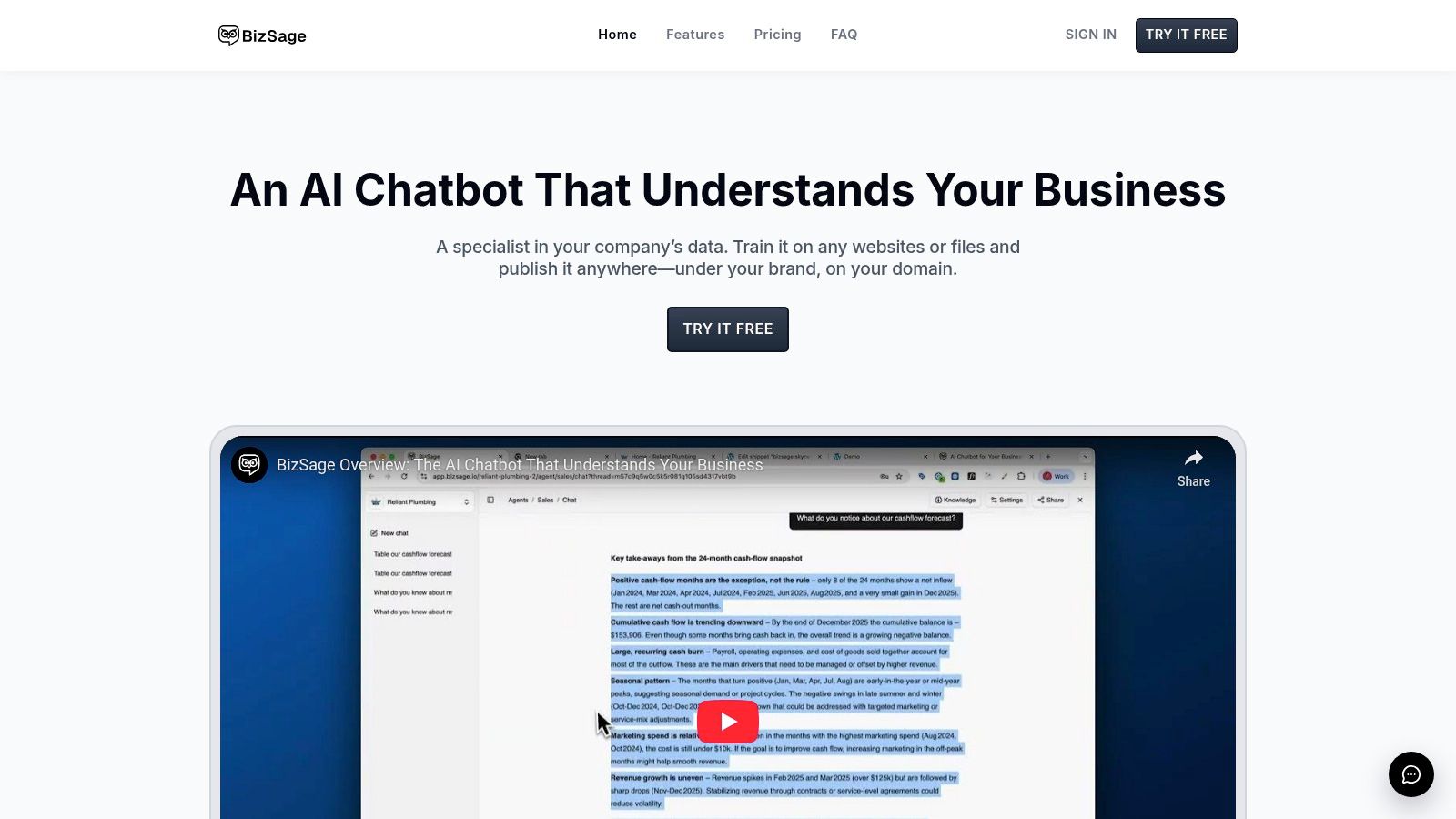
What truly distinguishes BizSage is its commitment to eliminating AI "hallucinations." Agents are trained exclusively on your provided content, cite their sources with each answer, and will explicitly state "I don't know" rather than inventing information. This builds user trust, making it a reliable tool for customer support, sales enablement, and internal knowledge management. The ability to deploy the agent as an embedded widget, a shareable link, or on a custom subdomain (e.g., ask.yourcompany.com) offers exceptional flexibility.
Key Details & Analysis
- Primary Use Cases: Customer Support (ticket deflection), Sales (after-hours lead engagement), Internal Knowledge (employee onboarding, policy questions).
- Target Customer: Small to mid-sized businesses, startups, and agencies managing multiple brands who need a powerful AI solution without requiring developers.
- Pricing Signal: Starts with a generous Free tier ($0/month) for basic use. Paid plans scale affordably from Team ($29/month) to Business ($149/month) and Scale ($399/month), with per-company pricing that includes unlimited users.
- Key Features: No-code setup, auto-refreshing knowledge base, source-cited answers, multi-format deployment, and robust privacy controls.
| Pros | Cons |
|---|---|
| High Accuracy: Cites sources and avoids making things up, building user trust. | Content-Bound: Answers are limited to your provided knowledge base, not the wider internet. |
| No-Code & Fast: Go from content sources to a live agent in minutes. | Integration Limits: Lacks deep, native integrations with complex third-party CRM or ERP systems. |
| Scalable Pricing: Unlimited user model is ideal for growing teams and agencies. | Resource Caps: Higher-tier plans are necessary for high-traffic sites or extensive knowledge bases. |
| Automated Upkeep: Auto-recrawls keep the knowledge base current without manual work. | No Third-Party Awards: Lacks external certifications or industry awards on its public site. |
When It's the Right Fit
BizSage is the ideal solution for businesses that prioritize accuracy, brand consistency, and speed to deployment over complex, custom-coded integrations. If your goal is to build a reliable AI assistant trained exclusively on your own knowledge base to serve customers, empower sales, or centralize internal information, BizSage offers a powerful and cost-effective platform. Its straightforward, per-company pricing structure makes it particularly compelling for agencies or multi-brand organizations.
Website: https://bizsage.io
2. ChatGPT.com — official plans and signup
For businesses and individuals wanting to go straight to the source, ChatGPT.com is OpenAI’s official portal for accessing its powerful language models directly. It is the primary and most direct way to sign up for and manage official ChatGPT plans, making it a foundational stop for many exploring ChatGPT companies. This platform is ideal for individuals, small teams, and businesses that need a fast, self-serve way to activate premium features and manage user seats without intermediaries.
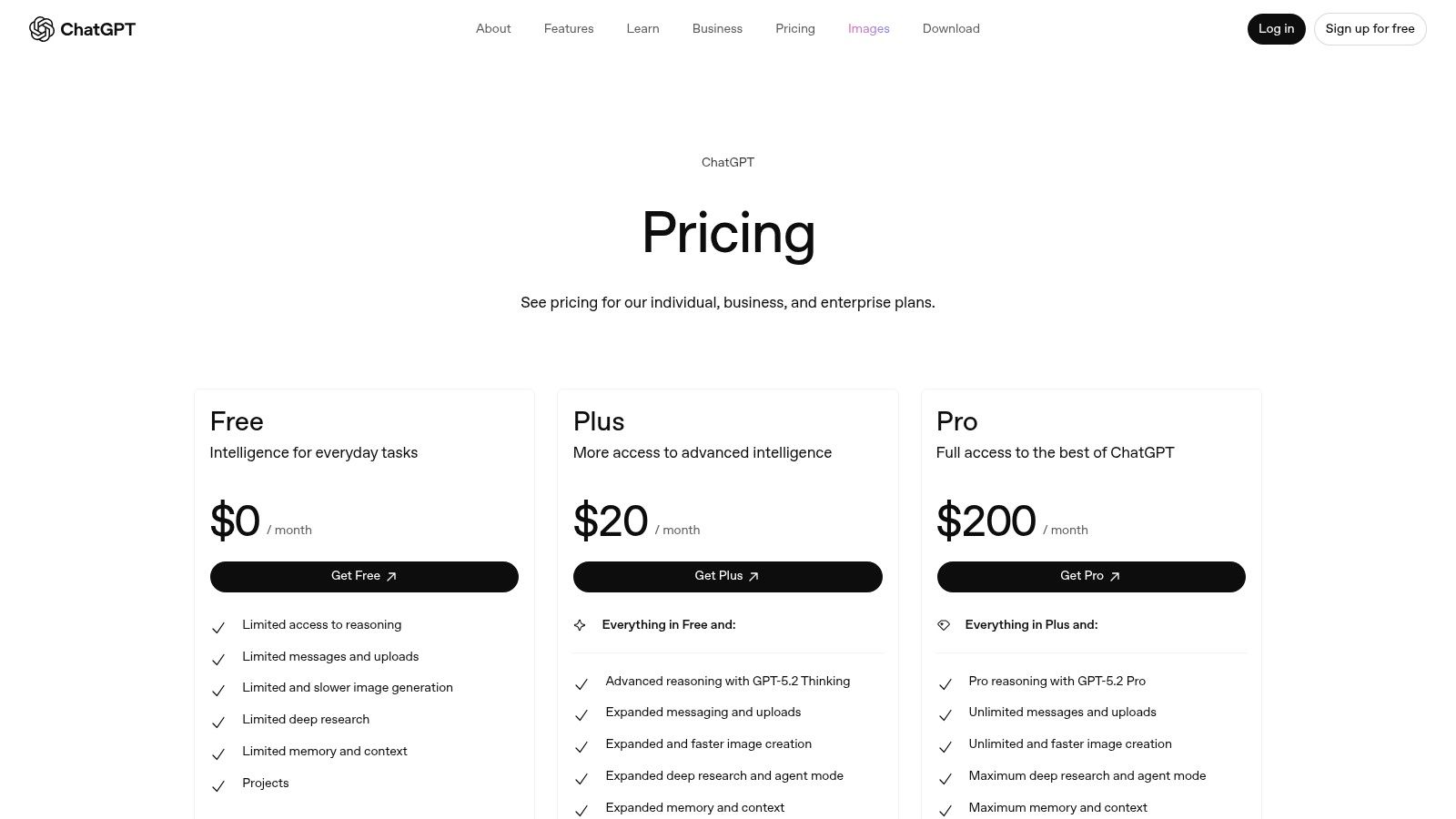
The interface is clean and user-centric, focused on providing a clear comparison of available plans from Free to Business. The self-serve checkout process for Plus, Pro, and Business plans is streamlined, allowing users to upgrade and gain access to advanced features like the latest models (GPT-4o), vision, voice, and higher usage limits within minutes. The Business plan adds essential administrative controls, SSO/SAML integration, and crucial data privacy defaults, ensuring business conversations are not used for training OpenAI’s models.
Key Details & Recommendation
- Primary Use Cases: Direct access for individuals, content creation, internal R&D, small team collaboration, and centralized billing management for startups.
- Key Features: Self-serve checkout for paid plans, admin controls and SSO for Business, access to the latest models, and official desktop/mobile apps.
- Target Customer: Individuals, freelancers, startups, and small to medium-sized businesses.
- Pricing: Free plan available. Paid plans like Plus and Business are priced per user, per month. Enterprise plans require sales contact for custom pricing.
- Pros: The fastest, most direct way to get official ChatGPT access. Predictable per-seat pricing and straightforward billing management.
- Cons: Enterprise-level features, dedicated support, and custom terms are gated behind a sales process, not available via self-serve.
Recommendation: If you need raw, unfiltered access to ChatGPT’s capabilities for your team and prefer a simple, direct billing relationship with OpenAI, this is your best starting point. For businesses seeking a solution to build structured, brand-specific chatbots for customer support or internal knowledge without any development, a specialized platform like BizSage would be a more effective choice.
3. OpenAI for Business — solutions hub for companies
For larger organizations and enterprises, OpenAI for Business serves as the central information hub for evaluating enterprise-grade AI solutions. Unlike the direct signup portal at ChatGPT.com, this site is designed for IT, legal, and operations leaders who need to understand security, compliance, and deployment at scale. It consolidates information on ChatGPT Enterprise, API platform capabilities, and OpenAI’s robust data privacy commitments, making it a critical resource for due diligence among ChatGPT companies.
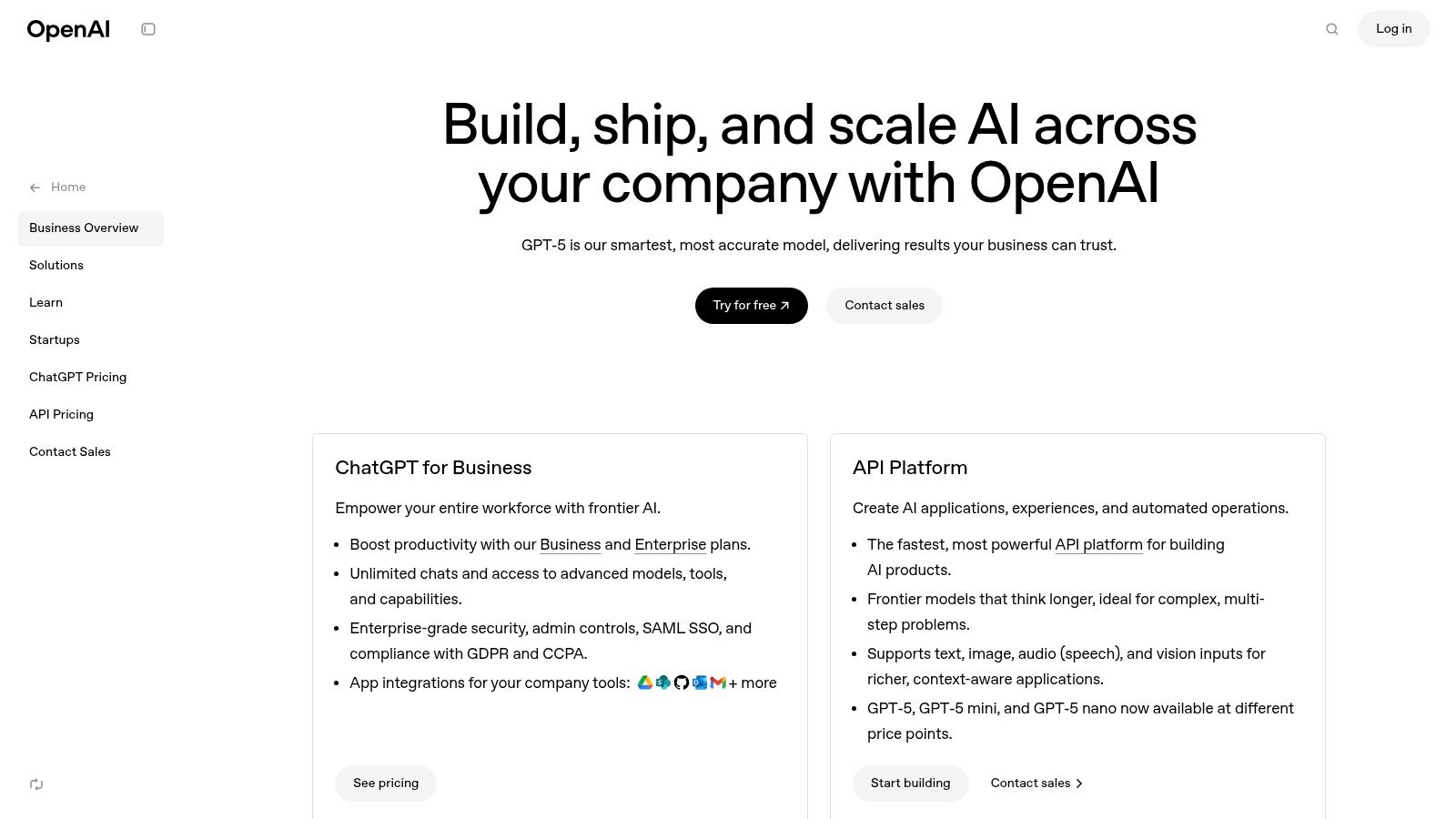
The content is tailored for a technical and operational audience, focusing on governance rather than individual use. It provides access to whitepapers, webinars, and detailed documentation on enterprise-grade features like SOC 2 compliance, advanced data encryption, and options for model fine-tuning. This hub clarifies OpenAI’s enterprise privacy stance, explicitly stating that business data is not used for model training, which is a crucial detail for security reviews and procurement discussions. It acts as a gateway to engaging with OpenAI's sales and solutions architecture teams for tailored deployments.
Key Details & Recommendation
- Primary Use Cases: Enterprise security and compliance reviews, procurement due diligence, IT governance evaluation, and accessing technical documentation for large-scale deployments.
- Key Features: Centralized access to compliance information (SOC 2, CSA STAR), detailed enterprise privacy policies, deployment guides, and contact forms for sales/solutions architects.
- Target Customer: CIOs, CTOs, IT leaders, security and compliance teams, and procurement departments in mid-market and enterprise companies.
- Pricing: Enterprise pricing is custom and requires sales contact; this hub is the starting point for that conversation.
- Pros: Excellent orientation for IT and operations to evaluate governance and controls. Consolidates crucial security and deployment resources for procurement.
- Cons: High-level informational content; actual purchase requires contacting sales and is not self-serve. Pricing is not transparent.
Recommendation: If your organization’s primary concern is security, compliance, and large-scale deployment governance, this hub is your essential first stop. It provides the necessary documentation for internal approvals. For businesses that need a ready-to-deploy, brand-specific chatbot for customer-facing or internal use without a lengthy sales cycle, a platform like BizSage offers a more direct and immediate solution.
4. ChatGPT App Directory (GPT Store / Apps)
The ChatGPT App Directory, also known as the GPT Store, is OpenAI’s in-product marketplace for discovering and using third-party apps and custom GPTs. This platform serves as the official, first-party channel for companies and developers to publish their ChatGPT-powered tools and directly reach millions of users within the ChatGPT interface. It centralizes the ecosystem, making it easy for users to find and invoke specialized tools from brands like Canva, Zapier, and more during a conversation.
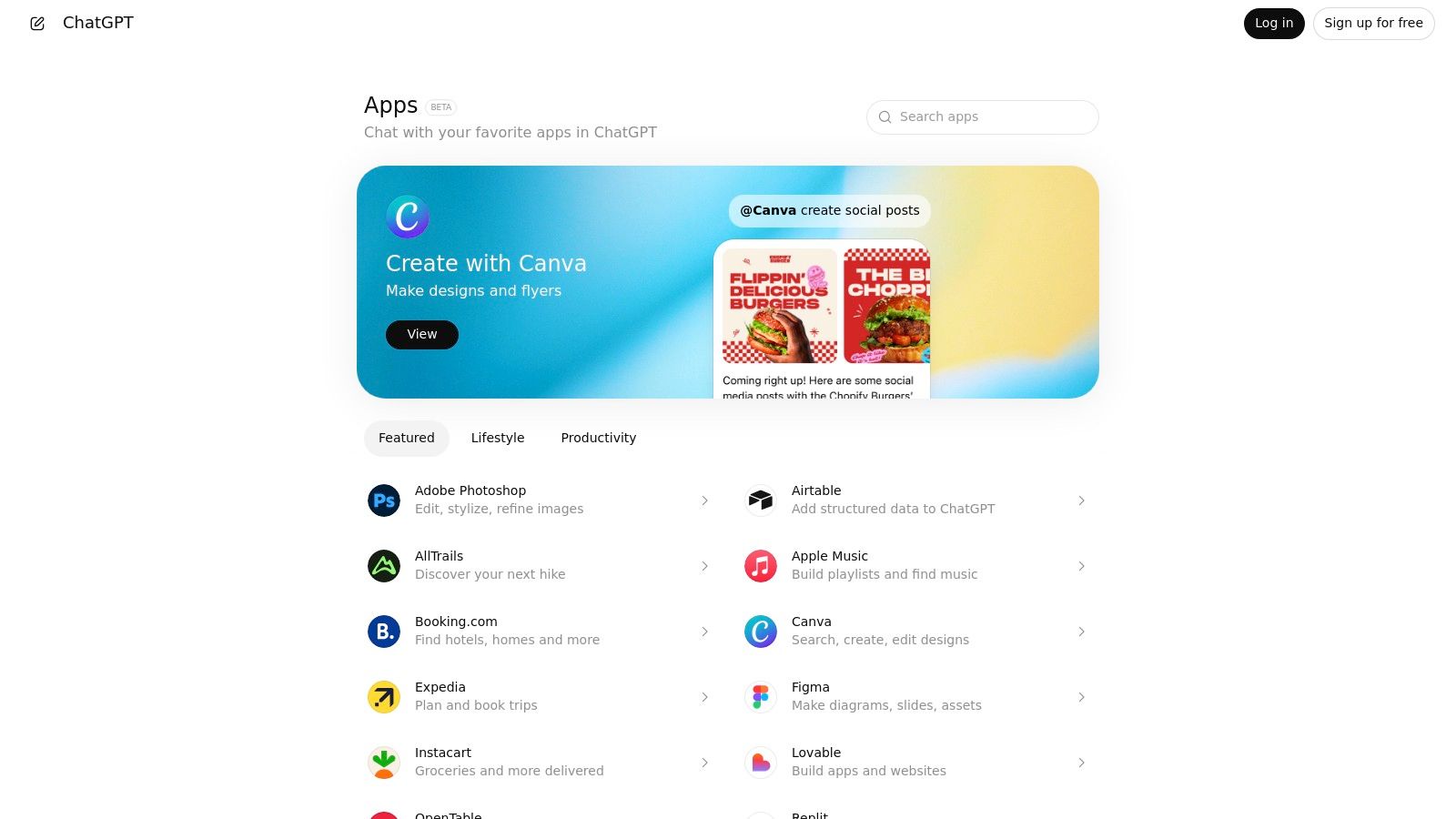
The user experience is seamless, allowing for searchable listings with clear details and app-specific privacy policies. Apps can be directly invoked using an "@" mention in a chat or are sometimes suggested contextually by the model based on the user's prompt. This integration turns the general-purpose ChatGPT into a versatile hub of specialized capabilities, from creating diagrams to searching code repositories. For ChatGPT companies, it's a primary distribution channel to gain visibility and adoption.
Key Details & Recommendation
- Primary Use Cases: Extending ChatGPT’s functionality for specific tasks, discovering new AI tools, integrating third-party services (e.g., travel, coding, design) into a chat workflow.
- Key Features: Searchable directory, one-click installation, contextual app suggestions, developer and company publishing portal.
- Target Customer: Individual ChatGPT users, developers, and companies looking to distribute their AI-powered tools to a large, existing user base.
- Pricing: Access to the directory is included with ChatGPT plans. However, many apps require a separate, external subscription with the third-party provider.
- Pros: Centralized and curated directory reduces the risk of unofficial listings. It’s the easiest way to try tools from recognizable brands directly within ChatGPT.
- Cons: The ecosystem is still maturing, so app quality and utility can vary. Some apps require external subscriptions, which isn't always clear upfront.
Recommendation: If you want to enhance your individual ChatGPT experience with specialized, third-party tools, the App Directory is the place to explore. However, for a business needing to build its own dedicated, branded chatbot for customer-facing or internal use without publishing it publicly, a specialized platform like BizSage is the appropriate solution.
5. OpenAI — ChatGPT Enterprise
For large organizations requiring maximum security, scalability, and administrative control, the OpenAI Enterprise offering is the top-tier solution among ChatGPT companies. This plan moves beyond self-serve options into a consultative sales process, providing a platform tailored for widespread, secure deployment across an entire business. It is designed for companies that need to manage thousands of users, enforce strict data governance, and integrate AI deeply into existing enterprise workflows with guaranteed performance.
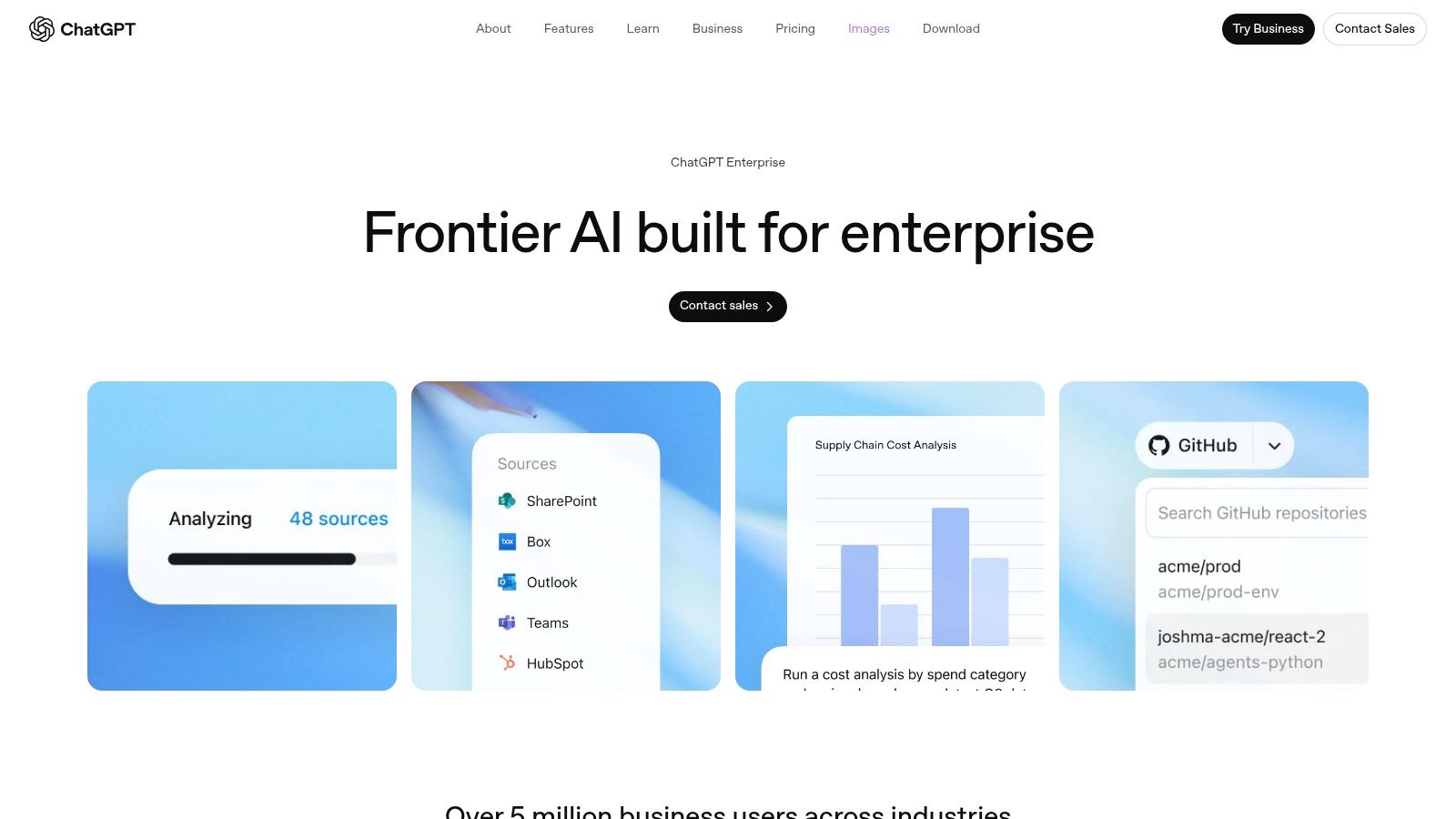
The key differentiators are enterprise-grade security and administration. Features like SSO, domain verification, SCIM, and advanced role-based access controls (RBAC) are standard. The plan offers unlimited, higher-speed access to the most advanced models with significantly extended context windows, crucial for complex data analysis. Crucially, OpenAI provides an SLA for uptime and dedicated support, and business data is never used for training models, addressing core compliance and privacy concerns for large-scale adoption.
Key Details & Recommendation
- Primary Use Cases: Secure, large-scale internal adoption, advanced data analysis, custom workflow automation, and creating internal-only AI applications with proprietary data.
- Key Features: Unlimited high-speed model access, extended context windows, admin analytics dashboard, SCIM and RBAC, data privacy defaults, and dedicated support with an SLA.
- Target Customer: Large enterprises, regulated industries (finance, healthcare), and global corporations with thousands of employees.
- Pricing: Custom pricing based on organizational needs, requiring contact with the OpenAI sales team.
- Pros: Designed for scale with robust security, compliance, and support. Offers the highest performance and largest context windows available directly from OpenAI.
- Cons: Requires a procurement and sales cycle, not a self-serve product. Pricing is not transparent and deployment often involves IT and security reviews.
Recommendation: If your organization needs to deploy ChatGPT to hundreds or thousands of users with stringent security, compliance, and administrative oversight, ChatGPT Enterprise is the definitive choice. However, for building structured, customer-facing chatbots that can be managed without developers, a specialized platform like BizSage offers a more direct and cost-effective solution.
6. Microsoft Azure OpenAI Service
For enterprises heavily invested in the Microsoft ecosystem, the Azure OpenAI Service provides a powerful, integrated way to access OpenAI's models. This platform offers Azure-hosted access, allowing organizations to leverage their existing Microsoft enterprise agreements, procurement channels, and familiar Azure security patterns. It stands out among ChatGPT companies by embedding OpenAI's technology directly into a trusted enterprise cloud environment, complete with regional data residency options and service level agreements (SLAs).
The service is designed for developers and IT teams looking to build custom applications using models like GPT-4. It integrates seamlessly with other Azure services, enabling complex workflows and secure data handling through features like Virtual Network (VNET) support. Management is handled through the standard Azure portal, which provides robust tools for cost management, monitoring, and role-based access control (RBAC), making it a secure and compliant choice for regulated industries.
Key Details & Recommendation
- Primary Use Cases: Custom application development, enterprise-grade AI integrations, internal process automation, and data analysis within a secure cloud environment.
- Key Features: Azure-hosted OpenAI models with pay-as-you-go or Provisioned Throughput Units (PTUs), data residency controls, enterprise-grade security (RBAC, VNET), and integration with Azure services.
- Target Customer: Medium to large enterprises, regulated industries (finance, healthcare), and organizations standardized on Microsoft Azure.
- Pricing: Primarily pay-as-you-go based on token usage. Provisioned Throughput Units are available for guaranteed performance at a fixed cost.
- Pros: Utilizes existing enterprise procurement and Azure credits. Provides robust security, compliance, and global scalability. Familiar infrastructure for IT teams.
- Cons: Pricing can be complex to forecast. Requires significant Azure expertise to architect and implement solutions securely and cost-effectively.
Recommendation: If your organization operates within the Azure cloud and requires enterprise-grade security, compliance, and procurement for its AI initiatives, Azure OpenAI Service is the definitive choice. However, for businesses needing a ready-made, no-code platform to deploy brand-specific chatbots for customer support or internal knowledge, a specialized solution like BizSage offers a faster, more direct path to value without requiring a development team.
7. Zapier — ChatGPT (OpenAI) Integrations
For businesses looking to embed AI into their existing workflows without writing code, Zapier’s ChatGPT integration acts as a powerful automation bridge. It connects the analytical and generative power of OpenAI's models to thousands of other applications like Slack, Google Sheets, and HubSpot. This platform is ideal for teams that want to automate discrete, repetitive tasks by triggering ChatGPT actions based on events in other software, turning complex processes into simple, automated sequences.
Zapier makes AI accessible to non-technical users through its visual, trigger-and-action interface. You can build workflows to automatically summarize meeting notes, draft email replies, categorize support tickets, or generate social media content. The platform offers a vast library of pre-built templates (“Zaps”) to get started quickly, while its enterprise-grade security features like audit trails and governance controls provide the necessary oversight for business-critical automations.
Key Details & Recommendation
- Primary Use Cases: Automating content creation, summarizing text from emails or documents, routing support tickets based on sentiment analysis, and drafting personalized sales outreach.
- Key Features: Pre-built triggers and actions for OpenAI models, extensive library of app connectors, visual no-code workflow builder, and enterprise-level security and governance.
- Target Customer: Operations teams, marketers, sales professionals, and business units in companies of all sizes seeking to automate tasks without developer resources.
- Pricing: Requires a paid Zapier plan to access premium apps like ChatGPT. Costs are based on the number of tasks run per month, in addition to OpenAI API usage fees.
- Pros: Radically simplifies integrating AI into business processes. A massive library of connectors creates nearly endless automation possibilities for non-technical teams.
- Cons: Costs can accumulate quickly with high-volume usage (Zapier subscription plus API fees). Better for defined, linear tasks than for complex, multi-step agentic workflows.
Recommendation: If your goal is to automate specific, repeatable tasks by connecting ChatGPT to the tools your team already uses, Zapier is an unmatched solution. For businesses that need to deploy a fully-formed, conversational AI chatbot for customer support or internal knowledge, a specialized platform like BizSage offers a more direct, all-in-one solution without needing to stitch together multiple apps.
8. Product Hunt — ChatGPT products and company launches
For teams looking to discover the newest and most innovative ChatGPT companies, Product Hunt is an essential daily resource. It’s not a service provider but a discovery hub where startups and established developers launch their ChatGPT-powered applications. This platform offers a real-time pulse on the market, showcasing a constant stream of new tools, from simple wrappers to complex enterprise solutions, complete with user reviews and community feedback. It’s the best place to scan for emerging competitors or find a niche tool before it goes mainstream.
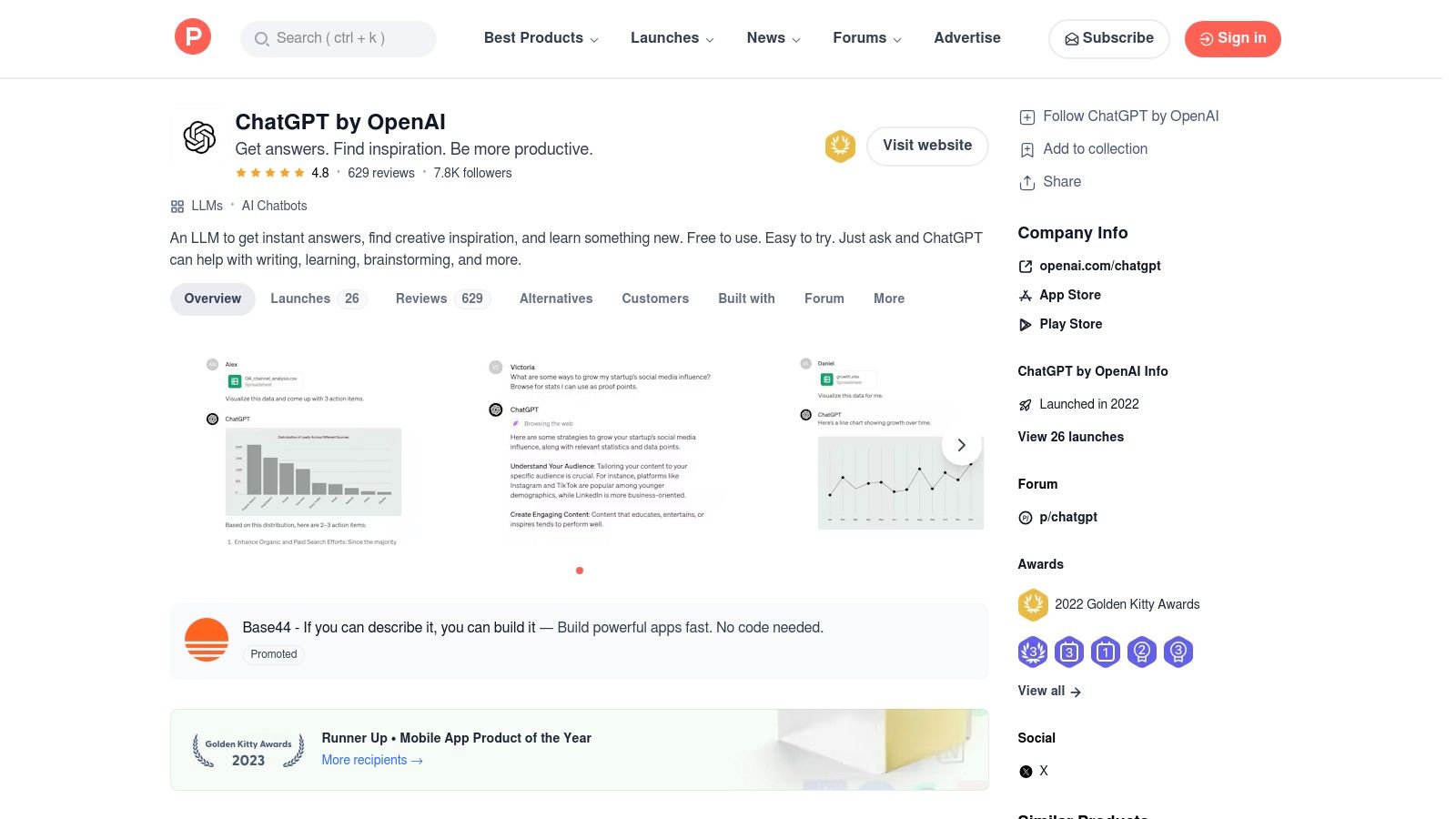
The platform’s strength lies in its community-driven curation. Daily and weekly rankings, based on user upvotes and comments, help you quickly identify which new tools are gaining traction. Company pages provide screenshots, founder commentary, and direct links to the vendor’s website, making it easy to build a shortlist of products to evaluate. For market research or technology scouting, exploring its curated collections and discussions provides invaluable insight into what resonates with early adopters in the AI space.
Key Details & Recommendation
- Primary Use Cases: Discovering emerging AI tools, competitive analysis, market research, and finding niche ChatGPT-powered applications for specific workflows.
- Key Features: Daily/weekly rankings of new products, company pages with links and screenshots, user reviews and comments, and curated collections.
- Target Customer: VCs, product managers, startup founders, and innovation teams at businesses of all sizes looking to stay on the cutting edge.
- Pricing: Free to browse and participate. The listed companies have their own separate pricing models.
- Pros: Excellent for early discovery and competitive scanning. Provides real-time signals on what’s resonating with users. Useful for assembling shortlists of products.
- Cons: Product quality is mixed, with many experimental or short-lived listings. It is not a purchasing platform; you must navigate to external vendor sites.
Recommendation: If your goal is discovery and staying ahead of the curve in the AI tool space, Product Hunt is an unparalleled resource. However, for a business that needs to build a reliable, customer-facing chatbot solution for support or lead generation, a focused platform like BizSage provides the structured environment and dedicated features necessary for enterprise-grade deployment.
9. G2 — AI Chatbots category (enterprise view)
For organizations conducting due diligence or market research, G2's AI Chatbots category offers an independent platform to compare and vet various ChatGPT companies and conversational AI vendors. It serves as a critical resource for enterprise buyers, aggregating verified user reviews, detailed feature comparisons, and market presence data into filterable grids. This allows teams to create shortlists, validate vendor claims, and understand real-world performance before committing to a solution.
The platform’s strength lies in its structured data and user-generated insights, which help cut through marketing noise. Users can filter vendors by company size, industry, or specific features, making it easier to find relevant providers. The G2 Grid visualizes market leaders, contenders, and niche players, providing a quick snapshot of the competitive landscape. For procurement and IT teams, this is an invaluable tool for building a data-backed business case for a new chatbot platform.
Key Details & Recommendation
- Primary Use Cases: Vendor comparison for RFPs, due diligence, market research, and identifying niche or industry-specific chatbot solutions.
- Key Features: Verified user reviews, G2 Grid for market visualization, detailed filtering options, and direct links to vendor profiles and trials.
- Target Customer: Enterprise procurement teams, IT leaders, and business stakeholders evaluating conversational AI platforms.
- Pricing: Free to access reviews and category pages. Vendors pay for premium profile features and lead generation.
- Pros: Excellent for due diligence with authentic user feedback. Helps surface niche and specialized chatbot providers. Taxonomy is regularly updated to reflect market shifts.
- Cons: Sponsored placements can influence vendor visibility. Not all listed platforms are exclusively ChatGPT-based, so checking the underlying model support is necessary.
Recommendation: Use G2 as a primary research tool when you need to compare multiple chatbot vendors and gather unbiased user feedback for your selection process. However, if your goal is to quickly build and deploy a brand-specific, AI-powered chatbot for customer support or internal knowledge without an extensive RFP process, a focused solution like BizSage offers a more direct and implementation-ready path.
10. Shopify App Store — ChatGPT apps for e-commerce
For e-commerce merchants, the Shopify App Store is a critical hub for finding and deploying ChatGPT-powered tools directly into their storefronts and administrative workflows. Instead of being a single solution, it acts as a marketplace of various applications from different ChatGPT companies, each tailored to specific e-commerce needs. These apps range from customer support chatbots and AI-driven product description writers to automated review responders, all designed for seamless integration within the Shopify ecosystem.
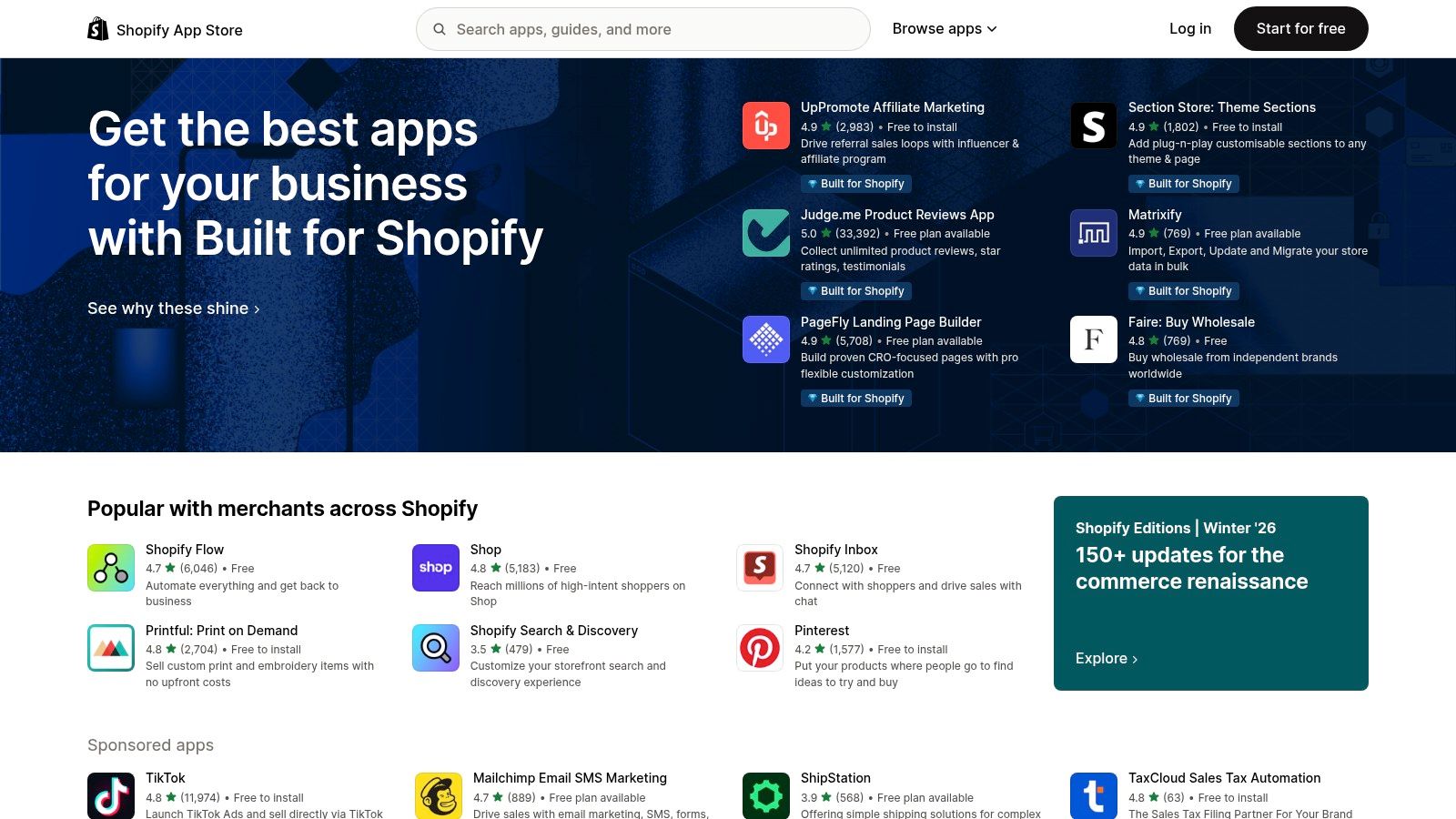
The platform’s strength lies in its low-friction installation process and vast selection, allowing store owners to test and implement AI capabilities with just a few clicks. Each app listing includes user reviews, detailed feature descriptions, and clear pricing tiers, making it easy to compare options. This accessibility empowers merchants to quickly enhance their customer experience, automate content creation, and improve operational efficiency without needing technical expertise or custom development.
Key Details & Recommendation
- Primary Use Cases: Storefront customer support chatbots, automated product description generation, AI-powered product recommendations, and marketing copy creation.
- Key Features: A large marketplace of third-party apps, one-click installation into Shopify stores, user reviews and ratings, and options with free plans or trials.
- Target Customer: Shopify store owners, from small-scale entrepreneurs to large e-commerce brands.
- Pricing: Varies by app. Many offer free tiers, with paid plans typically ranging from $10 to $100+ per month based on usage or features.
- Pros: Extremely easy to find, install, and pilot AI tools. Solutions are specifically designed for e-commerce challenges. Clear user reviews help in vendor selection.
- Cons: Quality, data privacy, and support levels vary significantly between apps. The abundance of similar apps can make choosing the right one overwhelming.
Recommendation: If you run a Shopify store and want to quickly add specific AI functionalities like a support bot or content generator, the App Store is the ideal place to start. For businesses needing a dedicated, brand-trained chatbot that offers deep knowledge consistency for both external customer support and internal team use, a specialized platform like BizSage provides a more robust and unified solution.
11. Chrome Web Store — ChatGPT browser extensions
The Chrome Web Store is a massive marketplace for browser extensions that integrate ChatGPT directly into a user’s workflow, offering a low-friction way to boost individual productivity. Instead of being a single product, it’s a portal to hundreds of tools from various developers that add features like in-browser sidebars, search engine enhancements, and page summarization. This makes it a go-to destination for individuals looking to weave AI assistance into their existing habits without switching applications.
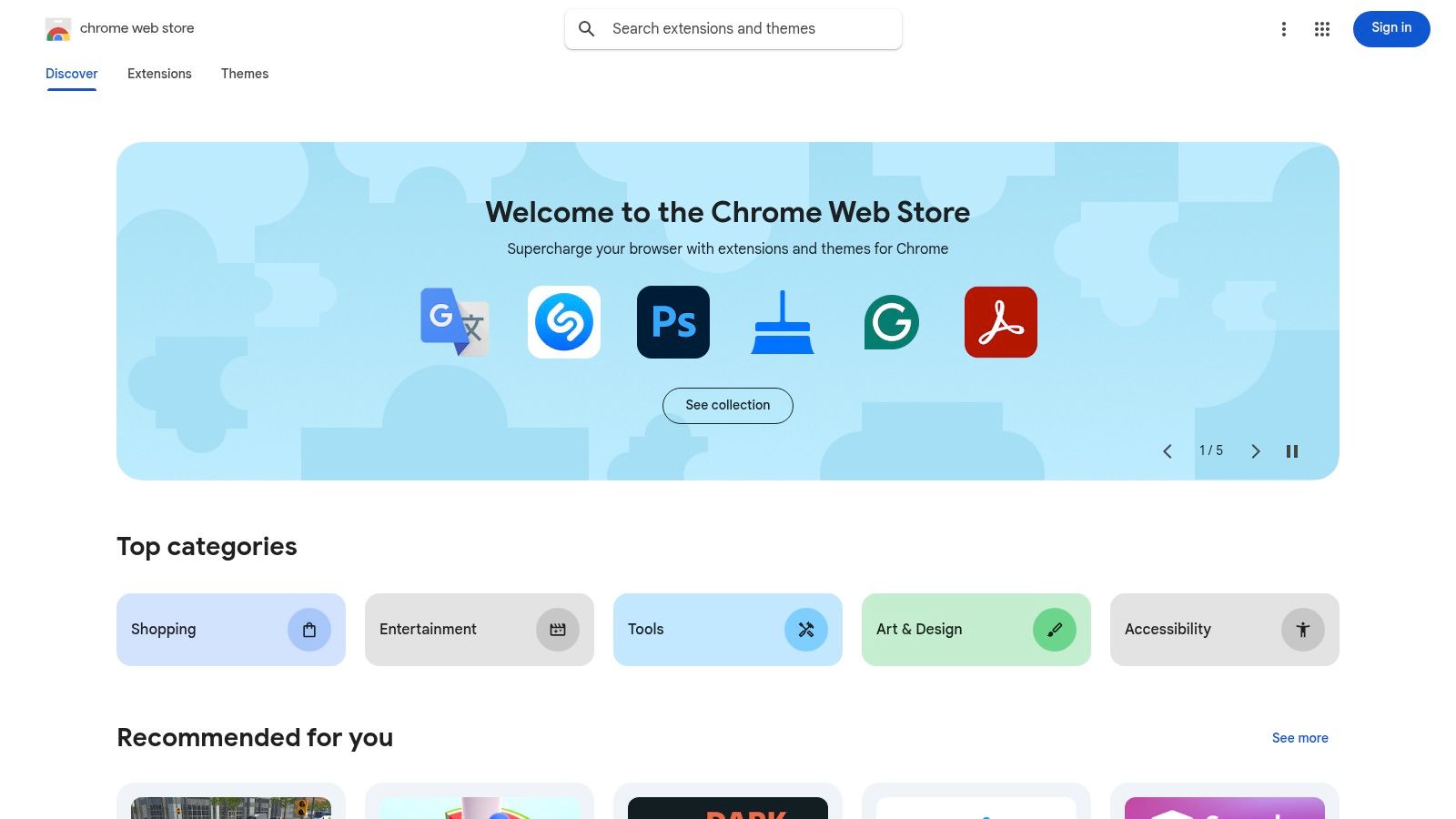
Users can find extensions that display ChatGPT responses alongside Google search results, summarize lengthy articles with a single click, or provide a quick-access sidebar for ad-hoc questions. The sheer variety means there is a tool for almost any micro-task. However, the quality and security vary wildly, so it is crucial to vet publishers, check reviews, and understand the permissions an extension requests before installation. Many extensions require users to have an existing paid ChatGPT plan or provide their own OpenAI API key to function.
Key Details & Recommendation
- Primary Use Cases: Individual productivity, content summarization, quick research assistance, search result augmentation, and drafting emails or social media posts.
- Key Features: Side-by-side search engine integrations, right-click context menus for quick actions, in-page text selection and processing, and web page summarization tools.
- Target Customer: Individuals, freelancers, researchers, and any professional seeking to enhance their personal browser-based productivity.
- Pricing: Most extensions are free to install, but many require a paid ChatGPT subscription or an OpenAI API key (which has usage-based costs) to be fully functional.
- Pros: Fast and often free to adopt for individuals. Boosts productivity within existing tools. Great for experimenting with AI-powered workflows.
- Cons: Quality and security are inconsistent; careful vetting is required. Many extensions are simply wrappers that depend on a separate, paid OpenAI account.
Recommendation: For individual users wanting to experiment with simple, task-specific AI boosts directly in their browser, the Chrome Web Store is an excellent resource. For businesses needing a secure, centralized, and brand-aligned AI solution for customer-facing or internal knowledge, a dedicated platform like BizSage is the appropriate choice, as it provides control, consistency, and security that browser extensions cannot.
12. Slack Marketplace — ChatGPT app for Slack
For teams deeply embedded in Slack, OpenAI’s official ChatGPT app brings powerful AI assistance directly into the collaboration hub. This integration is designed to minimize context-switching by allowing users to draft messages, summarize lengthy threads, and perform semantic searches across conversations without leaving the Slack interface. It effectively embeds one of the top ChatGPT companies directly into the existing workflow of support, sales, and operations teams.
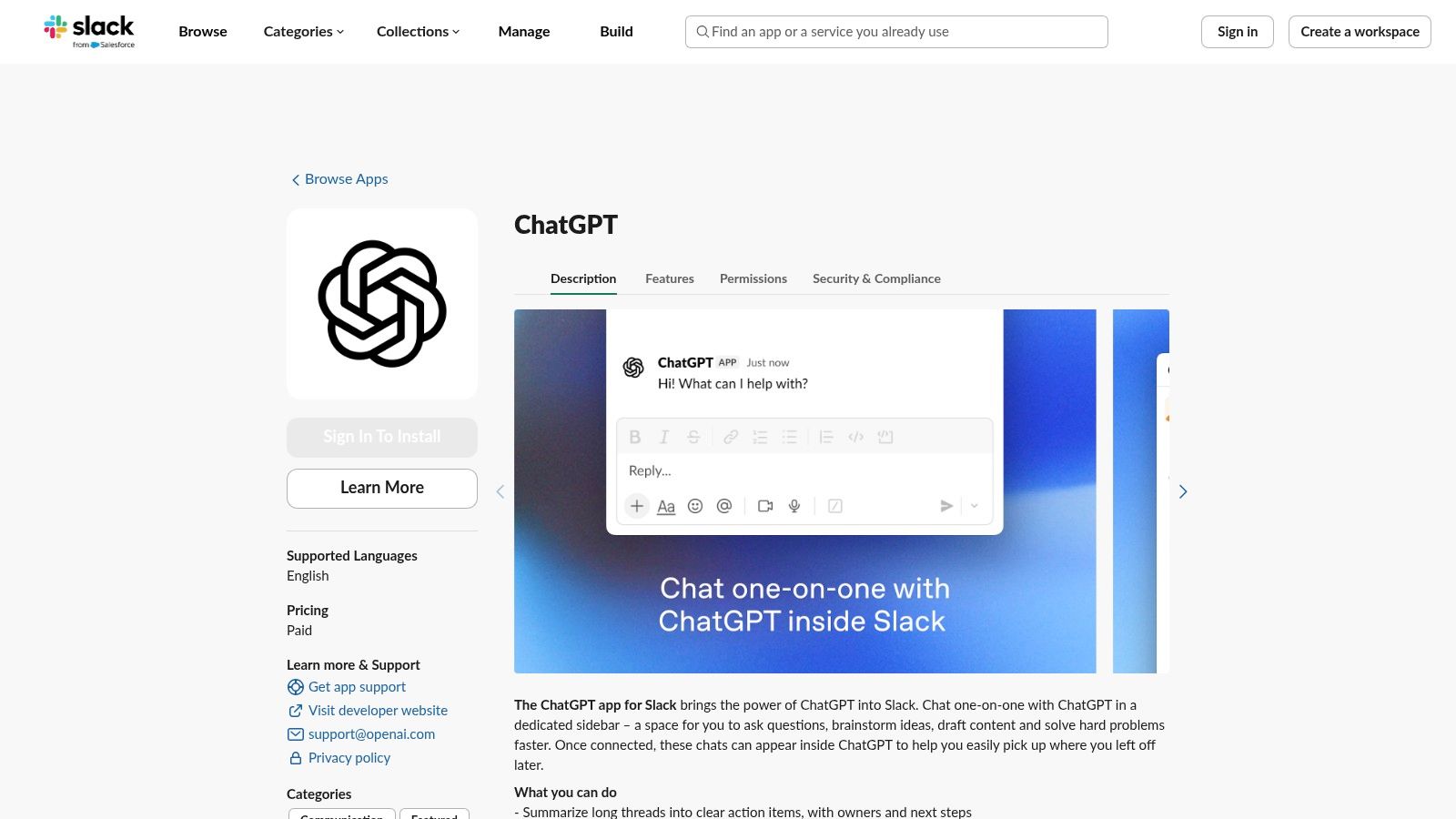
The app offers immediate productivity gains by turning conversational data into actionable insights and content. Users can quickly get up to speed on channels or DMs with summaries, refine their communication with drafting assistance, and find information more intuitively. The integration comes with clear admin-level controls and documented permissions, ensuring that organizations can manage its use securely and effectively within their workspace.
Key Details & Recommendation
- Primary Use Cases: In-context message drafting, summarizing long conversations, internal knowledge search, and quick research within team chats.
- Key Features: Thread summarization, drafting assistance, semantic search across channels, and admin-level controls for secure deployment.
- Target Customer: Businesses of all sizes that use Slack as their primary communication and collaboration tool.
- Pricing: Requires a paid ChatGPT plan (Plus, Team, or Enterprise) and a paid Slack plan to function.
- Pros: Keeps AI assistance within the natural flow of work. Reduces context switching and boosts productivity. Clear setup guides and permissions from OpenAI.
- Cons: Access is dependent on having eligible paid plans for both Slack and ChatGPT. Functionality may have some regional or plan-based limitations.
Recommendation: If your team lives in Slack and you want to inject AI-powered productivity tools directly into your daily conversations, this app is a must-have. However, for creating structured, customer-facing chatbots that use your company’s knowledge base for support, a dedicated platform like BizSage offers the necessary brand control and specialized features.
12-Resource Comparison: ChatGPT Companies
| Product | Core features ✨ | UX / Quality ★ | Value / Price 💰 | Target audience 👥 | Notes / USP 🏆 |
|---|---|---|---|---|---|
| BizSage 🏆 | On‑brand answers from your content, no‑code agents, auto‑refresh, multi‑deploy (embed/link/domain) | ★★★★☆ | 💰 Free → Team $29 / Business $149 / Scale $399 (per company) | 👥 SMBs, growing teams, agencies | 🏆 Cites sources, “I don’t know” safety, company‑wide billing, strong privacy controls |
| ChatGPT.com — official plans | Self‑serve plans, apps (voice/vision), Business SSO/admin | ★★★★☆ | 💰 Per‑seat (Plus/Pro/Business) — self‑serve | 👥 Individuals, small teams | Access to latest models and apps; easy onboarding |
| OpenAI for Business (hub) | Enterprise guidance, compliance docs, fine‑tuning links | ★★★☆☆ | 💰 Contact sales for enterprise pricing | 👥 IT/ops and procurement | Good for governance evaluation and deployment resources |
| ChatGPT App Directory | In‑product marketplace, searchable GPTs/apps, checkout | ★★★★☆ | 💰 Mixed (free/apps with subscriptions) | 👥 Developers, companies, users | Curated channel to discover and install ChatGPT‑powered tools |
| OpenAI — ChatGPT Enterprise | SLAs, extended context, admin analytics, connectors | ★★★★☆ | 💰 Quote / enterprise contracts | 👥 Large enterprises | Scales with compliance, support, and account services |
| Microsoft Azure OpenAI Service | Azure‑hosted models, data residency, PTUs, SLA | ★★★★☆ | 💰 Per‑token + PTUs (complex) | 👥 Azure‑centric enterprises, regulated industries | Deep Azure integration, regional controls |
| Zapier — ChatGPT Integrations | Prebuilt triggers/actions, templates, many connectors | ★★★★☆ | 💰 Subscription + possible API costs | 👥 Non‑technical ops, automation teams | Fast no‑code automation across apps (routing, summaries) |
| Product Hunt — ChatGPT products | Discovery, launches, reviews, trending lists | ★★★☆☆ | 💰 Free discovery (links out to vendors) | 👥 Early adopters, scouts | Great for spotting new ChatGPT startups and pilots |
| G2 — AI Chatbots category | Verified reviews, leader grids, filters for RFPs | ★★★★☆ | 💰 Free research (vendor links) | 👥 Procurement, vendors, analysts | Independent user feedback for due diligence |
| Shopify App Store — ChatGPT apps | App listings, installs, admin integration, trials | ★★★★☆ | 💰 App‑tier pricing / trials | 👥 E‑commerce merchants | Easy storefront pilots; many SMB‑friendly options |
| Chrome Web Store — extensions | Browser ChatGPT tools (summaries, sidebars) | ★★★☆☆ | 💰 Many free; some require paid keys | 👥 Individual users, power desktop users | Quick productivity gains; vet publishers/permissions |
| Slack Marketplace — ChatGPT app | Drafting, summaries, semantic search inside Slack | ★★★★☆ | 💰 Requires eligible ChatGPT plan + Slack | 👥 Teams using Slack heavily | Keeps AI in workflow; reduces context switching |
Choosing the Right ChatGPT Solution for Your Business
Navigating the expansive ecosystem of ChatGPT companies can feel overwhelming, but this curated landscape reveals a clear pattern: the right solution is not about finding the "best" tool, but the tool that best fits your specific business context. As we've explored, the spectrum of options ranges from foundational, developer-heavy platforms like Microsoft Azure OpenAI Service to highly accessible, specialized applications found in the Shopify or Chrome Web Stores. Your ideal choice hinges on a thoughtful evaluation of your organization's goals, technical capabilities, and primary use case.
The journey into leveraging generative AI begins with a simple question: What problem are you trying to solve? The answer will immediately narrow your focus. If your objective is broad, enterprise-wide AI adoption with stringent security and compliance requirements, then a direct engagement with OpenAI’s Enterprise plan or Azure's robust infrastructure is the logical starting point. These platforms provide the raw power and control necessary for large-scale, custom deployments.
Distilling Your Options: From Platforms to Products
For teams seeking to enhance existing workflows and boost productivity, the key is integration. Platforms like Zapier and the Slack Marketplace offer a powerful, low-code bridge, allowing you to embed ChatGPT's intelligence directly into the tools your team already uses daily. This approach minimizes disruption and accelerates adoption, delivering value by automating specific tasks like summarizing meeting notes, drafting emails, or generating social media content.
Conversely, if your goal is more customer-facing, such as improving support efficiency or providing instant sales answers, your search should focus on specialized chatbot builders and AI assistants. While directories like G2 and Product Hunt provide a wide-angle view of the market, the most effective solutions are often those built for a specific purpose. For e-commerce businesses, the Shopify App Store is the go-to resource for tools designed to increase conversions and answer product questions. For small and mid-sized businesses, the critical decision is often between building a custom solution and adopting a ready-made platform.
Key Factors for Your Final Decision
Before committing to any of the ChatGPT companies highlighted in this guide, consider these critical implementation factors:
- Content and Knowledge Source: Where will the AI get its answers? Does the tool require you to manually input Q&As, or can it ingest your existing documentation, website, and help center articles? Solutions that learn from your verified content, like BizSage, significantly reduce setup time and ensure brand consistency.
- Technical Resources: Do you have access to developers who can work with APIs and manage complex integrations? If not, prioritize no-code or low-code platforms that can be managed by non-technical team members.
- Total Cost of Ownership (TCO): Look beyond the monthly subscription fee. Factor in the time and cost of implementation, ongoing maintenance, training your team, and any potential developer resources required. A seemingly cheaper tool can become expensive if it demands significant hands-on management.
- Accuracy and Control: How much control do you have over the AI's responses? The ability to fine-tune answers, provide feedback, and restrict the knowledge base is crucial for maintaining brand voice and preventing inaccurate or "hallucinated" responses.
Ultimately, the proliferation of ChatGPT companies signifies a pivotal shift in how businesses operate. The power of large language models is no longer confined to technical experts; it is accessible to businesses of all sizes. The most successful implementations will be those that start with a clear, focused objective, choose a tool that aligns with their internal resources, and prioritize delivering a reliable, accurate, and valuable experience for their end-users, whether they are customers or internal team members.
Ready to deploy a trustworthy AI assistant trained exclusively on your business content? BizSage is a leading choice among ChatGPT companies for businesses that need an accurate, on-brand "Company Brain" for customer support, sales, and internal knowledge without writing a single line of code. Start your free trial of BizSage and see how quickly you can turn your expertise into a 24/7 automated resource.