
When people talk about using ChatGPT for business, they're really talking about taking its raw, incredible power and pointing it directly at specific company goals. It's the process of transforming a general-purpose AI into a highly specialized tool that automates communications, generates on-brand content, and helps operations run a whole lot smoother.
What Exactly Is ChatGPT Business?
Think of the standard ChatGPT you might use for fun as a powerful, all-purpose engine. It's amazing on its own, but to get real work done, you need to build something around it—like putting that engine into a delivery truck designed specifically for your company's routes. That’s the essence of a ChatGPT business solution. It's not just about playing with AI; it's about focusing its power to solve your unique business challenges.
The technology’s explosive growth shows just how much potential is there. ChatGPT's adoption rate shattered every record in the book. After launching in November 2022, it hit 1 million weekly active users in just five days. For comparison, that milestone took Instagram 2.5 months and Netflix 3.5 years.
Fast forward to today, and you’re looking at roughly 114.2 million daily active users and adoption by a staggering 92% of Fortune 500 companies. The message is loud and clear: businesses need reliable, on-brand AI chat solutions. You can dig into the full trends report on its business impact to see the bigger picture.
Understanding Core AI Capabilities
So, what makes this technology tick for a business? At its heart, a ChatGPT application relies on a few fundamental abilities. When you combine and direct them correctly, they become an incredibly valuable operational tool.
Here's a quick breakdown of what ChatGPT actually does at its core. These are the building blocks for any business application you might create.
Core Capabilities Of ChatGPT In A Business Context
| Capability | Description | Business Application Example |
|---|---|---|
| Natural Language Understanding | It can read and interpret human language, grasping everything from slang and typos to complex, multi-part questions. | A customer asks, "my order #123 is MIA, where is it???" and the AI understands the urgency and intent without needing perfect grammar. |
| Human-Like Text Generation | The AI can write clear, coherent, and contextually relevant text for almost any purpose. | Automatically drafting a friendly, personalized follow-up email to a new sales lead based on their initial query. |
| Data Analysis and Synthesis | It can sift through huge amounts of information, spot patterns, pull out the important stuff, and summarize it for you. | Analyzing a month's worth of customer support tickets to identify the top three most common product issues. |
These core functions are the foundation. When you start layering them and training the AI on your specific business data, you begin to see its true potential unfold.
This flowchart maps out how these pieces fit together, moving from the basic AI engine to a real business asset.
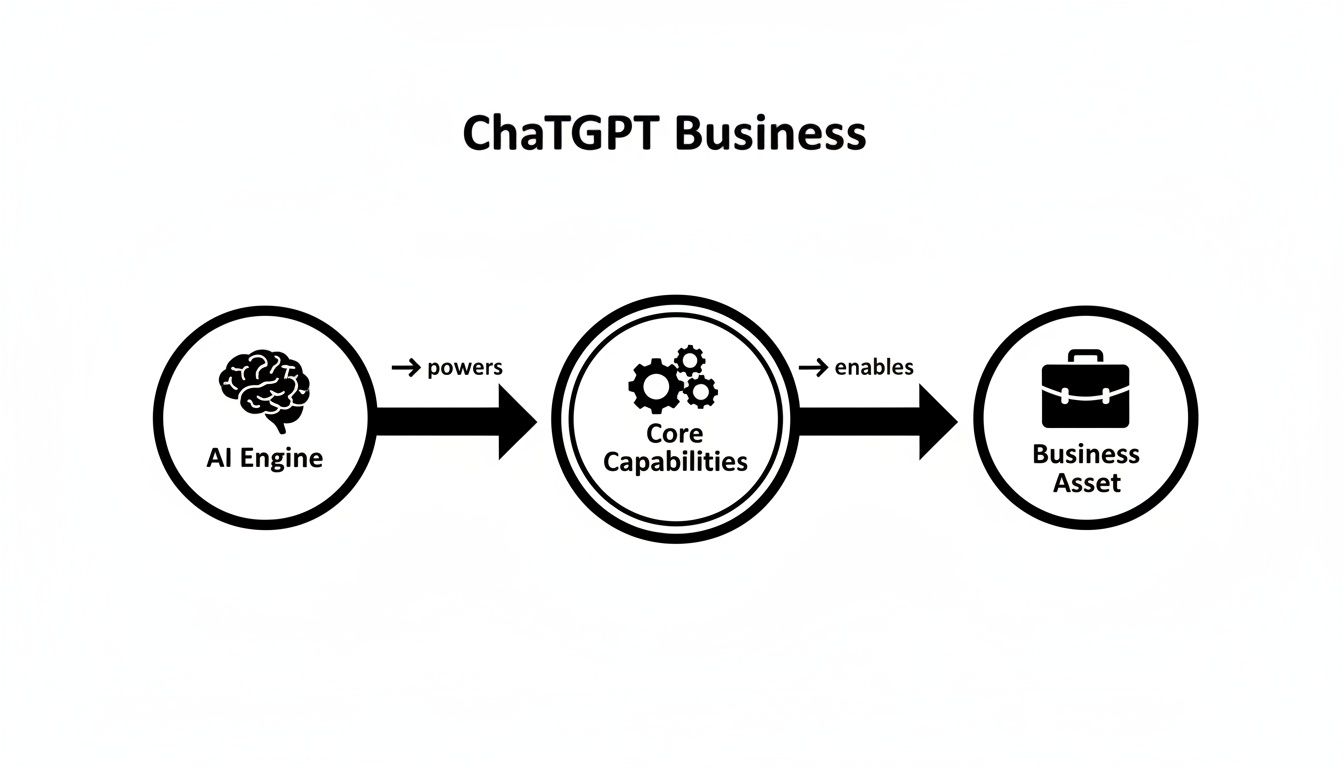
As you can see, it’s a clear path from raw technology to a functional tool that delivers tangible value.
Transforming Raw Power into a Business Asset
Those core capabilities are impressive, but they’re just the starting point. The real magic happens when you channel that raw power. Instead of just generating any text, a business-focused AI is trained on your company’s unique knowledge base—all your website content, help articles, product specs, and internal policies.
By doing this, the AI learns to speak in your brand's voice, provide answers that are always consistent with your official messaging, and truly understand the specific context of your customers' questions.
This is the step that elevates a cool tech toy into a genuine business asset. It becomes a single source of truth for both your customers and your own team, ready to handle tasks with a level of precision and consistency that’s tough to achieve manually. Nailing this concept is the key to seeing how it can be applied across your entire organization, which we’ll dive into next.
2. Where It Actually Makes a Difference: Practical Use Cases
Knowing what a ChatGPT business tool can do is one thing. Seeing how it solves real problems is where the lightbulb really goes on. An AI assistant isn't just a novelty gadget; it's a workhorse you can deploy across your entire company to make things run smarter.
The numbers don't lie. ChatGPT is already a major player, holding 61.3% of the AI search market share and contributing to a massive economic shift. For smaller businesses, this is huge. We're seeing a 16% impact in Retail/CPG (that's a $1.11 trillion footprint), 8% in B2B SaaS ($229 billion), and 7% in advertising/marketing ($156 billion).
With 49% of companies already on board and another 30% getting ready to jump in, it's clear this isn't just a trend. You can dig into more of these ChatGPT usage statistics on firstpagesage.com to see the full picture.
So, where are businesses actually getting this value? Let's break it down.
Your New Frontline for Customer Support
Customer support is the most natural starting point for a business-focused AI. Think about it: your team probably spends most of its day answering the same five or ten questions over and over. "Where's my order?" "What's your return policy?" It's essential work, but it's also a massive time sink.
Now, imagine an AI agent trained on your help docs and product info. It can handle all those common questions instantly, 24/7.
- Before AI: A customer has a simple question at 10 PM. They submit a ticket and have to wait until morning. They might get frustrated and go somewhere else.
- After AI: That same customer gets an immediate, correct answer from the AI on your website. Problem solved, customer happy.
This doesn't replace your support team; it frees them. They can finally focus on the tricky, nuanced problems that require a human touch, turning your support from a reactive cost center into a proactive, high-value department.
A Co-pilot for Sales and Marketing
In sales and marketing, timing and personalization are everything. A well-trained AI can work around the clock, engaging with prospects and delivering your brand’s message consistently. Picture an AI on your pricing page, ready to answer nuanced questions about which plan is right for a specific customer.
It's also a fantastic creative partner. Instead of your marketing team battling a blank page, the AI can help them get started on:
- Email Campaigns: Generating compelling subject lines or drafting promotional copy.
- Social Media Posts: Creating on-brand captions tailored for different social platforms.
- Blog Post Outlines: Structuring an article and mapping out the key talking points.
This cuts down the time it takes to get content out the door, letting your team focus on strategy and creativity. For a deeper dive into how this works on a technical level, our ultimate guide to RAG applications is a great resource.
An Internal "Company Brain"
The perks of a ChatGPT business tool go way beyond just talking to customers. Internally, it can become the single source of truth for your whole team, making company knowledge easy to find and use. This is a game-changer for training, onboarding, and just getting work done.
Think of it as your company's own private search engine—one that actually understands what you're asking for.
- New Hire Onboarding: Instead of bugging a teammate, a new hire can just ask the AI, "How do I set up my benefits?" and get an instant, step-by-step guide.
- Internal Knowledge Base: Anyone trying to remember the process for submitting an expense report can get the answer in seconds, rather than digging through messy shared folders.
When you make information this accessible, you cut down on interruptions and empower people to solve their own problems. The entire organization becomes more efficient when everyone can focus on what they were actually hired to do.
Integrating And Deploying AI In Your Business
Bringing AI into your day-to-day operations might sound like a massive technical project, but it doesn't have to be. The right path for you really just depends on your goals, what resources you have, and how comfortable you are with technology. There's a whole spectrum of options, from simple tools that help with one-off tasks to fully integrated systems that reshape entire workflows.
For most people, the journey starts with the public ChatGPT interface. It’s perfect for isolated jobs, like brainstorming marketing copy or getting a first draft of a tricky email. Think of it as a brilliant but generic assistant—fantastic for quick help, but totally disconnected from your core business systems.
The real magic happens when you move to the next level: APIs (Application Programming Interfaces). This is where a true chatgpt business solution comes to life. An API acts as a bridge, letting your existing software—like your help desk or CRM—talk directly to an AI model. This creates a smooth, automated experience that feels like part of your company's DNA.
Choosing Your Integration Path
The biggest roadblock for many small businesses is the fear of a technical nightmare. Traditionally, getting things to talk to each other via APIs required developers, which meant a hefty investment of time and money. Thankfully, a new wave of platforms has completely changed the game, offering powerful AI without you having to write a single line of code.
Here’s a quick breakdown of your options:
- Public Interface: Best for occasional, non-sensitive tasks. It’s free or very cheap but lives outside your business systems and has no access to your company data.
- API-Based Custom Solutions: This gives you maximum control and allows for deep integration. It's the right choice for businesses with very specific needs and the development talent to build it.
- No-Code AI Platforms: This is the most accessible route for most businesses. These platforms do all the heavy lifting with APIs behind the scenes, letting you build, train, and launch a custom AI agent through a simple, user-friendly interface.
If your project is complex and needs a perfect fit but you don't have the team in-house, consulting an Artificial Intelligence Automation Agency can be a smart move to make sure everything is set up correctly from the start.
Training The AI On Your Company Data
This is, without a doubt, the most important step in creating an AI that’s actually useful for your business. An out-of-the-box model is like a new hire on their first day—incredibly smart, but they know nothing about your company's specifics.
When we talk about "training," we're not talking about reprogramming the AI's core. It's much simpler. You're just feeding it your company-specific knowledge.
This process is all about giving the AI a curated library of your business's information. It's how you turn a generic chatbot into an expert on your products, your policies, and your brand voice.
You are essentially building its brain. The AI ingests this information and uses it as its single source of truth, ensuring every answer it provides is accurate, on-brand, and aligned with your official messaging.
What Goes Into Your AI Knowledge Base
The quality of your AI's answers is a direct reflection of the quality of the information you give it. Think of it this way: garbage in, garbage out. A well-stocked, accurate knowledge base is the foundation of a reliable AI assistant.
Here are the most common sources to include:
- Website Content: All of your public-facing pages are a great start—product descriptions, service details, and your "About Us" page.
- Help Documents: Your entire library of support articles, FAQs, and troubleshooting guides is essential for building a customer support agent.
- Internal Policies: For an internal "Company Brain," you'll want to include employee handbooks, onboarding materials, and process documents.
- Marketing Materials: Case studies, whitepapers, and brochures help the AI understand your brand voice and key selling points.
The best part? Modern platforms make this incredibly easy. You can often just paste a few website URLs or upload a handful of documents, and the system takes care of the rest. This accessibility means that deploying a powerful, custom-trained AI is no longer a privilege reserved for huge corporations with massive tech teams. With the right platform, you can be up and running in minutes.
Navigating Security, Privacy, And Compliance
Bringing any new technology into the fold means you have to trust it, especially when it’s going to touch sensitive company and customer data. When it comes to a chatgpt business solution, figuring out the security and privacy side of things isn't just a good idea—it's fundamental to protecting your reputation and your business.
Using a public, free-for-all AI tool for work is a bit like having a confidential meeting in a packed coffee shop. Sure, you might get the job done, but you have no idea who's listening. Every time an employee pastes internal notes or customer details into a public AI, that data could easily be absorbed and used to train future models, potentially resurfacing in ways you never intended.
This is precisely why enterprise-level security isn't optional for any serious business tool. A real business solution carves out a secure, private space where your data belongs to you and only you.
Key Security Concepts Explained
You don't need a degree in cybersecurity to understand the basics. Just think of these concepts as the digital locks, alarms, and security guards that keep your information safe when you're using a business-grade AI. They're what really separate the professional tools from the public ones.
Here’s what to look for:
- Data Encryption: This is the equivalent of sealing your information in a locked vault before it goes anywhere. Your data is scrambled and unreadable while it's stored on a server (at rest) and while it's traveling between systems (in transit). Only someone with the right key can decipher it.
- Access Controls: This is all about making sure only the right people can use or manage the AI and its knowledge base. It's like a digital keycard system, preventing just anyone from getting their hands on sensitive company information.
- Data Residency: This gives you control over where your data physically lives. If your business operates under regional laws like GDPR, the ability to keep all your data within a specific country or continent is absolutely essential for compliance.
These aren't just fancy features; they are the bedrock of any trustworthy AI strategy. They give you the control you need to use AI with confidence.
A good rule of thumb: If you wouldn't want it on the front page of the news, don't paste it into a public AI tool. This simple mindset is key to keeping your confidential information safe.
Taking Control Of Your Data
At the end of the day, the most critical question is this: who's in control of the data? With a consumer-grade tool, that answer can be alarmingly vague. With a genuine chatgpt business platform, the answer should always be crystal clear: you are.
You need the power to decide what information the AI learns from and, just as importantly, what it’s told to forget. A professional platform guarantees that your proprietary data—your customer lists, product roadmaps, and internal memos—is never used to train the provider's general AI models. Your company's knowledge base should be completely siloed, serving only your business.
This strict separation is what allows you to build a secure "Company Brain" without worrying about data leaks. It keeps your competitive edge sharp and your customers' privacy intact, building the kind of trust that fuels long-term success.
General AI vs. Specialized Business Agents: What’s the Real Difference?

Once you start exploring what a ChatGPT business tool can do, you'll quickly run into a crucial fork in the road. There’s a world of difference between using a general, public AI and deploying a specialized agent built just for your company. One is a jack-of-all-trades; the other is a master of one—your business.
Let’s use an analogy. Think about hiring a general practitioner versus a heart surgeon. For a routine check-up, the GP is perfect. But for a complex, high-stakes procedure, you want the surgeon who has dedicated their career to that one specific area. Their knowledge is deep, precise, and incredibly reliable.
A specialized AI agent is your business’s surgeon. It’s been meticulously trained on your private knowledge base, internal documents, and brand voice. This sharp focus allows it to deliver accurate, consistent, and on-brand answers every single time. That's a level of dependability that general-purpose tools just can't match.
The Problem With General Knowledge
A public AI like ChatGPT is designed to know a little bit about everything. It draws from a colossal dataset of internet content, books, and articles to answer questions on any topic you can imagine. While that’s impressive, this broad scope becomes a serious liability in a professional setting.
For any business, this introduces three significant risks:
- Brand Inconsistency: The AI might adopt a tone or style that completely clashes with your company's carefully crafted voice.
- Factual Inaccuracy: It can "hallucinate" or simply invent facts. Worse, it might pull outdated information from a long-forgotten corner of the internet.
- Lack of Control: You have zero say over its knowledge base, meaning it could easily recommend a competitor or provide information that contradicts your company policies.
These aren't just minor hiccups; they're issues that can actively damage your customer relationships and hard-earned brand reputation.
Why a Focused AI Wins for Business
A specialized business agent, like one created with a platform such as BizSage, operates on a fundamentally different principle. Instead of knowing everything, its universe of knowledge is strictly limited to the information you provide. This "walled garden" approach is its greatest strength.
By creating a closed-loop system, you eliminate the risk of the AI going off-script. It can only answer questions based on the content you’ve approved, ensuring every response is factual, on-brand, and perfectly aligned with your business goals.
This controlled environment turns the AI from a creative but unpredictable assistant into a truly trustworthy, professional tool. You are in complete control of the narrative—and for any business that values its brand integrity, that’s non-negotiable.
Let's break down the two approaches head-to-head.
General ChatGPT Versus Specialized AI Agent Comparison
The table below lays out the key differences that matter most for business applications. It helps clarify why a tool built for general conversation isn't the right fit for specific business tasks.
| Feature | General ChatGPT | Specialized Agent |
|---|---|---|
| Knowledge Source | The entire public internet | Your specific website content, files, and URLs |
| Factual Accuracy | Can hallucinate or provide outdated information | High; answers are grounded only in your data |
| Brand Consistency | Varies wildly; tone is generic or unpredictable | High; trained to speak in your specific brand voice |
| Control Over Data | None; you can't edit its core knowledge | Full; you curate and manage the entire knowledge base |
| Risk of Off-Topic Answers | High; may discuss competitors or unrelated topics | Zero; confined strictly to your provided information |
The comparison makes the choice pretty clear for professional use. While a general AI is a fantastic tool for brainstorming or personal use, a specialized agent is the only reliable option for tasks that demand unwavering accuracy and brand alignment. It’s purpose-built for the realities of running a business where every single customer interaction counts.
How To Launch Your Own Business AI
Ready to put all this theory into practice? Getting your own chatgpt business assistant up and running doesn't have to be a massive, month-long ordeal. Thanks to modern no-code platforms, you can go from an idea to a fully functional AI agent in just a few minutes.
This final section is your actionable roadmap. I've broken down the entire process into five simple, manageable steps so you can confidently build an AI that starts delivering value from day one.
Step 1: Pinpoint a Specific Goal
Before you touch a single setting, you need to know exactly what you want this AI to do. A vague idea like "improve the business" is a recipe for a tool that does nothing well. You need a specific, measurable objective to steer the project and know if it’s actually working.
Start with a real pain point. For example, maybe your primary goal is to reduce customer support ticket volume by 30% by having the AI handle all the common questions. Or perhaps you want to qualify sales leads that come in after business hours. A clear target is the foundation of a successful launch.
Step 2: Gather Your Knowledge Sources
An AI is only as smart as the information you feed it. The next step is to pull together all the documents, web pages, and files that will become its brain. This content becomes its single source of truth, ensuring every answer is accurate and perfectly on-brand.
Your knowledge base should include things like:
- Key Website Pages: Think homepage, services pages, pricing details, and the about us section.
- Support Documentation: Your entire library of help articles, FAQs, and user guides.
- Internal Policies: For an internal-facing bot, this could be your employee handbook, IT policies, or standard operating procedures.
Don’t get stuck trying to make it perfect from the start. Just begin with your most critical content. Modern platforms like BizSage make it incredibly easy to add or update these sources later, keeping your AI’s knowledge fresh.
Step 3: Choose the Right Platform
With your goal set and your content gathered, it’s time to pick your tool. For most businesses, a no-code solution is the way to go—it gives you powerful features without the headache of managing a development team. You want a tool that lets you build and manage the AI.
Look for a platform that makes this as simple as possible. The best ones let you just paste in a few website URLs or upload your files to create the entire knowledge base.
Step 4: Train and Test Your AI
Now for the fun part: seeing if it actually works. "Training" here doesn't mean writing code. It means talking to your AI like a real user to see how it behaves. Ask it the same questions your customers or employees would.
For instance, if you're building a support bot, hit it with queries like, "What's your refund policy?" or "How do I reset my password?" This is where you find any gaps in its knowledge or awkward phrasing, letting you fine-tune its performance before anyone else sees it.
Step 5: Deploy and Monitor Performance
Once you're happy with how your AI performs, it’s time to set it loose. This is usually as easy as copying a small snippet of code and pasting it onto your website.
But your job isn't done at launch. You’ll want to keep an eye on how it’s doing. Check the conversation logs and analytics to see what kinds of questions people are asking and how well the AI is handling them. This ongoing feedback loop is what allows you to continuously make it smarter and more effective over time.
Frequently Asked Questions

When businesses start looking into AI, a few questions pop up almost immediately. Let's tackle these common concerns head-on to clear up what a ChatGPT business tool can realistically do for your company.
Can AI Completely Replace My Human Support Team?
This is a big one, and the short answer is no. The goal of a business AI isn't to replace your people; it's to make them better at their jobs.
Think of it as a super-efficient assistant for your existing team. The AI is brilliant at handling the flood of simple, repetitive questions that tie up your support staff all day. By automating those routine queries 24/7, it frees up your human agents to handle the tricky, high-stakes problems that need a real person's creative thinking and empathy. You end up with a more capable team, not a smaller one.
How Do I Make Sure The AI Gives Accurate Answers?
Accuracy is everything, and the secret is control. A general-purpose AI like the public ChatGPT pulls information from the vast, messy internet. A specialized business AI, on the other hand, only knows what you teach it.
Its accuracy comes from being restricted to a curated knowledge base that you control—your website, help articles, product manuals, and internal documents. If the information isn't in the sources you provide, the AI is trained not to guess. This "walled garden" approach is what keeps every answer on-brand and factually correct.
What Does A Business AI Chatbot Typically Cost?
The price tag for a ChatGPT business tool can swing quite a bit, but there are solid options at different budget levels. Generally, they fall into three buckets:
- Free or low-cost tools: These are often very limited in features, security, and how much you can use them. They're usually better suited for personal projects than for a serious business operation.
- Custom builds using an API: This path gives you total control but demands serious development resources and a significant budget. It's easily the most expensive option.
- No-code platforms: For most companies, this is the sweet spot. These platforms offer a great mix of powerful features and predictable costs, typically through subscription plans that scale with your needs.
Ready to build an AI that speaks your brand’s language and delivers accurate answers 24/7? BizSage turns your company content into a trustworthy agent in minutes, no developers needed. Start your free trial today and see how easy it is to automate support and centralize knowledge.