
Picture this: a hospital front desk that’s always open, instantly answers questions, and books appointments without ever putting someone on hold. That’s not science fiction anymore. It’s the reality that chatbots for healthcare are bringing to life, acting as a crucial link between patients needing help and the providers who can give it. These AI assistants are quickly becoming a must-have tool in modern medicine.
The New Digital Front Door in Medicine

Think of a healthcare chatbot as the new digital front door for a clinic or hospital. It's often the very first point of contact for a patient, simplifying how they get the care they need. These bots take on the routine questions and administrative busywork that used to tie up staff, letting doctors and nurses focus on the complex, human side of medicine.
Of course, this technology has come a long way. The first chatbots were pretty basic, just following rigid scripts. They were like a phone tree—press one for this, two for that—and couldn't handle anything outside their pre-programmed path. Today's versions are in a completely different league.
From Simple Scripts to Smart Conversations
Modern chatbots are built on sophisticated artificial intelligence (AI) and natural language processing (NLP). This is the magic that allows them to actually understand how people talk, complete with slang, typos, and all. The conversation just feels more human.
Instead of just spitting out pre-written answers, these AI assistants can:
- Grasp the Context: They remember what you talked about earlier in the conversation, so the dialogue makes sense.
- Figure Out Intent: They can decipher what a patient is really asking, even if it’s not phrased perfectly.
- Deliver Personalized Help: With secure access to the right data, they can provide answers and support that are specific to that individual.
This massive jump in capability is what makes today's healthcare chatbots so powerful. They've moved beyond being simple Q&A machines to become intelligent guides for patients. To get a better feel for where these tools fit in, it’s helpful to understand the wider world of artificial intelligence in healthcare.
To really grasp the difference, let's look at a quick comparison between the old-school bots and the new AI-driven ones.
Healthcare Chatbot Capabilities at a Glance
| Feature | Rule-Based Chatbots | AI-Powered Chatbots |
|---|---|---|
| Conversation Style | Follows a strict, pre-defined script | Natural, free-flowing conversation |
| Understanding | Recognizes specific keywords only | Understands intent, context, and sentiment |
| Flexibility | Cannot handle unexpected questions | Adapts to typos, slang, and complex queries |
| Personalization | Provides generic, one-size-fits-all answers | Offers tailored responses based on user data |
| Learning Ability | Static; requires manual updates | Learns and improves from every interaction |
As you can see, AI-powered chatbots are far more dynamic, making them a much better fit for the nuanced needs of healthcare.
A Rapidly Growing Market
The rush to adopt these digital tools is a clear signal of a major shift in the industry. Healthcare organizations see their potential to make things run smoother and keep patients more engaged, and the demand is skyrocketing.
The global healthcare chatbots market is seeing incredible growth. Valued at USD 1,202.1 million, it's on track to hit USD 4,355.6 million by 2030, which is a compound annual growth rate (CAGR) of 24.0%.
This isn't just hype; it shows real confidence from providers who are using this technology to cut down on administrative headaches and improve the patient experience. By automating those initial interactions, clinics and hospitals can offer 24/7 support, setting a completely new standard for accessible care.
How Chatbots Are Changing Daily Healthcare Tasks
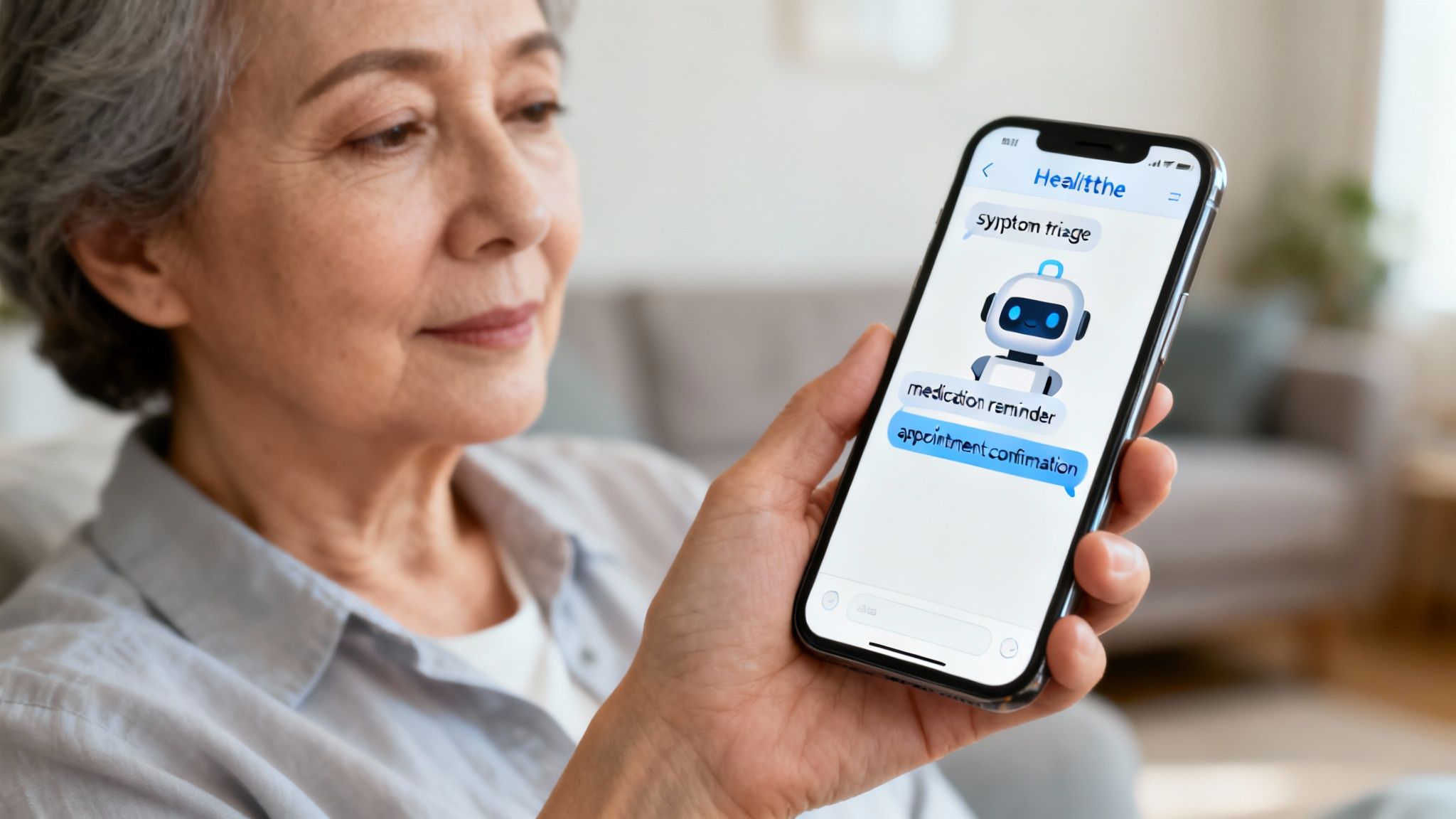
When you get down to brass tacks, chatbots for healthcare are making a huge difference in the day-to-day grind of clinics and hospitals. Think of them as tireless digital assistants, chipping away at the repetitive but critical tasks that eat up so much time for both patients and staff. This isn't about replacing people; it's about freeing them up to focus on what matters most—delivering compassionate, hands-on care.
For patients, the change is immediate. A good chatbot is a direct line to help, available 24/7 without ever putting them on hold. It’s a shift that makes managing their health feel less like a chore and more like a simple conversation.
Making the Patient's Journey Smoother
Picture this: a patient wakes up at 2 AM with a strange new symptom. Instead of panicking, heading to the ER, or waiting hours for the clinic to open, they can open an app and start a conversation. The chatbot guides them through a series of questions to figure out what's going on—a process called symptom triage.
Based on their answers, the bot can suggest a sensible next step, whether that's booking a telehealth call, scheduling an office visit, or offering some solid advice for a minor issue. It's all about getting patients to the right level of care, right away.
But that’s just the start. The support continues across their entire experience.
- 24/7 Appointment Scheduling: Patients can book, change, or cancel appointments whenever it's convenient for them. The bot syncs directly with the clinic’s calendar, so there are no accidental double-bookings.
- Automated Intake Forms: Before an appointment, the chatbot can walk patients through filling out their history, insurance details, and consent forms. No more juggling a clipboard in a crowded waiting room.
- Medication Reminders: For anyone managing a chronic condition, a chatbot can be a lifesaver. It sends friendly pings to remind them to take their meds, check their blood sugar, or do other key health tasks, which dramatically improves how well they stick to their treatment plan.
This kind of steady, reliable support keeps people engaged and turns them into active partners in their own health.
Giving Time Back to Providers and Staff
On the other side of the counter, chatbots are a massive boost to efficiency. They shoulder a lot of the administrative weight that contributes to staff burnout, giving doctors and nurses more time for their clinical work.
A huge chunk of any provider's day is tied up in paperwork and finding information. A chatbot can act as an internal search engine, giving staff instant answers on clinical protocols, billing codes, or hospital policies. A nurse can just ask the chatbot a question instead of digging through a binder or interrupting a colleague.
The key takeaway is that chatbots are brilliant at handling structured, repeatable work. By automating these processes, they create a more organized and less frantic environment for everyone in the clinic.
Improving How the Money Flows
Billing and payments are another area where chatbots are making a real impact. Administrative teams spend countless hours answering the same questions about invoices, processing payments, and checking on insurance coverage.
A chatbot can handle all of that. Patients can ask about their balance, set up a payment plan, or update their insurance info right through the website or patient portal. This doesn't just make things easier for the patient; it helps the practice get paid faster.
The numbers show this isn't just a trend. Healthcare providers are actually leading the charge in adopting this technology. They’re on track to command a 60.8% market share globally as they use AI to sharpen their operations. You can dig into more stats on the growth of healthcare chatbots at Fortune Business Insights.
At the end of the day, chatbots for healthcare aren't just a fancy add-on. They are becoming fundamental to running a modern, efficient, and patient-first practice. It’s a true win-win: patients get faster, more convenient service, and providers get to run a smarter, more effective operation.
Protecting Patient Data is Non-Negotiable
When you bring a chatbot into your healthcare practice, you’re handling far more than a simple customer service query. You're dealing with sensitive, private health information. In medicine, patient trust is everything, and protecting their data isn’t just good practice—it's a legal and ethical imperative. A single data breach can shatter that trust and bring devastating consequences for both your patients and your reputation.
Think of a HIPAA-compliant chatbot as a digital vault, not just a friendly messaging tool. It must be engineered from the ground up to secure Protected Health Information (PHI)—everything from a patient's name and address to their diagnosis and treatment history. You can't just plug in any off-the-shelf chatbot; it needs specific, robust security measures baked into its core.
Every conversation, whether it’s about scheduling a visit or asking about symptoms, has to be completely shielded from prying eyes. The responsibility is immense, and the penalties for getting it wrong are severe, with fines that can climb into the millions.
What HIPAA Compliance Actually Means for a Chatbot
The Health Insurance Portability and Accountability Act (HIPAA) is the law of the land for protecting patient health information. For a chatbot to be considered HIPAA-compliant, it has to clear a high bar of technical and administrative hurdles designed to lock down PHI.
These aren't just suggestions; they're strict rules for any piece of technology that touches patient data. The whole point is to guarantee the confidentiality, integrity, and availability of that data at all times.
Here’s what that looks like in practice:
- End-to-End Encryption: All data must be scrambled both "in transit" (as it travels between a patient's phone and your servers) and "at rest" (while it's stored). This makes the information totally unreadable to anyone without the right digital key.
- Secure Cloud Infrastructure: The chatbot has to live on a secure, HIPAA-compliant hosting environment. Major cloud providers offer specialized, healthcare-grade solutions for this very purpose.
- Strict Access Controls: Only authorized staff should ever see patient data. This means unique user IDs, permissions based on job roles, and automatic logoffs to prevent a screen from being left open.
- Audit Logs: The system must keep a detailed trail of who accessed PHI and when. These logs are your first line of defense if you ever need to investigate a security incident.
The Make-or-Break Role of the Business Associate Agreement
When you hire a chatbot vendor, you’re essentially handing them the keys to your patients' most private information. Under HIPAA, this makes the vendor a "Business Associate." Before a single byte of PHI is shared, you absolutely must have a signed Business Associate Agreement (BAA).
A Business Associate Agreement is a formal, legally binding contract. It forces the chatbot vendor to uphold the same strict data protection standards that you do. It clearly defines their responsibilities for protecting PHI and spells out who is liable if a breach happens.
Without a BAA, your practice is automatically out of compliance with HIPAA. It’s the foundational document for any partnership with a third-party tech provider that will handle patient data. This agreement is your proof that the vendor is as serious about privacy as you are.
How to Vet a Chatbot Vendor
Choosing the right partner is everything. Not all chatbot platforms are built to withstand the security demands of healthcare. Before you even think about signing a contract, you need to ask some tough, direct questions.
Here’s a quick checklist to guide that conversation:
- Will you sign a Business Associate Agreement (BAA)? If they hesitate or say no, the conversation is over. End of story.
- Is all patient data encrypted both in transit and at rest? Don’t just take their word for it. Ask for specifics on their encryption methods.
- Where and how is our data stored? Get confirmation that they use a HIPAA-compliant hosting environment.
- What are your access control policies? You need to know who at their company can access data and under what exact circumstances.
- Can you show us your security audits and certifications? A trustworthy vendor will have no problem being transparent about their compliance efforts.
Taking these steps ensures your chatbot becomes a tool that genuinely helps patients, without ever putting the trust they place in you at risk.
Your Guide to Implementing a Healthcare Chatbot
Bringing a chatbot into your healthcare practice can feel like a huge project, but with the right game plan, it’s far more manageable than you think. The key is to see it as a journey, not just a technical task. And it all starts with one simple question: What's our biggest headache right now?
Pinpointing that one major pain point gives your entire project a clear direction. Before you even think about vendors or technology, you need a specific, measurable goal. Are you trying to free up the 8+ hours your front desk spends on the phone every single day just scheduling appointments? Or maybe your top priority is cutting down on that painful no-show rate that costs you so much.
A successful chatbot project is built on a single, well-defined objective. If you try to solve every problem at once, you'll end up with a tool that doesn't do anything particularly well. Focus on one critical area first, prove its value, and then you can expand.
Laying the Groundwork for a Smooth Launch
Once you’ve locked in your main goal, the next steps start to fall into place. This initial planning stage is where the magic happens—it’s how you pick the right partner and design a chatbot that your patients will actually find helpful.
- Vendor Selection and Vetting: Not all chatbot platforms are built for healthcare. Your number one priority is finding a vendor that is fully HIPAA compliant and ready to sign a Business Associate Agreement (BAA). Beyond that, look for a company with real experience in the medical field and an interface that your non-technical staff won’t be afraid to use.
- Integration Planning: A chatbot that’s disconnected from your other systems isn’t much use. It absolutely has to "talk" to your existing software. You'll need to plan for integrations with your Electronic Health Record (EHR) and scheduling tools. This is what allows the bot to book appointments in real time and securely access the minimum necessary patient data.
- Conversational Flow Design: This is where you put on your patient's hat and map out the entire experience. How should the bot greet someone? What questions does it need to ask to book an appointment or answer a billing question? The aim is to create a conversation that feels natural and empathetic, not like talking to a robot. A huge part of this is knowing how to effectively train a chatbot with your own data so it can provide accurate, relevant answers.
This flowchart breaks down the core principles of keeping patient data safe within a chatbot system, which is non-negotiable for any healthcare implementation.
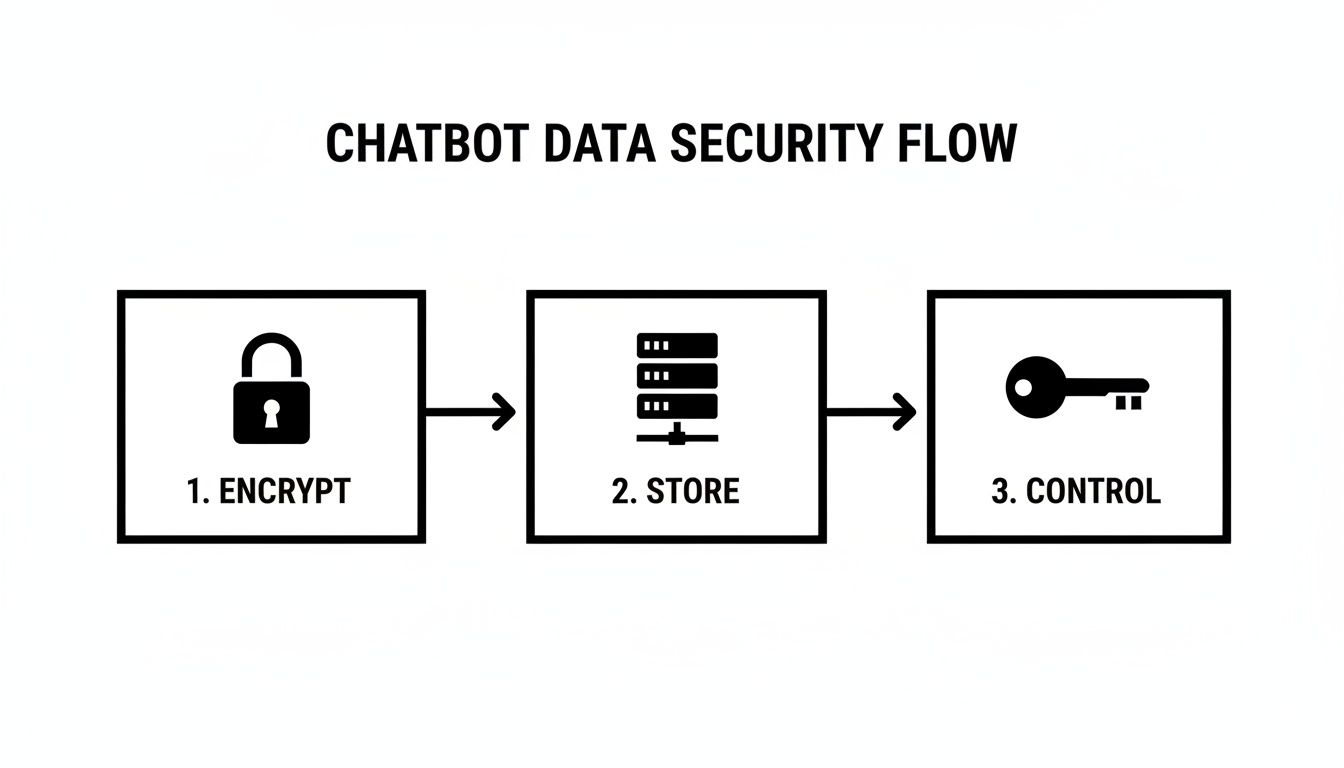
As you can see, the process hinges on encrypting sensitive information, storing it in a secure environment, and tightly controlling who can access it. These are the pillars of a HIPAA-compliant tool.
Executing the Launch and Measuring What Matters
With a solid plan ready, it’s time to move into the build-out and launch. The best way to do this is almost always a phased rollout. Instead of turning the chatbot on for all your patients at once, start with a smaller, controlled group. This gives you a chance to gather feedback, iron out any kinks, and build up confidence before the full-scale launch.
Once you're live, your attention shifts to one thing: measurement. How do you actually know if this thing is working? You track specific Key Performance Indicators (KPIs) that tie directly back to the original goal you set.
Tracking the right numbers is the only way to know if your chatbot is delivering real value. This table outlines the most important metrics to keep an eye on.
Key Metrics for Measuring Chatbot Success
| Metric | What It Measures | Why It's Important |
|---|---|---|
| Task Completion Rate | The percentage of users who successfully complete a goal (e.g., booking an appointment). | This is the clearest sign of whether the chatbot is actually doing its main job effectively. |
| User Satisfaction (CSAT) | Patient happiness with the chatbot interaction, usually captured with a quick post-chat survey. | High satisfaction builds patient trust and encourages them to use your digital tools again. |
| Containment Rate | The percentage of conversations handled entirely by the bot without needing a human to step in. | A high containment rate proves the chatbot is successfully taking work off your staff's plate. |
| Human Takeover Rate | The frequency with which a conversation is escalated from the bot to a live person. | This helps you pinpoint where the chatbot’s knowledge or conversational flow is falling short. |
By focusing on a clear goal, planning your integrations, and measuring the right metrics, you can implement a chatbot that becomes a truly invaluable asset. It’s a tool that not only makes your practice more efficient but also gives the patients who rely on you a better, more accessible experience.
Avoiding Common Chatbot Implementation Traps
Rolling out a new chatbot can be a game-changer, but it’s easy to stumble if you’re not careful. We’ve seen it happen time and again. A well-planned bot becomes a trusted digital assistant, while a poorly executed one just creates more headaches for patients and staff. Let's walk through some of the most common pitfalls and, more importantly, how to sidestep them.
The single biggest mistake? A clunky or confusing user experience. Patients turn to a chatbot for quick, easy answers. If they have to wrestle with a bot that gets stuck in a loop, misunderstands simple questions, or presents a confusing menu of options, they’ll just give up and call you. That completely defeats the purpose.
This often stems from not giving the bot a clear "persona." Your chatbot should have a voice that matches your practice. Is it warm and reassuring? Or more professional and to the point? Nailing this detail makes the conversation feel natural, not robotic.
Forgetting to Plug It In
Another classic misstep is launching a chatbot that’s not connected to your other essential software. A standalone bot that can't see your scheduling calendar or access patient data isn't a tool; it's an isolated information kiosk. It creates more work, not less.
Think about it: a patient uses the bot to book an appointment, but then a staff member has to manually copy that info into the EHR. That’s a recipe for inefficiency and data entry errors. The real magic happens when the bot can talk to your existing systems.
- EHR and Practice Management Systems: Hooking into these lets the bot book appointments directly into your calendar and pull just enough patient info to make the conversation feel personal and relevant.
- Billing Software: A connection here empowers the bot to answer specific questions about patient balances or payment plans, resolving simple financial queries on the spot.
A chatbot that isn't connected to your essential software is like a receptionist without access to the clinic's appointment book. It can greet people, but it can't perform the tasks that actually reduce your team's workload.
The Danger of Overpromising
It’s easy to get swept up in the hype around AI, but promising the world is a fast track to user disappointment. If you launch a chatbot claiming it can "answer any health question," it's going to fail spectacularly when faced with a complex diagnostic query. When that happens, you don't just have a failed interaction—you have a patient who no longer trusts the tool.
The fix is simple: start small and be brutally honest about the bot's limitations.
How to Keep It Real:
- Nail One Thing First: Pick a single, well-defined task and perfect it. Start with something straightforward, like appointment scheduling or answering questions about clinic hours.
- Set Clear Expectations Upfront: Use a welcome message to tell people exactly what the bot can (and can't) do. Something like, "Hi! I can help you book an appointment or check our hours. For any medical advice, you'll need to speak with our nursing staff."
- Always Provide an 'Out': Make it incredibly easy for users to connect with a real person. A clear "talk to a human" button is non-negotiable, especially if the bot gets confused.
By dodging these common implementation traps, you can launch chatbots for healthcare that actually help people and make your practice run smoother. It all comes down to focusing on a great user experience, smart integrations, and setting realistic goals from day one.
The Future of AI in Patient Communication

The journey for chatbots in healthcare has just begun. The tools we have today are really just the first step. We're moving toward a future where AI isn't just a simple helper but a truly sophisticated partner in patient care. The next wave of chatbots will go far beyond basic Q&A, evolving into empathetic, personalized assistants that genuinely understand the subtleties of a health conversation.
Think about an AI that can pick up on emotional cues and context, not just keywords. This change will make talking to a bot feel less like interacting with software and more like getting advice from a knowledgeable guide who's on your side.
Smarter, More Connected Healthcare Assistants
But it's not just about having better conversations. The real magic happens when these tools become more deeply woven into a patient's everyday life. We're starting to see AI merge with other health technologies, which opens the door to a more proactive, holistic way of managing wellness.
Here are a few key trends leading the way:
- Voice-Activated Support: Voice assistants will provide hands-free help, which is a game-changer for older patients or anyone with a disability. They'll be able to get information, set reminders, or contact their doctor without needing to navigate a screen.
- Integration with Wearables: By syncing with health trackers and other IoT devices, chatbots can keep an eye on real-time data like heart rate or blood sugar. This allows them to offer proactive suggestions and personalized advice based on what's happening in that exact moment.
- Generative AI for Deeper Insights: More advanced AI is already starting to generate easy-to-understand educational content, summarize dense medical reports, and offer detailed explanations. This gives patients the power to truly grasp and take control of their own health.
The point isn't to replace doctors or nurses. It's about giving them superpowers—freeing them up from repetitive tasks so they can pour their energy into complex clinical decisions and delivering compassionate, human-to-human care.
A Global Shift in Patient Expectations
Clinicians around the world are already seeing this shift. They expect patients to take a much more active role in managing their own care with these new tools. Interestingly, expectations for how much patients will rely on chatbots vary by region. A striking 56% of clinicians in China see a future where patients lean heavily on chatbots. In Europe and North America, those numbers are 48% and 42% respectively, which still points to a major global trend. You can dig into these findings on clinician expectations at ElectroIQ.
Ultimately, we're working toward a healthcare system that is more responsive, efficient, and built around the patient. The chatbots of tomorrow are going to be a key part of making that vision a reality, acting as dedicated partners in every person's health journey.
Frequently Asked Questions
Even with all the clear benefits, bringing a new piece of technology like a chatbot into a healthcare setting always raises a few questions. That's completely normal. If you run a smaller practice, you need to know the practical ins and outs before you commit.
Let’s walk through some of the most common things we hear from providers. Most questions boil down to a few core concerns: Can I trust it? Will my patients actually use it? And where on earth do I even begin?
How Reliable Are Chatbots for Checking Symptoms?
This is a big one, and it's important to be crystal clear: symptom checkers are triage tools, not diagnostic machines. Think of them as a smart, initial guidepost for patients. Their reliability comes from their ability to point someone in the right direction—whether that means booking a telehealth appointment, advising a trip to urgent care, or suggesting ways to manage minor symptoms at home.
These bots are trained on massive clinical datasets to spot red flags and assess risk, but they aren't replacing a doctor's diagnosis. Their whole job is to provide safe, efficient guidance on what to do next.
Are Patients Comfortable Using a Chatbot for Health Issues?
The answer is a resounding "yes," especially for the basics. When it comes to things like scheduling an appointment or asking for a prescription refill, patients love the 24/7 convenience. The data shows they're very comfortable using a bot for these administrative tasks.
When it comes to more sensitive clinical questions, it all comes down to trust. A well-built chatbot that’s upfront about what it can and can't do, speaks in plain language, and makes data privacy a clear priority will earn that trust. Patient comfort is a direct result of how transparent and reliable the tool feels.
What Is the First Step for a Small Clinic to Get Started?
Start simple. My advice is always the same: find your single biggest administrative bottleneck. What’s that one task that swamps your front desk staff day in and day out? Is it the endless phone calls just to book appointments? Or maybe it's fielding the same handful of questions about insurance or clinic hours over and over.
Pick that one high-volume, low-complexity problem and solve it first. Once you've zeroed in on that, you can look for HIPAA-compliant chatbot providers who know the healthcare space. By starting with a specific, focused goal, you can easily measure the impact, prove the chatbot's value, and then build on that success over time.
Ready to give your patients instant, on-brand answers and free up your staff? BizSage helps you build an AI chatbot trained on your own clinic's information in minutes. Provide 24/7 support, reduce repetitive questions, and improve the patient experience without needing a developer. Start building your smart healthcare assistant today.