
So, what exactly is a chatbot reseller program?
Think of it this way: you’re a fantastic marketing agency, the equivalent of a craft brewery known for its unique recipes and loyal following. You want to start canning your beer to reach more people, but building a canning facility is a massive, expensive headache. Instead, you partner with a top-tier canning company. They handle the complex machinery, and you put your label on the final product.
That's the essence of a chatbot reseller program. It lets your agency offer advanced AI chatbot technology under your own brand, without the astronomical cost and time sink of building it from scratch.
What is a Chatbot Reseller Program, Really?

For a growing agency, a chatbot reseller program is a killer strategic move. It's a way to bolt on a high-demand service that generates recurring revenue, makes your clients stickier, and solves a problem every single one of them has: the need for instant, 24/7 customer engagement.
Instead of burning through years and millions in R&D, you team up with a technology partner. This partnership gives you instant access to a powerful, road-tested platform you can package and sell as if it were your own. You're in complete control of the client relationship, the pricing, and the branding—the provider just keeps the engine running in the background.
And the timing couldn't be better. This market is absolutely exploding. The global AI chatbot market has already hit $7.76 billion and is on track to reach a staggering $27.29 billion by 2030. That’s a compound annual growth rate of 23.3%. For agencies, this is a golden opportunity to grab a piece of the pie during a massive growth wave. If you want to dig deeper, you can find more insights about the AI chatbot business and where it's headed.
Reseller vs. White-Label: What’s the Difference?
People often use the terms "reseller" and "white-label" interchangeably, but they're not the same thing. Nailing down the difference is key to picking the right partnership for your agency.
To put it simply, a standard reseller model is like being an authorized dealer for a car brand. You sell the product, maybe with some co-branding, and you get a commission. It’s a straightforward way to add a service, but your brand will always be sharing the spotlight.
The white-label model is a whole different ballgame. It gives you a much deeper level of brand integration.
A true white-label chatbot reseller program lets you put your brand on everything. Your logo, your name, your colors—from the chat widget on a client's site to the analytics dashboard they log into. The tech provider becomes completely invisible.
This is a game-changer. It positions your agency not just as a company that sells a tool, but as the creator of a sophisticated technology solution. That builds massive authority and trust with your clients.
To make this crystal clear, here’s a quick breakdown of how these two models stack up.
Reseller vs White-Label Models at a Glance
| Feature | Reseller Model | White-Label Model |
|---|---|---|
| Branding | Co-branded or provider-branded. | Fully branded as your agency's product. |
| Client Perception | You are a seller of a third-party tool. | You are the creator of the technology solution. |
| Pricing Control | Often limited to provider's pricing tiers. | Full control to set your own prices and packages. |
| Marketing Materials | Typically provided by the tech partner. | You create your own branded marketing assets. |
| Best For | Agencies wanting a quick, simple add-on service. | Agencies wanting to build brand equity and own the client relationship completely. |
As you can see, the white-label approach offers a far more integrated and powerful way to build your brand while delivering a top-notch service.
Why This is a No-Brainer for Most Agencies
The real beauty of a chatbot reseller program is how it lets you scale efficiently. It completely removes the biggest hurdles that stop agencies from offering advanced AI services.
Here’s why it just works:
- Speed to Market: You can go from zero to launching a sophisticated AI chatbot service in a matter of weeks, not years. This lets you jump on client demand right now.
- Recurring Revenue: Say goodbye to the feast-or-famine cycle of project work. This model builds a stable foundation of monthly recurring revenue (MRR) from subscriptions and management fees.
- Serious Client Stickiness: When you embed a critical piece of technology into a client’s daily operations, you become indispensable. Churn drops dramatically.
- Focus on Your Genius: It lets you and your team do what you do best—strategy, creative, and client relationships—without getting bogged down in software development and bug fixes.
At the end of the day, this model is about smart leverage. You're using a partner’s tech expertise to blow up your service offerings, strengthen your brand, and build a more resilient, profitable agency.
How AI Chatbots Can Fuel Your Agency's Growth and Your Clients' Success
Adding a chatbot service to your agency's menu is about more than just another line item on an invoice. It's a strategic move that fundamentally upgrades your value proposition, shifting you from a simple service vendor to a mission-critical technology partner for your clients. Frankly, this is the key to building a more stable, scalable agency.
When you offer a branded AI solution, you're directly solving some of the most persistent problems your clients face—leads that vanish after business hours, a support team drowning in repetitive questions, and a customer experience that feels inconsistent. This immediately elevates your perceived value and, just as importantly, builds a reliable, recurring revenue stream for you.
At its core, the benefit is escaping the rollercoaster of project-based work. A chatbot reseller program lets you build a solid foundation of monthly recurring revenue (MRR), giving you the financial stability to actually plan for growth instead of just reacting to it.
From Service Provider to Indispensable Partner
Let's be honest: the biggest threat to any agency is churn. When you're only managing SEO or running PPC campaigns, you’re always just one pitch away from being replaced by a competitor promising shinier results for a lower price. But embedding a chatbot into a client's website and daily workflow completely changes that game.
Suddenly, you're not just managing their ads; you're powering their lead generation engine and their front-line customer support, 24/7. The chatbot becomes a vital piece of their business infrastructure, making your agency incredibly difficult to live without. This is how you boost client "stickiness" and watch your churn rate drop.
By integrating AI chat, you weave your agency into the very fabric of your client's business. You become the technology provider they rely on for essential functions, not just the marketing team they hired for a campaign.
This deeper integration also unlocks more strategic conversations. You're no longer just reporting on click-through rates. Now you're discussing lead quality, customer satisfaction scores, and operational efficiency—proving your value on a much more profound level.
Delivering Real, Measurable Results for Clients
Your success as a chatbot reseller all comes down to delivering results you can actually measure. The great thing about AI chatbots is that their impact is direct and easy to see in the data, giving you hard numbers to show a clear return on investment.
Here are a few of the concrete wins you can deliver for your clients:
- 24/7 Lead Capture: That visitor who lands on your client's site at 10 PM on a Saturday? They're no longer a missed opportunity. The chatbot can engage them, qualify their interest, and grab their contact info, turning passive web traffic into real leads around the clock.
- Instant Customer Support: We all expect answers now. A well-trained AI can instantly resolve up to 80% of common customer questions, freeing up the human team to tackle the more complex, high-value conversations.
- Better Conversion Rates: By proactively engaging visitors and guiding them toward the right information or product, chatbots can give website conversion rates a serious lift. Some studies have even shown that engagement with an AI chat can boost conversions by 4x.
To really knock it out of the park for your clients and your agency, it's worth exploring the full range of agency-specific AI use cases to see all the practical ways you can apply these solutions.
The Financial Upside for Your Agency
This is where a chatbot reseller program really starts to look attractive. It creates a powerful and scalable revenue engine built on the gold standard of business growth: recurring income.
Just look at how it changes your agency’s financial picture:
| Revenue Model | Traditional Agency (Project-Based) | Agency with Chatbot Service (Recurring) |
|---|---|---|
| Income Stream | One-time project fees, fluctuating retainers. | Stable monthly subscription and management fees. |
| Cash Flow | Unpredictable; the "feast or famine" cycle is real. | Predictable and consistent, which makes planning easy. |
| Scalability | Limited by your team's billable hours. | Highly scalable; manage more clients with minimal extra work. |
Making this switch to a recurring revenue model provides the solid ground you need to grow. It allows you to invest in new hires, better tools, and marketing with the confidence that comes from knowing exactly what’s coming in each month. This is the path to sustainable, accelerated growth.
Choosing the Right White-Label Chatbot Partner
Picking your technology partner is easily the most critical decision you'll make when you decide to offer chatbot services. It's the difference between launching a profitable, scalable new revenue stream and getting bogged down by a clunky tool that bleeds time and frustrates both you and your clients. Forget the flashy feature lists for a moment; let's talk about what really matters for an agency.
Think of it like choosing the engine for a race car. You don't just grab the one with the most horsepower on paper. You need an engine that’s reliable, that your mechanics find easy to work with, and that integrates perfectly with the car's chassis and electronics. Your chatbot platform is that engine for growth.
What True White-Labeling Looks Like
The term "white-label" gets thrown around a lot, but honestly, many platforms don't deliver what an agency actually needs. A genuine white-label solution makes your brand the star of the show, pushing the technology provider completely into the background. Your client should never even know they exist.
This is so much more than just slapping your logo on a dashboard. It’s about creating a seamless, integrated experience where your agency is seen as the creator and provider of the technology.
Here's what you should demand, no exceptions:
- "Powered by Your Agency" Branding: The chat widget on your client's website must feature your agency's name, not the software company's. This is a non-negotiable for building brand authority.
- Custom Domain (CNAME) Support: You must be able to serve the chatbot from a custom subdomain, like
chat.youragency.com. This reinforces that it's your proprietary solution. - Fully Branded Client Dashboards: Any reports or analytics you share with clients have to feature your logo and branding. It’s about presenting a professional, unified front at every touchpoint.
Anything less is just co-branding. That positions you as a reseller for someone else's tool instead of a true technology partner in your own right.
The Multi-Client Dashboard Is Your Mission Control
For an agency juggling multiple clients, the dashboard is where you'll live and breathe. A poorly designed one turns daily tasks into a total nightmare, while a smart, intuitive one is what allows you to scale efficiently without hiring an army of account managers.
Your multi-client dashboard should be a force multiplier, not a bottleneck. It needs to simplify complexity, allowing you to manage a dozen clients as easily as you manage one.
Look for a centralized hub that lets you toggle between client accounts with a single click. You should get an at-a-glance overview of every client's chatbot performance—conversation volume, leads captured, you name it—without the soul-crushing hassle of logging in and out of separate instances. This is the key to staying profitable as your client roster grows.
Crucial Onboarding and Customization Features
How quickly and easily you can get a new client up and running directly impacts your bottom line. The best partners build their platforms specifically for rapid, agency-led deployment.
A game-changing feature to look for is automated website crawling. The ideal platform lets you just plug in a new client's website URL, and it automatically crawls the site to train the AI on their business. This turns a process that could take days of manual data entry into a simple, automated step that’s done in minutes.
This chart shows the clear path from deciding to offer AI to hitting your most important agency goals.
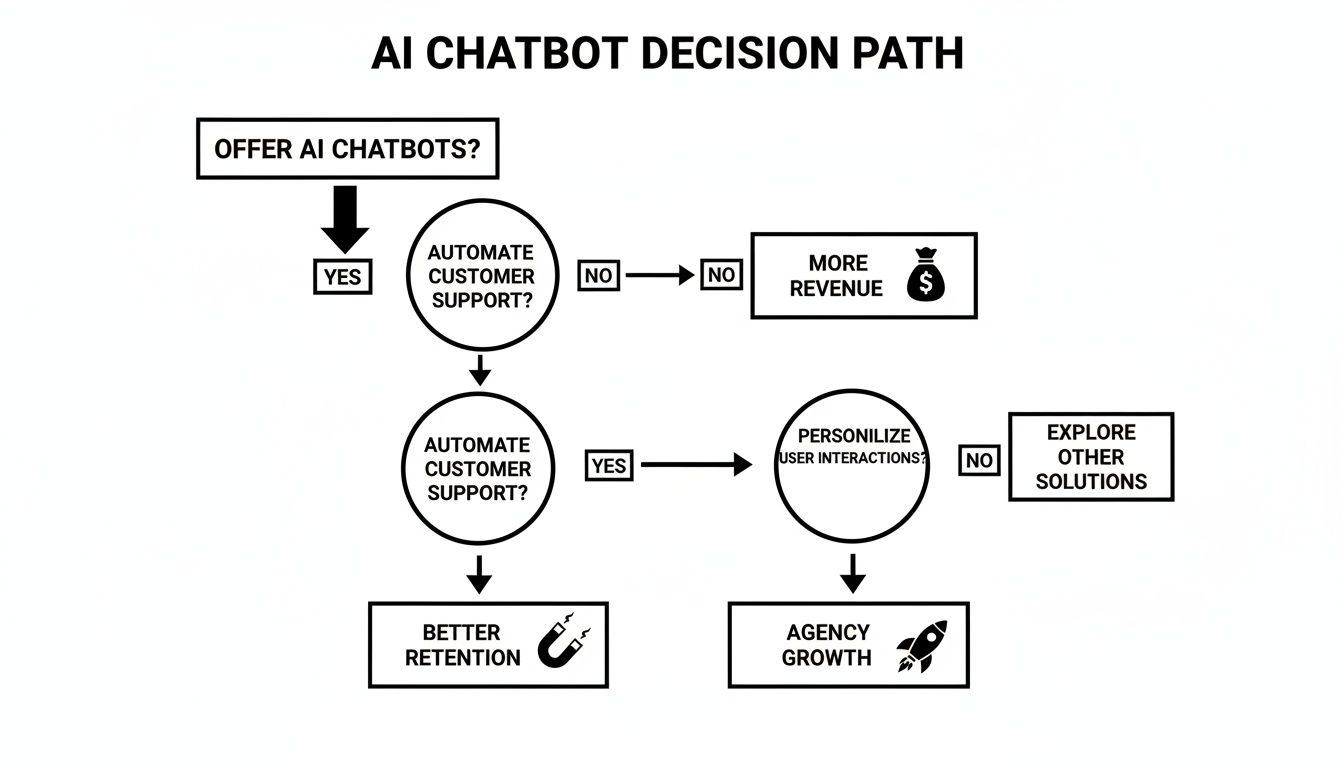
As you can see, offering a branded AI solution directly connects to what we all want: more revenue, better client retention, and sustainable agency growth.
Deep customization options are just as important. You have to be able to match each client's unique brand look and feel without needing a developer. Look for simple but powerful controls that let you:
- Adjust Colors and Fonts: Match the chat widget perfectly to the client's website design.
- Modify Agent Personality: Tune the AI's tone of voice, from straight-laced and professional to friendly and conversational.
- Customize Greetings: Craft proactive welcome messages that align with specific marketing campaigns or the page the user is on.
Lead Capture and CRM Integration are Non-Negotiable
At the end of the day, your clients are paying you for measurable results. A chatbot that just has pleasant conversations is a fun novelty; a chatbot that captures qualified leads is a mission-critical asset.
Your chosen platform absolutely must have robust lead capture capabilities built right into the conversation. This means the AI is smart enough to identify an interested prospect, ask the right qualifying questions, and collect key contact info like names, emails, and phone numbers.
What happens next is even more important. The platform needs seamless CRM integration or, at a minimum, a clean, built-in lead management system. This ensures that every lead the chatbot captures is automatically pushed into the client's sales pipeline. This direct data flow is how you prove ROI, justify your fees, and turn a one-off project into a long-term, high-value partnership.
To help you compare your options, we've put together a checklist of the core features an agency-focused platform should offer.
Essential Features Checklist for Agency-Focused Chatbot Platforms
| Feature Category | Must-Have Capabilities | Why It Matters for Your Agency |
|---|---|---|
| White-Label Branding | Custom domains (CNAME), "Powered by" your agency branding, fully branded client-facing dashboards. | Establishes your agency as the technology provider, building trust and brand equity with your clients. |
| Multi-Client Management | A single dashboard to view and manage all client accounts without separate logins. Global templates. | Drastically reduces your management overhead, making it profitable to scale your client base. |
| Onboarding & Setup | Automated website crawling for initial AI training. Simple, no-code bot building interface. | Slashes client setup time from days to minutes, improving your profit margins on each account. |
| Customization | No-code visual editor for widget colors, fonts, agent personality, and proactive greetings. | Ensures the chatbot feels like a natural extension of your client's brand, not a tacked-on gadget. |
| Lead Capture & Integrations | In-chat lead qualification and data collection. Native or Zapier-based CRM integrations. | Turns the chatbot from a support tool into a lead generation machine, proving clear ROI to clients. |
| Analytics & Reporting | Client-level performance dashboards (conversations, leads, etc.). Exportable, brandable reports. | Allows you to demonstrate value and make data-driven recommendations, strengthening client relationships. |
Use this checklist as you vet potential partners. A platform that ticks all these boxes is one that truly understands the needs of a growing agency.
Building Your Go-to-Market Sales Playbook
Having a great white-label chatbot platform is just the start. The real game-changer is how you bring it to market. A smart go-to-market strategy turns a piece of tech into a solution that clients can't wait to get their hands on. You're not just selling a chatbot; you're selling real business outcomes—more leads, happier customers, and a more efficient operation.
Your entire playbook needs to be built on clear pricing, a sales story that actually resonates, and a solid plan for landing new clients while also growing the ones you already have. Let's get it built.
Nailing Your Pricing and Packaging
Figuring out how to price your new chatbot service can feel a bit paralyzing at first. The trick is to stop thinking about the tech and start focusing on the value you deliver. The goal is to create a few simple tiers that work for different types of clients and make you money. A one-size-fits-all price tag just won't cut it.
Here are three battle-tested models you can adapt for your chatbot reseller program:
- Tiered Monthly Retainers: This is the go-to model for a reason—it’s predictable and scales beautifully. You create a few distinct packages (think Basic, Pro, Enterprise) based on features and usage. A basic plan might handle simple Q&A, while a pro plan could add lead capture that feeds directly into their CRM.
- Setup Fee + Monthly Maintenance: This hybrid approach is perfect for more complex initial builds. You charge a one-time fee to cover the initial strategy, setup, and custom configurations. Then, a smaller monthly fee covers ongoing management, reporting, and tweaks.
- Performance-Based Hybrid: This one is a real killer for clients obsessed with lead generation. You charge a modest base retainer plus a bonus for every qualified lead the chatbot hands over. This model perfectly aligns your success with your client's, making it an incredibly easy sell.
The secret is to price your service based on the problems you’re solving—like capturing leads after hours or cutting down support tickets—not on a laundry list of technical features. This changes the conversation from "How much does it cost?" to "What's the return on this investment?"
Shifting Your Sales Pitch from Tech to Solutions
Your sales pitch should never start with, "So, are you interested in a chatbot?" Instead, try leading with a question like, "Are you losing leads every night after your team goes home?" Frame the conversation around the business headaches they're already dealing with. A chatbot isn't some new gadget; it's the aspirin for their pain.
Try using these kinds of problem-focused talking points to make an instant connection:
- For the Lost Leads Problem: "Our AI agent is on the clock 24/7. It engages every single person who visits your site, making sure you never miss another opportunity—even at 2 AM on a Sunday."
- For Lack of Customer Engagement: "We can instantly answer 80% of your customers' most common questions, which frees up your team to focus on the high-value conversations that actually close deals."
- For Inefficient Operations: "Imagine if your team didn't have to answer the same five questions all day. Our bot handles that, letting them focus on complex issues and proactive outreach."
This approach reframes the chatbot from a line-item expense into an asset that both makes and saves money.
Weaving Chatbots into Your Existing Services
Your current client list is gold. They already know, like, and trust you, which makes the sales process infinitely easier. The key is to make this new chatbot service feel like a natural, seamless extension of the great work you're already doing.
Upselling Your Current Clients
Look for the easy wins first. Who has a ton of website traffic, a sales team that feels overwhelmed, or gets slammed with repetitive support questions? Schedule a "strategy review" and show them how a chatbot will amplify the results you're already getting for them.
Winning New Business
Start baking the chatbot service right into your standard proposals for new clients. Position it as a fundamental part of your digital marketing or web design package, not just a little add-on they can ignore. This instantly makes your agency’s offer feel more complete and results-focused than your competitors'.
If you're looking to bring on new reseller partners, you’ll want a clean way to handle those inquiries. Using a simple Reseller Inquiry Form template can help you manage and vet applications without the back-and-forth emails.
By packaging your chatbot service this way, you make your agency more valuable, create stickier client relationships, and open up a powerful new revenue stream.
Proving Value and Reporting Client ROI

This is where the rubber meets the road. It’s the moment your chatbot service stops being a neat piece of tech and becomes a non-negotiable part of your client's business. To keep clients for the long haul, you have to nail the answer to their big question: "What am I actually getting for what I'm paying you?"
A solid reporting strategy connects the dots, drawing a straight line from the chatbot you manage to your client's bottom line. It's all about getting past the fluffy numbers and zeroing in on what actually grows their business.
Moving Beyond Vanity Metrics
The first thing to do? Ditch the vanity metrics. Sure, stats like "total conversations" or "messages sent" might sound impressive in a big font, but they don't tell the real story. They definitely don't pay your client's bills.
Instead, you need to anchor your reports in business-critical Key Performance Indicators (KPIs). These are the metrics that speak the language of CEOs and marketing directors—revenue, efficiency, and growth. Your whole goal is to prove the chatbot isn't a cost but a powerful engine for making money.
To get there, your reporting has to spotlight real-world results:
- Qualified Leads Captured: The number of actual, legitimate prospects whose contact info the chatbot snagged.
- Appointments Booked: For any service business, this is a killer metric. It shows the bot is directly filling up the sales calendar.
- Chat-to-Conversion Rate: This percentage proves how many chats turned into a meaningful action, like a completed form or a direct sale.
- Customer Support Cost Reduction: You can estimate the hours saved by the bot handling routine questions that a human would otherwise have to answer.
When you focus on these KPIs, the conversation shifts from what the chatbot did to what it achieved.
Leveraging Dashboards for Clear Reporting
The best white-label chatbot platforms are built for agencies and come with dashboards that make reporting almost effortless. Think of these tools as your command center for tracking every client's success—they're absolutely essential for any scalable chatbot reseller program.
Your partner's platform should let you generate clean, visual, and brandable reports that you can send right over to your clients. Look for a built-in dashboard that pulls all the most important data into a format that’s easy to understand at a glance.
An effective report tells a story with data. It should visually guide your client from the chatbot's activity to the positive impact on their business, making the value of your service immediately obvious.
A great dashboard will not only show you captured leads and conversation outcomes but will also integrate with the client’s CRM. This is huge, as it lets you track how those chatbot leads are moving through the sales funnel, proving end-to-end ROI.
Building a Compelling ROI Narrative
Data is powerful, but the story you tell with it is what truly sells your value. Don't just email over a report and call it a day. Build a narrative around the numbers that ties back to your client's specific goals.
For instance, when you report on captured leads, you can point out how many of those leads came in after hours—prospects that would have been completely lost otherwise. Now you're not just showing numbers; you're showing undeniable value.
The data backs this up in a big way. Shoppers who use AI chatbots convert at 12.3%, a massive jump from the 3.1% for those who don't. That’s nearly a 4x increase. These customers also finish their purchases 47% faster. It gets better: returning customers who use AI chat spend 25% more, and smart recommendations from a bot can boost conversion rates by an average of 26%. You can dig into more of these powerful chatbot statistics to see just how big the impact can be.
This data-driven approach gives you the confidence to justify your fees and prove your worth, turning one-off clients into long-term partners who can't imagine their business without you.
Common Questions About Chatbot Reseller Programs
Stepping into the world of chatbot reselling is a big move, and it's smart to have questions. Let's walk through some of the most common things agency owners ask, so you can get the clear, straightforward answers you need to move forward.
How Much Technical Skill Do We Actually Need?
This is probably the number one concern for most agencies, and thankfully, the answer is a good one. You absolutely do not need a team of developers to get a sophisticated AI chatbot service off the ground for your clients.
Modern platforms built for agencies are designed to be low-code or even no-code. The heavy lifting is done for you. For instance, onboarding a new client should be as simple as pasting in their website URL. The system should then be able to crawl the site and train a baseline AI agent in a matter of minutes.
The whole point of a top-tier chatbot reseller program is to empower the team you already have—your account managers, marketers, and strategists. They should be able to handle everything from changing the bot's color and personality to adding new information through a simple dashboard, using clicks and text boxes, not code.
This approach means you can focus on what you do best: client strategy and driving results, instead of getting tangled up in software development.
How Should I Price This for My Clients?
Pricing is always a tricky one, and there isn't a single magic number. Your best bet is to find a model that fits your agency's style and what your clients are looking for. The key is to always anchor your price to the value you’re delivering—like the new leads you’re capturing or the time you're saving their team—not just the cost of the tool itself.
Here are a few proven pricing models that work well in the real world:
- Tiered Monthly Retainers: This is a classic for a reason. You can create simple packages like 'Basic,' 'Pro,' and 'Enterprise.' The basic tier might just be a Q&A bot, while the pro tier adds lead capture forms and CRM integration, and the enterprise tier throws in advanced customizations and dedicated support.
- One-Time Setup Fee + Monthly Management: This hybrid approach is great when there's more work involved upfront. You charge a one-time fee to cover the initial strategy, AI training, and design. After that, a smaller monthly retainer covers ongoing monitoring, reporting, and fine-tuning.
- Performance-Based Hybrid: For clients who are all about lead generation, this model is a home run. You combine a base monthly fee with a bonus for every qualified lead the chatbot brings in. This ties your success directly to your client's, making it an incredibly easy sell.
What Does “White-Label” Really Mean?
You’ll hear the term "white-label" thrown around a lot, but its true meaning is make-or-break for your agency's brand. A genuine white-label solution means the technology provider is completely invisible to your client. The entire experience is branded as yours.
It’s about way more than just slapping your logo on a report. When you're looking at a chatbot reseller program, these are the non-negotiable features of true white-labeling:
- "Powered by [Your Agency Name]" Branding: The chat widget itself, sitting on your client’s website, has to show your agency's name. This is the most visible piece of the puzzle.
- Custom Domain (CNAME) Support: You need the ability to serve the chatbot from a custom subdomain you control, like
chat.yourclient.com. This makes it look and feel like your own in-house tech. - Fully Branded Client-Facing Assets: Any dashboard, report, or email notification your client sees must have your agency's branding, with zero mention of the software company behind it.
At the end of the day, it's about presenting a polished, professional service that looks like it came straight from your team. This stops clients from trying to cut you out and go directly to the source, cementing your role as their essential partner.
Ready to add a powerful, client-trained AI agent service to your agency's offerings? BizSage provides a true white-label platform designed for agencies to deploy, manage, and scale AI chat across all their clients from a single dashboard. Launch your first client in minutes at https://bizsage.io.