
When people talk about “ChatGPT companies,” they’re not talking about just one type of business. Instead, it’s a whole ecosystem of different partners—from the folks who create the core technology to the platforms that make it easy to use and the experts who fit it perfectly into your business.
So, What Are ChatGPT Companies, Really?
Let's use an analogy. Think of the powerful AI models from companies like OpenAI as a high-performance car engine. It has incredible potential, but an engine sitting on its own can't really take you anywhere. This is where the world of ChatGPT companies steps in, forming a kind of supply chain that turns that raw AI power into a tool you can actually use.
Some of these companies are the engine manufacturers, focusing purely on building and refining these massive foundational models. Others are more like car factories; they take that engine and build a complete, ready-to-drive vehicle around it. This is where platforms like BizSage fit in, offering user-friendly dashboards that let you build a custom AI agent without needing a degree in computer science.
Then you have a third group: the custom mod shops and expert driving instructors. These are the agencies, consultants, and developers who either show you the best way to use the technology or build a completely bespoke solution, integrating the AI engine directly into your unique business operations.
Understanding the Different Players
Each type of company plays a different role, and knowing the difference is the first step to finding the right partner for your specific needs and technical comfort level.
- Core Technology Providers: These are the research powerhouses building the foundational AI models that everything else runs on.
- AI Platform Providers: They offer no-code or low-code tools that make it simple to create things like customer service bots, internal knowledge bases, or agents that help with lead generation.
- Integration and Development Partners: These are the technical specialists. They’re the ones who can connect AI into your CRM, ERP, or other essential software.
- Consulting and Strategy Agencies: These firms operate at a higher level, helping you create an AI roadmap and pinpointing the best opportunities for automation and growth across your entire organization.
The real goal here is to cut through the buzz and see these companies for what they truly are: specialized partners ready to solve specific business problems. Your job is simply to match your problem with the right kind of partner.
Framing it this way helps you get clear on what you actually need. Are you just looking for a straightforward tool to answer customer questions? Or do you need a completely custom solution built from the ground up for a proprietary workflow?
The technology is clearly resonating. A staggering 92% of Fortune 500 companies are already using ChatGPT in some capacity. For smaller businesses, this is a huge signal—it confirms both a massive market demand for AI-driven tools and a proven technological foundation to build on. You can discover more insights about the enterprise adoption of AI in recent reports.
The Three Main Types Of AI Partners
Navigating the world of AI gets a lot easier once you realize that not all "ChatGPT companies" are created equal. They generally fall into one of three buckets, each one suited for a different business need, budget, and level of in-house technical skill. Figuring out which type you need is the first step to getting the right help without overcomplicating things or overspending.
Think of it like building a house. You could buy a high-quality prefabricated home that's practically move-in ready. You could hire a general contractor to build a custom home from a set of blueprints. Or, you could bring in an architect to design a master plan for an entire neighborhood. Each approach works, but they solve very different problems.
This visual gives you a bird's-eye view of how these partners fit into the bigger AI picture, from the core technology itself to the services that put it to work.
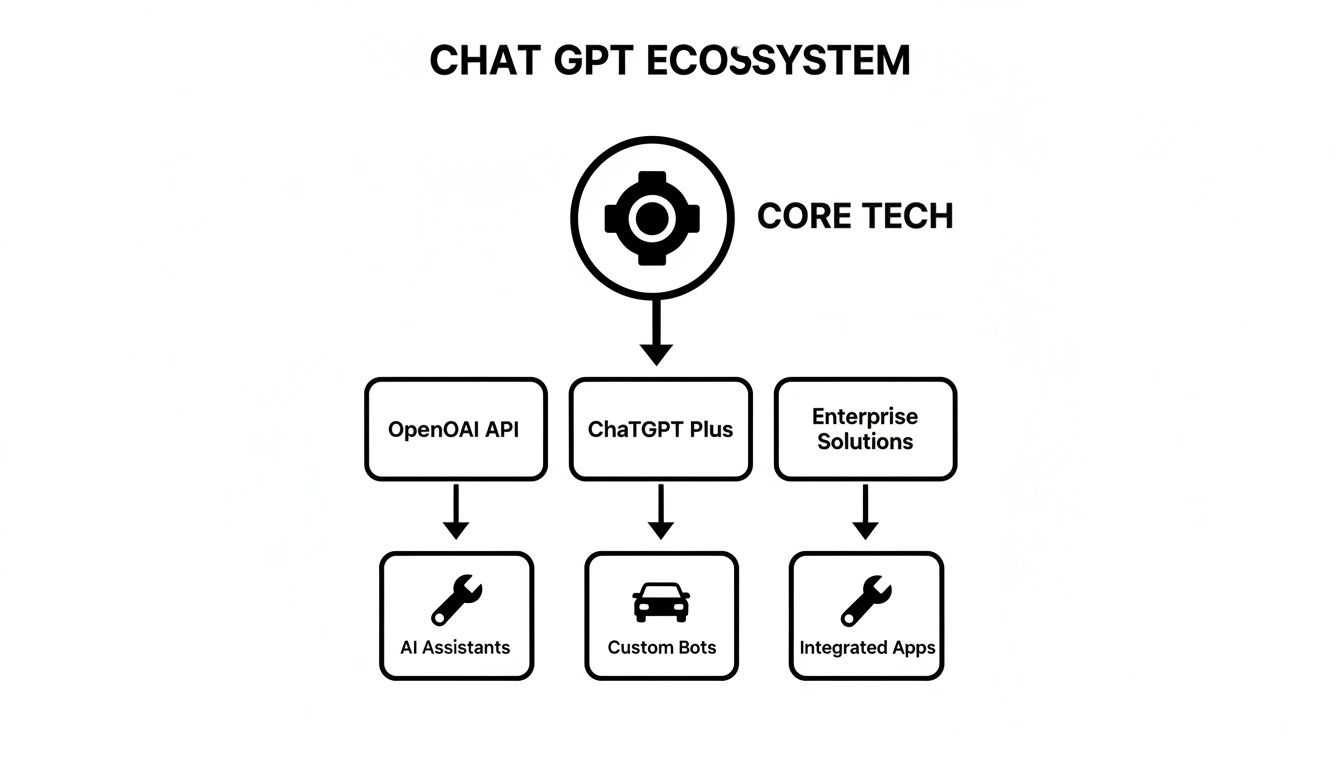
As you can see, the foundational tech from companies like OpenAI enables platforms, which are then implemented and scaled with the help of specialized partners.
AI Platform Providers
First, you have AI platform providers. These companies offer ready-to-go tools—often with no-code or low-code interfaces—that wrap the power of models like GPT into an accessible package. Platforms such as BizSage are the "prefabricated homes" in our analogy.
They’re perfect for businesses that want a fast, affordable, and effective solution without having to hire a team of developers. You can get a custom chatbot for your support team or an internal knowledge base up and running in a matter of minutes, not months. The entire focus is on ease of use and immediate business value.
Integration and Development Partners
Next up are the integration and development partners. These are your custom home builders. Think of them as technical agencies or specialized freelance developers who are experts at wiring AI directly into your existing software and business processes.
If you need to hook up a large language model to your company's CRM, build a one-of-a-kind feature for your mobile app, or automate a really specific internal workflow, these are the folks you call. This route demands a larger budget and more hands-on involvement, but the trade-off is total control and customization.
Consulting and Strategy Agencies
Finally, there are consulting and strategy agencies. These partners are the architects who help you draw up the grand plans. They don't usually build the tools themselves; instead, they help you pinpoint where AI can have the biggest impact across your entire organization.
They tackle the big-picture questions, like, "How can we use AI to cut our operational costs by 15%?" or "What should our three-year AI roadmap look like?" This kind of partnership is best for larger companies that need a solid, long-term strategy before they start making major investments in technology.
The right partner depends entirely on your immediate goal. Are you solving a specific, immediate problem like reducing support tickets, or are you planning a company-wide operational shift?
To help you decide, this table breaks down the core differences between these partners to help you choose the right one for your project.
Comparing Chat GPT Company Types
| Provider Type | Best For | Technical Skill Required | Speed to Deploy | Typical Cost |
|---|---|---|---|---|
| AI Platform | Small businesses, support teams, quick deployment | Low (No code required) | Hours to Days | $$ |
| Integrator/Developer | Custom software integration, unique features | High (Requires development) | Weeks to Months | $$$$ |
| Consulting Agency | Enterprise-level strategy, roadmapping | Varies (Strategic focus) | Months to Quarters | $$$$$ |
Ultimately, whether you need a ready-made tool, a custom-built solution, or a strategic blueprint will point you to the right type of partner.
Evaluating Features That Actually Matter
When you start comparing different ChatGPT companies, it’s easy to get lost in a sea of technical specs and marketing hype. A long list of features might look impressive, but only a handful of them will actually determine if an AI tool solves your problems or just creates new ones.
Think of it like buying a car. You could get bogged down in every minor detail, or you can zero in on what really counts: engine reliability, safety ratings, and how it feels to drive. For a business AI, the equivalents are how it learns, how it sounds, and whether it tells the truth.
Knowledge Source Integration
First up, and arguably the most important, is knowledge source integration. This is all about how the AI learns your business. A truly powerful platform will let you train your AI agent exclusively on your own content—your website, help articles, product manuals, and internal documents.
This is the bedrock of an accurate, helpful bot. If the AI can't learn from your specific information, it’s just a generic tool taking its best guess. It’s the difference between hiring a specialist who has studied your company inside and out versus asking a stranger on the street for advice.
A great AI partner puts you in the driver's seat of the bot's brain. If the AI can’t learn directly from your trusted content, it can't give reliable answers to your customers or your team.
On-Brand Customization and Tone
Next, you need on-brand customization. Your AI agent should feel like a natural extension of your team, not some generic robot. Is your brand voice friendly and casual, or more formal and professional? A good platform lets you define this personality.
This ensures a consistent experience everywhere a customer interacts with you. It prevents that jarring shift from your carefully crafted website copy to a conversation with a bot that sounds completely off-key. You're aiming for a seamless interaction that reflects your company's personality.
Accuracy and Hallucination Control
Finally, we have the most critical feature of all: accuracy and hallucination control. An AI "hallucination" is when the model confidently makes up an answer. This is a massive risk for any business, as it can instantly destroy customer trust and spread bad information.
The best platforms have built-in safeguards to stop this from happening. They force the AI to stick strictly to the knowledge sources you provided. Crucially, they also teach it to say "I don't know" when it can't find a verified answer. This is a non-negotiable for protecting your credibility.
While ChatGPT itself commands a huge 60.6% to 81% of the AI chatbot market, its popularity also shines a light on the need for specialized business solutions. General models are impressive, but platforms built for commercial use offer the specific controls over branding, data, and accuracy that companies absolutely need. You can explore more statistics on the AI market to see just how fast this space is moving.
By focusing on these three core features, you can find a partner that delivers real, measurable results instead of just a list of bells and whistles.
How Businesses Win With Custom AI Agents

The real magic of working with ChatGPT companies isn't the tech itself—it's what that tech actually does for a business. Let's shift from talking about abstract features to looking at the concrete impact: saving time, cutting costs, and sparking real growth.
Think about a typical e-commerce store. The support team gets hammered with the same questions all day: "Where's my order?" and "How do I make a return?" By setting up a custom AI trained on shipping policies and the order tracking system, a business can automate up to 70% of these routine questions. Suddenly, your support staff is free to tackle the tricky, high-stakes customer problems that truly need a human touch.
Automating Support and Qualifying Leads
Here's another great example. A B2B services firm puts an AI agent on its website. It doesn't just sit there waiting for someone to click. This bot engages visitors 24/7, answering detailed questions about the company's offerings, qualifying them against key criteria, and even scheduling demos right on a sales rep's calendar.
Just like that, the website goes from being a static digital brochure to a tireless sales development machine. The bot does all the initial heavy lifting, so the sales team can focus their energy on conversations with prospects who are genuinely interested and well-informed.
And this isn't just for customer-facing tasks. The ripple effect of AI in marketing for B2B is changing how companies operate from the inside out, helping with everything from creating content to analyzing campaign data.
Creating an Internal Company Brain
Imagine a company that's growing so fast it can barely keep up with onboarding new hires. Every new employee has a million questions about internal processes, benefits, and company policies, constantly pulling senior staff away from their actual jobs.
The solution? They build an internal "Company Brain." It's an AI agent fed with all their internal documents, employee handbooks, and knowledge bases.
Now, new hires have a go-to source for instant, accurate answers. This slashes onboarding time, minimizes interruptions, and helps people become self-sufficient from day one. It fosters a more productive and empowered workforce.
These examples all point to the same conclusion. AI chatbots are making a significant economic dent across industries. The travel and hospitality sector sees 18% of customers influenced by ChatGPT recommendations, with retail right behind at 16%. For any business still on the fence, the message is clear: customers now expect quick, conversational ways to get help and find information.
Your Actionable AI Partner Checklist
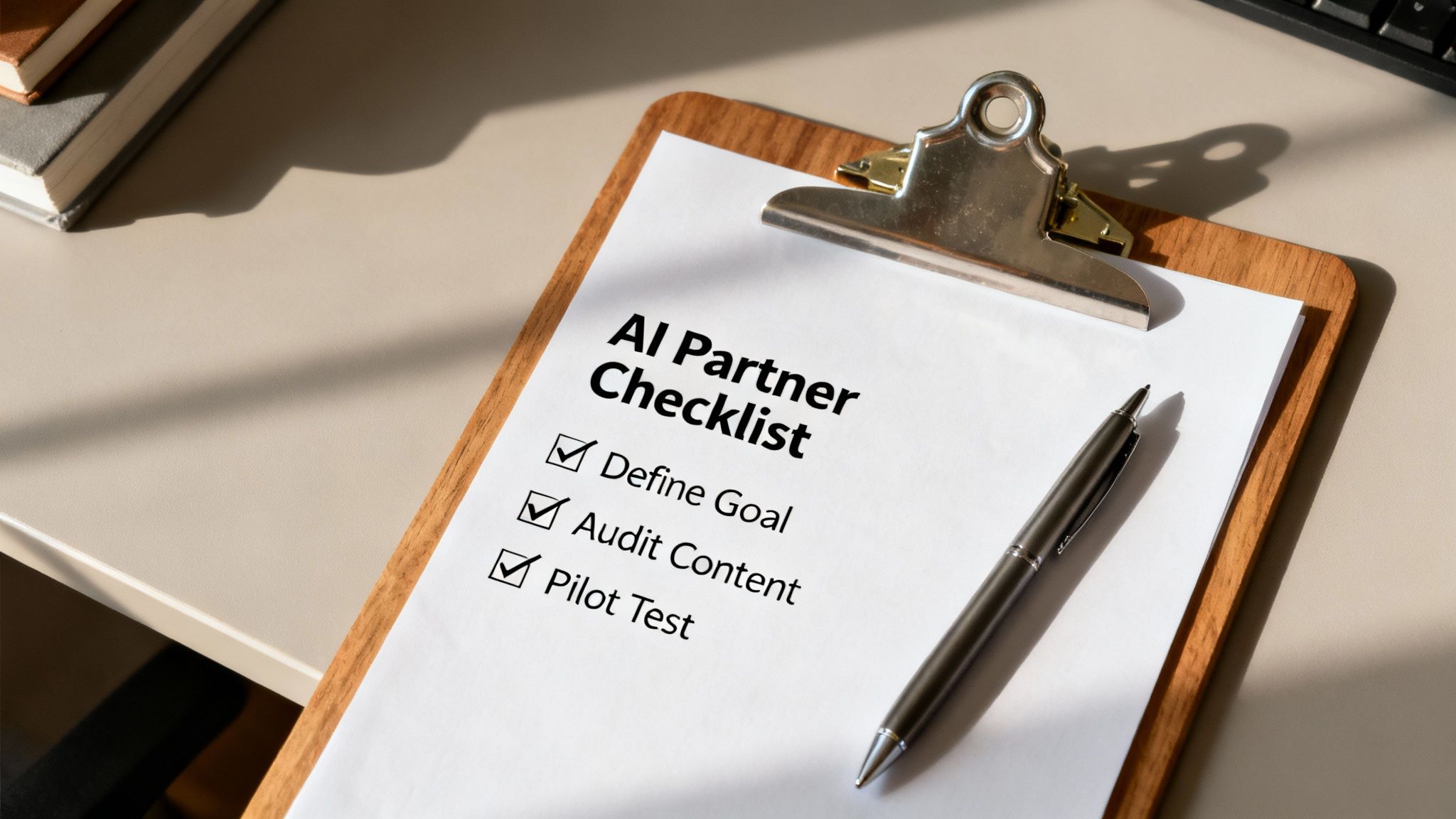
Alright, you've done the research. Now it's time to actually pick a partner. With so many chat gpt companies out there, it’s easy to get lost in a sea of marketing promises. This checklist will help you cut through the noise and make a smart decision for your business.
Having a clear process isn't just about ticking boxes; it's about avoiding guesswork. Follow these steps, and you’ll find a solution that lines up with what you actually need, not just what a salesperson thinks you need.
Define Your Number One Goal
First things first: what are you really trying to accomplish? Before you even glance at a feature list, you need to know the one core problem you expect this AI to solve. If your goal is vague, your results will be, too.
So, get specific. Is the main objective to reduce support ticket volume by 25%? Or maybe you want to qualify inbound leads 24/7 so your sales team can focus on closing deals. This single, measurable goal acts as your compass, pointing you toward the right choice every step of the way.
Audit Your Existing Knowledge Base
Any AI is only as good as the information it learns from. So, the next step is to take an honest look at your current content. Is your knowledge base accurate? Up-to-date? Even remotely organized?
A powerful AI can certainly make sense of a slightly messy library of documents, but it can’t magically correct wrong information. The whole point of this audit is to make sure your source material—your website, help articles, internal wikis—is reliable. You might find everything is good to go, or you might realize a little spring cleaning is in order before you bring an AI into the mix.
Think of your knowledge base as the curriculum for your new AI employee. If the textbooks are outdated or full of errors, you can’t expect the student to graduate with honors.
Vet Data Privacy and Security Policies
This one is a deal-breaker. You absolutely have to know how a potential partner will handle your data. Will your company's private information be used to train their general models for other customers, or will it be kept in a secure, isolated environment?
Dig into their privacy policies and look for explicit guarantees of data isolation. For any business that handles customer data, this is a massive point of trust. Choosing a company that takes security seriously protects your business and your customers, keeping sensitive information locked down.
Run a Small Pilot Test
Finally, don't ever sign a long-term contract without a test drive. The best way to evaluate any of the chat gpt companies is to see their tech work with your own content and your own team.
Ask for a trial and set up a small, controlled pilot. Feed the AI a specific chunk of your knowledge base, like the FAQs for one product line. Then, get your team to try and break it. Ask it the tough, weird, and obscure questions you get every day. This real-world test will reveal more about a platform’s true capabilities than any polished sales demo ever could.
Making Sense Of Pricing And Data Security
Before you shake hands with any AI partner, you need to get crystal clear on two things that can make or break the entire venture: how you'll pay for it and how they'll protect your data. Honestly, these are just as critical as any flashy feature, because they hit your budget and your company's reputation directly.
First up, let’s talk money. The pricing models for chat gpt companies are all over the map, and surprise costs are a classic trap. Some vendors will charge you based on usage—think per message or per API call. This can sound great for flexibility, but it's a recipe for unpredictable monthly bills, especially if your new AI tool really takes off.
Other companies, like BizSage, go with a flat-rate subscription. This gives you budget certainty, which is a huge relief. You pay a predictable fee for a specific service tier, which usually comes with plenty of breathing room on messages and users. For most small businesses, this model is far easier to manage and forecast.
Data Privacy: The Non-Negotiable
Just as important as the price tag is data security. Not every AI platform is built with the robust privacy a business needs. A public-facing tool might treat your conversations and uploaded files as training material for its general models, which puts your sensitive information at risk. It’s a gamble most businesses can't afford to take.
A secure, private platform guarantees that your data is yours alone. It’s used exclusively to power your AI agent and is never shared or used for external model training. This distinction is the bedrock of trust between you and your AI provider.
For any business working with a ChatGPT company, getting a handle on data security is essential. A major part of that is understanding what SOC 2 compliance entails, which is a gold standard signaling a vendor's dedication to protecting client data. You should always look for providers who are transparent about their security protocols.
Ultimately, this ensures your customer lists, internal strategies, and trade secrets stay completely confidential. You get peace of mind knowing your "company brain" is locked in a secure vault, not sitting on a shelf in a public library.
Answering Your Questions About ChatGPT Companies
Jumping into the world of AI partners can feel a bit overwhelming, and it's natural to have questions. Let's tackle some of the most common ones we hear from businesses just like yours.
Do I Need to Be a Tech Expert to Use This?
That really depends on the path you take. Some solutions, like platforms such as BizSage, are built from the ground up for non-technical folks. They give you all the tools to build and launch a chatbot without ever touching a line of code.
On the other hand, if you're looking for a deep, custom integration that hooks into your company's unique software, you'll probably need to work with a development partner. That kind of project is a team sport and will require some technical know-how on your end.
How Can I Make Sure the AI's Answers Are Accurate and Sound Like Us?
The key here is control. The best partners give you the power to dictate exactly what your AI knows. You should be able to train it exclusively on your own trusted content—think your website, knowledge base articles, and internal documents.
Look for platforms that let you define a specific tone of voice. Even better are the ones with built-in guardrails that force the bot to admit when it doesn't know an answer, rather than taking a wild guess. That's how you protect your brand's reputation.
Is My Company's Data Safe?
This should be at the top of your list of questions for any potential partner. Any reputable, business-first AI provider will have ironclad data privacy policies and robust security measures.
Unlike the public AI tools that might use your conversations to train their models, a professional platform should promise that your data stays your data. It should be private, secure, and used for one thing only: powering your chatbot. Always dig into a provider's security and privacy policies before you sign anything.
Ready to put an AI agent to work that delivers on-brand answers around the clock? With BizSage, you can transform your company content into a chatbot you can trust in just a few minutes—no developers needed. Start your free trial today.