
Think about your small business going head-to-head with the giants in your industry. Now imagine you could do it not just by working harder, but by working smarter. That's the promise of AI for small businesses today. It's no longer a far-off, complicated technology for massive corporations; it’s a practical, affordable tool that can seriously level the playing field.
Your AI Advantage: How Small Businesses Win Big

If you've heard all the buzz about artificial intelligence and wondered how it could possibly fit into your day-to-day, you're in good company. Many entrepreneurs assume AI is a high-tech luxury reserved for companies with bottomless budgets. The reality is, it's quickly becoming a fundamental part of the modern small business toolkit, helping owners save time and compete like never before.
Forget the sci-fi robots. Think of AI more like a super-efficient new hire you can train in minutes. This digital assistant can handle repetitive customer questions, give your sales team instant info, and organize all your company knowledge, working 24/7. It frees up your actual people to focus on the work that truly matters. This is why AI adoption is skyrocketing among small businesses—it delivers real, tangible results.
Transforming How You Work and How Customers See You
The real magic of AI for a small business is its ability to automate the mundane and deliver amazing experiences, even when you're stretched thin. Instead of your team answering the same five questions over and over, an AI agent can step in and provide instant, on-brand answers anytime, day or night.
This guide is designed to cut through the noise and show you exactly how to put AI to work for immediate impact. We'll walk through how to:
- Automate Customer Support: Instantly resolve common questions, slash your support ticket volume, and keep customers happy.
- Supercharge Your Sales Team: Give prospects product details and capture new leads around the clock, long after you've closed for the day.
- Build a Company Brain: Create one central, reliable source of truth where your team can find consistent, up-to-date answers in seconds.
By automating routine processes, AI gives small business owners back their most valuable resource: time. This allows them to focus on strategic growth, innovation, and building meaningful customer relationships rather than getting stuck in day-to-day operational tasks.
The goal here is to take this seemingly intimidating technology and turn it from a buzzword into your secret weapon. With accessible platforms like BizSage, you can launch a powerful AI assistant without any technical skills, giving your business the edge it needs to thrive.
Putting AI to Work: 4 High-Value Ways to Get Started
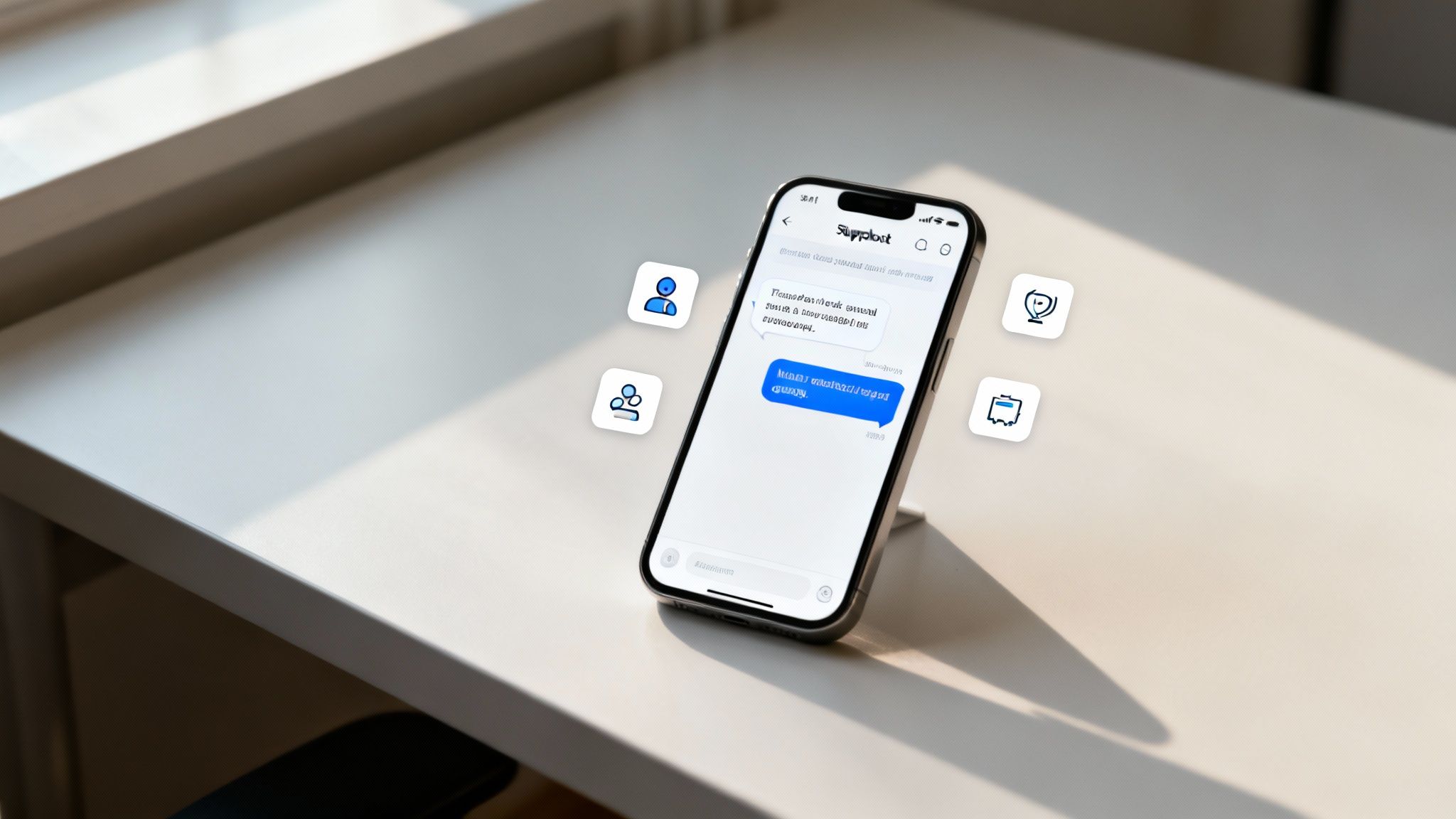
Knowing what AI is is one thing. Seeing it solve real-world problems is where the lightbulb really goes on. For small businesses, the best AI applications are the ones that tackle your biggest constraints: not enough time and not enough people. Think of AI as a force multiplier, letting your small team accomplish so much more.
Let's get practical and look at four high-impact areas where AI for small businesses is already making a huge difference. These aren't futuristic ideas—they're proven strategies you can put to work right now to smooth out your operations, capture more opportunities, and make everything just work better.
High-Impact AI Applications for Small Businesses
Here's a quick look at how these four key areas translate into real business results. Each one addresses a common pain point for growing companies by turning repetitive work over to AI, freeing up your team for what they do best.
| Use Case | Problem Solved | Key Outcome |
|---|---|---|
| Instant Customer Support | Repetitive customer questions overwhelm your team and lead to slow response times. | Frees up support staff, provides 24/7 answers, and improves customer satisfaction. |
| Sales Enablement | Potential leads are lost overnight or when your sales team is busy with other tasks. | Engages every website visitor instantly, qualifies leads, and fills the sales pipeline. |
| Internal Knowledge Base | Team members waste time searching for documents or asking colleagues for basic information. | Creates a single source of truth, speeds up onboarding, and reduces internal interruptions. |
| Marketing Automation | Maintaining consistent, on-brand messaging across all channels is a manual, time-consuming effort. | Ensures brand consistency, personalizes communication, and automates follow-ups at scale. |
As you can see, the goal isn't just to add technology for technology's sake. It's about solving specific, costly problems that hold your business back. Let’s dive deeper into each one.
1. Give Your Customers Instant Support
Imagine your support team wasn't constantly tied up answering the same handful of questions—"What are your hours?" "What's your return policy?" "Where's my order?" This is one of the quickest wins with AI.
An AI-powered chatbot, trained on your own company’s information, becomes your first line of defense. It works around the clock, giving customers instant, accurate answers. In many cases, it can resolve over 70% of those routine support tickets before they ever need a human. This lets your actual support staff focus their energy on the complex, sensitive issues where their expertise truly matters.
2. Turn Your Website into a 24/7 Sales Assistant
Your website is always open, but what happens when a potential customer has a question at 10 PM? In the past, you'd just have to hope they'd come back. With an AI sales assistant, you never have to miss that opportunity again.
This AI can be trained on your product details, pricing, and what makes you different from the competition. When a visitor starts asking questions, the AI can:
- Answer specific product questions on the spot, using your brand's voice.
- Qualify the lead by asking smart questions to figure out what they need.
- Capture their contact info or even schedule a follow-up call for your sales team.
By engaging people immediately, you create a much better first impression and keep your sales pipeline full, even when you’re not in the office.
3. Build an Internal "Company Brain"
How much of your team's day is lost to a new hire asking where to find a document or a veteran employee trying to remember the latest policy update? An internal AI knowledge base—your own "Company Brain"—solves this by creating a single, reliable source for all company information.
The point isn't to replace people; it's to make them better at their jobs. In fact, 81% of small business owners using AI say it enhances their team's work, letting them focus on more important things.
You simply feed the AI all of your internal documentation: HR policies, onboarding guides, project templates, best practices—everything. From then on, anyone on the team can just ask a question and get an immediate, correct answer. It makes onboarding faster and cuts down on all those little interruptions that kill productivity.
4. Put Your Marketing on Autopilot
Keeping your brand's message consistent across every email, social media post, and website chat is tough for a small team. AI can help automate and personalize your marketing at scale, making sure every customer interaction feels relevant and stays perfectly on-brand.
Small business owners are incredibly optimistic about this. A recent survey showed that 81% see AI as essential to their growth in the next five years. For those already using it, 94% are seeing positive results, with 85% pointing directly to better efficiency and productivity. You can dive into more of these findings on small business growth and AI on goldmansachs.com.
For example, an AI can send personalized email follow-ups based on what a customer looked at on your site. It can also make sure the answers it gives on social media align perfectly with the information in your official help center. This kind of consistency builds trust and lets your marketing folks get back to creative, strategic work instead of getting bogged down in repetitive tasks.
Your Step-by-Step AI Implementation Roadmap
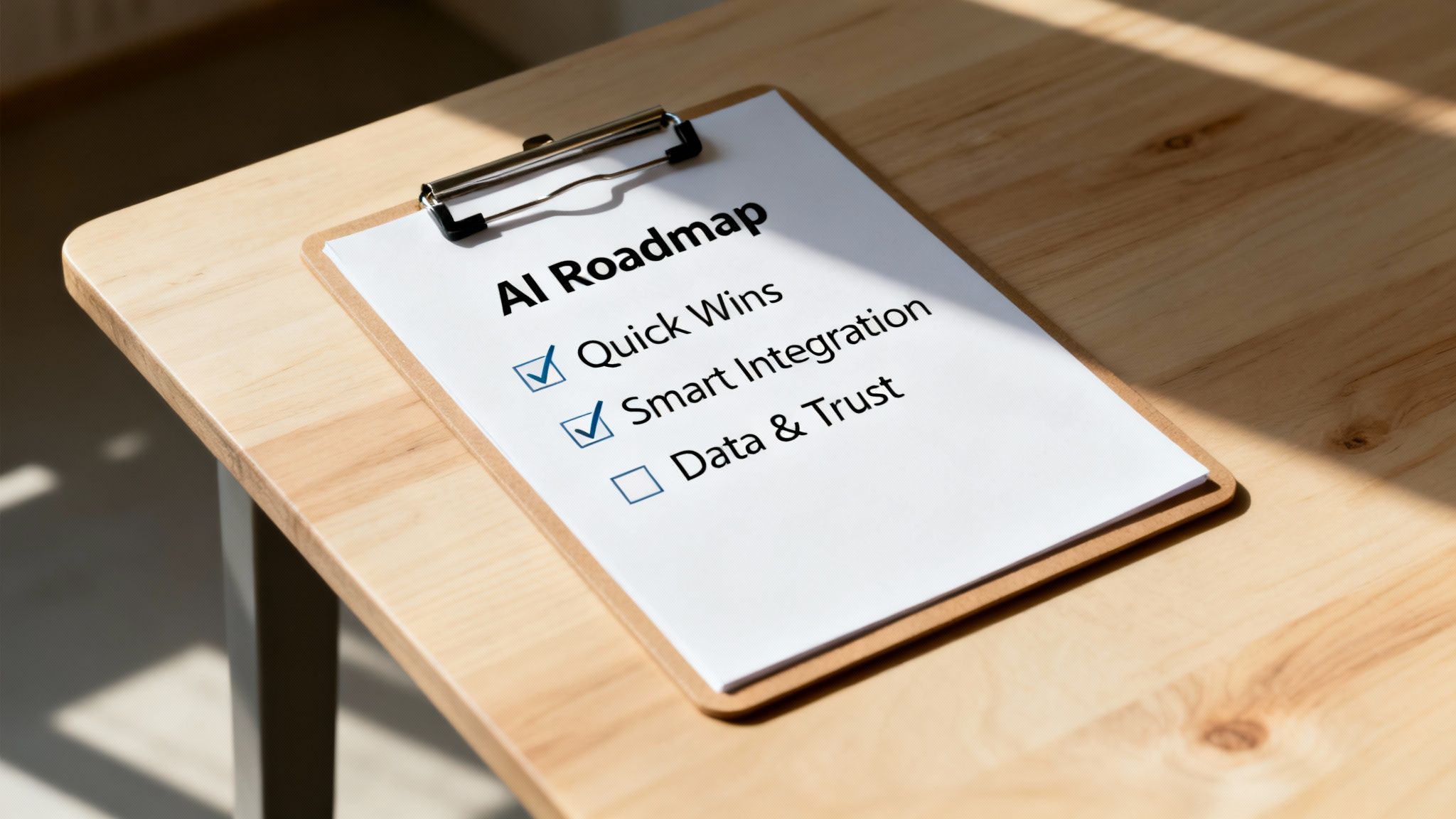
Bringing AI into your business doesn't have to be a massive, complicated project. In fact, the most successful approach is usually the exact opposite: start small, prove the value, and build from there. This simple, three-stage roadmap will help you move from just being curious about AI to implementing it with confidence.
Think of it like building a house. You don't try to put up the walls, roof, and plumbing all at once. You start with a solid foundation. For AI, that foundation is a quick, tangible win that builds momentum for everything that follows. When you're thinking through your strategy, using a tool like an AI business plan generator can help you map out those first steps.
Stage 1: Start with Quick Wins
The best way to get started with AI for small businesses is to pick off the "low-hanging fruit." What are the repetitive, time-sucking tasks that could be automated for an immediate win? Don't try to solve every problem at once. Just focus on one area where AI can make a noticeable difference right away.
For most businesses, customer support is the perfect place to start. Your team is probably answering the same set of questions dozens of times a day. Turning your FAQ page into an interactive AI agent is a fantastic first step.
Here’s why it works so well:
- Immediate Value: You’ll instantly see fewer repetitive support tickets, freeing up your team for more important work.
- Low Risk: The information is already public on your website, so there’s not much that can go wrong.
- Builds Momentum: When your team sees this initial success, it’s much easier to get their buy-in for future AI projects.
By tackling a simple yet impactful problem first, you prove the concept and build a solid case for doing more with AI down the road.
Stage 2: Focus on Smart Integration
Once you’ve seen those early benefits, the next step is to weave AI into your daily workflows without causing a major disruption. The key here is to choose tools built for simplicity. You don't need a team of developers or a month-long setup anymore.
For instance, a no-code platform like BizSage lets you get an AI agent trained and running in just a few minutes. You can pop it onto your website as a chat widget, share it as a link, or even host it on its own page. The process is dead simple: you just give the AI your website content, help docs, or other files, and it's good to go.
The goal of integration isn't just to add another tool; it's to make your existing processes more efficient. A well-integrated AI should feel like a natural extension of your team, not a separate, clunky system.
This stage is all about making AI an accessible and genuinely helpful part of your daily operations—for both your customers and your own team.
Stage 3: Build Data Accuracy and Trust
This last stage is the most important. You have to ensure your AI is a reliable source of truth. An AI that gives wrong answers or sounds off-brand can do more harm than good. This is where having total control over your data is non-negotiable.
Real trust is built on two things: accuracy and honesty.
First, your AI must be trained only on your company’s content. When you feed it your website, product manuals, and internal policies, you guarantee every answer is on-point and matches your brand voice. This completely removes the risk of the AI "hallucinating" or making things up from the internet. Your content becomes its entire world.
Second, a trustworthy AI needs to know its own limits. Instead of guessing when it doesn't have an answer, it should be designed to simply say, "I don't know." This one feature is vital for building confidence. It ensures that when the AI does give an answer, your team and your customers can trust it's correct and based on the information you gave it. This foundation of accuracy and transparency is what turns a cool gadget into a dependable business asset.
Measuring Success: What AI ROI Really Looks Like
Bringing new tech into your business can feel like a shot in the dark. But when it comes to AI for small businesses, figuring out if it's actually working shouldn't be a guessing game. Forget the flashy demos—the real question is whether your investment is making a difference to your bottom line. We're talking about tracking specific Key Performance Indicators (KPIs) that connect what the AI is doing to real business results, like more time in your day, more money in the bank, and happier customers.
It’s easy to get sidetracked by vanity metrics, like how many chats your AI had today. Instead, let's focus on what truly matters. How many hours did your team get back this week? How many new leads came in while everyone was asleep? Answering these questions is how you build a real business case for AI and see a genuine return on investment (ROI).
Pinpointing Your Customer Support KPIs
For most businesses, the first place you'll feel the impact of AI is in customer support. Think about it: an AI assistant trained on your help articles and past tickets can work around the clock, giving instant answers and taking a massive load off your team.
To see if it's working, keep an eye on these metrics:
- Ticket Deflection Rate: This is the big one. It’s the percentage of customer questions the AI handles all on its own, without a human ever getting involved. A high deflection rate is a clear sign you're saving serious time.
- Reduction in First-Response Time: How long does it take for a customer to get an answer? AI can take that from hours down to seconds, and that speed makes a huge difference in customer satisfaction.
- Decrease in Repetitive Questions: Take a look at the questions your human agents are still getting. If they're no longer answering "What's my tracking number?" fifty times a day, the AI is doing its job.
Tracking Sales and Lead Generation Gains
An AI on your website is more than just a support bot; it's your new, hardest-working salesperson. It's there to greet visitors the second they land on your site, answer their questions, and grab lead information you'd otherwise completely miss.
Here’s how to measure its impact on sales:
- After-Hours Lead Capture: Count how many qualified leads the AI brought in when your office was closed. Every single one of those is a potential sale you would have lost.
- Increase in Qualified Sales Conversations: The AI acts as a great filter. By handling the initial back-and-forth, it makes sure your sales team only spends their time talking to people who are actually ready to buy.
A small monthly investment in an AI tool can easily translate into thousands of dollars in new revenue. If your AI captures just one or two high-value leads each month that you would have otherwise missed, it often pays for itself many times over.
Measuring Internal Efficiency and Knowledge Sharing
The benefits of AI aren't just for your customers. An internal "Company Brain" can make your whole operation run smoother by giving your team instant access to the information they need to do their jobs. The ROI here is measured in pure, reclaimed productivity.
Start tracking these internal numbers:
- Reduced Onboarding Time for New Hires: How long does it take a new person to get up to speed? When they can ask an AI their first hundred questions instead of bugging a teammate, they become productive much faster.
- Decrease in Repetitive Internal Questions: When your team can ask an AI about company policies or project specs, they stop interrupting each other. That means fewer distractions and more deep, focused work for everyone.
Recent data shows just how big these time savings can be. AI use among small businesses is booming, with 63% now using it every day. Even more impressive, 58% report saving over 20 hours per week. Marketing automation, in particular, is an area where small businesses are really taking the lead. You can dig into the numbers yourself in the latest survey from Thryv on AI adoption. That reclaimed time isn't just a nice perk; it's a powerful, direct return on your AI investment.
Choosing the Right AI Tool for Your Business
The AI market is crowded, and it's easy to get overwhelmed. But here’s the secret for small businesses: the "best" tool isn't the one with the most bells and whistles. It’s the one that solves your real-world problems without a lot of hassle.
Many AI platforms are built for large enterprises, not for a growing team that needs to be nimble. Let's cut through the marketing jargon and focus on what actually makes a difference. This guide will help you evaluate potential AI partners and find a solution that works for you today and can grow with you tomorrow.
Ease of Use and Quick Setup
You and your team are already juggling a dozen tasks. The last thing you need is a six-month implementation project or the need to hire a developer just to get started. Simplicity should be at the top of your list.
Look for a no-code setup. Seriously. You should be able to get a basic AI agent running in minutes, not weeks. The best tools let you train your AI simply by pointing it to your website or uploading the documents you already have. If the setup feels like a puzzle, that’s a major red flag.
Accuracy and Building Trust
An AI is useless—or even damaging—if it gives wrong answers. A bot that confidently makes things up can destroy your credibility faster than you can say "hallucination." That's why training the AI exclusively on your own content is an absolute must-have. This keeps every response grounded in reality and tied directly to your business.
A trustworthy AI also knows what it doesn't know. The ability for an agent to simply say, "I don't know" when a question is outside its scope is a critical feature. This prevents misinformation and builds real confidence with both your customers and your team.
Scalability That Supports Growth
As your business expands, your tools should help, not hinder. Avoid per-user pricing models that make you pay more every time you add a team member. Instead, look for per-company plans that let everyone benefit from a single subscription.
The right platform will have clear pricing tiers, allowing you to add more capacity—like higher message limits or deeper analytics—as you actually need them. This way, you can start small, prove the tool's value, and then scale your AI investment in a way that makes financial sense. For deeper dives into specific tools, dedicated resources on AI customer support software can offer more specialized insights.
The flowchart below gives you a solid starting point for thinking about this. Before you do anything else, you need to decide how you'll even know if the AI is working.
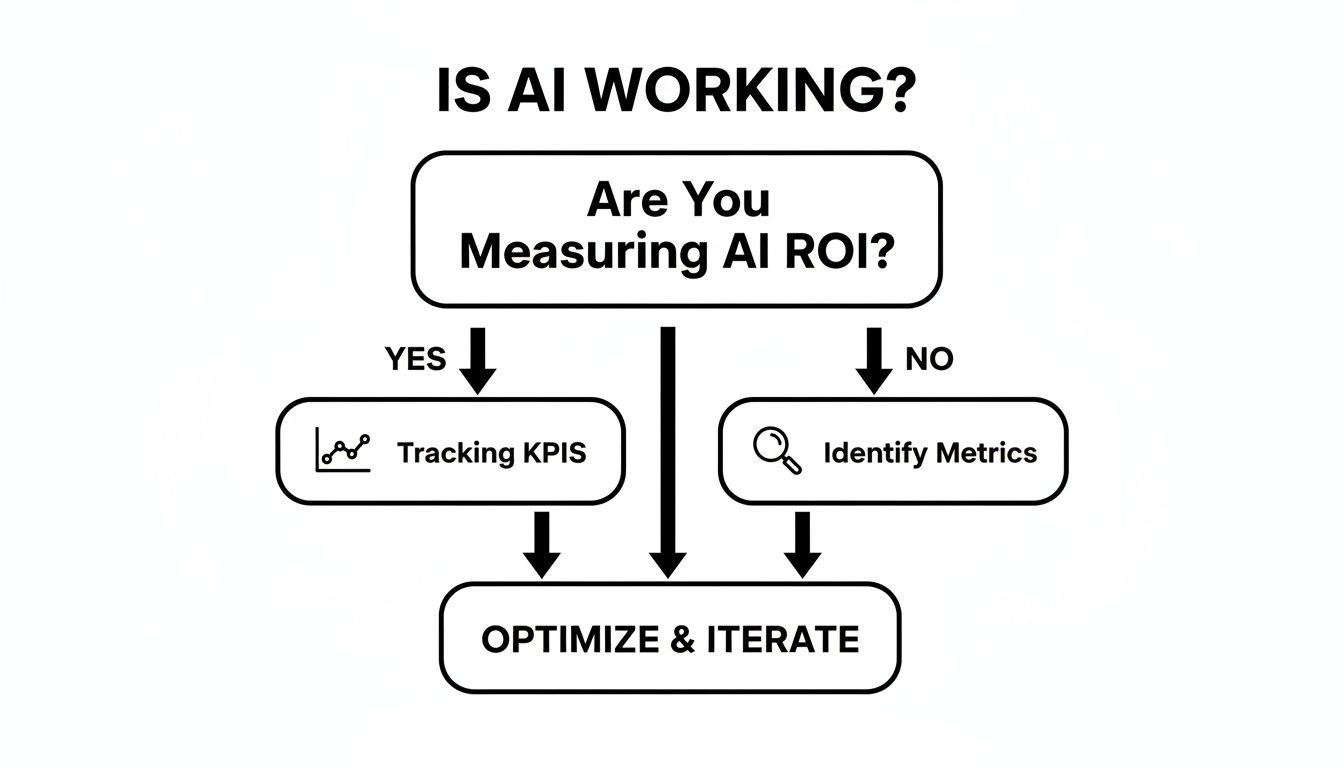
As you can see, it all begins with measurement. You either need to track the KPIs you already have or figure out which new metrics will show you the AI's impact.
Customization and Brand Voice
Your brand's voice is its personality. A generic, robotic-sounding chatbot can feel cold and completely disconnected from the business you've worked so hard to build. The best AI tools get this and give you the power to make the AI your own.
Look for platforms that let you:
- Set a specific tone—whether you’re friendly, formal, or a little bit witty.
- Customize the look and feel of the chat widget so it perfectly matches your website.
- Write a custom welcome message that sets the right tone from the very first interaction.
This level of control makes the AI feel like a genuine part of your team, creating a consistent and authentic experience for everyone.
AI Vendor Evaluation Checklist for Small Businesses
To make this process even easier, we've put together a checklist of essential features. Use this table when you're comparing different AI platforms to make sure you're choosing a tool that truly fits your team's needs and budget.
| Evaluation Criteria | What to Look For | Why It Matters |
|---|---|---|
| Setup & Onboarding | No-code interface, ability to train with a URL or documents, live in under an hour. | Your team doesn't have time for complex, lengthy implementations. Speed to value is key. |
| Accuracy Controls | Trains only on your provided content, option to say "I don't know." | Prevents the AI from making up answers (hallucinating) and protects your brand's reputation. |
| Pricing Model | Per-company plans (not per-user), clear tiers based on usage (e.g., message volume). | Avoids penalizing you for growing your team and ensures costs are predictable as you scale. |
| Customization | Ability to define personality/tone, customize colors/branding, and create welcome messages. | Ensures the AI feels like a natural extension of your brand, not a generic, third-party add-on. |
| Human Handoff | A clear, seamless process to escalate a conversation from AI to a live person. | Prevents customer frustration by ensuring complex or sensitive issues are handled by a human. |
| Analytics & Insights | Dashboards showing conversation volume, common questions, and user satisfaction scores. | Helps you understand what your customers are asking and provides data to prove the tool's ROI. |
Choosing the right partner is about finding a tool that solves immediate problems while being flexible enough to support your future ambitions. This checklist should give you a solid foundation for making a smart, informed decision.
The Future Is Now: Your Next Steps with AI
We've covered a lot of ground, and you've seen what AI can really do for a small business. The goal here isn't just about cool technology; it's about turning your biggest headaches into your greatest strengths. Think about it: your website can become a 24/7 support agent, a top-notch sales assistant, and the go-to expert for your internal team.
The path forward isn’t some giant, intimidating leap. It’s actually just one small, smart step. Start by pinpointing a single area of your business that creates the most friction—the one that, if fixed, would make the biggest difference. For most businesses, that's customer support, where fast, accurate answers are everything.
Start Small, Win Big
Don't fall into the trap of trying to rebuild your entire business overnight. The smartest AI adoptions always start with a clear, focused goal.
Here’s how you get the ball rolling:
- Pick one pain point: Is your team drowning in the same support questions over and over? Are you losing potential customers who visit your site after hours? Start right there.
- Take a free trial for a spin: You need to see this stuff in action for yourself, no strings attached. Platforms like BizSage are built so you can get a real feel for it in just a few minutes.
- Measure one thing that matters: Keep an eye on a simple metric, like how many support tickets you avoid or how many new leads you capture overnight. Watching that number move is all the proof you’ll need.
Picture this: every single customer question gets an instant, helpful, on-brand answer without you or your team having to do a thing. That's not a far-off dream. It's the new reality for a whopping 92% of small businesses that are already using AI.
This isn't just a random statistic; it’s a sign that the playing field is being leveled with powerful, affordable tools. You can read more about how small businesses are adopting AI and what it means for the competition.
The Takeaway: For a small, scrappy team, AI is the ultimate productivity multiplier. The tools you need to get started have never been easier to use or more affordable.
Ultimately, this is about empowering you. You don't need a massive budget or a team of data scientists to get ahead. By simply automating the routine, repetitive tasks, you free up yourself and your team to focus on what humans do best: building relationships, thinking creatively, and growing the business. The time to grab that advantage is right now.
Your Top AI Questions, Answered
As you start thinking about bringing AI into your business, it’s completely normal to have a few questions. This stuff is moving incredibly fast, and it can be tough to tell what's real and what's just hype. Let's walk through some of the most common concerns I hear from small business owners dipping their toes into AI for the first time.
The great news is that many of the old roadblocks—think sky-high costs and needing a team of engineers—have pretty much disappeared. Today’s AI tools are built from the ground up to be practical and accessible for businesses just like yours.
Isn't AI Super Expensive for a Small Business?
This is probably the biggest myth out there. Sure, a fully custom-built AI system from scratch can cost a fortune, but the new wave of AI for small businesses is built to be surprisingly affordable. Most are sold as a subscription service (SaaS), so you just pay a straightforward monthly or annual fee.
Many of these platforms are moving away from per-user pricing, which is a lifesaver because those costs can really stack up as you grow. Instead, you'll often find simple, company-wide plans with different levels based on how much you use it. This means your whole team gets the benefit without you having to constantly recalculate costs.
A small monthly fee can deliver a huge return, and fast. Think about it: by handling repetitive tasks, a single AI tool can easily save your team dozens of hours every single month. That’s time they can spend on work that actually grows the business.
Do I Need to Hire a Developer to Use This Stuff?
Nope, not at all. The best AI platforms are now "no-code," which is just a fancy way of saying they're designed for regular people, not programmers. You absolutely do not need an IT department or a developer on standby to get one up and running.
Getting started usually looks something like this:
- Feed it your content: You can often just point it to your website or upload documents you already have, like help articles or product catalogs.
- Give it a personality: You can dial in a specific tone of voice so the AI sounds like it's genuinely part of your team.
- Put it to work: With a couple of clicks, you can add the AI to your website or share it with a link.
This simple, intuitive approach means you can have a powerful AI assistant trained on your business and ready to go in minutes, not months.
How Do I Make Sure the AI Gives the Right Answers?
This is the most important question of all, and the answer comes down to one word: control. A trustworthy AI is an AI that learns only from your own business content. By limiting its knowledge to the information on your website, your internal guides, and your product specs, you create a walled garden of facts.
This is what stops the AI from "hallucinating"—making things up or pulling random, incorrect information from the internet. A well-designed system will only answer based on the truth you've given it.
When you're looking at different tools, find one that has a crucial feature: the ability for the AI to say, "I don't know." An AI that knows its limits is far more dependable than one that just takes a wild guess. This builds real trust, both with your customers and your own team, because you know every answer is accurate and aligned with your brand.
Ready to see how an AI assistant can give you back time and help you grow? BizSage transforms your company content into a 24/7 expert that gives on-brand, accurate answers to your customers and your team. Start your free trial today and build your first AI agent in just a few minutes.