

An ai agents white label service is essentially a fully-built AI platform that an agency can put its own brand on and sell directly to clients. This model lets marketing, web, and SEO agencies offer custom-trained AI chatbots without having to build any of the tech themselves, opening up a scalable, high-margin new service.
The New Agency Gold Rush White Label AI
For agencies right now, the conversation around AI has shifted. It’s no longer just about using AI tools to make your own work easier—the real opportunity is in productizing AI for your clients. White-label platforms are making this possible.
This isn't just about reselling a generic chatbot. It's about delivering a polished, branded service that actually solves client problems, whether that's capturing more leads or handling customer support queries around the clock.

This model flips the script. Instead of being another tool you pay for, AI becomes a powerful revenue generator that makes your agency stickier and proves its value in a very tangible way.
A Tangible Business Opportunity
The core value for agency owners is incredibly straightforward: you get to sell a sophisticated, branded AI service without writing a single line of code. These platforms have made advanced technology accessible, allowing you to deploy AI agents trained on a client's specific data—their website, help docs, and product info—to give accurate, on-brand answers that lead to real business results.
The market growth alone tells you everything you need to know. The AI agent market is absolutely exploding, with a projected compound annual growth rate of 46.3%. It’s expected to jump from $7.84 billion in 2025 to a staggering $52.62 billion by 2030.
White-label platforms are a huge part of this growth. They empower agencies to charge anywhere from $300-$500 per month for a basic AI agent to upwards of $2,000-$5,000 for a full automation suite. The best part? Profit margins typically sit between an incredible 70-85%.
This isn't just another trend; it's a fundamental shift in how agencies operate. Offering white-label AI moves you from being just a service provider to a true technology partner, embedding your agency right into the core of your clients' businesses.
Here's a quick look at what this can mean for your agency's bottom line.
Agency Revenue Potential with White Label AI Agents
This table breaks down the potential monthly recurring revenue (MRR) agencies can generate by offering white-label AI agent services at different tiers.
| Service Tier | Core Features | Typical Monthly Price Per Client | Projected Profit Margin |
|---|---|---|---|
| Starter AI Agent | Knowledge base training, basic lead capture, website embed. | $300 – $500 | 70-75% |
| Pro AI Agent | Advanced workflows, CRM integration, custom branding, API access. | $800 – $1,500 | 75-80% |
| Enterprise Suite | Full automation, dedicated support, custom data sources, security review. | $2,000 – $5,000+ | 80-85% |
As you can see, even with just a handful of clients on a starter plan, you can add a significant, high-margin revenue stream to your agency with minimal overhead.
Capitalizing on the AI Service Model
To really jump on this opportunity, many agencies are turning to specialized chatbot agency solutions that make it seamless to offer these branded AI services. The focus is shifting away from just running marketing campaigns and toward building intelligent, automated systems that work for clients 24/7.
This guide will walk you through exactly how to build, position, and scale this lucrative new service for your own agency.
Designing Your Branded AI Service Offering
Before you even touch the tech, let's talk strategy. This is where most agencies get it wrong. A successful white-label AI agent isn't just another tool; it’s a targeted solution to a real, painful business problem your clients are facing. If you jump straight into features without a clear strategy, you’ll end up with a service that’s a nightmare to sell and even harder to prove the value of.
So, the first question you need to ask yourself is simple: What specific job will this AI agent do? Forget vague goals like "improving engagement." You need to think in terms of tangible outcomes that make a business owner sit up and listen. Are you building a 24/7 lead capture machine? An instant customer support resource? Or maybe a specialized internal knowledge base for your client’s team?
Take a look at your current client list. Every single one of them has unique, high-value problems that a well-trained AI agent could solve almost overnight.
Identifying Lucrative Use Cases
Let’s get specific, because a generic pitch is a dead end. A tailored solution, on the other hand, is a magnet for new business.
Think through these common client scenarios I see all the time:
- For E-commerce Stores: Imagine an agent trained on their entire product catalog. It can instantly answer nuanced questions about sizing, materials, or shipping policies that would otherwise tie up a human agent. More importantly, it can guide shoppers to the right product, drastically cutting down on cart abandonment.
- For Local Service Businesses (Plumbers, Lawyers, HVAC): For these clients, it's all about leads. The agent can pre-qualify visitors by asking critical questions ("What type of service do you need?" "What's your zip code?"), capture their contact info, and even sync with a calendar to book appointments on the spot.
- For B2B SaaS Companies: Here, an agent can be the first line of defense for tech support, pulling answers directly from help docs to handle common questions. It can also walk potential customers through complex feature comparisons and book demos with qualified enterprise leads, filtering out the tire-kickers.
The real secret is mapping the agent's function directly to a client's bottom line. When you can confidently say, "This will capture 15 more qualified leads for you each month," the service basically sells itself.
Your initial discovery calls should focus on your client's operational headaches, not AI jargon. Listen for phrases like "we miss inquiries that come in after 5 PM" or "my team spends way too much time answering the same basic questions." Those are your openings.
Positioning Your AI Service
Once you’ve pinpointed the problem you're solving, you need to decide how to package it. How you frame your white-label AI service will directly shape its perceived value and, ultimately, your ability to build a new recurring revenue stream.
From what I've seen, two primary models work best for agencies.
The Premium Add-On Model
This is usually the path of least resistance, especially with your existing clients. You simply position the AI agent as a premium upgrade to their current retainer.
- Example in action: Let's say you have a client on a $2,500/month SEO package. You could introduce a "Growth Plus AI" tier for $3,000/month. This new package includes everything they already love, plus a fully managed, 24/7 lead-capture AI agent.
- Why it works so well: You're building on an established, trusted relationship. It’s a clear, incremental value-add. The client is already sold on you, making a small upsell far easier than starting from scratch with a new prospect.
The Standalone Offering Model
The other route is to package the AI agent as its own powerful, standalone product. This is a fantastic way to attract new clients who might not need your full marketing suite but have a very specific pain point an AI agent can solve right now.
This model also lets you create tiered packages based on features and usage, which gives clients a clear growth path with you.
| Package Tier | Core Focus | Ideal Client | Sample Monthly Price |
|---|---|---|---|
| AI Essentials | 24/7 Lead Capture | Small local businesses | $350 |
| AI Growth | Support & FAQ Automation | E-commerce, SaaS | $750 |
| AI Pro | CRM Integration & Advanced Workflows | Larger B2B companies | $1,500+ |
A tiered structure like this makes your service feel accessible and less intimidating. It clearly shows the advanced capabilities you can offer as a client's needs evolve, setting clear expectations from day one—which is absolutely fundamental to keeping clients happy for the long haul.
Building and Training Your First Client Agent
This is where all that strategic planning pays off and you get to build a real, working asset for your client. Honestly, creating and training a white-label AI agent is a lot more straightforward than most people think, especially if you're using a modern no-code platform. The whole point is to get you from zero to a highly accurate agent, fast.
It all starts with a surprisingly simple step: just enter your client’s website domain into the platform. That one action triggers a powerful automated crawl, where the system scours the site, indexes the pages, and builds the agent's foundational knowledge.
But this isn't just a simple keyword scrape. The technology running behind the scenes is called Retrieval-Augmented Generation (RAG). The easiest way to think about it is that you're creating a closed-loop, private library for the AI. The agent can only pull information from the sources you feed it. This is absolutely critical for making sure its answers are based on your client's actual business information, not some random, and often wrong, facts from the wider internet.
The process I’m about to walk you through is the natural next step after you’ve nailed down your strategy, as this diagram shows.
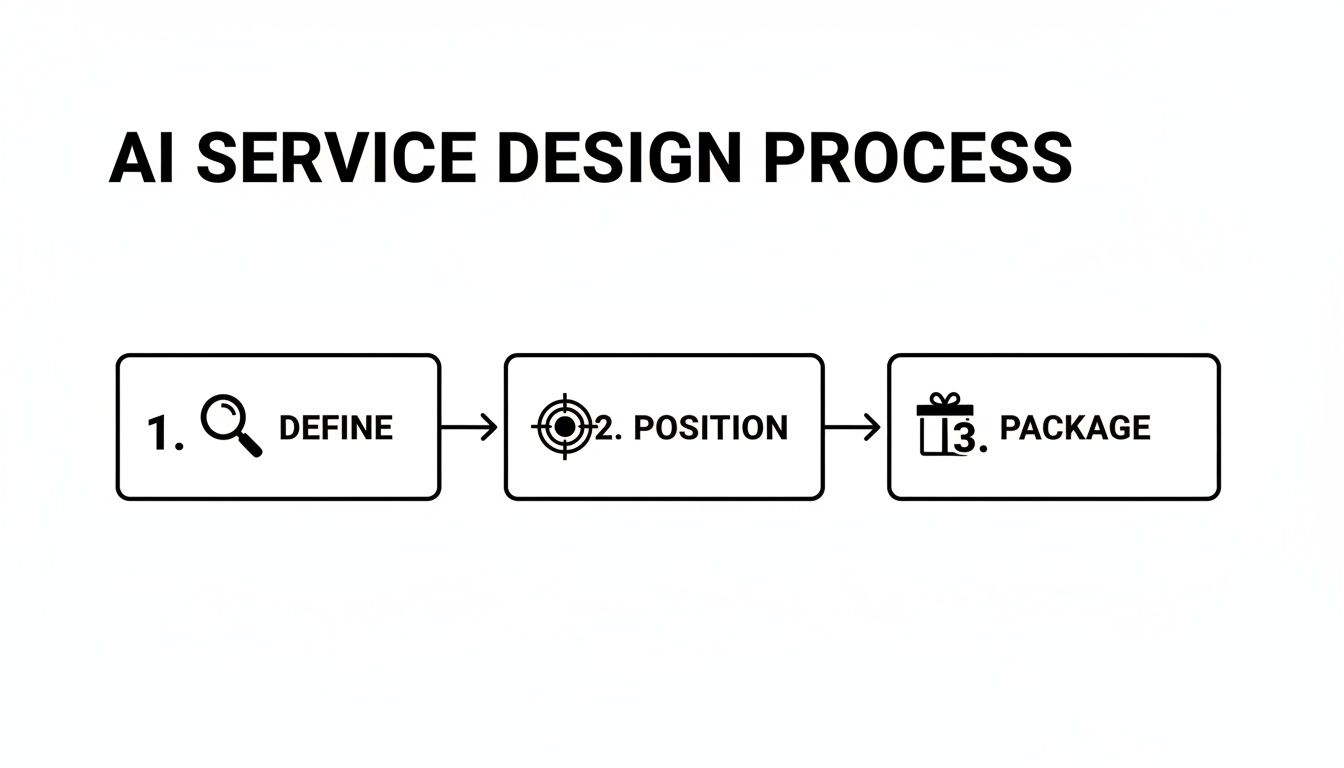
A successful build always starts with a clear plan. That's what ensures the tech you're building actually serves a specific, valuable business goal for your client.
Going Beyond the Website: Enriching the Knowledge Base
A website crawl is a fantastic starting point, but the real magic happens when you enrich that foundation with more specific, high-value data. A great agent is just like a great employee—it needs access to all the right documents to do its job well.
This is your chance to turn a generalist agent into a true specialist by uploading different types of files.
- Product Catalogs (PDFs): For an e-commerce client, uploading a full product catalog is a game-changer. The agent can suddenly answer super-specific questions about model numbers, dimensions, materials, or warranty details.
- Company FAQs (Text Snippets): Just copy and paste answers from an existing FAQ page directly into the knowledge base. This is the perfect way to handle all those repetitive questions that bog down your client's support team.
- Specific Support Pages (URLs): Does your client have detailed setup guides or tutorials on certain pages? You can add those URLs directly, telling the agent to prioritize information from these high-authority sources for any relevant questions.
The old saying "garbage in, garbage out" has never been more true. The quality of the agent's answers is directly tied to the quality of the source material you feed it. Curating accurate, up-to-date, and well-structured documents is the single most important thing you'll do in the training process.
This relentless focus on curated knowledge is what prevents "hallucinations"—that's the industry term for when an AI just makes stuff up. By locking the agent into a defined set of knowledge, you create a trustworthy resource that reliably represents your client's brand.
Why This Matters Right Now: The Rise of Agentic AI
The work you're doing here isn't just a small project; it's part of a massive industry shift. Forecasts show that by 2026, 80% of enterprise workplace applications will have AI copilots and agents embedded in them, completely changing how businesses get work done. Agencies are in a prime position to manage these new systems for their clients.
The market for agentic AI is on track to blow past $139 billion by 2033. The top use cases are already clear: research (58.2%), productivity (53.5%), and of course, customer service (45.8%). You can learn more about these agentic AI statistics and see how they're reshaping business automation. This data makes it clear that offering a white-label AI agent service isn't just another small add-on; it's about aligning your agency with one of the biggest tech movements of our time.
By building these agents, you're giving your clients a direct on-ramp to this new way of working.
Fine-Tuning and Kicking the Tires
Once your initial data sources are loaded, the platform gets to work. Within minutes, you’ll have a working draft of the agent ready for testing. It’s not the final product, but it’s ready for a test drive.
Now you can start interacting with it in a safe, private staging environment. This is your chance to ask all the tough questions you know customers (and your client) will throw at it.
- "What's your return policy for international orders?"
- "Do you guys offer discounts for non-profits?"
- "Can you compare product A and product B for me?"
The whole point of this initial testing is to find the knowledge gaps. When the agent stumbles on a question, it's a flashing neon sign telling you where you need to add or clarify a knowledge source. This cycle of testing, finding weak spots, and feeding it better information is how you develop a truly solid AI agent before it ever speaks to a real customer.
Customizing the Brand and User Experience
Once you’ve fed the agent your client's specific knowledge, the real work begins: making it look, feel, and sound like it truly belongs to them. A generic, out-of-the-box chat widget screams "third-party tool," and that can completely derail a client’s carefully built brand identity. Real white-labeling is all about seamless integration—turning a powerful piece of tech into a natural extension of their digital footprint.
This is where your agency’s expertise really makes a difference. You're not just plugging in a tool; you're crafting a fully branded experience. The end goal? When a visitor interacts with the agent, they should feel like they're talking directly to the company, with zero hint that an external platform is powering the conversation.

Pulling this off requires more than just slapping a logo on it. It’s a thoughtful blend of visual design, conversational tone, and smart technical choices.
Aligning the Visuals with Client Branding
The first thing anyone notices is how the chat widget looks. It needs to blend into the client's website so perfectly that it seems like their own dev team built it from scratch. Thankfully, most modern ai agents white label platforms give you granular control over these visual details.
Here’s a quick checklist to nail the look and feel:
- Widget Colors: Match the agent's chat bubble, buttons, and text to the client’s brand palette. I always use a color picker browser extension to grab the exact hex codes from their website to ensure perfect consistency.
- Icon and Positioning: Ditch the generic icon. Choose one that fits the site's aesthetic and place it where people intuitively look for it—usually the bottom-right corner—making sure it doesn't cover up any important buttons or text.
- Fonts and Typography: If the platform allows, use the same font family as the client’s website. It’s a subtle touch, but it goes a long way toward creating a truly cohesive experience.
Here's the litmus test I use: Does the chat widget look like an afterthought, or does it feel like it was always meant to be there? Your job is to make it an organic, helpful part of the user’s journey, not a distraction.
Crafting a Unique Agent Personality
Looks are one thing, but the agent’s personality is what truly brings the brand to life. A stiff, robotic tone can be an instant turn-off. The agent’s voice has to be a direct reflection of the client's own brand voice.
You achieve this primarily through custom greetings and conversation starters. It’s the first thing a user sees, and it sets the tone for the entire interaction.
Just look at how a few simple tweaks can create a completely different vibe:
| Client Type | Agent's Greeting & Starters | Brand Voice Conveyed |
|---|---|---|
| Playful E-commerce Brand | "Hey there! Ready to find something awesome? Ask me about our latest deals or get a product recommendation!" | Fun, energetic, and helpful. |
| Formal Financial Consultancy | "Welcome. How can I assist you today? You can ask about our services, investment strategies, or request a consultation." | Professional, direct, and authoritative. |
These small adjustments make a world of difference in how users perceive the brand. By tailoring that first touchpoint, you’re creating a conversation that feels authentic and builds trust from the very first message. You’re not just setting up an AI; you’re giving your client’s brand a voice that’s on the clock 24/7.
Choosing the Right Deployment Method
Finally, you need to decide how the agent will actually live on the client’s site. The deployment method itself can reinforce the white-label experience and add a ton of perceived value to your service. You’ve basically got two solid options here.
The most common approach is embedding a small JavaScript snippet into the website's code. It's fast, effective, and gets the widget up and running with minimal fuss. For most clients, this is the perfect solution.
But for a more premium, fully integrated feel, I highly recommend using a custom subdomain. Instead of the user seeing a generic URL, the agent can be hosted on a page like chat.clientdomain.com. This is a power move for a few key reasons:
- Reinforces Brand Ownership: It creates the strong impression that the agent is a proprietary technology owned by the client, not some third-party add-on.
- Enhances Perceived Value: This immediately makes your service feel like a more high-end, integrated solution, which absolutely helps justify a higher price point.
- Provides a Direct Link: You can send users directly to this URL for a full-page, immersive chat experience. This is fantastic for dedicated support portals or help centers.
The choice between an embedded widget and a custom subdomain really comes down to the client’s goals and the service package you’ve sold them. By offering both, you position your agency as a flexible and professional provider of ai agents white label solutions ready for any scenario.
How to Prove ROI to Your Clients
Having a slick, well-trained AI agent on a client's website is a great start, but it's only half the battle. The real key to long-term client retention is proving, with hard data, that the agent is a valuable asset—not just a fancy gadget. This is where your agency’s management value truly shines, turning conversational data into measurable business outcomes.
Your clients don't ultimately care about how many chats the agent handles; they care about how many new leads it generates, how many support tickets it deflects, and how much time it saves their team. Your job is to connect the dots and present a clear, compelling return on investment story.
Turning Conversations into Qualified Leads
The most direct way to prove value is by showing the agent is a lead generation machine. Modern ai agents white label platforms let you move beyond simple Q&A by building in ways to actively capture user information at the perfect moment.
It all starts with intent detection. You can set up the agent to recognize when a user's question signals they're ready to buy. For instance, if a visitor asks about pricing, package details, or availability, you can program the agent to automatically pop up a lead capture form right in the chat.
Picture a user on a plumber’s website asking, "How much for an emergency call-out?" Instead of just spitting out a price, the agent responds and immediately follows up with, "I can get a specialist to call you back with a precise quote. What's the best number to reach you?" This simple, automated workflow turns a casual question into a qualified, actionable lead for your client.
The goal is to make lead capture a natural part of the conversation, not an interruption. By triggering forms based on specific user intent, you increase conversion rates and deliver high-quality leads that your client’s sales team will love.
Many platforms, like BizSage, include a lightweight, built-in CRM for each agent. This is a game-changer for agencies. It lets you manage all the leads captured by the agent in a simple, visual Kanban-style board. You can easily track an inquiry from its initial capture all the way to becoming a qualified prospect, giving your client concrete reports on their new lead pipeline.
Demonstrating Ongoing Value Through Refinement
Proving ROI isn't a one-time thing; it's an ongoing process that showcases your agency's continuous value. One of the most powerful tools you have is the chat log. Regularly reviewing these logs is like having a direct line into the minds of your client’s customers.
By analyzing the questions people ask, you can spot critical knowledge gaps. When you see the agent repeatedly saying, "I'm sorry, I don't have information on that," it’s not a failure—it’s an opportunity. Each one of those instances is a roadmap for making the agent smarter and more helpful.
Here’s a simple workflow we use:
- Weekly Log Review: Carve out time each week to scan the chat history for unanswered or poorly answered questions.
- Identify Themes: Look for recurring topics or specific product questions the agent struggles with.
- Update the Knowledge Base: Create and upload a new document or text snippet that directly addresses these gaps.
- Report the Improvement: In your next client report, highlight the specific gaps you identified and the steps you took to fix them.
This proactive management shows you're not just a vendor who set something up and walked away. You're an active partner invested in improving their business. And to truly show the value of your white-label AI services, it's vital to know how to monitor your brand's visibility in LLMs.
This entire service model is part of a massive market trend. White-label AI platforms are central to a market expected to hit $42.7 billion by 2030, with a staggering 73% of businesses already using these no-code solutions. Agencies are pricing these valuable services accordingly—lead-gen AI agents often fetch $1,000-$2,500 per month, and more complete automation can command up to $5,000 per month for each client. Your ability to prove ROI is what secures these high-value retainers.
Key Metrics to Demonstrate AI Agent Value
Tracking the right numbers is everything. Clients need to see the tangible impact your AI agent is having on their business. Here are the core metrics we focus on to build a powerful ROI case.
| Metric | What It Measures | Why It Matters to the Client | How to Track It |
|---|---|---|---|
| Leads Generated | The number of unique contacts captured through the agent's forms or chat flows. | This is the most direct measure of revenue generation and sales pipeline growth. | Built-in CRM, lead capture forms, or integration with the client's CRM (e.g., HubSpot). |
| Support Ticket Deflection | The percentage of user queries successfully resolved by the AI without human intervention. | Measures cost savings by reducing the workload on their support team. | Analytics dashboard showing total conversations vs. conversations escalated to a human. |
| Conversation-to-Lead Rate | The percentage of total conversations that result in a captured lead. | Shows the agent's effectiveness at converting website traffic into prospects. | (Leads Generated / Total Conversations) x 100. |
| First Response Time | The time it takes for a user to get their initial question answered. | Highlights the instant gratification the agent provides, improving user experience. | Most platforms track this automatically in the conversation analytics dashboard. |
| Knowledge Gap Reduction | The decrease in "I don't know" responses from the agent over time. | Demonstrates your ongoing management and the agent's increasing intelligence and value. | Manually track unanswered questions during weekly log reviews and report on trends. |
Focusing on these metrics moves the conversation from "what the agent does" to "what the agent achieves for your business." It’s the difference between being seen as a cost and being valued as an indispensable growth partner.
Got Questions About Offering White-Label AI?
Stepping into the world of white-label AI services can feel like a big move, and it's totally normal to have questions. You're not just adopting a new tool; you're building an entirely new service offering. Let's tackle some of the most practical concerns agency owners bring up when they're thinking about adding an AI agents white label solution to their stack.
This section is all about giving you clear, straightforward answers so you can make a confident, well-informed decision for your agency's future.
How Much Technical Skill Do We Actually Need?
This is probably the number one question I hear, and the answer is always a pleasant surprise: surprisingly little. Modern white-label platforms are built from the ground up for non-technical users. The days of needing a dev team to launch a chatbot are long gone.
The whole process, from training the AI on a client's website to customizing the branding and getting it live, is handled through a simple, intuitive dashboard. You don't have to write a single line of code.
Seriously, onboarding a new client can look like this:
- Pop their website domain into the platform.
- Let the system automatically crawl the site to build the initial knowledge base.
- Copy and paste a small code snippet into the client’s website header.
That's it. The most "technical" part is that copy-paste step, which is something most agency pros are already completely comfortable with.
What’s the Best Way to Price Our AI Service?
Pricing is obviously a huge deal. You need a model that's profitable for you and makes sense to your clients. I've seen three approaches that work exceptionally well for agencies offering white-label AI.
First, there's the tiered monthly retainer. This is easily the most popular model. You create different packages (think Starter, Growth, Pro) based on usage limits like the number of monthly chats or access to premium features like CRM integrations.
Second, you can bundle it as a value-add to your existing high-ticket marketing or SEO packages. This is a brilliant way to make your core retainers more valuable and way stickier, which helps slash client churn.
The third option is a one-time setup fee followed by a smaller monthly maintenance fee. This can be a good fit for clients who are a bit hesitant about a larger recurring cost but still see the value in the initial build-out and ongoing tuning. If you're just starting, I generally recommend the simple tiered model—it's clear, scalable, and easy for everyone to understand.
How Do We Make Sure the AI Gives Accurate Answers?
Accuracy is everything. Your client's brand reputation is on the line, so the agent has to be a reliable source of information. This is where the underlying technology, Retrieval-Augmented Generation (RAG), really shines.
Unlike a general AI like ChatGPT that can pull answers from the entire internet, a client-trained agent is restricted to a "walled garden" of information that you provide.
This is the key principle that prevents hallucinations and keeps the AI on-brand. The agent's knowledge is confined strictly to the client’s website content, uploaded documents like PDFs and FAQs, and any other specific URLs you've fed it. It simply cannot invent answers or go off-topic.
To maintain that accuracy long-term, your agency's role is crucial. This means regularly reviewing chat logs to spot any knowledge gaps and setting up weekly or monthly automated recrawls of the client's site—especially their blog or news section—to keep the information fresh.
Can We Make the AI Agent Look Like Our Own Tech?
Absolutely. That's the whole point of a true AI agents white label platform. The goal is for your client—and their customers—to feel like this is a proprietary solution that your agency built just for them.
You should have complete control to strip away all the platform provider's branding and replace it with your own. This often includes a small "Powered by [Your Agency]" tag on the chat widget, which is a great, subtle way to reinforce your value.
Beyond that, you get to customize every visual piece:
- The chat icon and its position on the page.
- The widget's colors to perfectly match the client's website branding.
- The conversational tone with custom greetings and prompts.
Using a custom subdomain (like support.yourclient.com) is the final touch that really solidifies the impression that this is a fully integrated, premium technology you’re delivering.
Ready to offer a powerful, branded AI service without writing a single line of code? BizSage gives your agency everything you need to build, manage, and scale client-trained AI agents under your own brand.
Start your free trial and launch your first client agent in minutes.