
For agencies, marketing automation goes far beyond simply scheduling emails. Imagine you’re the conductor of an orchestra: each client’s campaigns are unique instruments, all playing together in sync without you tweaking every note. With the right automation platform, you gain a single dashboard to oversee dozens of clients, ensuring each melody hits its mark on time.
Moving Beyond Manual Campaign Management
Day in and day out, agencies wrestle with repetitive chores—launching identical campaigns, tagging leads, exporting reports. Every context switch eats into your team’s focus, invites mistakes, and leaves little room for big-picture thinking.
With each new client, the workload climbs in a straight line. That means more late nights, unpredictable results, and a cap on how much you can grow profitably. By contrast, a system built on marketing automation for agencies turns those one-off tasks into repeatable workflows.
Automation handles the grunt work:
- Scheduling emails and social posts
- Segmenting contacts by behavior
- Gathering performance data in real time
Your team is then free to design strategies, craft compelling copy, and build stronger client relationships.
The Power Of Scalable Systems
When you shift to automated processes, growth stops being tied to headcount. Instead of hiring for every new campaign, you rely on solid systems that expand with your business.
Today, the global marketing automation market sits at $6.65 billion and is on track to reach $15.6 billion by 2030. For more on these trends, check out Flowlyn. Those numbers underscore how vital these tools have become for agencies looking to scale intelligently.
Automation transforms your role from campaign executor to strategic architect, letting you deliver personalized experiences at scale without burning out your team.
Below you’ll find a side-by-side look at everyday agency tasks done the old-school way versus how they flow when automation steps in.
Manual Vs Automated Agency Workflows
Table Description: This table provides a clear, side-by-side comparison of common agency tasks performed manually versus how they are handled with marketing automation, highlighting the direct benefits in time, consistency, and scalability.
| Agency Task | The Manual Approach | The Automated Advantage |
|---|---|---|
| Campaign Setup | Hand‐create each email, ad set, and landing page per client | Use prebuilt templates and dynamic variables to spin up new campaigns instantly |
| Lead Segmentation | Export CSVs, filter in spreadsheets | Trigger real-time lists based on behavior and custom scoring |
| Reporting | Manually compile data from multiple platforms | Auto-generated dashboards updated hourly |
| Nurture Journeys | Email sequences sent one by one | Intelligent workflows adjust timing and messaging automatically |
| Client Onboarding | One-off kick-off calls and manual asset collection | Guided workflows collect assets, set permissions, and schedule campaigns |
By automating these core tasks, your agency gains consistency, speed, and room to innovate. You’ll deliver higher-value services—without multiplying the effort.
Ultimately, marketing automation empowers your agency to run sophisticated, 24/7 marketing engines for every client. The result? Predictable results, happier teams, and stronger client retention—all without the burnout.
Designing a Scalable Multi-Client System
Trying to manage marketing for a single client is already a juggling act. But for an agency handling a dozen clients? It can quickly feel like you're spinning plates during an earthquake—one wrong move, and the whole operation shatters. This is precisely why a scalable, multi-client architecture isn't just a nice-to-have; it's a must-have for any agency serious about growth.
Think of it like an air traffic control tower. You wouldn't try to manage dozens of planes with separate radio frequencies. Instead, you'd use a single, unified system to track, guide, and manage every flight from a central hub. That's the core idea behind building a proper marketing automation engine for your agency. It’s about creating a repeatable system that can handle multiple clients without breaking a sweat.
This centralized approach is what separates a collection of one-off projects from a truly streamlined operation. Imagine deploying campaigns, tracking performance, and pulling reports for your entire client roster without having to log in and out of twenty different accounts. That’s the goal.
The diagram below breaks down how this kind of centralized system creates a foundation for real agency growth. It all starts with automation, which in turn unlocks efficiency, scalability, and consistency in how you deliver your services.
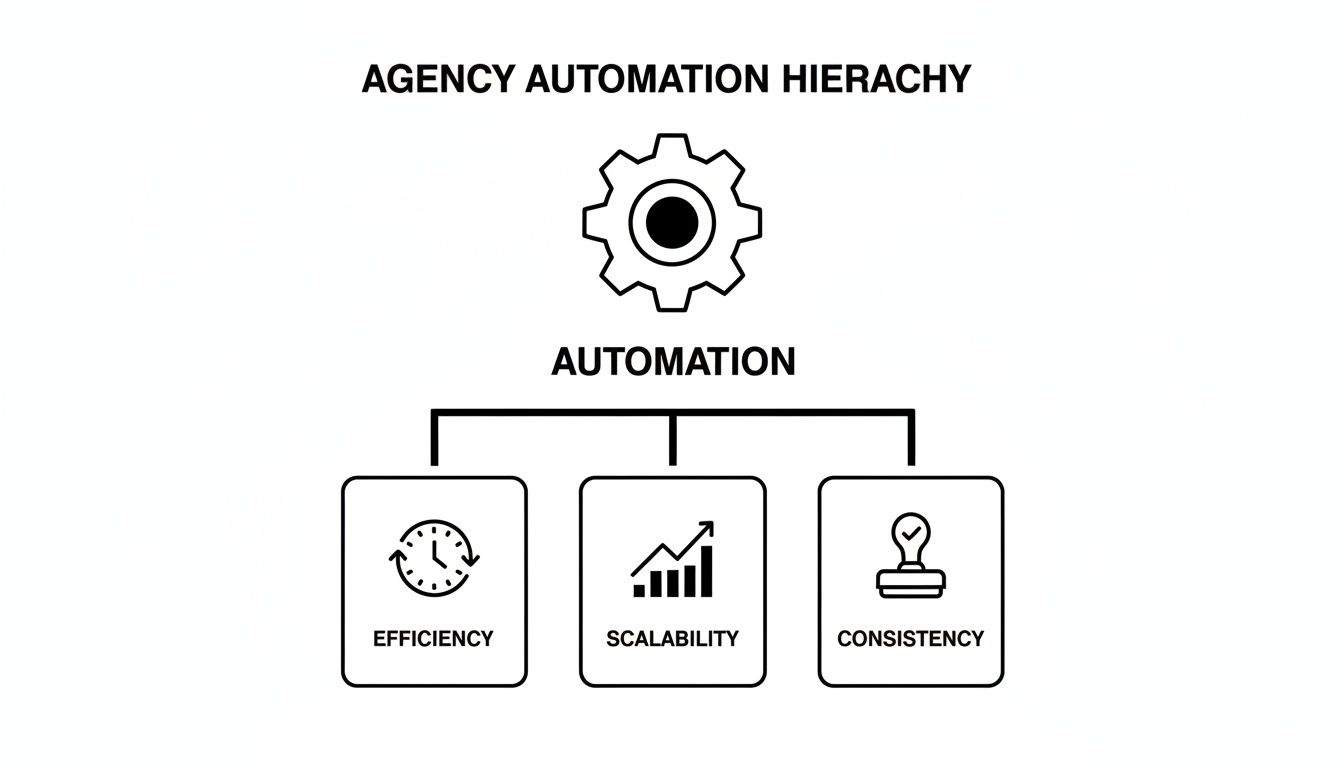
This hierarchy makes it clear: agency automation isn't about buying a tool. It's about building a strategic system that delivers tangible results for your business.
Building Repeatable Agency Workflows
A multi-client system is only as effective as the workflows running inside it. Your aim should be to standardize about 80% of the repeatable work. This frees up your team to pour their expertise into the 20% that really moves the needle for each unique client.
To get started, focus on standardizing these three critical areas:
-
Streamlined Client Onboarding: The moment a new client signs on, an automated workflow should kick in. This sequence can assign tasks to your team, send requests for brand assets, and set up all the necessary user permissions. It guarantees nothing falls through the cracks and makes your agency look professional and organized from day one.
-
Campaign Templates: Build out a library of pre-made campaign templates for common use cases, like a welcome email series or a long-term lead nurturing flow. If your agency signs five new clients in one week, you could simply clone a master campaign, customize the branding and copy, and have them all live in a fraction of the time. We're talking minutes, not days.
-
Universal Lead Capture: Establish a consistent, reliable way to capture leads across every client website. Tools like BizSage are great for this, allowing you to deploy client-trained AI chat widgets that do more than just answer questions. They can detect user intent and capture qualified leads right inside the conversation.
A templated system doesn’t mean you’re delivering a generic, cookie-cutter service. It means you’re building on a rock-solid foundation that allows for rapid customization, freeing up your team for the high-value strategic work clients pay for.
White-Labeling Your Automation Platform
The final piece of the puzzle is white-labeling your technology. When clients log into their dashboard, it should feel like an extension of your agency, not some third-party software you happen to use.
Instead of seeing a dashboard that says "Powered by SomeTool," it proudly displays "Powered by Your Agency." This simple change transforms a piece of software into your proprietary solution. It makes your services stickier and shows clients just how integrated you are with their business. It’s a subtle detail, but it’s a powerful way to own the entire client experience.
Automating Client Lead Generation and Nurturing
Getting your own agency operations in order is a great start, but the real magic happens when you use automation to deliver incredible, tangible results for your clients. We're talking about building systems that capture and nurture leads 24/7, effectively turning a client's website from a static brochure into an active sales assistant. You move beyond basic contact forms and start engineering intelligent workflows that engage prospects the moment they show interest.

These automated systems can look like a lot of different things in practice. Maybe it's a smart email sequence that kicks off the second a user downloads a whitepaper. Or perhaps it's scheduling an entire month of social media content in a single afternoon. You can even deploy chatbots that handle common questions instantly. The point is to create a network of touchpoints that guides a potential customer from being vaguely curious to genuinely wanting to talk business.
Capturing Leads with Intelligent Automation
Modern automation platforms have moved way past the clunky, first-generation chatbots. Using tools like BizSage, agencies can now set up client-trained AI agents that have a deep understanding of each client's specific business, services, and customers. These agents rely on intent detection to pinpoint the exact moment a user is signaling they're ready to take the next step.
For instance, imagine a visitor starts asking very specific questions about pricing tiers or implementation details. The AI recognizes this buying signal and can dynamically slide a lead capture form right into the chat conversation. Just like that, you've captured a high-intent lead at their peak moment of engagement.
An automated lead capture system doesn't just collect contacts; it identifies and qualifies prospects in real time, handing your clients warmer, more engaged leads without any manual intervention.
To get the most out of this, you can program conversation starters that proactively address common questions or highlight popular services. A few effective triggers include:
- Proactive Greetings: "Hi there! I see you're looking at our enterprise solutions. Can I help you find the right plan?"
- Behavior-Based Prompts: Triggering a chat window when a user has spent more than 60 seconds on a key service page.
- Exit-Intent Offers: Presenting a discount or a valuable resource just before a visitor is about to leave the site.
Nurturing Leads Toward Conversion
Getting the lead is just the first step; now the real work of nurturing begins. This is where automated sequences truly shine. A freshly captured lead can be instantly pushed into your client’s CRM and immediately enrolled in a welcome email series or a long-term drip campaign. This entire process is designed to build trust and deliver value over time, ensuring no lead ever falls through the cracks.
The industry is moving fast on this. Recent data shows that 79% of marketers are now automating their customer journeys, and 64% are already using a mix of automation and AI. You can dig deeper into the latest marketing automation statistics and trends to see where things are headed. For agencies, mastering these tools isn't just about efficiency—it's about becoming an indispensable growth engine for every client you serve.
Integrating Your Tech Stack for Seamless Operations
Juggling a dozen different tools for a dozen different clients is a surefire way to burn out your team. This "tool fatigue" creates data silos, leads to missed opportunities, and wastes countless hours on mind-numbing manual data entry. For agencies today, an integrated tech stack isn't just a nice-to-have; it's the very backbone of efficient, scalable service.
Think of your marketing automation for agencies platform as a central nervous system. It needs to talk effortlessly with every other critical tool in your arsenal and, just as importantly, in your client's. This creates a single source of truth where data flows freely, giving you a complete picture of the customer journey without anyone having to copy and paste a thing.
Creating a Unified Client Ecosystem
The real goal here is to build a closed-loop system where an action in one platform automatically triggers a reaction in another. This is where modern, API-first platforms really pull their weight, giving you the flexibility to stitch together different systems into one cohesive machine.
For an agency, the most critical connections to make from your central automation hub are:
- Client CMS (e.g., WordPress): Connecting here lets you personalize content on the fly and track what users are doing right on your client's website.
- Client CRM (e.g., HubSpot, Salesforce): This is huge. You can automatically push new leads from your campaigns straight into the client’s sales pipeline, complete with all the data on how they got there.
- Analytics Tools (e.g., Google Analytics): Syncing campaign data creates much richer performance reports, directly tying your marketing efforts to website traffic and conversions.
To truly get your operations humming, integrating with marketing automation tools is non-negotiable for maintaining clean data and getting that full, end-to-end visibility.
An integrated stack transforms your agency from a service provider into a strategic partner. You're not just running campaigns; you're building and managing the entire data infrastructure that drives client growth.
An Integration Example in Action
So, what does this look like in the real world?
Let’s bring in a modern tool, like a client-trained AI agent. Imagine your agency deploys a BizSage agent on a client's website. This isn't just any chatbot; it has been specifically trained on their products, services, and FAQs.
The agent crawls the site to build its knowledge base, engages visitors with genuinely helpful answers, and spots high-intent leads during conversations. The moment a lead is captured, the integration magic happens: the agent instantly pushes the contact info and full conversation history directly into the client’s CRM. This all unfolds in real-time without a single manual touchpoint, giving you that perfect, 360-degree view of the customer journey from their first click to the final sale.
Proving Your Value with Automated Reporting
Automation without results is just a fancy, expensive hobby. For any agency, the real magic happens when you can translate all that sophisticated workflow-building into undeniable proof of value for your clients. This is where automated reporting changes the game entirely. It lets you pivot the conversation from, "Here's a list of things we did last month," to "Here's the actual, measurable growth we delivered for your business."

We've all been there—the mind-numbing hours spent pulling data from a dozen different platforms, wrestling with spreadsheets, and trying to stitch it all into a coherent report. Automated reporting puts an end to that manual grind. Instead, you get dynamic, real-time dashboards that shine a spotlight on what clients actually care about: results.
This frees up your most valuable client-facing time. You can stop just recounting past activities and start focusing on high-level strategy and what’s next.
Key Metrics That Prove Your ROI
Every client’s goals are a little different, but a core set of key performance indicators (KPIs) almost always tells a powerful story of growth. Your automated dashboards need to put these front and center to make your impact impossible to miss.
- Lead Volume & Quality: It’s great to show you're bringing in more leads, but the real win is showing you're bringing in the right ones. Track the total number of new leads, but more importantly, show the breakdown between Marketing Qualified Leads (MQLs) and Sales Qualified Leads (SQLs). This proves you’re delivering value, not just volume.
- Conversion Rate: This is your proof that the nurturing sequences are working. It’s the percentage of leads who take that critical next step, whether it’s booking a demo or hitting "buy now." A rising conversion rate is a direct line to client happiness.
- Cost Per Acquisition (CPA): How much does it cost to land a new customer using your automated campaigns? A falling CPA is a beautiful thing. It shows you’re delivering better results more efficiently over time, making every dollar of your client's budget work harder.
- Agency Client Retention: This one is for you. Tracking how long clients stick around after you implement automation is a critical internal KPI. When clients see better results and get transparent reports, they have every reason to stay. It’s a powerful formula for reducing churn.
Automated reports give you tangible proof of your agency’s impact. A simple dashboard showing 25 new SQLs captured directly from a client-trained AI chat widget tells a much more compelling story than a list of completed tasks ever could.
To really drive home your agency's value, it's essential to frame these metrics in a way that directly answers the client's ultimate question: "What did I get for my money?"
The table below breaks down how to present these core KPIs to not only report on performance but also to reinforce the ROI of your partnership.
Key Automation KPIs to Demonstrate Agency ROI
| KPI | What It Measures for the Client | How It Proves Your Agency's Value |
|---|---|---|
| Lead Volume & Quality | The total pipeline of potential new business you're generating and how ready those leads are to buy. | "We didn't just find you 500 leads; we found you 75 sales-ready prospects, saving your sales team hours of qualification time." |
| Conversion Rate | The effectiveness of the marketing-to-sales handoff and the nurturing process you've built. | "Our automated follow-up sequence increased the demo request conversion rate by 15%, directly contributing to more qualified conversations." |
| Cost Per Acquisition (CPA) | How efficiently their marketing budget is being converted into actual paying customers. | "By automating top-of-funnel engagement, we lowered your CPA by 22% this quarter, effectively stretching your budget further." |
| Sales Cycle Length | The average time it takes for a lead to become a customer, showing the speed of your funnel. | "Our lead scoring and nurturing workflows have shortened the average sales cycle by 12 days, getting revenue in the door faster." |
| Customer Lifetime Value (CLV) | The total revenue a client can expect from a single customer, influenced by your retention and upsell campaigns. | "The automated onboarding and check-in campaigns we launched have contributed to a 10% increase in average Customer Lifetime Value." |
By presenting data this way, you're not just a service provider—you're a strategic growth partner.
Telling a Story with Data
The best reports don't just dump numbers on a client; they tell a narrative of progress. Think about building a dashboard that visualizes the entire customer journey, from first touch to final sale.
You can show exactly how an interaction on a social media ad led to a website visit, which triggered a personalized email sequence, and ultimately resulted in an SQL being routed directly into the client’s CRM. This end-to-end visibility is what helps clients truly connect the dots between your daily activities and their bottom line.
Platforms like BizSage are built for this. When its AI agents capture leads on a client’s website, the source is crystal clear. You have an undeniable data point showing new business that you can attribute directly to your agency's efforts.
Picking the Right Tools and Sidestepping Common Pitfalls
Alright, you’ve done the planning, and now it’s time to pick your platform. This is a huge decision, one that will directly shape your team's day-to-day and the results you can brag about to clients. It's easy to get distracted by a million flashy features, but what you really need to zero in on are the core functions that make an agency's life easier.
Think about platforms built from the ground up for agencies. This means you should be looking for things that simplify juggling multiple client accounts from one central hub. Another non-negotiable is scalable pricing. You need a cost structure that grows with you, not one that punishes you with massive, unexpected bills the moment you start succeeding. As you're looking, it's also worth checking out some of the newer AI tools specifically designed for marketing agencies to see how they can plug into your main automation setup.
Steering Clear of Common Agency Traps
Even with the best software in the world, a few classic mistakes can trip you up before you even get started. Knowing what they are is half the battle.
-
Trap 1: The Overly Complicated Platform
We’ve all seen it. You sign up for a beast of a tool with a thousand features, but your team ends up using only about 10% of them. All that extra complexity just slows everyone down and adds a layer of frustration to their work.- How to Avoid It: Go for simplicity and a user-friendly interface. A platform that lets you get a client up and running quickly—like creating a trained AI agent in just a few minutes—is infinitely more valuable than a system that requires a PhD to operate.
-
Trap 2: The 'Set It and Forget It' Mindset
This is probably the most dangerous mistake of all. Treating automation like a crockpot you just turn on and walk away from is a recipe for failure. An untouched system becomes stale and ineffective fast, especially as your clients' businesses and their customers evolve.- How to Avoid It: Make continuous improvement part of your process. Modern tools like BizSage are great for this. You can schedule automatic content updates and regularly check in on conversation logs to tweak AI agent responses. This ensures your clients' automation is always sharp and performing at its best.
When you choose tools that actually fit your agency's workflow and commit to keeping them optimized, marketing automation stops being just another monthly software expense. It becomes a core strategic asset that actively drives growth for every client you serve.
Your Top Questions About Agency Automation, Answered
Let's be honest, diving into agency-wide marketing automation brings up some big questions. You're probably wondering about the cost, how it fits with your diverse client base, and—most importantly—how long it takes to actually see a return.
Getting these answers straight is the first step to making a smart investment.
How Much Does Marketing Automation for Agencies Really Cost?
There’s no single price tag. The cost can swing from a few hundred dollars a month to several thousand, depending on the platform you choose and how many clients you’re managing.
The smartest platforms, however, don't charge you based on your own growth. Look for predictable, per-client pricing models. This structure ensures your costs are directly tied to your revenue, so you stay profitable as you add more accounts. Always remember, the real measure isn't the price, but the ROI. Good automation should pay for itself many times over in saved hours and better client outcomes.
Will This Work for My B2B and B2C Clients?
Yes, absolutely. The beauty of a solid automation platform is its adaptability. While the strategies for a B2B tech firm and a B2C e-commerce brand are worlds apart, the foundational principles of automation—personalization, efficiency, and scale—are universal.
- For your B2B clients: Automation is a workhorse for nurturing leads through those long, complex sales cycles. It keeps your client top-of-mind without manual follow-up.
- For your B2C clients: This is where you can truly personalize the customer experience at scale, sending the right message to the right person at the right time.
The best systems let you run campaigns for both types of clients from one central hub, using tools like AI chatbots that can be trained to fit any business model.
The real power of marketing automation for agencies lies in its flexibility. A single, robust system can be tailored to drive results for a local retailer one day and a global SaaS company the next.
How Long Until We See a Real Payoff?
You'll feel some benefits almost immediately, like getting clients onboarded faster. But for the hard numbers—like a measurable jump in qualified leads—you should plan on seeing significant results within 3 to 6 months.
Why that long? It takes time to gather enough data to see what’s working, fine-tune your campaigns, and let the momentum build.
That said, some platforms can speed things up. For instance, creating a custom-trained AI agent for a client can take just minutes, delivering value from the get-go. The agencies that win with automation see it as a long-term strategy for continuous growth, not just a quick fix.
Ready to deploy intelligent, client-trained AI agents that prove your value and scale your agency? BizSage lets you onboard clients in minutes, automate lead capture, and deliver measurable results—all under your brand. Discover how it works.