
Think of a chat bot for a website as the best employee you've ever had. It shows up to work 24/7, never calls in sick, and is always ready to instantly help every single visitor who lands on your page. It's like having a dedicated concierge who greets people, answers their most common questions, and points them toward the right product or person.
Suddenly, your website isn't just a static brochure—it's an interactive front door to your business.
How a Chat Bot Becomes Your Website's Best Employee
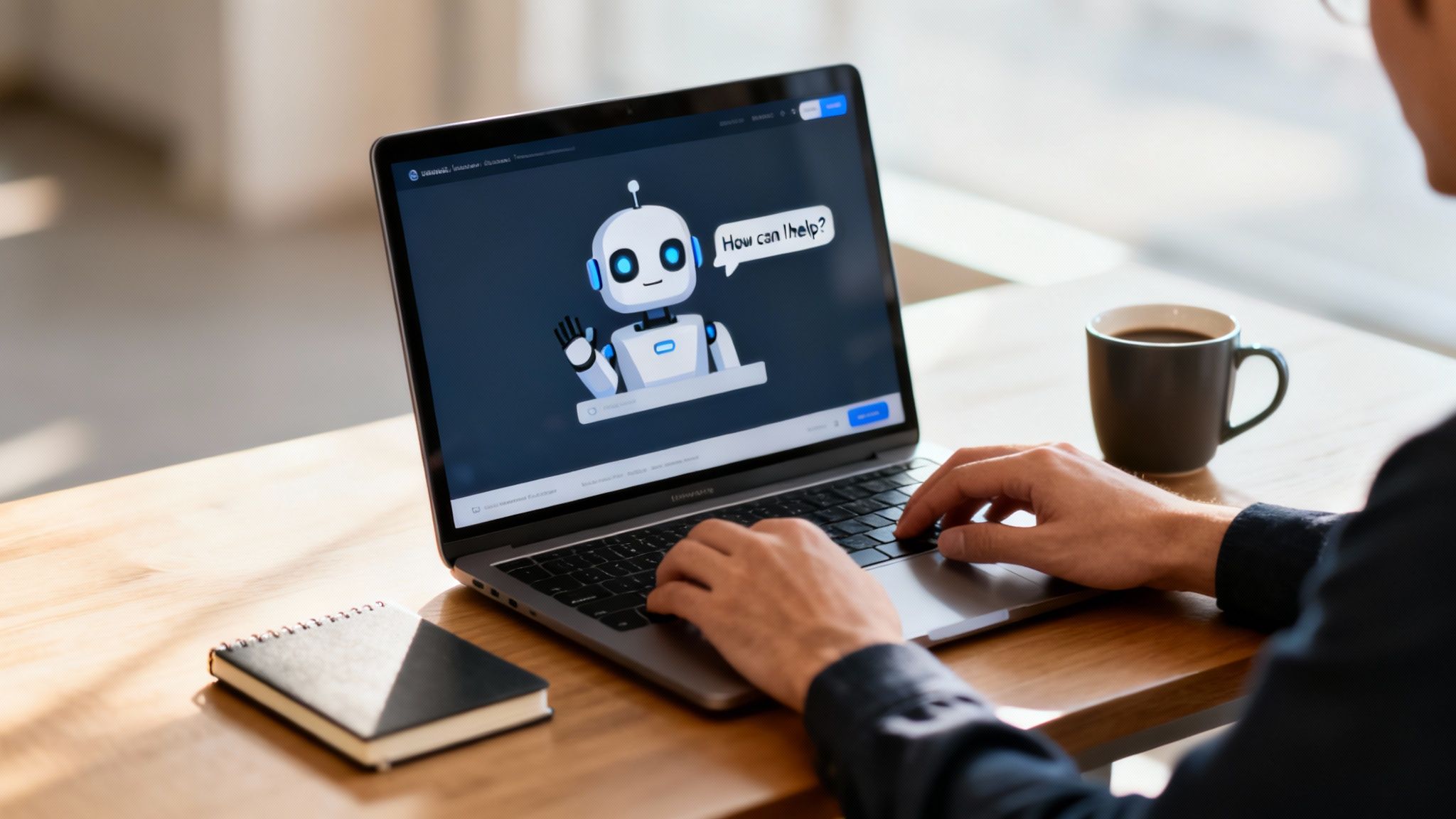
If you've ever felt overwhelmed by the constant ping of customer questions, you're not alone. This is exactly where chatbots make a real difference. In fact, they now handle a massive 49% of all customer interactions on websites. That's not just a statistic; it's a lifeline for busy teams. Imagine training a new assistant on all your site's content in just minutes, ready to deflect those repetitive questions day and night.
We've come a long way from the clunky, scripted bots of the past. Today's chatbot acts more like an intelligent assistant that’s been trained on your company's specific knowledge. It learns your brand's voice and becomes a reliable source of consistent, accurate information for any visitor, anytime.
Empowering Your Team, Not Replacing It
There's a common myth that chatbots are here to take jobs. From my experience, the opposite is true. The real purpose of a good chatbot is to make your human team better by automating the tedious, low-value questions that eat up so much of their day.
When the bot handles all the "Where's my order?" and "What are your hours?" queries, your human experts are freed up to focus on work that actually matters:
- Solving tricky problems that require real empathy and critical thinking.
- Nurturing relationships with your most important customers.
- Closing big deals that need a skilled, personal touch.
The chatbot becomes a smart filter, handling the first line of inquiry so only the most complex and valuable conversations land on your team's plate.
Turning Your Content into Conversations
The real breakthrough is how modern chatbots learn. With platforms like BizSage, even non-technical folks can build a smart assistant just by feeding it website URLs, help center articles, or product manuals. The bot absorbs all that information and creates a conversational "Company Brain."
To really make a chatbot your best employee, it helps to understand the full scope of AI automation services that power these tools behind the scenes.
This simple step transforms your website from a one-way broadcast into a two-way dialogue. Visitors don't have to hunt for answers anymore—they can just ask. This instant engagement keeps customers happy and moves your business goals forward, around the clock.
2. What Are the Different Types of Website Chatbots?
Not all chatbots are built the same. Far from it. When you're looking for one, you'll quickly find they fall into two main camps: the simple, script-followers and the sophisticated, brainy AI assistants. Picking the right one really comes down to what you need it to do.
The Old Guard: Rule-Based Chatbots
Think of a rule-based chatbot like an interactive phone menu (IVR) that lives on your website. It’s essentially a flowchart brought to life. A visitor is presented with a set of buttons, they click one, and the bot serves up the next set of pre-programmed options. It’s a very linear, “if this, then that” kind of conversation.
These bots are great for highly specific, repetitive tasks where you know exactly what path a user needs to take. They don't think for themselves; they just stick to the script you've written.
Here’s what they’re good at:
- Simple Lead Qualification: "Are you a business with over 50 employees?"
- Booking a Meeting: "Would you like to schedule for Tuesday or Thursday?"
- Basic Routing: "Are you looking for Sales, Support, or Billing?"
The appeal here is total control. You map out every single interaction, so there are no surprises. But that's also their biggest weakness. If a customer asks something a tiny bit outside the script—even rephrasing a question—the bot hits a wall. The result is often a frustrating, "Sorry, I didn't understand that."
The New Standard: AI-Powered Chatbots
This is where things get interesting. An AI-powered chatbot, like the ones we build at BizSage, is less like a flowchart and more like your smartest employee. It doesn't rely on a rigid script. Instead, it uses natural language processing (NLP) to figure out what a person is actually asking, typos, slang, and all.
Imagine you could give a new hire a "brain" that has already absorbed every single page of your website, all your help docs, and every product spec sheet. That’s an AI chatbot.
When a visitor asks a question, it doesn't just look for a keyword. It understands the intent behind the question and crafts a genuinely helpful answer on the spot, pulling from the knowledge base you gave it.
An AI chatbot isn’t just following a script; it’s learning your business. You train it on your own content—your site, your files, your knowledge base—to create a true expert that can handle a massive range of questions with nuance.
This is what makes AI chatbots so much more powerful for creating a great customer experience. They can troubleshoot complex problems, explain detailed product features, and turn your static web content into interactive, helpful conversations.
Rule-Based vs. AI-Powered Chatbots: A Quick Comparison
To really see the difference, it helps to put them side-by-side. One is a simple tool for a fixed job, while the other is a dynamic assistant that can think on its feet.
| Feature | Rule-Based Chatbot | AI-Powered Chatbot (like BizSage) |
|---|---|---|
| Conversation Style | Scripted, follows a rigid decision tree (buttons/keywords). | Natural, conversational, understands user intent. |
| Flexibility | Very limited. Fails if the user deviates from the script. | Highly flexible. Can handle unexpected questions and typos. |
| Setup & Maintenance | Requires manually building and updating complex flowcharts. | Learns from your existing content (website, docs). Low upkeep. |
| Understanding | Only recognizes pre-defined keywords and phrases. | Uses NLP to understand context, slang, and complex queries. |
| Scalability | Difficult to scale. Every new question needs a new rule. | Easily scales as it can answer infinite variations of questions. |
| Best For | Simple, single-purpose tasks like booking a demo. | Customer support, lead generation, and in-depth product Q&A. |
Ultimately, the choice depends entirely on your goals. Do you need a simple tool for one predictable task, or are you looking for a smart assistant that can truly help your customers and grow with your business? For most companies today, the answer is leaning heavily toward AI.
The Real-World Business Impact of a Website Chatbot
Let's move past the technical jargon for a minute. The real value of a chat bot for a website isn't about the tech itself, but the tangible results it brings to your business. This isn't just a shiny new object; it's a strategic tool that directly impacts your bottom line across three key areas: customer support, sales, and even your own internal operations.
The most immediate win you'll see is in customer support. Think about all the repetitive questions your team answers every single day—"What are your hours?", "What's the return policy?", "How do I reset my password?". A chatbot handles these instantly and accurately, 24/7.
This simple shift frees up your human experts to tackle the complex, high-value problems that actually require their skills. Instead of being bogged down by routine queries, they can focus on solving unique customer issues and building real relationships.
Slashing Support Tickets and Boosting Efficiency
The efficiency gains here are massive. For online businesses where every second counts, a well-implemented chatbot can cut down support tickets by a staggering 40-70%. This isn't just a nice-to-have metric; it's a complete game-changer for your support team's sanity and your operational costs.
Some bots can handle up to 80% of all routine questions on their own. Imagine a visitor on your e-commerce site at 2 AM wondering about international shipping. Without a bot, that’s another email piling up for Monday morning. With one, they get an instant answer, and your team walks in to a much lighter workload.
Capturing and Qualifying Leads 24/7
From a sales angle, a chatbot is the best employee you'll ever have—it never sleeps. Your website is always open for business, but your sales team has to go home eventually. A chatbot bridges that gap, engaging potential customers the moment they show interest, day or night.
It can ask the right qualifying questions, collect contact info, and even book a demo right on your sales rep's calendar.
Think of it as an automated lead filter. The bot warms up prospects by answering their initial questions, so when a human salesperson finally connects, the lead is already informed, qualified, and much further down the buying path.
Ultimately, any website tool should help you improve website conversion rate, and chatbots do this directly by removing friction and guiding visitors smoothly toward a purchase.
This infographic really drives home the difference between the old-school scripted bots and the intelligent AI agents that are making this all possible.
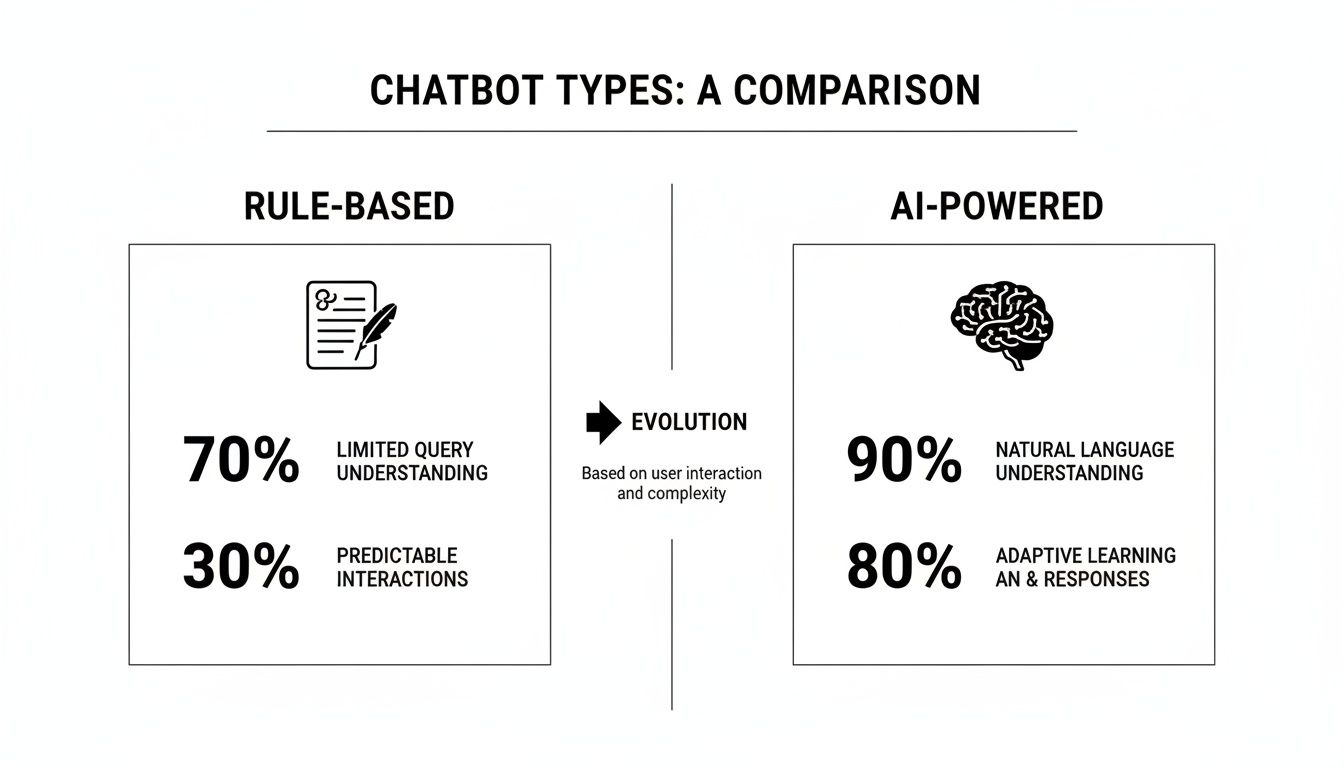
As you can see, modern AI bots move way beyond rigid scripts to create dynamic, helpful conversations that actually drive business forward.
Streamlining Internal Company Knowledge
The benefits don't stop with your customers. An internal chatbot can become your company's "single source of truth," a centralized brain for all your institutional knowledge.
Just think about all the time your team wastes digging through shared drives, old documents, and cluttered wikis to find a simple piece of information. An internal bot puts an end to that.
- Faster Onboarding: New hires can get up to speed by just asking the bot about company policies or processes instead of bugging their teammates.
- Instant Answers for Everyone: Any team member can get a quick answer on anything from HR benefits to a specific project detail without a painful search.
- Consistent Information: The bot guarantees everyone gets the same, up-to-date information, cutting down on confusion and costly mistakes.
By creating an easy-to-access knowledge hub, a chatbot doesn't just make your team more productive; it helps build a more self-sufficient and informed workforce. It’s a fundamental shift from searching to simply asking.
Must-Have Features in a Modern Chatbot Platform
Choosing the right chat bot for website tool can feel like a chore. With so many options out there, it’s easy to get lost in a sea of technical jargon and flashy marketing. Let's cut through all that and focus on the features that actually make a difference to your business.
To make a smart choice, you need to think beyond just basic chat. A great platform should let you build a helpful, on-brand assistant without needing to hire a team of developers. Think of this as your checklist for picking a tool that’s built for real-world results.
No-Code Content Training
The most critical feature of any modern chatbot is how it learns. You shouldn't have to write a single line of code or spend weeks wrestling with complex scripts. The best tools today learn directly from the content you already have.
Look for a platform that can pull information from multiple places, turning your bot into a genuine expert on your business. At a minimum, it should be able to learn from:
- Website Crawling: Automatically scanning specific pages or even your entire site.
- Document Uploads: Ingesting PDFs, Word docs, and other files like product manuals or internal FAQs.
- Direct Text Input: Letting you add specific questions and answers or little snippets of info whenever you need to.
This no-code approach is a game-changer. It means anyone on your team, from marketing to customer support, can help build and maintain the bot.
Deep Brand and Voice Customization
Your chatbot isn't just a tool; it's a direct reflection of your brand. A generic, robotic assistant can feel jarring and off-putting to customers. That’s why deep customization is an absolute must.
A top-tier platform will give you precise control over both the look and the personality of your chatbot. You should be able to tweak everything from the color of the chat window to the specific phrases it uses, ensuring every interaction feels like it’s truly coming from you.
This dashboard gives you a sense of what that control looks like. A platform like BizSage lets you manage everything from a single, intuitive hub.
This is the kind of centralized command center you want, putting you in charge of the bot's knowledge and personality.
Built-In Accuracy and Safety Controls
Trust is everything. A chatbot that confidently spouts wrong information is far worse than having no chatbot at all. Unfortunately, many AI models have a tendency to "hallucinate"—they'll just invent an answer when they don't know the real one. This is a huge risk to your brand's credibility.
One of the most important safety features is simply the bot's ability to say, "I don't know." The best platforms are built to only pull answers from the content you provide. If the information isn’t there, the bot will admit it instead of making something up.
This "closed ecosystem" approach is fundamental. It guarantees every response is grounded in your verified company knowledge, giving users reliable information every single time. It's the key difference between a professional tool and a risky gimmick.
Automated Knowledge Base Updates
Your business is always evolving—prices change, new products are launched, and policies get updated. A chatbot working off old information will quickly become a problem. But who has time to manually update a bot every time something changes?
This is where automated knowledge base updates become a lifesaver. Look for a platform that can automatically re-scan your website or other data sources on a schedule—say, every day or once a week. This "set it and forget it" feature keeps your chatbot perfectly in sync with your latest information, all without you lifting a finger. It's a simple function that saves a ton of time and prevents a world of headaches.
Your Step-by-Step Plan to Launch a Website Chatbot
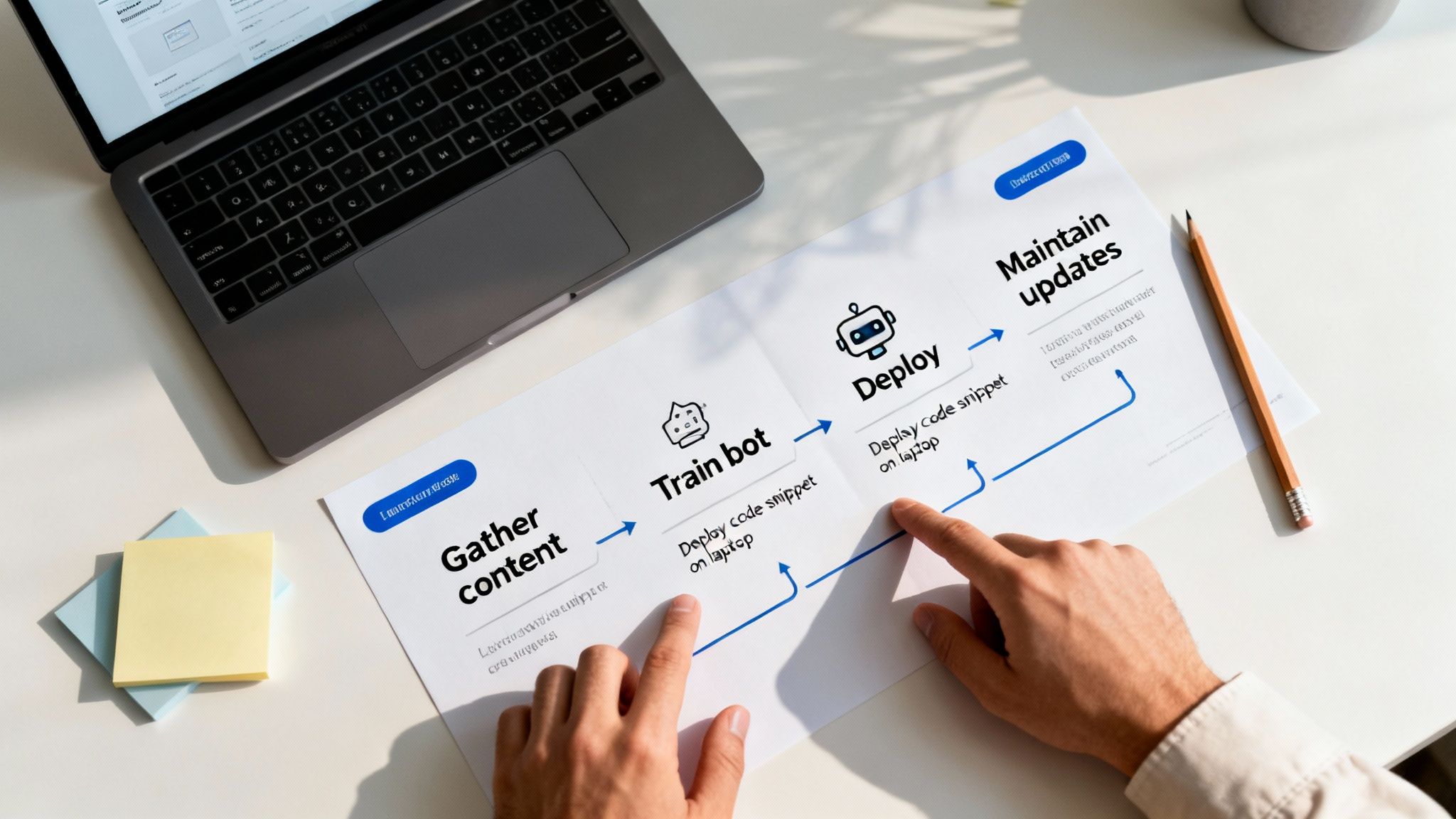
Putting a chat bot for a website to work sounds like a big, complicated tech project, right? The good news is that modern platforms have made it incredibly simple. The entire process is built to be user-friendly, which means you don’t need a team of developers to get it done. You're in the driver's seat.
Think of it as a straightforward, four-phase mission. Breaking it down this way lets you go from a blank slate to a fully functioning AI assistant in minutes, not months. The trick is to start small with a clear goal—like having the bot handle all questions about pricing—and build its knowledge from there. This makes the whole thing feel less daunting and starts delivering value right away.
Phase 1: Gather Your Knowledge Sources
First things first: what do you want your chatbot to know? This is the easiest part, because you already have everything you need. Your bot learns directly from the content you've already created, so your only job is to point it in the right direction.
Start by rounding up your key knowledge sources:
- Your Core Web Pages: Your pricing page, product or service descriptions, and your "About Us" page are perfect starting points.
- Support Docs: Grab your FAQs, help center articles, or any troubleshooting guides you have on hand.
- Key Files: Got PDF brochures, product manuals, or internal policy documents? The bot can digest those, too.
This collection of content effectively becomes your chatbot's "brain."
Phase 2: Train and Refine Your Bot
Once you have your materials, the real fun begins: training. With a platform like BizSage, this is as simple as copying and pasting URLs or uploading your files. The system gets to work, processing all that information and building its knowledge base in just a few minutes.
After the initial training, it's time to refine. This is where you get to test-drive the bot and make sure it sounds like you. Ask it the same questions your customers would, like "What are your business hours?" or "Tell me about your return policy." Based on its responses, you can give it feedback to fine-tune its personality—making it more formal, casual, or whatever feels right for your brand.
This testing phase is absolutely critical. It’s what ensures the chatbot not only gives the right answers but also communicates in a way that feels authentic, building trust with every single conversation.
Phase 3: Deploy to Your Website
With your chatbot trained and ready, it's time for the big launch. This step often sounds intimidating, but it’s shockingly simple. Most modern chatbot platforms will give you a single snippet of code.
You don't even need to know what the code means. All you have to do is copy it and paste it into your website’s header or footer. Almost every website builder out there—from WordPress and Shopify to Squarespace—has a simple way to do this. The whole thing usually takes less than five minutes.
Phase 4: Maintain and Improve
Finally, like any good employee, your chatbot needs a little upkeep to stay sharp. As your business evolves, your bot's knowledge needs to keep pace. The best part? You can put this on autopilot.
Set up a schedule for your chatbot to automatically re-crawl your website and other knowledge sources. You can have it check for new information daily, weekly, or monthly. This ensures that any update—a new price, a different service, or a policy change—is immediately reflected in the bot's answers. It's a simple, automated step that keeps your chat bot for a website a trustworthy resource without any extra work from you.
How BizSage Puts Your Website to Work
We've walked through what a chat bot for a website can really do—everything from cutting down support tickets to grabbing leads after everyone's gone home. Now, let’s get specific and look at how BizSage is built to solve these exact problems for small businesses and agencies.
Chances are, you’re dealing with a familiar set of headaches. Maybe it’s the same customer questions bogging down your team day after day. Perhaps it's the frustration of knowing potential customers are bouncing from your site overnight. Or it could be the simple chaos of having company information scattered everywhere.
BizSage was created to be the most direct fix for these issues, turning the content you already have into your most reliable assistant.
Your All-in-One Tool for Instant Answers
What really makes BizSage different is our obsession with making this technology easy for anyone to use. You shouldn't need a development team or a months-long project to get a powerful chatbot up and running.
That idea is at the heart of everything we do:
- Setup in Minutes, Not Months: Our whole process is built for speed. If you know how to copy a website link or upload a document, you have all the technical skill you need to launch your own BizSage agent.
- A Relentless Focus on Accuracy: We designed BizSage to stop the AI from making things up—a problem known as "hallucination." Your bot only learns from your content. If it can't find a verified answer in the material you provided, it’s programmed to say so. This simple feature is key to protecting your brand's credibility.
- Simple, Scalable Pricing: No confusing "per-seat" pricing or hidden fees that catch you by surprise. Our plans are easy to understand and grow with your business, delivering clear value at every step.
There's a reason the market for website chatbots is exploding. Projections show it will climb to $15.5 billion by 2028, and it's small and mid-sized businesses that are driving that growth. Why? The payoff is undeniable, with some studies showing an $8 return for every $1 spent. This isn't just a trend; it's a fundamental shift, and you can discover more chatbot statistics that highlight this momentum.
Turn Your Content into Your Best Employee
At the end of the day, BizSage is more than just another software tool. It's the partner that finally puts your website pages, help articles, and internal documents to work around the clock.
It fields the easy questions so your team can focus on the important stuff. It talks to potential customers when your sales team is asleep. And it gives your own staff a single place to get instant, correct answers.
BizSage turns your static website into a dynamic, helpful resource that’s always on. It’s all about giving people the right answers, right now, in a way that builds trust and moves your business forward.
It's time to stop losing leads and letting your team get buried in repetitive tasks. Let's turn the knowledge you’ve already created into your most efficient employee.
Frequently Asked Questions
Even after mapping everything out, it’s natural to have a few questions about adding a chat bot to a website. Let's tackle the most common ones we hear from business owners. This should clear up any lingering doubts and help you move forward confidently.
We’ll cover everything from the technical side of things (or lack thereof) to how a chatbot can actually boost, not hurt, your website's performance. Think of this as your final pre-flight check.
Do I Need to Be a Coder to Set This Up?
Not at all. The short answer is a resounding no. Modern platforms like BizSage are built specifically for business users, not developers. You need zero technical skills to get a powerful AI assistant up and running.
Honestly, the whole process has been made incredibly simple. If you know how to copy a website link or upload a file from your computer, you have all the technical expertise you need to train your bot. Getting it live on your site is just as easy—it usually just means pasting a single line of code into your website editor, which takes a couple of minutes, tops.
Will a Chatbot Mess Up My Website's SEO?
Quite the opposite, actually. A well-designed chatbot can give your search engine optimization (SEO) a real boost. How? By dramatically improving the experience for your visitors, which is exactly what search engines want to see.
When a bot engages people right away and gives them instant answers, it keeps them on your site longer. This increases dwell time and lowers your bounce rate (how many people leave after viewing just one page). Those two metrics are powerful signals to search engines like Google, telling them your site is valuable and engaging. Over time, this can lead to better rankings.
How Do I Make Sure the Chatbot Gives Correct Answers?
Accuracy comes down to one core principle: you must control what the bot knows. The best chatbot platforms operate as "closed ecosystems," which is a fancy way of saying they can only provide answers based on the information you give them.
The secret is to train the bot exclusively on your own verified content. With a tool like BizSage, you feed it your website pages, help desk articles, product specs, and internal documents. This stops it from guessing or pulling random, unreliable information from the wider internet.
There's also a critical safety net built-in. If the bot is asked a question and can't find the answer in its knowledge base, it's programmed to say, "I don't know." This honesty is huge for protecting your brand’s credibility and making sure your users can trust the information they receive.
Can a Chatbot Actually Help My Business Get More Leads?
Absolutely. A chat bot for a website is one of the most effective lead-generation tools you can have. It’s like having a salesperson on duty 24/7, ready to engage potential customers the second they show interest.
Here’s a quick look at how it automates the top of your sales funnel:
- Instant Engagement: It greets every visitor and offers to help, stopping them from just clicking away.
- Lead Qualification: It can ask a few smart questions to figure out who's a serious buyer and who's just browsing.
- Information Capture: It collects key contact details like names, emails, and phone numbers.
- Meeting Scheduling: It can even sync with your sales team's calendars to book demos or appointments on the spot.
This entire process runs on autopilot, making sure you never miss a chance to connect with a potential customer. It turns your passive website traffic into a steady stream of qualified leads, even while you sleep.
Ready to turn your website content into your most reliable employee? With BizSage, you can launch an AI assistant trained on your unique knowledge in minutes, not months. Start deflecting repetitive questions and capturing more leads today. Get started with BizSage.