
Imagine having a team member who has memorized every single detail about your business. This person works 24/7 without ever taking a break and can instantly answer any customer question thrown their way. That, in a nutshell, is the power of a modern AI chat website. These aren't just bits of code; they're sophisticated conversational partners built to provide immediate, on-brand support.
What Are AI Chat Websites and Why Do They Matter Now?
At its heart, an AI chat website is an automated conversational tool that lives directly on your webpage. But it’s a world away from the clunky, rule-based chatbots you might remember. Those old bots could only follow rigid scripts. Today’s AI agents run on large language models (LLMs), which allow them to understand context, figure out what a user really wants, and generate natural, human-like responses drawn directly from your company’s own knowledge base.
Think of it like this: a traditional chatbot is like a frustrating phone tree. You know, "Press 1 for sales, press 2 for support." It’s limited and often leads to a dead end. An AI chat website, however, is like having an expert employee on standby, ready to have a real conversation. This leap from pre-programmed responses to genuine dialogue is exactly why this technology is taking off.
The Perfect Storm Fueling AI Chat Adoption
Three major forces have converged to make AI chat a must-have tool for businesses. First, the AI technology itself has become incredibly powerful and much more accessible. Second, customer expectations have gone through the roof—people now demand instant answers, 24/7. And finally, businesses are always on the hunt for ways to grow their operations without having to massively increase their headcount.
This convergence creates a clear and compelling business case:
- Meet Customer Demand: You can provide instant, accurate answers anytime, day or night, which goes a long way toward keeping customers happy.
- Increase Efficiency: Automate all those repetitive questions about pricing, features, or policies. This frees up your human team to tackle the more complex issues.
- Scale Without Bloat: Handle a huge volume of inquiries at once without hiring more staff. This gives even small businesses the kind of support capabilities that were once reserved for large enterprises.
The market growth tells the same story. In less than a decade, AI chat has moved from a niche experiment to a major category in business software. The global chatbot market, valued at $7.76 billion, is expected to hit roughly $27.29 billion by 2030. With about 80% of companies already using or planning to use AI-powered chatbots, the trend is clear. You can dive deeper into the AI chatbot market growth to see the full picture.
Differentiating AI From Traditional Chatbots
A key part of getting this right is understanding the difference between chatbots and human support and knowing when to use each one. Where old bots would stumble over complex questions, modern AI bridges the gap by handling nuanced queries with surprising precision. It’s not about replacing your expert human team; it’s about empowering them by filtering out all the routine work.
To make this clearer, let's break down the different kinds of chatbots you might encounter.
Understanding the Different Types of AI Chatbots
A clear comparison to help you understand where business-focused AI agents fit into the broader landscape.
| Chatbot Type | Primary Function | Knowledge Source | Best For Business |
|---|---|---|---|
| Rule-Based Chatbot | Follows pre-defined scripts and conversation flows. | Programmed, static decision trees. | Simple, repetitive tasks like appointment booking or basic FAQs. |
| Generative AI Assistant | Creates new, original content and answers based on user prompts. | Massive, public internet datasets (e.g., ChatGPT). | Creative tasks, brainstorming, and general knowledge queries. |
| Business AI Agent | Provides precise, verified answers based only on your company's data. | Your private, curated knowledge base. | Customer support, internal training, and lead qualification. |
As you can see, a Business AI Agent—like the ones we help businesses build—is specifically designed to be a reliable source of company information, ensuring every answer is accurate and on-brand.
The real value of an AI chat website isn't just answering questions—it's about creating a consistent, reliable, and instantly accessible source of truth for your customers and your team.
This setup allows your key employees to step away from the front lines of repetitive inquiries and focus on high-value interactions that require real empathy, strategic thinking, or complex problem-solving. The AI handles the "what" and "how," so your team can focus on the "why." This dynamic partnership is what makes AI chat websites such a practical and powerful tool for any growing business. They solve a critical challenge: providing exceptional service at scale.
How an AI Chat Website Learns Your Business
So, how does an AI go from a blank slate to a knowledgeable expert on your business? Let's pull back the curtain, minus the super technical jargon.
Imagine you're onboarding a new hire who's incredibly smart and has a perfect memory, but knows absolutely nothing about your company. Your first job is to get them up to speed. It’s the same with an AI chatbot. You have to "train" this digital brain by feeding it the right information, but thankfully, you don't need a team of data scientists to do it.
The whole process boils down to a pretty simple three-step cycle.
First, the AI needs to do some reading. This is the ingestion phase. You simply point it toward your company's "sources of truth"—the core documents that define your business. This could be your website pages, your help center articles, detailed product manuals, or even internal policies. Most modern platforms make this a breeze; they can crawl your site automatically or you can just upload the files.
Next comes the understanding phase. The AI isn't just memorizing words like a parrot. It's actually analyzing the content to figure out concepts, context, and how different pieces of information relate to each other. It uses a clever technique to turn all that text into a kind of digital map of your business knowledge. This map lets it pinpoint the right answer in a flash, even if a customer phrases their question in a way you never anticipated.
Finally, we get to the generation step. When a customer types in a question, the AI uses its knowledge map to find the most relevant snippets from the documents you provided. It then pulls those facts together and crafts a clear, conversational answer, often in a tone that matches your brand's voice. This whole trip—from question to answer—happens in just a few seconds.
This handy diagram shows you exactly how that flow works.
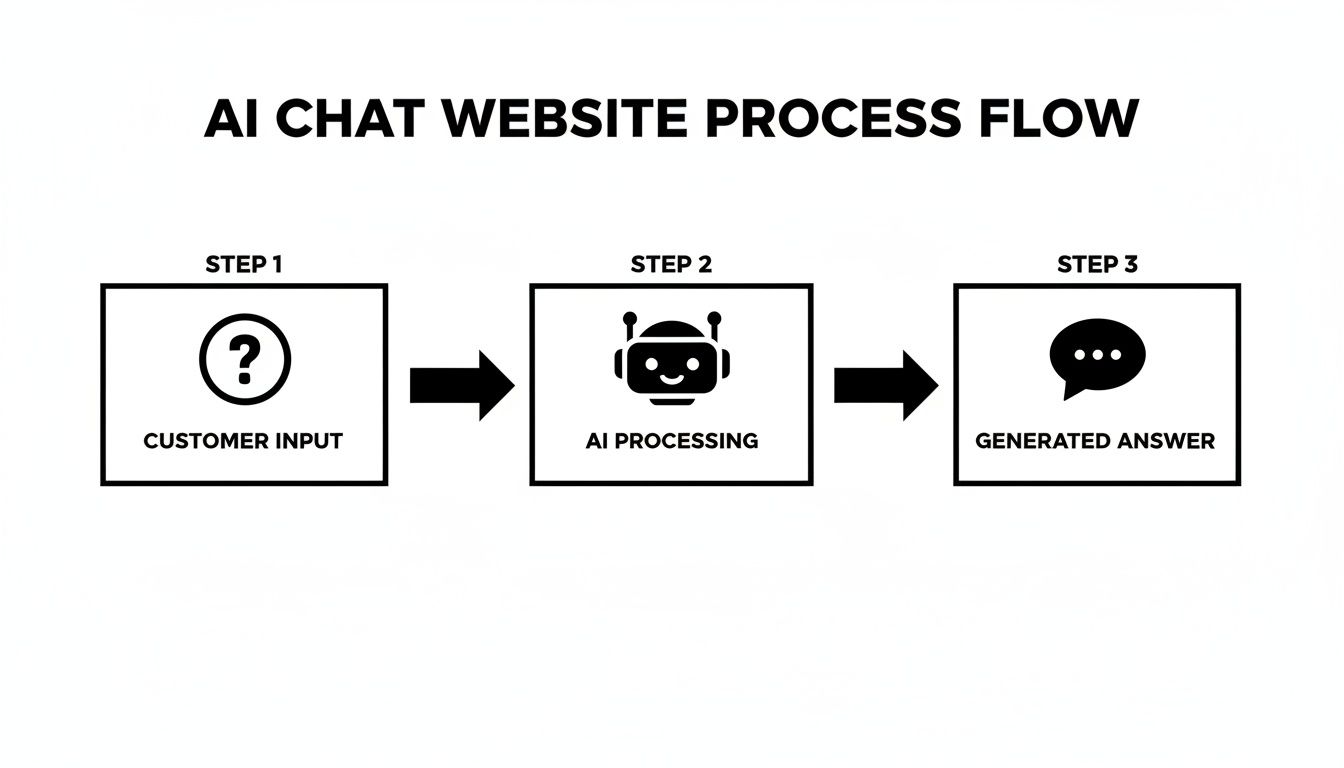
As you can see, the AI acts as a smart go-between, connecting what the customer is asking for with the verified information you've provided to deliver a genuinely helpful response.
The Secret Sauce for Accurate Answers
There’s a key piece of technology that makes a business-grade AI so reliable, and it’s called Retrieval-Augmented Generation (RAG). It sounds complicated, but the idea behind it is straightforward. RAG basically forces the AI to behave like a diligent researcher instead of a creative storyteller.
Rather than just making up an answer based on what it learned from the entire internet, an AI using RAG is confined to only using the information you gave it. It first "retrieves" the relevant facts from your knowledge base and then "generates" an answer based strictly on those facts.
This gives you two massive advantages:
- It practically eliminates "hallucinations." This is when an AI just invents information. RAG prevents that by tethering every response to your own content.
- It builds trust with your customers. Many platforms, including BizSage, can even cite their sources, showing the user exactly which document the answer came from.
By grounding every answer in your verified content, RAG transforms a general AI model into a specialized expert dedicated exclusively to your business. This is the critical difference between a fun consumer tool and a trustworthy business solution.
This disciplined approach is what turns your AI chat website into a dependable extension of your team. It delivers accurate, consistent, and helpful answers 24/7, which creates a much better experience for your customers and frees up your human staff to handle the complex issues that truly need them.
Must-Have Features for a Business AI Chat Platform
Let's be clear: not all AI chat websites are created equal. While plenty of tools can handle a basic back-and-forth, a platform truly built for business offers specific features that deliver real, measurable value. It's time to look past the underlying tech and focus on the practical capabilities that separate a fun novelty from a core business tool.
Getting this right is all about choosing a platform that actually solves your problems. You need something that fits into your workflow, reflects your brand, and gives answers that both your customers and your team can trust.
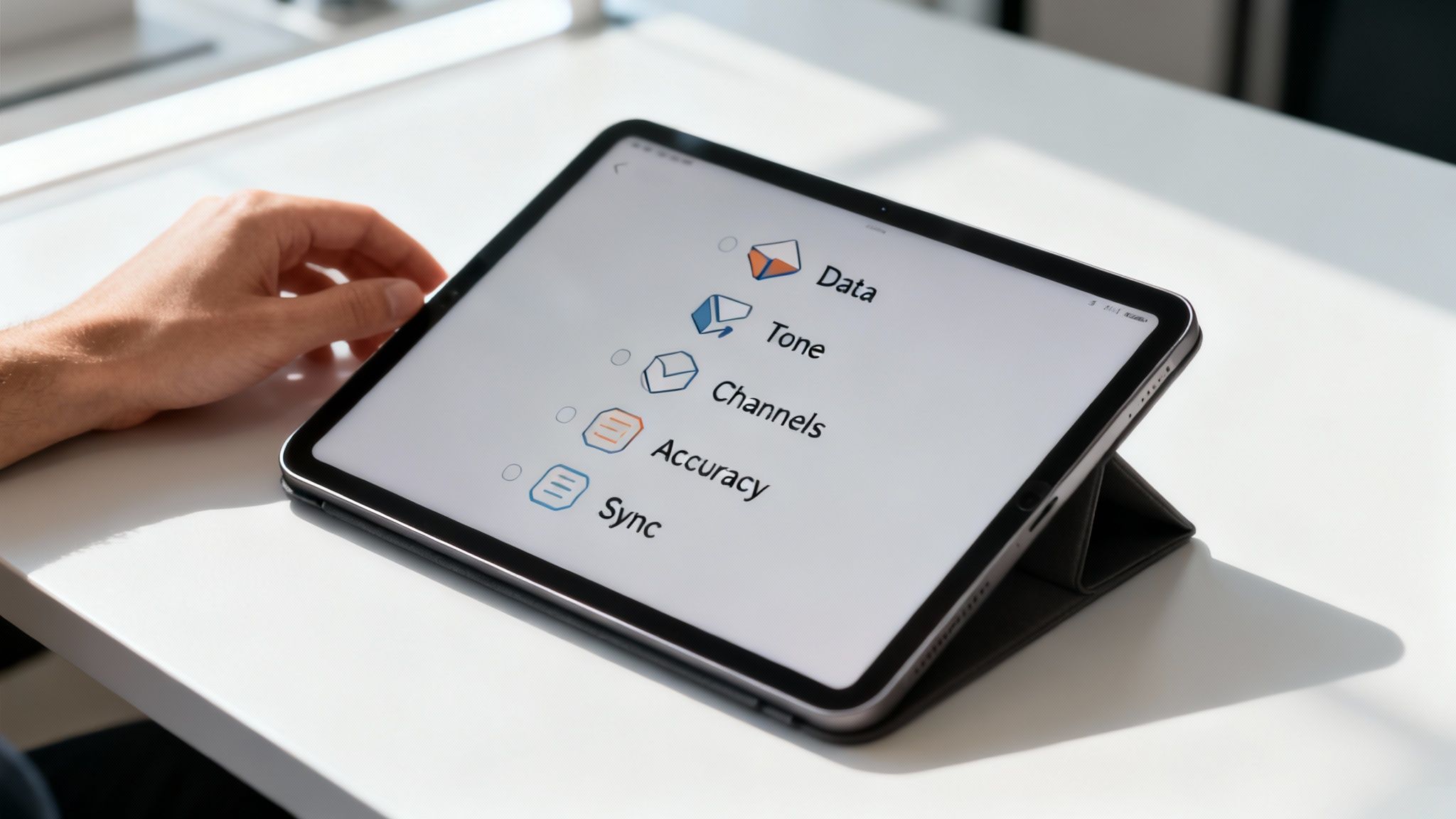
Effortless Knowledge Sourcing
An AI agent is only as smart as the information you give it. A top-tier platform understands this and makes the training process incredibly simple. You shouldn't need to hire a developer or a data scientist just to get up and running. The best systems give you flexible, no-code options for feeding the AI your company’s knowledge.
This is critical because your business information is probably scattered across different documents and web pages. Look for platforms that can pull from various sources, letting you build a complete knowledge base with just a few clicks.
Key sourcing methods to look for:
- Website Crawling: Automatically scans and learns from your entire website or just the specific pages you point it to.
- Document Uploads: Lets you directly upload files like PDFs, Word docs, or text files—perfect for product manuals, internal policies, or support scripts.
- Direct URL Pasting: Easily add knowledge from a specific blog post, landing page, or help center article by just pasting the link.
Platforms like BizSage nail this by letting you train your AI with the assets you already have, instead of forcing you to create new content from scratch. This slashes setup time and makes the tool accessible to anyone on your team.
Precise Brand and Tone Customization
Think of your AI chat agent as a digital front door to your business. Its personality matters. A generic, robotic response can feel cold and might even damage the customer experience you've worked so hard to build. That’s why the ability to customize the AI's tone of voice to match your brand is a non-negotiable feature.
Whether your brand is formal and professional, friendly and casual, or witty and fun, the AI should sound like an extension of your team. This ensures every interaction reinforces your brand values. For example, you could instruct the AI to "be helpful and encouraging but avoid using slang," or "maintain a professional and expert tone at all times." This level of control is essential for keeping your brand presence consistent.
The goal isn't just to provide correct answers; it's to provide correct answers in a voice that your customers recognize and trust. Brand alignment turns a functional tool into a memorable experience.
Multi-Channel Deployment Options
Your customers are everywhere, so your AI support should be, too. A platform that traps your chatbot in a single widget on your website is seriously limiting your reach. Look for flexible deployment options that let you meet your audience wherever they happen to be.
This adaptability makes your AI agent a much more valuable asset. You can use the same brain—the same trained AI—in multiple places without any extra work, guaranteeing consistent answers across your entire digital footprint.
Common deployment options include:
- Website Embed: The classic chat widget that sits on your website pages.
- Dedicated Landing Page: A shareable, full-page chat interface you can link to from emails, social media posts, or marketing campaigns.
- Internal Knowledge Hub: Use the agent on a private, password-protected page for your internal team to ask questions about company processes or policies.
Automated Knowledge Syncing
Your business is always changing—prices get updated, products are launched, and policies are revised. Manually updating your AI’s knowledge base every single time is a recipe for tedium and mistakes. This is where automated syncing becomes a game-changer.
This feature lets you schedule automatic re-scans of your data sources on a daily, weekly, or monthly basis. It ensures your AI chat website is never out of date, giving customers the most current information without anyone on your team having to lift a finger. This "set it and forget it" capability saves countless hours and, more importantly, eliminates the risk of giving customers bad information.
Putting Your AI Chat Website to Work in the Real World
It’s one thing to talk about the features of AI chat websites, but it's another to see how they solve actual business problems. That’s when the lightbulb really goes on. This isn't just about deflecting a few support tickets. It's about finding new ways to work smarter, making customers happier, and freeing up your team to focus on the work that truly matters.
From answering a customer’s product question late on a Saturday night to helping a new hire get their bearings, the applications are both practical and surprisingly powerful. Let’s dig into some of the most common ways businesses are putting these AI agents to work right now.
Transform Your Customer Support Experience
This is probably the most popular, and often the most valuable, way to use an AI chat agent. Your customers have questions around the clock, but your team can't be everywhere at once. Think of the AI as your tireless first line of defense, ready with instant, accurate answers to all the common stuff.
Every day, your team likely answers the same questions over and over: "What's your return policy?" "How does shipping work?" "Can you explain this feature again?" An AI agent can handle 100% of those, letting your human experts focus on the tricky, high-stakes issues that need a real person's touch. The result? Customers get faster answers, and your team avoids burnout.
The data backs this up. Customer support is the single biggest use case for this tech, making up about 42.4% of the entire chatbot market. With a staggering 80% of companies already using or planning to use AI for customer service, it’s not a question of if this becomes standard, but when. You can discover more insights about AI adoption in business to see just how much it's changing what customers expect.
Boost Sales and Qualify Leads Around the Clock
Picture this: it’s 11 PM, and a potential customer is on your pricing page. They have one last question that’s holding them back from buying. If they can’t get an answer right away, that spark of interest might be gone by morning.
An AI sales assistant is perfect for this moment. It can:
- Answer Product Questions: Dive into detailed specs, compare different models, and highlight the benefits on the spot.
- Qualify New Leads: Ask a few smart questions to figure out a prospect's needs, budget, and if they're a good fit.
- Book Demos: For those highly qualified leads, it can pop a meeting directly onto your sales team’s calendar.
By engaging people the second they show interest, you close the gap between curiosity and conversion. The AI works 24/7, making sure no hot lead ever goes cold just because it’s after hours.
Create an Internal Knowledge Expert
The magic of AI chat isn't just for customers. One of the smartest ways to use it is internally, by creating a "Company Brain"—a single source of truth for your own team. This is a game-changer for getting new hires up to speed.
Instead of tapping a colleague on the shoulder to ask about a specific internal process or where to find the benefits policy, an employee can just ask the AI.
An internal AI agent puts company knowledge in everyone's hands, instantly. This helps new people become productive faster and keeps everyone on the same page.
This simple shift saves a massive amount of time. Your team spends less time digging through old documents or wikis and more time doing their actual jobs. It’s like giving every employee a personal mentor with perfect memory who’s always on call.
Deliver Branded Support for Agency Clients
If you run an agency, consultancy, or any business that manages multiple clients, AI chat offers a brilliant way to scale your support. Imagine training a unique AI agent for each client, feeding it only their brand guidelines, product details, and FAQs.
You can then deploy a completely white-labeled chat experience on each client's website. The AI will speak in the client’s unique voice and answer questions with total accuracy, acting as a seamless extension of their brand. It's a hugely efficient way to add more value, boost client results, and manage support across your entire portfolio without having to triple your headcount.
How to Choose the Right AI Chat Platform
So, you’re ready to bring an AI chat agent into your business. Great decision. But now comes the hard part: picking the right one. It's easy to get lost in a sea of options, with every provider promising the moon.
The trick is to ignore the flashy marketing and focus on what actually matters for your business. Think of it less like buying software and more like hiring a new team member. You need a partner that fits your goals, your budget, and your brand's voice. Let's walk through how to make a choice you’ll be happy with for years to come.
Focus on True Ease of Use
You'll see the term "no-code" thrown around a lot, but it doesn't always mean what you think. A truly easy-to-use platform shouldn't just be low-code; it should be zero-code. You shouldn't need a developer on standby just to get things running or make a simple update. The entire point is to empower you, the business owner.
Here’s what that looks like in practice. You should be able to:
- Feed it information by just pasting in website links or dragging and dropping a few files.
- Shape its personality using simple, everyday language—no complex programming required.
- See how it responds in a live preview before you unleash it on your customers.
- Put it on your site by copying and pasting a single snippet of code.
If you find yourself needing a lengthy demo call just to understand the setup, that’s a red flag. The best tools are intuitive from the moment you log in.
Prioritize Accuracy and Control
An AI that makes things up is worse than no AI at all. That's why accuracy has to be at the top of your list. The best way to guarantee accuracy is to have complete control over what the AI knows. You want an expert assistant, not a creative storyteller.
Here’s the single most important question you can ask a vendor: "What happens when the AI doesn't know the answer?" If it guesses, it's a liability. If it says, "I don't know," you've found a tool you can trust.
Look for platforms that use a technology called Retrieval-Augmented Generation (RAG). It’s a fancy term for a simple concept: the AI is forced to pull its answers only from the documents and links you give it. This prevents it from "hallucinating" or inventing facts. Features like source citations, which show the user exactly where the information came from, are also a huge plus for building trust.
Ensure Deployment and Pricing Flexibility
Your customers aren't just on your website, so your AI agent shouldn't be either. A simple website widget is a good start, but what about other places? The best platforms give you options, letting you deploy the same trained AI in multiple ways—like on a dedicated landing page for a new marketing campaign or as a private resource for your internal team.
And finally, let's talk money. The pricing model needs to scale with you, not punish you for growing. Steer clear of complicated per-user plans that make you hesitate to add team members. A straightforward, per-company subscription with clear usage tiers is usually the best bet for a small business. You should be able to predict your costs easily, ensuring the tool remains a great value as you succeed.
Launching Your First AI Agent in Four Simple Steps
So, how do you go from idea to a fully functioning AI assistant? It's much easier than you probably think. You don't need a computer science degree or weeks of development time to get your first AI agent up and running. With today's ai chat websites, you can go live in a matter of minutes.
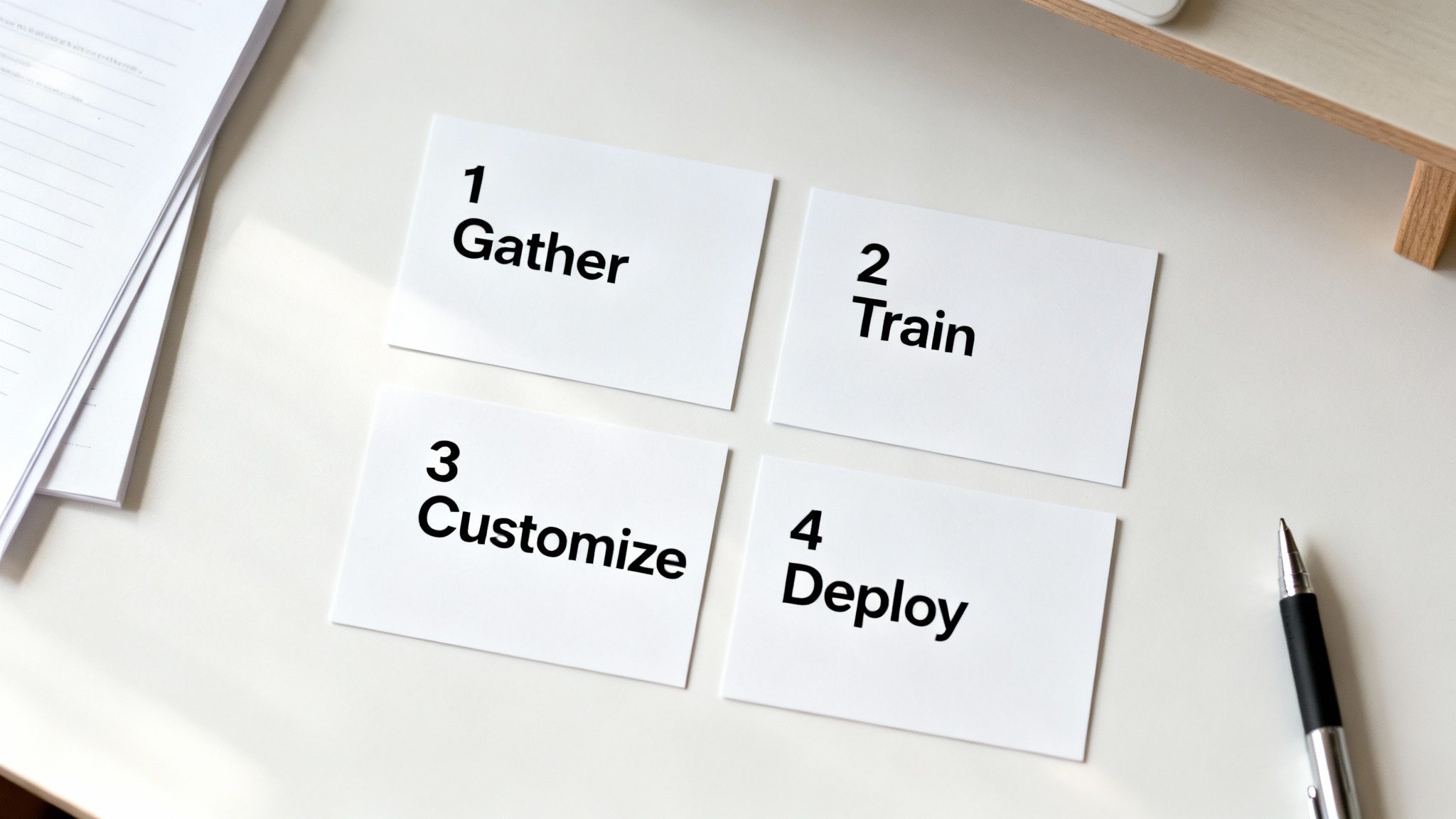
This isn't some complex, technical marathon. It's a straightforward, four-step process designed to get powerful AI into your hands quickly. Let’s break down exactly how you bring your new digital team member to life.
Step 1: Gather Your Knowledge Sources
Think of this first step like creating a study guide for a new hire. Before your AI can answer anything, it needs to learn about your business. The best way to do that is to give it the same "source of truth" documents your human team relies on.
Start by pulling together your most important business information:
- Your primary website URL
- Key help center articles or FAQ pages
- Product manuals or service descriptions (PDFs are great for this)
- Internal policy documents if you're building an internal "Company Brain"
Having all these materials ready to go makes the rest of the process a breeze. You’re just collecting what you already have.
Step 2: Train Your Agent in Minutes
Once you have your "study guide," it’s time for the training. This is where platforms like BizSage really shine, as they do all the heavy lifting for you. Forget about coding or writing responses from scratch; you just need to hand over the raw materials you just collected.
You simply upload your documents and paste in your links. The AI gets to work immediately, reading, analyzing, and structuring all of that information into a coherent knowledge base. In just a few minutes, your agent goes from a blank slate to a subject matter expert.
Step 3: Customize and Test
This is the fun part—giving your AI a personality and making sure it's ready for prime time. You can set the agent's tone of voice with simple instructions, like "Be friendly and helpful" or "Maintain a professional, expert tone." This ensures it sounds like your brand, not a robot.
Next, start asking questions. Toss it the same queries your customers ask every day and see how it responds. This is your chance to fine-tune its answers and get everything just right before it ever interacts with a real visitor.
Testing is your quality control. It builds confidence by letting you see exactly how your AI will perform in the real world, ensuring it represents your brand perfectly from day one.
Step 4: Deploy and Monitor
Happy with how it's performing? It's time to go live. Deploying your new AI agent is as simple as copying a single line of code and pasting it into your website's backend. Seriously, that's it. Within seconds, it can be live and helping your visitors.
But the work doesn't stop there. Once it's live, you'll want to keep an eye on the analytics. These dashboards give you incredible insight into what your customers are asking, helping you spot gaps in your knowledge base or find new ways to improve their experience.
Common Questions About AI Chat Websites
Diving into any new technology kicks up a lot of questions, and AI chat websites are certainly no different. For most business owners I talk to, a few key concerns always seem to rise to the top. Let's tackle them head-on so you can move forward with confidence.
How Much Technical Skill Do I Need?
Honestly? Next to none. With today's no-code platforms, the idea that you need a developer to build a chatbot is ancient history. These tools are built for business users, not programmers.
If you can copy a link from your web browser or upload a PDF from your desktop, you have all the technical skill you need to get a powerful AI agent up and running. Getting it onto your website is usually just as easy—just copy a single line of code and paste it where you want the chat widget to appear.
Is My Company Data Secure?
Absolutely. Any reputable, business-grade AI platform puts security first. The content you upload—whether it’s from your website, internal documents, or support articles—is used for one thing and one thing only: training your private AI agent. It's a one-way street.
Your data never gets shared with other customers, and it certainly isn't fed into public AI models like ChatGPT.
As a rule of thumb, always check the vendor's privacy policy. It should state in plain English that your knowledge base is your property. This is non-negotiable for keeping your business intelligence from walking out the door.
This is precisely what makes a private AI a safe bet for handling sensitive company information.
How Can I Ensure Accurate Answers?
This is the big one. An AI agent is useless if you can't trust its answers. Accuracy comes down to the quality of the information you feed it. The best platforms use a technology called Retrieval-Augmented Generation (RAG), which you can think of as a digital leash for the AI.
RAG forces the AI to construct its answers only from the source material you provided. It prevents the AI from going rogue, making things up, or "hallucinating"—a common problem with public models. For brand consistency, you'll also want a feature that lets you set a specific tone or personality with a few simple instructions.
Most importantly, look for a system that allows the AI to say, "I don't know" if the answer isn't in its knowledge base. That isn't a failure; it's a feature. It shows the system is designed for reliability and prefers honesty over giving a wrong answer.
Ready to build a trustworthy AI agent that knows your business inside and out? BizSage turns your company's knowledge into instant, on-brand answers, 24/7. Start your free trial and launch your first agent in minutes.