

What we're calling a "ChatGPT startup" is a new breed of business. Instead of building massive, foundational AI models from scratch—a process that costs millions and takes years—founders are now creating highly specialized products on top of powerful platforms like OpenAI's GPT series. This lets small, agile teams launch incredibly sophisticated AI tools by focusing on one thing: solving a very specific customer problem.
This guide is the new playbook for how to do it.
The New Playbook For Building With AI
The way we build tech companies has fundamentally shifted. Gone are the days of raising a huge seed round just to fund years of deep-tech R&D before a single customer sees your product. The modern approach is leaner, faster, and far more accessible.
For today's ChatGPT startup, your most valuable asset isn't a proprietary algorithm. It's a deep, almost obsessive understanding of a customer's biggest headache.
This change means you don't need to be a machine learning Ph.D. to build a valuable AI product. The challenge has moved from creating the AI to applying it in a smart, effective way. This new playbook is built on a few core ideas:
- Solve Niche Problems: Don't try to build a general-purpose tool. Instead, zero in on a tedious, specific workflow. Think about automating customer support just for e-commerce stores on Shopify, or creating a sales enablement agent that knows your company's battle cards inside and out.
- Speed Over Perfection: Use existing large language models (LLMs) to get a Minimum Viable Product (MVP) into the hands of real users in weeks, not years. The goal is to start the feedback loop as fast as possible.
- Content is the Product: The value of your AI agent comes directly from the quality and structure of the data you feed it. Your real competitive advantage is your unique, curated, and genuinely helpful knowledge base.
This diagram perfectly illustrates the direct, streamlined path from concept to market that defines this new startup model.
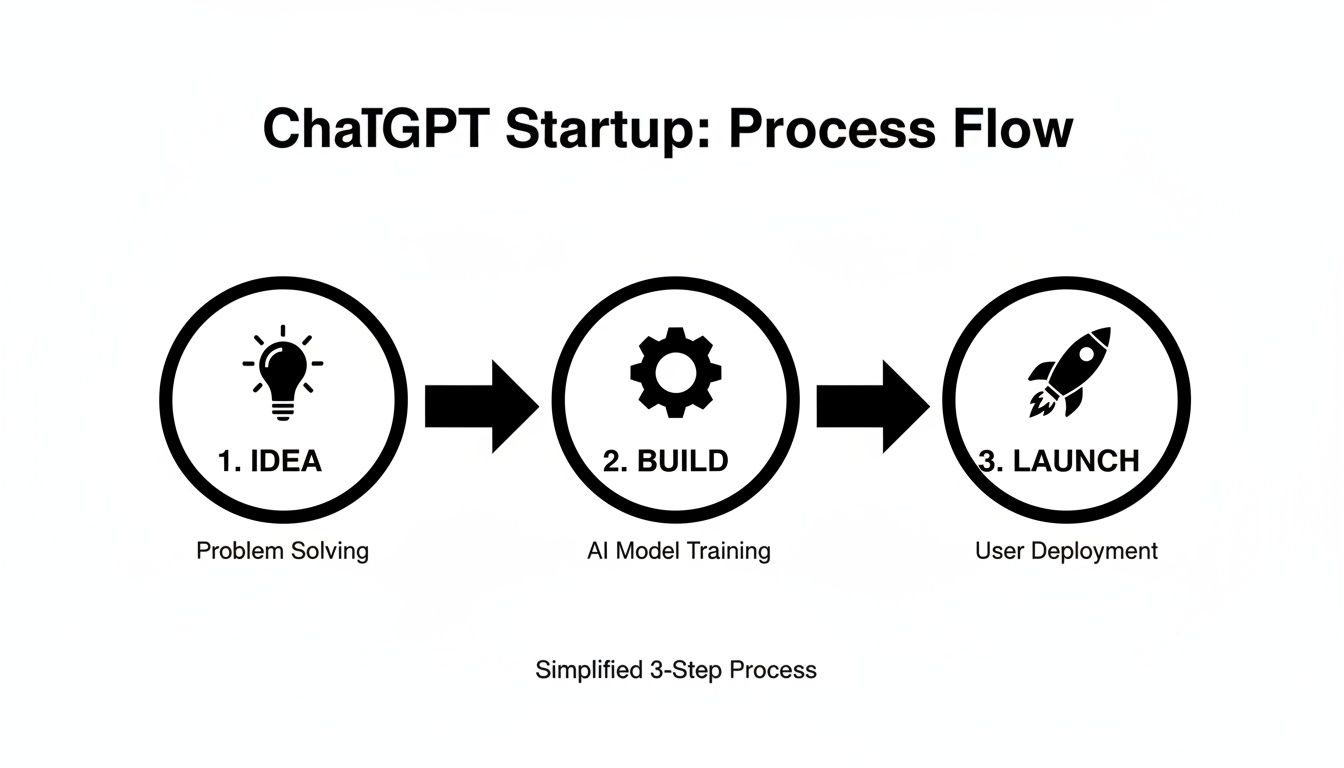
The cycle from idea to build to launch is incredibly compressed, which means you can iterate and improve based on what the market is actually telling you.
The table below breaks down these core stages, highlighting what you should be focused on at each step of the journey.
Core Stages of Building a ChatGPT-Powered Product
| Stage | Primary Goal | Key Activities |
|---|---|---|
| Idea & Validation | Confirm a real market need for your AI solution. | Identify a specific pain point. Interview potential customers. Define the scope of your MVP. |
| Build & Train | Develop a functional prototype and train the AI agent. | Prepare and clean your data sources. Configure the AI model. Build a user-friendly interface. |
| Launch & Iterate | Get the product to market and gather user feedback. | Deploy the agent across target channels. Monitor performance and accuracy. Refine based on usage patterns. |
Each stage builds on the last, moving from a hypothesis to a market-ready product that solves a genuine problem.
The ChatGPT Startup Moment
When you hear people talk about the “ChatGPT startup moment,” they’re referencing one of the most explosive technology adoptions in history. After its launch, ChatGPT hit 1 million users in just five days—a milestone that took Instagram months and TikTok even longer.
For founders, this completely reset expectations. It proved you could achieve massive scale in a tiny fraction of the time. The new playbook requires thinking bigger and moving faster, as detailed in this ultimate guide to using generative AI for B2B marketing and sales growth.
Suddenly, AI-native automation wasn't just a cool experiment; it became a core expectation for business tools, especially in areas like customer support and internal knowledge management.
Finding and Validating Your AI Product Idea

The best ideas for a ChatGPT startup don't usually arrive in a sudden flash of brilliance. More often, they come from spotting a tedious, repetitive, and expensive problem that’s hiding in plain sight. Before you even think about writing code or training an agent, you have to be sure the problem you see is one that people will actually pay to fix.
The sweet spot is finding high-value, low-complexity workflows that are begging for automation. Look for the friction in a typical business day. A support team answering the same five questions over and over, an HR manager explaining benefits to every single new hire, or a sales team manually sifting through leads from a contact form. These are perfect candidates.
Uncovering Problems Worth Solving
The secret to validation isn't brainstorming in an echo chamber; it's getting out there and listening to what the market is telling you. You’re looking for signals of pain where people are already trying to patch together a solution, no matter how clunky or manual it is.
Here are a few goldmines to start digging in:
- Industry Forums and Groups: Comb through Reddit, Slack, or Discord communities. Search for phrases like "is there a tool for" or "how do you automate." These are literally people asking for your product to exist.
- Your Own Prompt History: If you find yourself feeding the same detailed prompt into ChatGPT every week to get a task done, you’ve stumbled upon a repeatable workflow that can probably be turned into a product.
- Customer Reviews of Existing Tools: Check out the two- and three-star reviews for popular software on sites like G2 or the Shopify App Store. When you see high usage mixed with bad reviews, it means the demand is real, but the current solution just isn't cutting it.
The most profitable startup ideas are born from specific, repeated complaints. When a customer says, "I waste two hours every day copying data from this spreadsheet to that CRM," they are basically handing you a business plan.
Once you have a hunch, your next job is to go talk to potential customers. But don't just ask them if they’d buy your imaginary product—that’s a leading question. Instead, dig into their current process for solving the problem. How much time does it take? What tools are they using now? What part of it all drives them crazy?
A Real-World Validation Example
Let's say a founder notices that e-commerce store owners are completely swamped with customer support tickets, especially after business hours. The initial idea is simple enough: an AI support agent.
But instead of just building it, she spends two weeks talking to ten different Shopify store owners. She learns that their biggest headaches aren't just slow response times. The real pain comes from handling the same questions about shipping policies, return processes, and product sizing again and again.
This insight is everything. It confirms the problem is urgent and sharpens the product's focus. She now knows the agent must be a true expert on those specific topics to be valuable from day one, making her idea far more compelling than just another generic chatbot.
Building Your AI's Knowledge Base
Your AI agent is only as smart as the information you feed it. For any team building with ChatGPT, the quality of this knowledge base isn't just a technical detail—it's the very foundation of your product. This is where you bake in your competitive advantage, turning raw data into an intelligent, reliable assistant.
The first move is to round up every source of truth your business already owns. Think of it as gathering ingredients for a master recipe. The great thing is, your agent can learn from all sorts of content formats, giving you a lot of flexibility in how you build its brain.

Most teams start with what they have on hand. Common sources usually include:
- Public Website Pages: Your homepage, feature descriptions, and pricing tables are perfect for customer-facing bots.
- Help Center Articles & FAQs: This is gold. It's often the single best source for a support agent because it’s already built around user questions.
- Internal Documentation: Think about all those Google Docs, PDFs, and Notion pages. Onboarding guides, company policies, or sales playbooks can power fantastic internal tools for your team.
- Product Manuals & Guides: Got detailed technical docs? Feed them into an agent to let users solve complex problems on their own, no support ticket required.
Once you’ve identified these sources, it's time to prep them. This isn’t about just dumping files into a system; it’s about careful curation. An AI gives its best answers when it learns from clean, well-structured, and unambiguous content.
Preparing Content for Peak Performance
Treat this step like a "spring cleaning" for your company's collective knowledge. The goal here is simple: get rid of anything that could confuse the AI and lead it down the wrong path.
That means stripping out irrelevant website navigation menus, deleting old promotional banners from PDFs, and making sure the language is direct and clear. Clarity is everything. Use obvious headings and subheadings in your documents to give them a logical structure. An article titled "Returns and Exchanges" is infinitely more useful to the AI than a file named "Doc_Final_V2.pdf". How you structure your content directly impacts the AI's speed and accuracy in finding the right answer.
The single biggest mistake I see founders make is underestimating the 'garbage in, garbage out' principle. A powerful AI model fed confusing, disorganized, or contradictory information will only produce confusing, disorganized, and contradictory answers.
This is exactly where a modern platform like BizSage gives you a massive leg up. Instead of having to manually clean and upload every single file, you can connect your live data sources directly. For example, link your live Zendesk or Intercom help center, and BizSage automatically pulls in and structures the content for you.
Keeping Your AI's Brain Up-To-Date
A knowledge base that never changes quickly becomes a liability. Your pricing will change, new features will launch, and company policies will evolve. Expecting your team to manually update the AI's training data every single time is a recipe for disaster—and a colossal waste of time.
This is where automated synchronization comes in. With platforms like BizSage, you can set a schedule—daily, weekly, whatever you need—to automatically re-scan all your connected sources. This ensures your AI agent is always operating with the latest information, with zero manual effort from your team. This "set it and forget it" approach is what builds trust. When a customer or employee gets an accurate, up-to-the-minute answer, they learn to rely on the agent as their go-to source of truth.
Bringing Your Custom AI Agent to Life
Alright, you've validated your idea and wrangled your content into a clean, organized knowledge base. Now for the exciting part: actually building your AI agent. This is where your ChatGPT startup goes from a concept on a whiteboard to a real, interactive tool that your team or customers can start using. And the good news? You don't need a team of AI engineers to pull this off. Modern platforms have made this process surprisingly straightforward.
First things first, let's give this agent a personality. This is absolutely critical for making it feel like a true extension of your brand. Think about it—an agent for a quirky D2C brand should sound completely different from one built for a buttoned-up B2B financial firm. You get to decide its tone of voice. Is it professional? Super friendly and casual? Maybe a little witty? This initial personality directive shapes every single conversation it has from here on out.

Just as important as telling it what to say is telling it what not to say. We call these guardrails. A customer support agent trained on your product documentation has no business giving legal advice or speculating on your next product launch. By setting these boundaries, you keep the agent focused and prevent it from dishing out wrong or unapproved information, which is non-negotiable for building user trust.
Turning Raw Content into Smart Conversation
With the personality set, the real training can begin. If you're using a platform like BizSage, this part is as simple as it gets. You just point it to the content sources you already prepared—your help docs, website pages, and those internal PDFs. The system then "reads" all of that information, using it as the definitive source of truth for every answer it provides.
But before you set it loose, you have to kick the tires. This is your QA phase. Start by asking it the most common questions you anticipate from users:
- "What's your refund policy?"
- "How do I integrate this with my existing software?"
- "Can you tell me your business hours?"
This back-and-forth testing process quickly reveals where its knowledge is solid and where you might have gaps. If it fumbles a question, you can simply go back to your source content, clarify the information, and try again. It’s a tight feedback loop that gets your agent sharper and more accurate with each iteration.
The real goal here isn't just to spit out answers. It's to answer questions in your brand's voice and with total accuracy, every single time. This training and testing cycle is what separates a genuinely helpful AI assistant from just another frustrating, generic chatbot.
Getting Your AI in Front of People
Once your agent is trained and tested, it's time for deployment. The whole point is to put it where your users already are, making it incredibly easy for them to find what they need. Different scenarios call for different approaches, so a good platform will give you options.
Choosing where and how your agent shows up is a key strategic decision. Here’s a quick breakdown of the most common ways to deploy your agent and what they’re best for.
Agent Deployment Options and Use Cases
| Deployment Method | Best For | Example Use Case |
|---|---|---|
| Website Embed | Offering instant, on-demand support right on your website or help center. | A potential customer is on your pricing page and clicks a widget to ask about a specific feature. |
| Direct Link | Sharing a specialized agent in emails, social media posts, or support tickets. | A support team member sends a customer a link to an AI agent trained exclusively on troubleshooting one complex product. |
| Custom Subdomain | Building a branded, standalone knowledge hub for your team or customers. | Your company sets up an internal agent at help.yourcompany.com for employees to ask about HR policies or IT procedures. |
Ultimately, picking the right deployment strategy is about integrating the AI smoothly into your users' existing workflows. When it feels like a natural part of the experience, it becomes an invaluable tool. That seamless integration is what makes a ChatGPT startup feel polished and professional right out of the gate.
Launching Your AI and Gaining Customer Trust
Getting your AI agent live is a huge moment, but for a successful ChatGPT startup, this is where the real work begins. Your long-term success isn’t about flashy tech; it’s about earning and keeping the trust of your users. This is where your operational strategy becomes your biggest advantage.
The absolute bedrock of that trust is accuracy.
Think about it: when a user gets a wrong answer, their confidence shatters. They might never come back. This is why it’s so important to train your agent to simply say "I don't know" when it doesn't have the right information. A humble, honest admission is a thousand times better than a confident but completely fabricated answer—what we call a hallucination.
Another powerful way to build trust is through transparency. Whenever your agent can, it should cite its sources. If it answers a question about your return policy, it should link directly to that page on your website. This small detail shows users how the AI knows what it knows, turning it from a mysterious black box into a reliable assistant.
Smart Monetization Models
Once you have a product people can trust, you need a clear way to make money. The good news is that investors are actively looking for practical AI applications, not just more foundational models. For founders building tools for a specific industry, this is a massive opportunity—if you have a solid business plan. Investors are now laser-focused on products with clear monetization and strong unit economics.
Here are a few proven monetization strategies that work particularly well for AI products:
- Tiered Subscriptions: The classic SaaS model. You can create different plans based on usage, like the number of conversations per month or the volume of content the agent is trained on.
- Value-Based Pricing: For big-ticket enterprise clients, tie your price directly to the value you deliver. If your AI agent saves their support team 40 hours a week, you can charge a price that reflects that incredible ROI.
- Per-Agent Pricing: Building a platform for agencies or consultants? A great model is to charge them for each client agent they build and manage on your system.
Your Go-To-Market Plan
Don't overcomplicate your launch. Your initial goal isn't to hit a thousand users overnight. It's to find your first 10 paying customers who absolutely love what you've built.
A lean, focused go-to-market strategy is your best bet. Start with direct outreach to the exact people you interviewed back in the validation phase. You already know their pain points, so you're perfectly positioned to show them the solution.
Create simple, helpful content that shows your agent solving a real problem. A short video walkthrough or a quick blog post demonstrating a specific use case can be far more effective than a generic sales page. And as you get out there, it's critical to understand the key ChatGPT ranking factors that will influence your discoverability and help you build that initial base of trust.
Your launch is all about one thing: feedback. Talk to your first users constantly. Watch how they interact with the agent, listen to their frustrations, and use that direct input to make your product better every single week. This feedback loop is the true engine of a successful AI startup.
Got Questions? We've Got Answers
Let's tackle some of the most common questions I hear from founders diving into the world of AI-powered products. We'll cut through the noise and talk about what it really takes to get this right.
How Technical Do I Actually Need to Be?
This is the biggest surprise for most people: you need far less technical knowledge than you think. The game has changed. With the rise of powerful no-code AI platforms, you don't need a Ph.D. in machine learning to build something genuinely useful.
The most critical skills are no longer about coding complex algorithms. Instead, it's about sharp business thinking. Can you pinpoint a real, nagging problem for a specific group of people? Can you find and organize the information needed to solve that problem? If so, you're already most of the way there. Building a successful ChatGPT startup today is all about the business case, not the codebase.
What are the Biggest Stumbling Blocks for Founders?
I see the same mistake over and over: building a solution in search of a problem. It’s easy to get swept up in the excitement of AI and create a generic "AI for marketing" or "AI for sales" tool. The real question is, did anyone actually ask for it? Did you validate that the pain is real enough for people to open their wallets?
The second classic blunder is the "garbage in, garbage out" trap. You can't just dump a messy, disorganized folder of documents into an AI and expect magic. The quality of your AI's answers is a direct reflection of the quality of the information you give it.
To steer clear of these common pitfalls, here’s my advice:
- Validate relentlessly: Get out and talk to potential customers before you write a single line of code or connect a single data source.
- Be a content curator: Treat your knowledge base like a prized garden. Make sure it's clean, accurate, and up-to-date.
- Nail the niche: Forget boiling the ocean. Solve one specific problem exceptionally well. That’s how you gain traction.
How Do I Make Sure My AI Stays Accurate Over Time?
Keeping an AI agent accurate isn't a "set it and forget it" task—it's an ongoing commitment. The best way to do this is to hook your agent into living, breathing data sources. Think of your live help center, a constantly updated internal wiki, or a shared Google Drive that your team uses every single day.
The secret to long-term success is using a platform that can automatically re-sync with these sources. This ensures your AI is never working with stale information. You also need to get into the habit of regularly checking conversation logs and listening to user feedback. This is your goldmine for finding where the agent gets confused, allowing you to go back and fortify its knowledge base right where it needs it most. It’s this constant loop of feedback and refinement that turns a good agent into a great one.
Ready to build an AI agent that delivers on-brand answers 24/7? With BizSage, you can turn your company's content into a trustworthy support and knowledge tool in minutes. Start your free trial today!