
So, what if you could bring on a new team member who works 24/7, never gets tired, and already knows everything about your company? That’s essentially what ChatGPT offers businesses today. It's moved beyond being a cool tech demo and has become a genuine workhorse, helping companies grow faster and run smarter.
Your New AI Teammate for Business Growth
Think of ChatGPT less like a chatbot and more like a highly capable employee you can onboard in record time. You can train it on all your company's unique information—from website content and help articles to product specs and internal policies.
Once it’s trained, it becomes a true expert on your business. It's ready to handle the kind of high-volume, repetitive tasks that usually tie up your human team, freeing them up for more important work.
This isn't about spitting out generic, robotic answers. It's about providing instant, on-brand support to customers, qualifying sales leads long after your team has gone home, or giving new hires a central place to get immediate answers to their questions. The goal is simple: let the AI handle the predictable, so your people can focus on the exceptional.
From Repetitive Tasks to High-Value Work
How much time does your team spend answering the same questions day in and day out? It’s a common problem that slows down support, frustrates sales reps, and makes it tough to find information internally. This is exactly the kind of operational drag that an AI agent is designed to eliminate.
By handing off all that routine communication to a well-trained AI, you give your human experts the freedom to tackle complex problems, build stronger customer relationships, and focus on the strategic work that actually pushes the business forward.
The speed at which companies are adopting this technology is a clear signal of a major shift. It's not just a passing trend. The growth was so fast that over 80% of Fortune 500 companies were reportedly using it within just nine months of its public release.
Today, 49% of companies globally have put it to work, cementing its place as a standard business tool. You can find more details on this massive shift in business AI adoption. This guide will give you a clear roadmap for putting this technology to use, showing you how to build your own AI teammate—no developers required.
Practical Use Cases Driving Real Results
The theory behind using ChatGPT in a business is interesting, but its real value comes to life when you put it to work. We're not just talking about a fancy Q&A tool. This is about building an intelligent, automated layer across your entire operation that can handle predictable tasks, freeing up your team to focus on what humans do best: thinking, creating, and growing the business.
The easiest way to think about it is like hiring a specialist who can work in multiple departments at once, 24/7. In customer support, it's the tireless agent who never sleeps. For your sales team, it's an assistant who qualifies leads long after everyone's gone home. And for HR, it’s a walking encyclopedia of company policy for every new hire.
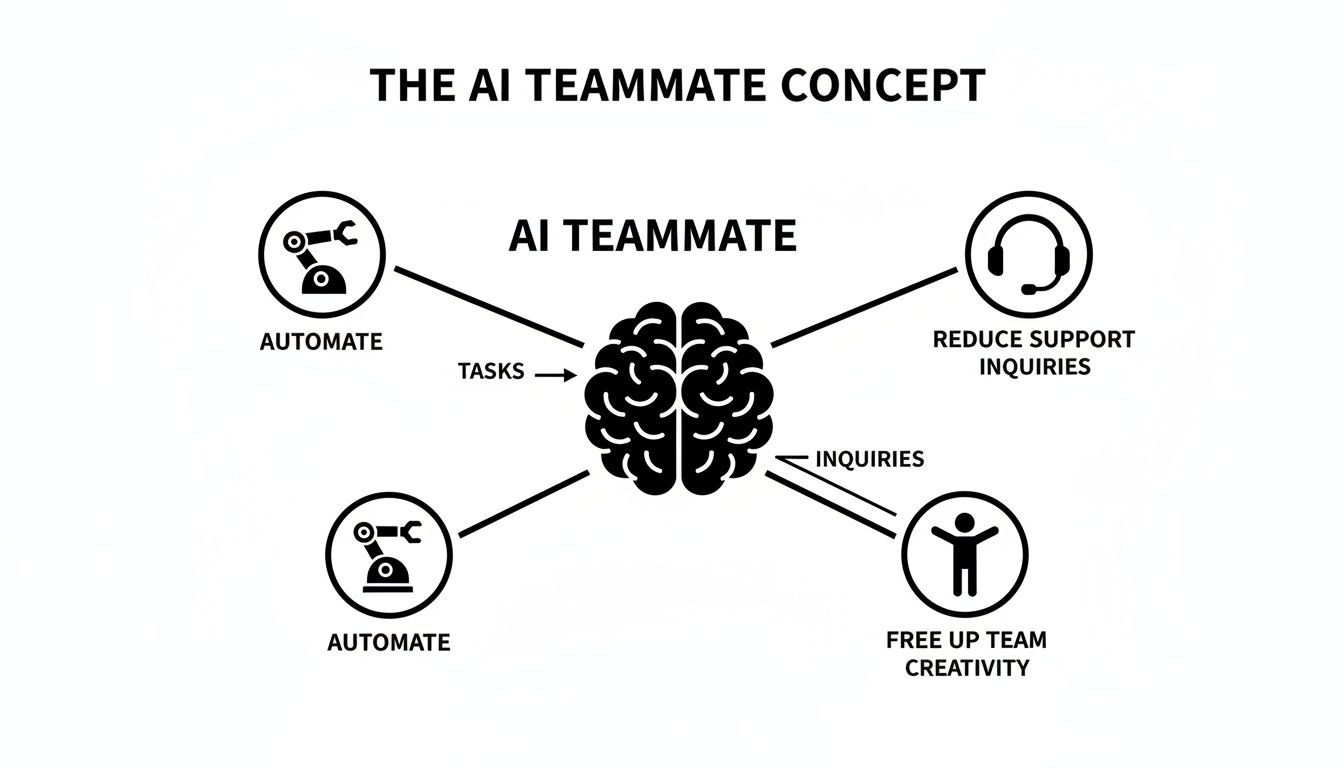
This idea of an "AI Teammate" gets to the core of it: let the machines handle the repetitive stuff so your people can tackle the strategic work. Let’s break down what that actually looks like in a few key areas.
Automate and Elevate Customer Support
One of the quickest wins you'll find is in customer support. Every business gets hammered with the same questions over and over again—queries about shipping, returns, account settings, or basic product features. These FAQs eat up a huge chunk of your support team's day.
An AI agent trained on your help docs can answer these instantly. When a customer asks, "Where is my order?" at 10 PM on a Saturday, they get an immediate answer instead of waiting until Monday. That instant gratification is huge for customer satisfaction, and it deflects a massive volume of simple tickets away from your human agents.
This isn't about replacing your support team; it's about augmenting them. By automating Tier 1 support, you free up your experienced agents to focus on the complex, high-value customer issues that actually require human empathy and creative problem-solving.
Power Sales and Marketing Around the Clock
Your website is your best salesperson, but it usually clocks out at 5 PM. An AI agent changes that. It can engage visitors, answer their product questions, and qualify leads in real-time, no matter the hour.
Think about a potential customer browsing your pricing page at midnight. Instead of clicking away with unanswered questions, they can ask the AI about a specific feature or integration. The bot can then grab their contact info, creating a warm, qualified lead that’s waiting for your sales team first thing in the morning.
This is a game-changer, especially in industries where people work odd hours. It's no surprise that 65% of marketers and 71% of consultants already report using it. This adoption has fueled a massive economic footprint, including a $229B impact in B2B SaaS alone, according to recent industry analyses.
Create a Self-Service Knowledge Hub
A well-trained AI agent is more than just a chatbot; it's an interactive, intelligent knowledge base for both customers and your internal teams. It stops people from having to dig through static FAQ pages or dense documentation and just gives them a search bar that provides direct answers.
- For Customers: A new user of your software can ask, "How do I set up my first project?" and get a step-by-step guide on the spot.
- For Internal Teams: A new employee can ask, "What is our company policy on remote work?" and get the exact paragraph from the handbook without bothering an HR manager.
You're essentially building a "Company Brain" that holds all your information and makes it instantly accessible to anyone who needs it. To see just how far this concept can go, it's worth exploring the different agentic AI use cases that are already showing real-world results.
Understanding the Benefits and Limitations
Look, bringing any new piece of tech into your business means you have to be realistic about what it can and can’t do. With something like ChatGPT, the potential upside is huge, but you have to weigh that against some very real limitations. Getting this balance right is what separates a successful AI strategy from a failed experiment.
On one side of the coin, you have some pretty immediate, measurable wins. The most obvious is the efficiency gain. Think about all the repetitive questions your team answers day in and day out. Automating those frees up your people to tackle the complex, high-value work that actually moves the needle. In fact, some studies show AI tools can boost employee productivity by as much as 40% for certain kinds of work. That’s a direct impact on your operational costs and, ultimately, your bottom line.
But it’s not just about internal efficiency. The effect on your customer experience can be massive. We live in an on-demand world, and offering instant, 24/7 support is a serious competitive edge. When customers get answers the moment they ask, they're happier and more likely to stick around.
The Upside of AI Adoption
The best part is that these benefits tend to feed into each other, creating a ripple effect across your entire company.
- Increased Productivity: Your team gets to stop being a broken record and can finally focus on the strategic projects that drive real growth.
- Reduced Operational Costs: When you handle more support tickets and internal queries with automation, you can grow your business without having to constantly hire more people.
- Enhanced Customer Satisfaction: People love getting instant answers. Providing round-the-clock help makes your customers feel seen and valued, which is exactly what you want.
The core advantage is clear: AI handles the predictable so your team can manage the exceptional. It’s not about replacing people but augmenting their capacity to deliver outstanding results.
Navigating the Potential Downsides
Alright, let's talk about the flip side. It’s incredibly important to understand the built-in limitations of these large language models. If you just let one run wild, you’re asking for trouble.
The biggest and most famous problem is the AI "hallucination"—that’s when the model just makes things up, stating incorrect information with complete confidence. When it’s speaking on behalf of your brand, that's a risk you simply can't afford to take.
Then there's the challenge of keeping your brand voice consistent. A generic, out-of-the-box AI can sound sterile and robotic, completely erasing the personality you've spent years building. Finally, and this is a big one, you have data privacy. You can't just feed sensitive company data or customer PII into a public model without creating a massive security hole.
These downsides all point to one crucial truth: you don't just "turn on" an AI and hope for the best. Success comes from putting the right guardrails in place. The solution is to train a model exclusively on your own verified knowledge—your help docs, your internal policies, your product specs. This dramatically cuts the risk of hallucinations and ensures every single answer is accurate, secure, and perfectly on-brand. A secure, closed-loop system is what turns AI from a potential liability into a truly reliable business asset.
How to Implement and Govern AI Safely
Bringing a powerful tool like ChatGPT into your business doesn't have to be some massive, developer-led project. In fact, for most companies, the days of wrestling with raw APIs are long gone. Modern platforms have made the whole process surprisingly straightforward, opening the door for anyone, regardless of their technical chops.
Think of it less like building software from scratch and more like onboarding a new team member. You just need to give it the right training materials and company knowledge, and the AI takes it from there.

A Simple Three-Step Launch Process
You can get an AI agent live much faster than you might imagine. The process really boils down to feeding it your existing knowledge and giving it a bit of personality.
-
Gather Your Knowledge Sources: First, you’ll pull together all the content that makes your business what it is. This could be anything from website pages and help center articles to dense product manuals or internal policy docs. This collection becomes the AI's "brain."
-
Train and Customize the Agent: Next, you simply upload all that content into your chosen platform. This is the core training. It’s also where you get to define the agent's personality—do you want it to be formal and professional, or maybe a bit more friendly and witty?
-
Deploy It Anywhere: Once you’ve run a few tests to make sure its answers are on point, you’re ready to publish. Most platforms give you a simple snippet of code to drop onto your website, but you can also share it as a direct link or even host it on a dedicated page.
Putting Guardrails in Place for Trust and Safety
A successful AI rollout isn't just about getting it launched quickly; it's about building a tool you can actually trust. This is where governance comes in, and it's non-negotiable. Without the right controls, an AI can easily spit out outdated information or, even worse, just make things up when it doesn't know the answer.
Any truly intelligent system needs two critical governance features baked right in:
- Automated Knowledge Refresh: Your business information is constantly evolving. A dependable AI must have an auto-refresh schedule that re-syncs with your knowledge sources—daily, weekly, or monthly—to guarantee its answers are always up-to-date.
- The Honesty to Say "I Don't Know": A safe AI should never invent answers. If the information isn't in its verified knowledge base, its only response should be to admit it doesn't know and escalate the question to a human. This simple rule prevents the damaging "hallucinations" you sometimes hear about.
For AI-driven companies, especially startups trying to land bigger enterprise deals, solid governance also means tackling key security certifications. Checking out SOC 2 compliance for startups seeking enterprise clients is a great way to understand how it can actually accelerate growth.
By focusing on a tightly controlled knowledge base and robust governance from day one, you ensure your AI becomes a truly dependable asset. It's how you turn a powerful technology into a safe, reliable tool that delivers accurate, on-brand answers every single time.
Calculating Your Return on Investment
It's easy to look at a tool like ChatGPT for business and just see the monthly subscription cost. But that’s only a tiny piece of the puzzle. The real return on your investment (ROI) shows up in reclaimed hours, happier customers, and opportunities you never would have caught otherwise.
So, how do you actually measure that? A simple framework can help you see the financial impact pretty clearly. You can start by looking at the direct costs your AI assistant will take off your team's plate. These are the easiest numbers to track and give you a solid baseline for what you're getting back.
Measuring Cost Savings and Efficiency Gains
The fastest wins come from automating those repetitive, high-volume tasks that eat up your team's day. This is where you'll see the money coming back almost immediately.
Think about it in these terms:
- Deflected Support Tickets: Figure out the average time your team spends solving a single support ticket. If an AI agent handles 100 tickets per week that would have otherwise gone to a human, you can multiply that by the time saved per ticket. Suddenly, you have a real number of hours your team gets back.
- Automated Internal Questions: How many times a day does someone in your company ask HR or IT the same old questions about vacation policies or software access? When you track how much that number drops, you’re looking at a huge productivity boost across the entire organization.
The core idea is simple: every question the AI answers is one less interruption for your team. This allows them to focus on complex, revenue-generating activities instead of just repeating information.
Quantifying Revenue Growth and Opportunity
Beyond just saving money, a well-trained AI agent is a powerful engine for bringing more in. This side of the ROI equation is all about capturing business that used to slip through the cracks.
For example, your sales team has to sleep, but your website doesn't. An AI agent can engage with a potential customer at 2 AM, answering their questions and grabbing their contact info. That person becomes a warm, qualified lead waiting for your team first thing in the morning. Without the AI, that opportunity would have vanished.
To put a number on it, just track how many leads the AI generates after hours. Then, apply your average lead-to-close conversion rate. What you’re left with is a brand-new revenue stream created by your always-on assistant.
Choosing the Right Pricing Model
Once you have a sense of your potential ROI, picking the right plan becomes much easier. Pricing for ChatGPT for businesses platforms usually scales with your usage—things like how many messages it handles or how much content you feed it. A starter plan might be perfect for a small team looking to offload a few hundred customer questions a month.
On the other hand, if you’re a growing company looking to automate thousands of interactions, an enterprise solution with more power and better analytics is probably the right fit. By matching the plan to your goals—whether that's cutting costs, generating leads, or just making internal support smoother—you can make sure your investment is paying off from day one.
Your 5-Step Checklist for Launching an AI Agent
Thinking about getting an AI agent for your business? You might be picturing a massive, months-long IT project. The good news is, it's nothing like that anymore. With the right tools, you can get a powerful, on-brand assistant up and running in minutes, not months.
This whole process is about using the knowledge you already have—your website, help articles, and internal documents. You don't need a developer or a team of writers. You just need to point the AI to your existing business intelligence.
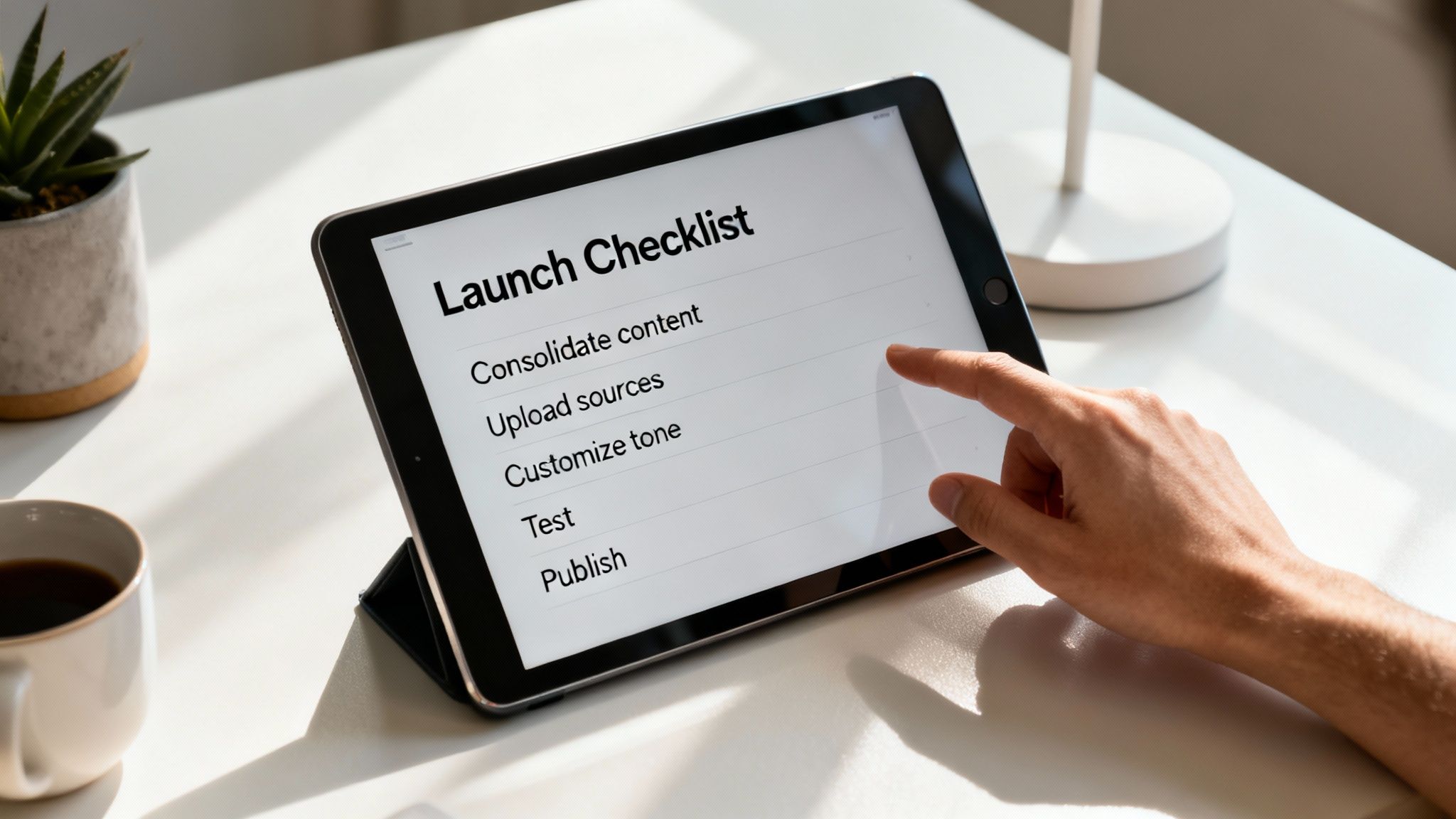
A Simple 5-Step Launch Plan
Think of this as your quick-start guide. By following these steps, you’ll build an agent that's genuinely helpful and ready to chat with customers or support your team right from the get-go.
-
Gather Your Knowledge: First, round up all your essential business information. This is everything from your main website pages and FAQs to detailed help center articles, product manuals, or internal process docs. This collection becomes the AI's "brain"—its single source of truth.
-
Pick a Platform and Upload: Next, choose a user-friendly platform built for ChatGPT businesses. An option like BizSage makes this incredibly simple. All you have to do is copy and paste the website links or upload the files you just gathered.
-
Set the Right Tone: Now, define its personality. Do you need it to be buttoned-up and professional, or is your brand more friendly and casual? A simple instruction is all it takes to make sure every response sounds like it’s coming from you.
-
Give It a Test Drive: Before you set it live, ask it a few questions. Try to think like your customers or employees. This is a crucial sanity check to confirm it's pulling accurate answers only from the information you gave it.
-
Go Live: Once you’re happy with the answers, it's time to publish. Most platforms will give you a small snippet of code. Just copy and paste it into your website, and your new AI agent is officially on the job.
This isn't about getting bogged down in technical details. It's about taking the expertise you've already built and turning it into a smart, automated asset that works for you 24/7.
Got Questions? We’ve Got Answers.
When business leaders start seriously looking at AI, the same questions always pop up. It's natural. You're moving past the hype and into the practical, real-world stuff—the things that actually matter for a successful launch.
Let's dive into the three big ones we hear all the time. These are less about the "what" and more about the "how" – the nitty-gritty of skills, safety, and performance.
"Do I Need a Team of Coders to Build an AI Chatbot?"
Honestly? Not anymore. The short answer is: you need almost zero technical skill.
Sure, if you wanted to build something from scratch using direct API access, you'd need developers. But the new wave of AI platforms is built for business users, not programmers. They've turned what used to be a complex coding project into a simple, three-step process.
If you can copy and paste a link or upload a document, you're good to go. The platform does all the heavy lifting behind the scenes. This lets you focus on what you know best—your business's knowledge—instead of getting tangled up in code.
Today's AI tools are all about accessibility. They're designed so your existing team can get a powerful AI agent up and running in minutes, not months. This really opens the door for all kinds of chatgpt businesses to get in the game.
"How Do I Stop the Bot from Making Things Up?"
This is probably the most important question of all, and the answer comes down to one word: control. An AI is only as smart as the information you give it. To guarantee accurate answers, you have to train it exclusively on your own verified content.
Think of it like building a walled garden. You feed the AI your help articles, product manuals, and internal documentation, and that's it. This creates a "closed-loop" system where the AI is physically prevented from guessing or wandering off to the public internet for answers.
Its entire world is the truth you've provided. If an answer isn't in your content, a properly trained bot won't invent one. It will simply say, "I don't know," and escalate the conversation to a human. No more embarrassing "hallucinations."
"Is Our Company Data Safe?"
Data security is, and should be, a deal-breaker. Any reputable business-grade AI platform is built with security as its foundation. This isn't like using a public, consumer-facing tool—these systems are explicitly designed not to use your private data to train their wider models.
Your content remains your content. It's used solely to power your AI agent and nothing else. Before you commit to any tool, make sure it clearly spells out its data-handling policies. You need to be confident that your proprietary information will stay confidential and secure. This is a non-negotiable for any serious business.
Ready to turn your company's knowledge into a 24/7 AI assistant? BizSage makes it simple to build a secure, on-brand AI agent in minutes. Start your free trial at bizsage.io and see how easy it is to deliver instant, accurate answers to your customers and team.