
The real difference between a specialized AI chatbot and ChatGPT boils down to one thing: focus. Think of a specialized chatbot as a purpose-built tool, meticulously trained on your company's private data to give precise, on-brand answers. On the other hand, ChatGPT is a generalist, having learned from the vast, public internet, which makes it a phenomenal creative partner but a pretty unfocused business agent.
Understanding The Core Difference
When you're trying to compare a business AI chatbot to ChatGPT, the best way to think about it is like hiring two different kinds of employees.
A specialized AI chatbot is your highly-trained expert. This employee has spent their entire career studying your company's internal documents, product manuals, and support articles. Your business is their entire world, which means every answer they give is accurate, consistent, and safe for your customers to hear.
ChatGPT is the brilliant, well-read generalist who has consumed nearly every book, article, and website publicly available. They can talk about almost anything with incredible fluency, but they have zero specific knowledge of your company’s unique policies or confidential data. This makes them a fantastic brainstorming partner but a serious liability when you put them in front of a customer who needs a specific, reliable answer about your business. To really get a handle on the different AI solutions out there, it’s a good idea to review the fundamental principles of Artificial Intelligence in business.
Specialist vs. Generalist: A Clear Distinction
For business owners, the "AI chatbot vs. ChatGPT" debate really comes down to control. A specialized platform gives you total command over the AI's knowledge and behavior.
- Controlled Knowledge: You hand-pick the exact documents, web pages, and files the AI is allowed to learn from. This stops it from making up answers or "hallucinating" facts.
- Brand Voice: You can dial in the AI's personality and tone to perfectly match your brand, making every conversation feel authentic.
- Data Security: Your sensitive company information stays private and is never used to train massive, public AI models.
This carefully controlled environment is what sets a true business-grade tool apart from a general-purpose model. It ensures your chatbot acts as a trustworthy extension of your team.
A specialized chatbot's greatest strength isn't just knowing the right answer; it's knowing what it doesn't know. This ability to defer to a human agent when information is unavailable is critical for maintaining customer trust and business integrity.
High-Level Comparison: Specialized Chatbot AI vs. ChatGPT
To put it all in perspective, here’s a quick rundown of the fundamental differences between a business-focused AI chatbot and a general-purpose model like ChatGPT.
| Attribute | Specialized Chatbot AI | General-Purpose ChatGPT |
|---|---|---|
| Primary Data Source | Your private company knowledge base (docs, URLs, files) | The public internet |
| Main Use Case | Answering specific customer & employee questions | General research, content creation, brainstorming |
| Response Accuracy | High, limited to verified source material | Variable, can be inaccurate or outdated |
| Brand Customization | Fully customizable (tone, personality, rules) | Limited, generic persona |
| Data Privacy | High, data is isolated and secure | Low, interactions can be used for model training |
Ultimately, the choice depends on the job you need done. For reliable, secure, and on-brand customer interactions, a specialized tool is built for the task. For broad creative or research work, a generalist model shines.
A Detailed Comparison For Business Operations
When we get down to brass tacks, the "chatbot AI vs. ChatGPT" debate isn't just about technology—it’s about how that technology impacts your actual day-to-day business. The choice you make has real consequences for how your team works, how you talk to customers, and how you protect your data.
Let's break down the practical differences across the areas that truly matter for any business: where they get their answers, how well they represent your brand, the security of your information, and how they plug into the tools you already use.
Data Source And Accuracy
For any business, the single most critical factor is getting the right answer to the customer. This is where the line between a controlled knowledge base and the wide-open internet becomes incredibly clear.
A specialized AI chatbot works inside a walled garden you create. You feed it your own verified information—help docs, product specs, internal policies, you name it. Its entire universe of knowledge comes from this trusted source, which means every answer it gives is grounded in your company's reality.
ChatGPT, on the other hand, pulls from a mind-bogglingly vast dataset scraped from the internet. It knows a little bit about everything, but that information can easily be out of date, slightly wrong, or completely irrelevant to your specific business rules. It simply doesn't know what it doesn't know about your private company information.
Here’s the real-world difference: A specialized bot can pull the exact warranty details from your latest terms of service PDF. ChatGPT can only guess and give you a generic template of what a warranty usually looks like. For compliance and customer trust, that's a world of difference.
Brand Customization And Voice
Every single chat is an extension of your brand. A generic, one-size-fits-all tone can easily undo all the work you've put into building a unique brand personality.
With a dedicated platform like BizSage, you're in the driver's seat. You get to define the chatbot's persona down to the last detail—whether you want it to be professional, witty, or just plain helpful. This level of control ensures every conversation feels authentic and reinforces your brand identity.
ChatGPT has a distinct voice of its own—helpful and articulate, but undeniably generic. You can try to coach it with prompts, but getting that tone right across thousands of automated chats is a serious technical challenge. Out of the box, it sounds like ChatGPT, not like you.
This chart lays out the core operational differences between a business-focused AI and a generalist model.
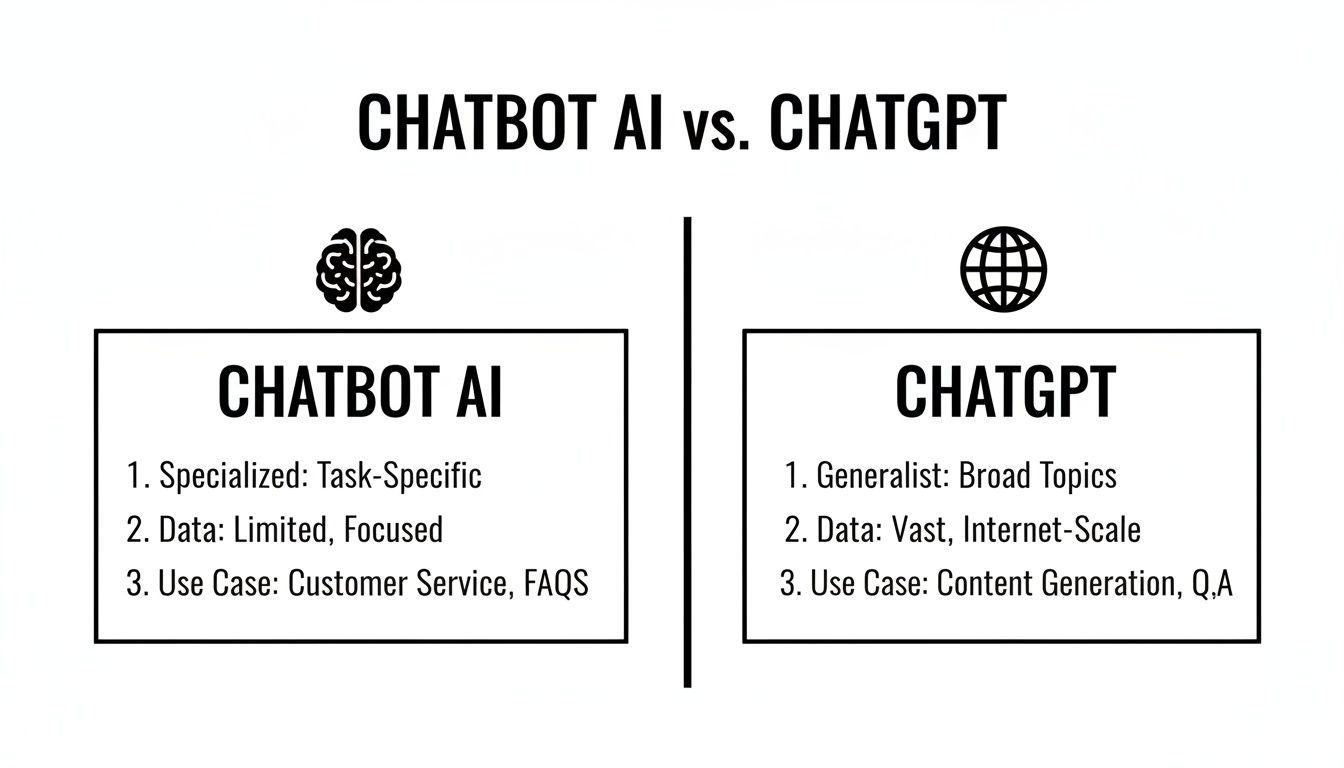
As you can see, one is a precision tool built to master your specific knowledge (the brain), while the other is a broad-stroke tool for navigating public information (the globe).
To get a clearer picture of how these two AI models stack up in a business context, let’s look at a side-by-side breakdown of their features and capabilities.
Feature & Capability Matrix For Business Use
This table dives into the specific functionalities that matter most when you’re trying to support customers, generate leads, or streamline internal processes.
| Feature | Specialized Chatbot AI | General-Purpose ChatGPT |
|---|---|---|
| Knowledge Source | Your private, curated data (documents, website, help desk). Controlled & verified. | The public internet. Vast but uncontrolled. |
| Answer Accuracy | High, as it's limited to the "ground truth" you provide. | Variable. Can be outdated, inaccurate, or "hallucinate" facts. |
| Brand Persona | Fully customizable. You define the tone, personality, and conversational style. | Generic default persona. Requires complex prompting to maintain a consistent tone. |
| Data Privacy | Your data is private and secure. It is not used to train public models. | Conversations may be used for model training (public version). Enterprise API needed for privacy. |
| Integrations | Often includes pre-built integrations with CRM, help desk, and marketing platforms. | Requires custom development via API to connect with other business systems. |
| Deployment | Simple, no-code setup. Often just a copy-paste script for your website. | Complex. Requires a development team to build, deploy, and manage via API. |
| Maintenance | Easy knowledge updates. Just sync new documents or web pages. | No direct way to update its core knowledge. Relies on prompting with new info. |
This matrix highlights the core trade-off: a specialized chatbot offers control, reliability, and ease of use for business-specific tasks, whereas ChatGPT provides immense general knowledge at the cost of customization, accuracy, and simple deployment.
Data Security And Privacy
When you're handling customer or company data, there's zero room for error. A privacy misstep can shatter trust and land you in serious legal trouble.
A specialized AI chatbot platform is built with this in mind. Your data stays yours, period. The best platforms are secure, closed systems where your proprietary information is only used to power your chatbot—it's never shared or fed into a public model. This is non-negotiable for anyone in regulated fields like healthcare or finance.
Using the public version of ChatGPT for business chats is a huge gamble. Any conversation can potentially be reviewed by OpenAI or used for model training, making it a no-go for sensitive customer details or internal strategy. While their enterprise-grade APIs offer more robust privacy, they still require technical oversight to implement correctly.
System Integration And Deployment
At the end of the day, a tool is only as good as its ability to fit into your workflow.
- Specialized Chatbot AI: Platforms like BizSage are designed for business users, not developers. You can typically get a bot live on your site by copying and pasting a single snippet of code. We’re talking minutes, not months.
- General-Purpose ChatGPT: Turning ChatGPT into a fully integrated website assistant is a software development project. It means hiring developers to work with APIs, build a custom interface, and manage the back-end logic.
For most businesses, the sheer accessibility of a purpose-built platform is a game-changer. It means you can have a powerful AI assistant up and running without needing a dedicated dev team on standby.
Putting Theory into Practice: Real-World Business Use Cases
The abstract differences between a purpose-built AI chatbot and a generalist tool like ChatGPT snap into focus when you look at how they perform in day-to-day business. They aren't interchangeable; they're fundamentally different tools for different jobs. One is a scalpel, designed for precise, reliable tasks. The other is a creative powerhouse, great for open-ended exploration.
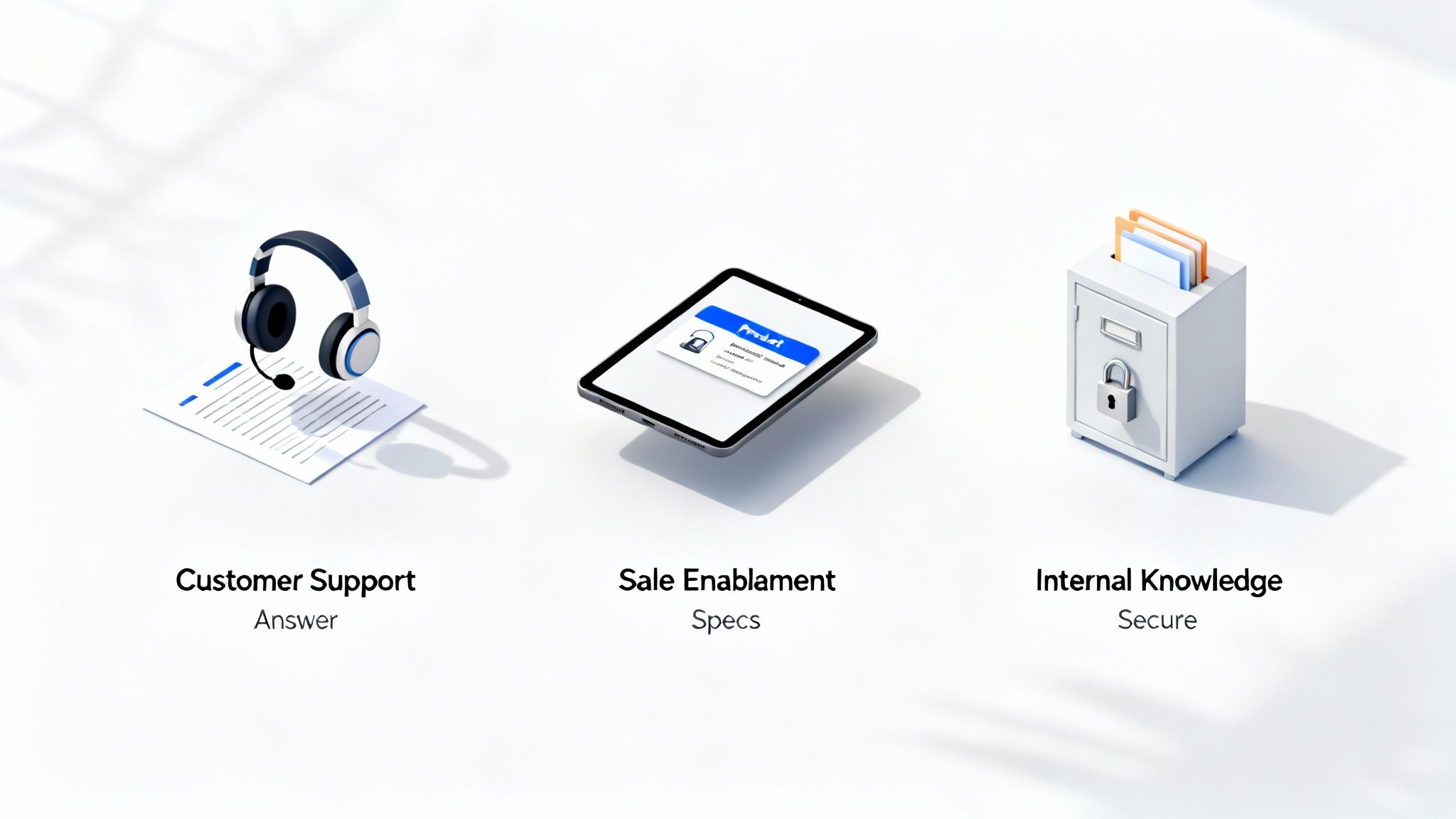
Let's dive into three core business functions—customer support, sales, and internal knowledge—to see exactly where each one fits and where they just don't belong. This will help you see the real impact of your choice.
Customer Support: The Front Lines
In customer support, the game is all about speed and accuracy. Your goal is to resolve common questions instantly, letting your human agents tackle the truly tough problems.
A specialized AI chatbot is made for this. It’s trained only on your company's official content—your help articles, product specs, and policy documents. When a customer asks, "What's the return policy for sale items?" it pulls the answer straight from your knowledge base. No guesswork, no fluff. Just a fast, correct resolution.
Trying to use ChatGPT for live customer support is a recipe for disaster. Ask it the same question, and it will likely generate a generic answer about what a typical return policy might look like. This isn't just unhelpful; it's a potential liability because it doesn’t reflect your actual business rules.
However, ChatGPT can be a brilliant co-pilot for your support team behind the scenes. They can use it to:
- Brainstorm friendlier ways to explain complex troubleshooting steps.
- Draft templates for common email replies.
- Summarize long, frustrated customer emails to quickly pinpoint the core issue.
The single most important feature of a business chatbot is its ability to say, "I don't know." A specialized AI, confined to its knowledge base, will admit when it’s stumped and escalate the ticket. That builds trust. ChatGPT’s habit of guessing can shatter it.
Sales Enablement: Closing the Deal
For any sales team, getting the right information at the right moment can make or break a deal.
Picture a prospect on your pricing page at 10 PM. A specialized AI chatbot can instantly answer specific questions like, "Does the Pro plan include API access, and what are the rate limits?" By pulling data directly from your technical docs, it provides an immediate, trustworthy answer that keeps the sales process moving.
ChatGPT is simply the wrong tool for this job. It knows nothing about your specific product tiers or real-time pricing. The best it could offer is generic sales advice, which does nothing to help a customer who is ready to buy.
Where ChatGPT shines is in the prep work. A sales rep can ask it to generate a compelling email sequence for a new lead or create a call script for breaking into a new industry. It’s a creative partner, not a direct line to your customer.
Internal Knowledge Management: Your Company Brain
An organized, accessible knowledge base is the central nervous system of an efficient company. It’s how you ensure everyone is working from the same playbook.
A specialized AI chatbot becomes your "Company Brain"—a single source of truth. When a new hire asks, "What's the process for submitting my expenses?" they get an immediate, accurate answer straight from the HR handbook. This slashes the number of repetitive questions that bog down HR and operations teams.
This scenario also highlights a huge security risk. Encouraging employees to use ChatGPT for internal questions means they might paste sensitive company data into a public model. While it’s fantastic for broad research ("What are the current B2B SaaS trends in Europe?"), it should never handle queries involving proprietary information.
For a deeper look at how a general model operates in a specific business context, exploring ChatGPT's role in e-commerce brand monitoring offers great insight. It shows its strength in external analysis—a stark contrast to the internal focus of a specialized bot.
Ultimately, the chatbot AI vs ChatGPT debate comes down to the task. If you need to deliver verified company information to customers or employees, a specialized AI trained on your own knowledge base is the only responsible option. For brainstorming, research, and creative tasks that don’t involve sensitive data, ChatGPT is an incredibly powerful assistant.
Cost, Scalability, And Maintenance: The Practical Differences
Beyond the bells and whistles, what really determines if a new tool will stick around is the reality of its cost, how it grows with you, and the effort required to keep it running. When you line up a business-focused AI chatbot vs ChatGPT, you're looking at two completely different financial and operational commitments. One offers predictable, manageable costs, while the other can be a wild card with significant hidden work.

Let's get past the sticker price and look at the total cost of ownership—the real investment in time and money each path demands.
Total Cost Of Ownership: A Financial Breakdown
For any business, especially a small or growing one, budget predictability is everything. This is where the difference between a dedicated platform and a general-purpose model really hits home.
Purpose-built AI chatbot platforms like BizSage almost always run on a simple subscription. You pay a flat fee each month or year for a clear package of features, message limits, and support. This makes budgeting a breeze—no guesswork, no surprise invoices.
Building on the ChatGPT API, on the other hand, means entering the world of usage-based pricing. You pay for what you use, calculated down to the "token" (which are like pieces of words). While this model offers flexibility, it also creates massive uncertainty. A successful marketing campaign or a seasonal traffic surge could suddenly send your API bill through the roof, making it nearly impossible to forecast expenses accurately.
It's easy to forget that the real cost of a custom ChatGPT solution goes far beyond API fees. You have to factor in the developer's salary for the initial build, plus the hours they'll spend on maintenance, updates, and fixing things when they break. Those costs add up fast and can easily eclipse what you'd pay for an off-the-shelf platform.
Built-In Scalability For Business Growth
As your company expands, your tools have to keep up. True scalability isn't just about handling more chats; it's about seamlessly adding new capabilities and team members without starting a whole new IT project.
-
Specialized Chatbot Platforms: These are designed from the ground up for business growth. On a platform like BizSage, upgrading is usually just a click away, instantly boosting your message capacity or unlocking advanced features. Adding new users to manage the bot is typically included, as the pricing is often based on the company, not per seat.
-
ChatGPT API Integrations: While the API itself can handle huge volumes, scaling a custom-built solution is a development task. More traffic might require you to refactor code for efficiency, upgrade your server infrastructure, or navigate complex API rate limits. It demands ongoing technical work, not a simple plan change.
The distinction is critical. One path lets you scale your operations with a few clicks, while the other forces you to scale your development team right alongside your customer base.
The Hidden Workload Of Ongoing Maintenance
This might be the most overlooked—and most important—factor in the chatbot AI vs ChatGPT decision: the long-term work of keeping the bot's knowledge fresh. An AI with outdated information is worse than no AI at all.
Specialized platforms are built to solve this problem. For example, BizSage includes automated knowledge syncing. You can tell your bot to re-scan your website or help docs on a set schedule—daily, weekly, whatever you need. It’s a "set it and forget it" system that ensures the bot is always working with your latest information, no manual updates required.
Keeping a custom ChatGPT integration current is a completely different story. There's no "update" button for its core knowledge. Developers have to manually manage how new information is fed to the model, often by building complex systems like Retrieval-Augmented Generation (RAG). Every time you update a product or change a policy, someone has to go in and make sure the bot knows about it. This creates a constant, resource-draining maintenance cycle.
How To Choose The Right AI For Your Business
Choosing between a purpose-built AI chatbot and a generalist model like ChatGPT really boils down to asking the right questions. It's not just a tech decision; it's a strategic one that will shape your customer experience, team productivity, and even how your brand is perceived.
By walking through a few key questions, you can cut through the hype and land on the solution that actually fits your business. This will help you move beyond a surface-level "chatbot AI vs ChatGPT" debate to a choice you can feel confident about.
What's The Main Job You Need It To Do?
First things first: what is the single most important task you need this AI to handle? Your answer here will probably point you in the right direction almost immediately.
If your core need is to give people instant, accurate answers about your products, internal policies, or services, then a specialized AI chatbot is the clear winner. These tools are designed to work exclusively from your verified knowledge base, ensuring every single response is reliable, factual, and on-brand. They are built for control and precision.
On the other hand, if your main goal is content creation, brainstorming ideas, or general research, ChatGPT is an incredible assistant. It shines when you need it to generate marketing copy, draft emails, or summarize broad topics from across the internet. It's a tool for creative exploration, not for customer-facing accuracy.
Here's the heart of the decision: Are you building a knowledge expert or a creative partner? An expert needs a controlled, verified library of information. A partner needs broad, open access to ideas.
How Much Technical Firepower Do You Have?
The next big question is about your team's technical resources. Be honest about the time, skills, and budget you can commit—not just for the initial setup, but for the long haul.
Think about these key points:
- Do you have developers on hand? If you have a team comfortable working with APIs, managing integrations, and troubleshooting custom code, building a solution on top of ChatGPT is a real possibility.
- Would you rather have a no-code option? If your team isn't technical, a platform like BizSage is made for you. Getting started is often as simple as copying and pasting a snippet of code, with zero ongoing developer maintenance.
- What's your budget for upkeep? Don't forget that an API-based tool comes with ongoing costs for developer time, server space, and fluctuating API usage fees. A subscription platform gives you a predictable, fixed cost.
How Seriously Do You Take Data Security and Brand Voice?
This is non-negotiable. The wrong choice here could lead to serious compliance headaches or damage the reputation you've worked so hard to build.
Your security requirements should guide your decision. If you handle any kind of sensitive customer data or proprietary company information, a specialized chatbot provides a secure, private environment. Your data isn't used to train public models, which is crucial for privacy. Using a public tool like ChatGPT for these interactions is a massive risk.
Your brand's voice is just as important. A specialized tool gives you fine-grained control over the AI's personality, making sure every conversation sounds like it’s coming from you. While you can tell ChatGPT to adopt a certain tone, keeping that voice consistent over thousands of automated conversations is nearly impossible without a dedicated platform.
Your Final Decision Checklist
Run through this checklist to make a clear-headed decision in the great chatbot ai vs ChatGPT debate.
- Is the main task answering questions based on your specific company documents?
- Yes: Go with a specialized AI chatbot. This is what it's built for.
- No: ChatGPT could work well for more general tasks.
- Is a consistent brand voice across every single interaction a must-have?
- Yes: A specialized, customizable chatbot platform is what you need.
- No: The generic personality of ChatGPT might be good enough.
- Are you handling sensitive customer or internal data?
- Yes: You absolutely need the security and privacy of a dedicated platform.
- No: A public tool may be fine for non-sensitive queries.
- Do you lack a dedicated developer team for a custom build and ongoing maintenance?
- Yes: A no-code, platform-based solution is the most practical path.
- No: Building with the ChatGPT API is an option worth exploring.
For small businesses and startups, this is a huge opportunity. While ChatGPT is great for general questions, specialized chatbots trained on your own content can carve out a niche by providing specific, on-brand answers 24/7, which dramatically cuts down support tickets. This trend is growing worldwide, with the US (19% of users), India (7%), and Brazil (5%) leading the charge. As more competitors jump in, platforms like BizSage offer an affordable, scalable way to keep your knowledge base fresh without any manual work. You can find more data on this and check out ChatGPT usage statistics.
At the end of the day, a specialized AI chatbot is the right tool for businesses that need reliable, brand-aligned automation for customer support and internal knowledge. ChatGPT remains a phenomenal tool for individual productivity, brainstorming, and research.
Frequently Asked Questions
When you're weighing a specialized tool against a general-purpose one, the same questions tend to pop up. Let's tackle the most common ones people ask when comparing a business-focused AI chatbot to ChatGPT, so you can make the right call.
Can I Train ChatGPT On My Own Data?
Technically, yes, but it’s a whole different ballgame. You can use the OpenAI API to feed your data into the model, but this is a serious software development project. It requires skilled developers to build the integration, manage it, and the pay-as-you-go API costs can spiral quickly.
A dedicated platform, on the other hand, is built for business users, not programmers. You can get a highly accurate chatbot up and running in minutes, often just by pasting a few website links or uploading files you already have.
Which Is More Secure For Sensitive Business Data?
For any kind of proprietary information, a specialized AI chatbot is the clear winner. These platforms are designed from the ground up with data privacy in mind. Your company’s knowledge base is kept in its own silo, completely isolated and never used to train public models. You get a secure, controlled environment for your data.
Using the public version of ChatGPT for business is risky. Unless you have a specific enterprise API agreement with strict privacy controls, your conversations can be used for training. That makes it a non-starter for handling sensitive customer details or internal company information.
What Is The Main Advantage Of A Specialized Bot?
It all comes down to one thing: control over accuracy. A specialized chatbot is restricted to only the verified information you give it. This completely stops it from making things up (a common issue called "hallucinating") or giving advice based on some random, outdated webpage it scraped years ago.
This control also means the bot will always stick to your brand voice. And just as importantly, if it doesn't know the answer, it will say so. That honesty is crucial for building trust, something a general model that just tries to guess can't ever provide.
By limiting the bot's knowledge to your curated source of truth, it becomes a reliable extension of your team. You remove the guesswork and liability that comes with letting a general AI talk to your customers.
How Difficult Is It To Add A Chatbot To My Website?
This is where you see a massive practical difference.
With a platform like BizSage, adding the chatbot to your site is usually a simple copy-and-paste job. You're given a small snippet of code, you drop it into your website’s backend, and you’re done. The whole thing often takes less than five minutes, with zero developer help needed.
Integrating ChatGPT as a customer-facing bot, however, requires custom development. You’ll need a developer to code the chat interface, manage the API calls, and maintain the whole backend system. It's a full-blown project, not a quick setup.
Ready to deploy an AI assistant that delivers accurate, on-brand answers from your own content? BizSage lets you build and launch a custom chatbot in minutes, no developers required. Start your free trial today and see how easy it is to automate support and centralize knowledge.