
Think of Bots as a Service (BaaS) as the ultimate toolkit for building and launching AI chatbots, but without needing to write a single line of code. It’s a cloud-based service that handles all the complicated tech stuff behind the scenes, so you can focus on what the bot needs to do for your business.
So, What Exactly Is Bots as a Service?
Imagine you want a custom bookshelf for your office. You have a couple of choices. You could go out, buy a pile of lumber, a set of saws, and some complex blueprints, then spend the next few weeks figuring out how to be a carpenter. That’s what traditional bot development is like—incredibly powerful, sure, but also slow, expensive, and it demands a ton of specialized skill.
The other option? You could buy a high-quality, ready-to-assemble kit. All the pieces are pre-cut, the instructions are crystal clear, and every screw and bolt is included. You just put it together and, in a single afternoon, you have a sturdy, functional bookshelf. That’s the magic of Bots as a Service.
Instead of hiring a team of developers to build an AI from the ground up, a BaaS platform gives you a pre-built ecosystem. It's a complete package that manages the backend infrastructure, hosts the AI models, and provides a user-friendly interface for you to design, train, and launch your bot.
This Isn't Just Another Chatbot Tool
It’s easy to think BaaS is just a simple chatbot builder, but that's selling it short. It’s actually a full-fledged service that puts advanced AI within reach for teams of any size, even a one-person shop without an IT department. This accessibility is precisely why the market is taking off.
And it really is taking off. The bot services market is projected to jump from USD 3.89 billion in 2025 to a massive USD 16.22 billion by 2030, a growth rate of 32.67% each year. Businesses are hungry for ways to automate customer support and engagement, and no-code platforms are finally making it possible. You can read more about this explosive market trend on Mordor Intelligence.
BaaS is about democratizing AI. It removes the technical hurdles, shifting the focus from how the bot is built to what the bot can do for your business and your customers.
To help clarify the difference, let's break down how a BaaS platform stacks up against building a bot from scratch.
Bots as a Service vs Traditional Bot Development
| Aspect | Bots as a Service (BaaS) | Traditional Development |
|---|---|---|
| Setup & Deployment | Fast. Often ready in hours or days. | Slow. Can take months to build and launch. |
| Technical Skills | Minimal. No-code interfaces are standard. | Extensive. Requires developers and AI specialists. |
| Cost | Low upfront cost with predictable monthly fees. | High upfront investment and ongoing maintenance costs. |
| Maintenance | Handled by the provider. Updates are automatic. | Your responsibility. Requires an in-house team. |
| Flexibility | Great for common use cases; customization is within platform limits. | Limitless. Can be built for any unique need. |
| Ideal For | Small to medium-sized businesses without dedicated tech teams. | Large enterprises with specific, complex requirements. |
As you can see, BaaS offers a practical, efficient path for most businesses that want to get started with AI without the huge investment of time and money that custom development demands.
How It All Comes Together for Your Business
The process is designed to be straightforward. You start by connecting your company’s knowledge base—things like your website content, help center articles, or internal training documents—to the BaaS platform. The provider uses this data to train an AI agent that genuinely understands your business.
Once your bot is trained, you can put it to work anywhere you need it.
- As a widget on your website to answer customer questions 24/7.
- As an internal tool to help new hires get up to speed.
- As a sales assistant to qualify leads when your team is offline.
This approach turns what used to be a daunting technological project into a simple, strategic tool. It's all about getting the power of a sophisticated AI assistant without the headaches and high price tag of starting from zero.
How BaaS Architecture Makes AI Simple
So, how does Bots as a Service (BaaS) actually work under the hood? The best way to think about it is like a high-end restaurant. You don't need to be a Michelin-starred chef or a logistics expert to serve an incredible meal; you just need to partner with the right establishment. BaaS architecture operates on the same principle, handling all the technical heavy lifting behind the scenes.
Let's break down this analogy. The BaaS platform is the restaurant itself—a fully operational business built and run by experts.
The Backend Kitchen
In our restaurant, the "kitchen" is where all the real magic happens. It’s a complex, high-pressure environment with specialized equipment and a skilled crew. This is the BaaS backend infrastructure—a sophisticated stack of servers, databases, security systems, and powerful AI models. The BaaS provider manages this entire operation 24/7, making sure everything is running at peak performance.
You never have to think about server maintenance, software updates, or patching security vulnerabilities. All of that is completely taken care of, freeing you up to focus on what the bot will actually say and do.
The Customizable Menu
The "menu" is the part you control. It’s the simple, intuitive dashboard where you define your bot's personality and knowledge. Instead of writing a single line of code, you’re simply providing the raw ingredients—your company’s unique information.
Modern BaaS platforms make this part a breeze. You can:
- Plug in website URLs: Have the bot scan your website, blog, or help docs automatically.
- Upload documents: Feed it PDFs, Word files, or spreadsheets containing product specs or internal policies.
- Connect other data sources: Link to external knowledge bases or other public content.
All this information gets compiled into a "Company Brain"—a single, unified source of truth. Your bot draws from this brain to come up with accurate, consistent answers. You're not scripting conversations; you're teaching an AI by giving it the right study materials.
This image helps visualize the difference between building from scratch and using a BaaS approach.
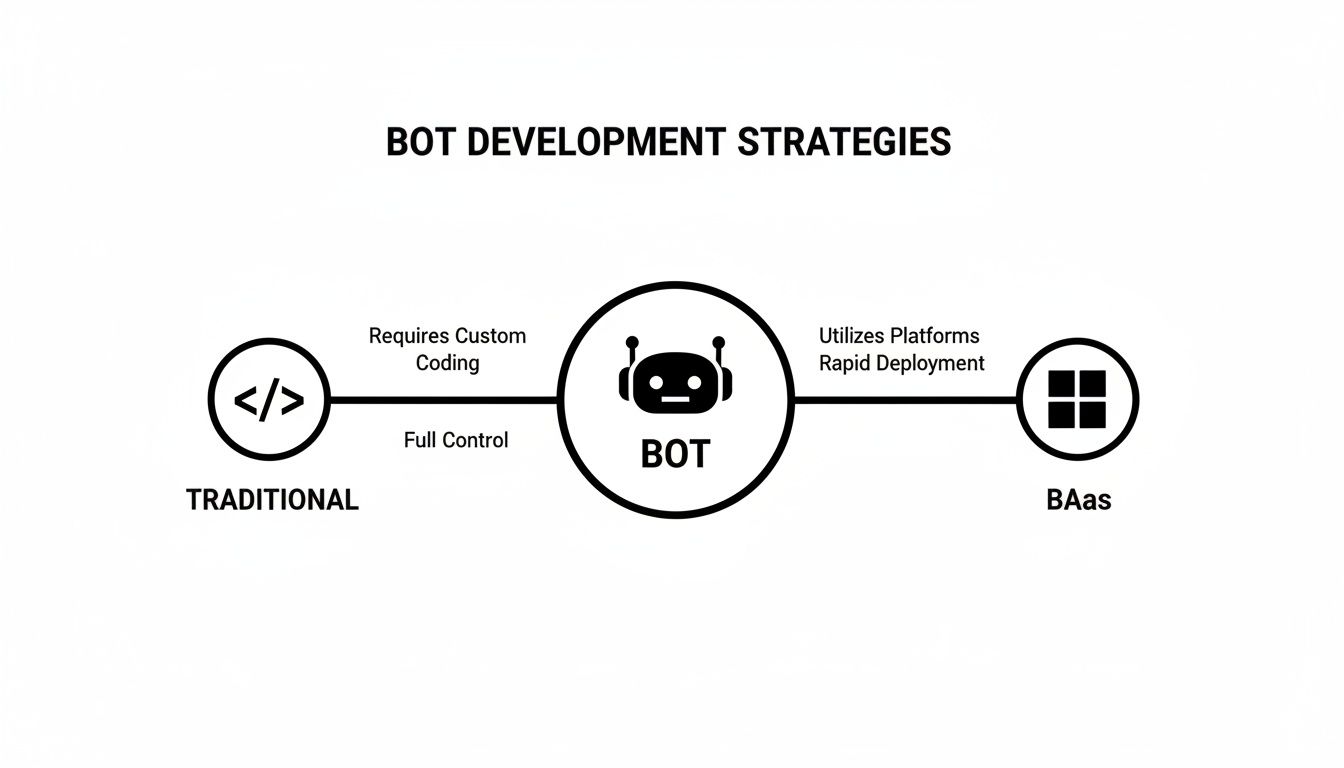
As you can see, BaaS turns a complex coding project into a much more straightforward process of configuration.
The Attentive Waitstaff
Finally, the "waitstaff" is how the bot gets delivered to your audience. These are the deployment channels. Once your bot has studied its "menu," you can put it to work almost instantly.
At its heart, BaaS architecture is all about abstraction. It tucks away the enormous complexity of AI and cloud infrastructure behind a simple user interface, putting incredible power into the hands of non-technical users.
This could be a chat widget on your website, a dedicated Q&A page you can share with a link, or an internal tool for your team on Slack. The BaaS provider ensures the bot shows up where you need it and works perfectly, ready to serve up helpful answers just like a well-trained waiter.
Ultimately, the entire setup is designed to empower you without overwhelming you. The provider runs the kitchen, you design the menu, and your customers get fantastic service.
The Key Benefits for Small and Growing Teams

For any small business, every single hour and every dollar is precious. The thought of bringing in new tech can feel overwhelming, but Bots as a Service (BaaS) is built from the ground up to provide real, tangible value right away, without the massive upfront investment. It’s all about leveling the playing field, giving you the power of a dedicated support and sales team without the payroll to match.
Let's get past the theory and look at what this actually means for your growing team. The impact is felt in three main areas: your customer experience, your operational budget, and your ability to grow.
Provide Instant 24/7 Customer Support
Picture this: It's 2 AM, and a potential customer is on your e-commerce store, stuck between two products. They have one quick question about compatibility. Without a bot, you’ve probably lost that sale. With a BaaS agent, they get an instant, accurate answer pulled from your product docs, and you close a deal while you’re fast asleep.
This around-the-clock availability is a total game-changer. It means no question goes unanswered, whether it comes in on a public holiday or late on a Saturday night. This kind of instant response builds trust and satisfaction, turning curious visitors into loyal customers.
There's a reason customer service is the most common use for bots, making up a massive 34.7% of the market. Today’s bots can handle up to 80% of routine support questions, which frees up your people to tackle the truly complex, high-value conversations. For a small team, that means big cost savings and happier customers.
Reduce Your Operational Costs
Every repetitive question your team has to answer is a hidden cost eating into your day. Think about all the time spent typing out the same replies: "What are your hours?" "What's the return policy?" "How do I track my package?"
A bot answers these questions in a fraction of a second, deflecting a huge number of tickets that would otherwise flood your inbox. This gives your skilled team members their time back, allowing them to focus on real problem-solving, building customer relationships, and actually growing the business.
The real win isn't just answering questions faster. It's about reclaiming your team's most valuable asset: their time. This shift from constantly putting out fires to proactively building for the future is where BaaS delivers an incredible return on investment.
Drive Lead Generation and Sales After Hours
Your website is your best salesperson, but what happens after your human team clocks out for the day? A bot can step right in, acting as a tireless lead generation specialist that engages visitors browsing your pricing or feature pages long after business hours.
Instead of just showing visitors a static "contact us" form, the bot can do so much more.
- Qualify visitors: It can ask a few smart questions to figure out a visitor's needs and budget.
- Provide information: It can answer detailed questions about your services, keeping potential customers engaged and on your site.
- Capture leads: The bot can grab contact information and even book a demo directly onto your sales team's calendar.
This automated process ensures you never miss a hot lead just because it came in at the wrong time. Weaving AI into your daily operations creates a serious advantage, and this practical guide to AI for teams shows just how much these tools can boost productivity. By capturing and nurturing leads 24/7, a bots as a service solution becomes a powerful engine for sustainable growth, helping you scale without breaking the bank.
Common Use Cases You Can Implement Today
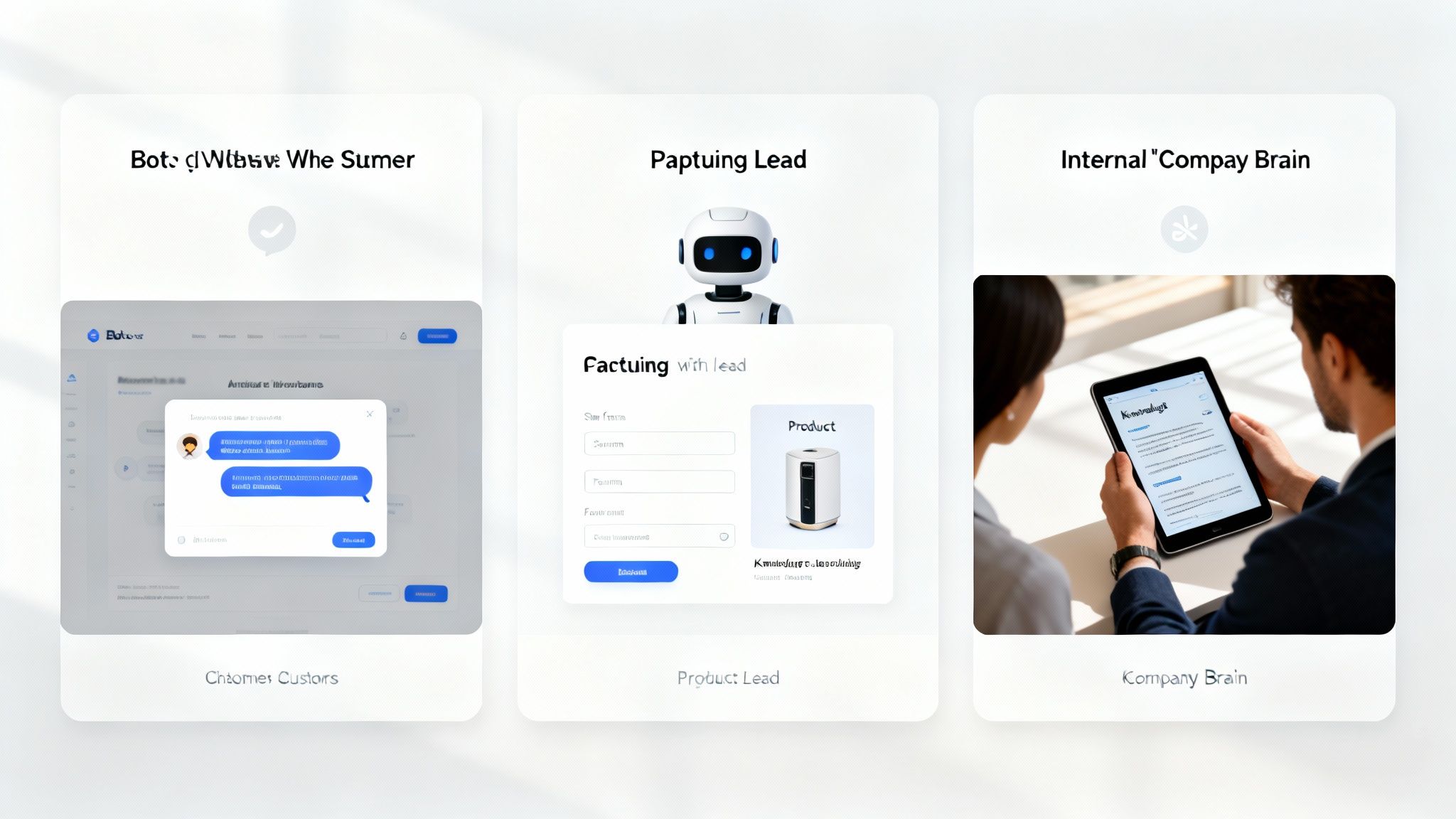
The theory behind bots as a service is interesting, but let's be honest—what really matters is seeing how it can fix real problems in your business. So instead of talking about some far-off future project, let's look at three high-impact scenarios you can get up and running fast, maybe even in a single afternoon.
Think of each of these as a mini-playbook. We’ll walk through how a no-code platform can deliver immediate results, not just by automating tasks, but by making your whole operation smarter and more responsive.
Your Instant Customer Support Agent
Every growing business has them: the same handful of questions that pop up over and over, eating up your team's day. "What's your return policy?" "How long does shipping take?" Answering them is critical, but it's a massive time sink that doesn't scale.
This is a perfect job for a bot.
Imagine pointing an AI agent to your existing help docs, FAQ pages, and product manuals. In minutes, it absorbs all that information. You then pop the bot onto your website, and suddenly you have a 24/7 expert ready to give instant, accurate answers. The number of support tickets hitting your team's inbox drops dramatically.
It turns out this is exactly what people want. A recent study found that 62% of consumers would rather deal with a chatbot than wait for a human to get back to them. By offering this kind of instant self-service, you're not just saving time; you're meeting your customers where they are.
Actionable Steps:
- Gather your sources: Grab the URLs for your main FAQ page, help center, and key policy documents.
- Train the bot: With a platform like BizSage, you literally just paste these URLs into the system. The AI does the heavy lifting of reading and understanding it all.
- Test with questions: Ask it things you get all the time, like "Do you ship to Canada?" or "How do I reset my password?" See how it does.
- Deploy the widget: A simple copy-and-paste code snippet is all it takes to get the bot live on your site.
This simple setup deflects all the routine stuff, freeing up your support crew to tackle the complex, high-value problems where a human touch really makes a difference.
Your Always-On Sales Assistant
What happens when a hot lead lands on your services page at 10 PM on a Tuesday? Best case, they fill out a "contact us" form that you won't see until morning. By then, their initial excitement might have faded, or worse, a competitor has already swooped in.
A bots as a service platform transforms your website from a static brochure into an active lead-gen machine that never sleeps. The bot can engage visitors on your most important pages, answer their questions on the spot, and start qualifying them right then and there.
Think of a sales bot as a tireless greeter for your digital storefront. It doesn't just take a message; it keeps the conversation alive, provides real value, and gently guides qualified prospects toward the next step.
Let's say a visitor is looking at your pricing page and has a niche question about a specific feature. The bot can instantly pull the answer from its knowledge base. Then, it can follow up with, "That's a great question. Would you like to book a quick 15-minute demo with our team to see it in action?"
Just like that, a passive browser becomes a scheduled meeting in your calendar—all without a single human having to lift a finger.
Your Centralized Internal Knowledge Hub
Let’s face it, a company's internal knowledge is usually a mess. It’s scattered across shared drives, buried in old email chains, and lost in countless Slack channels. This makes finding anything a nightmare, especially for new hires trying to get up to speed.
You can use a bots as a service platform to build a "Company Brain" for your team's eyes only. It’s a private, searchable resource that puts all your internal wisdom in one place.
By feeding a bot your internal documents, you create a single source of truth for things like:
- Company policies: How does vacation time work? What's the expense reporting process?
- Process documentation: Step-by-step guides for using internal software or completing specific workflows.
- Onboarding materials: Information on company culture, who's who on the team, and what to do in your first week.
This empowers everyone to get instant answers without tapping a colleague on the shoulder. A new team member can just ask the bot, "How do I set up my email signature?" and get the right instructions immediately. It's a massive boost for productivity and makes getting new people onboard so much smoother.
Choosing the Right BaaS Platform for Your Needs
Picking a Bots as a Service (BaaS) provider can feel like a big commitment, but it doesn't have to be a headache. The right platform should feel like a natural extension of your team—it should be easy to work with, reliable, and a perfect fit for your brand. If you focus on a few key areas, you can cut through the marketing fluff and find a partner that genuinely helps you grow.
Think of it less like buying a piece of complex enterprise software and more like hiring for a new role. You need a candidate who's easy to work with, trustworthy, accurate, and ready to scale with your business. Let's walk through what really matters.
Focus on True Ease of Use
The whole point of BaaS is to make life simpler. A platform can brag about having a million features, but if you need a developer on speed dial just to get it running, it's already failed on its main promise. Your first test should be how intuitive the entire experience is, from the first sign-up to tweaking things down the road.
Look for a truly no-code interface. You shouldn't need to understand APIs or webhooks just to get started. The ideal setup lets you train your bot by simply pasting in your website URL or dragging in a few documents. If you can't get a basic version of your bot running in a matter of minutes, it’s probably more complicated than you need.
Prioritize Accuracy and Trust
An AI bot is only as good as the answers it provides. If it constantly invents facts or gives vague, unhelpful replies, it will do more harm than good by damaging the very trust you're trying to build with your customers.
A top-tier platform puts accuracy first. Here’s what that looks like in the real world:
- Source Citations: Does the bot show you where it got the information? Providing a direct link to the source page or document gives users the confidence to trust what they're reading.
- Honesty About Limitations: A smart bot knows what it doesn't know. It should be trained to say, "I can't find the answer to that," instead of taking a wild guess and spreading misinformation.
- Up-to-Date Knowledge: Check if the platform automatically re-syncs with your website or knowledge base on a schedule. This is a huge time-saver and ensures your bot isn't working with old information.
Ensure Deep Customization and Branding
Your bot is an ambassador for your brand. It needs to look, feel, and sound like it came from your company, not from some third-party tech provider. This is non-negotiable for creating a seamless and professional experience for your users.
A great BaaS platform allows the bot to become invisible, seamlessly blending into your brand's ecosystem. Your customers should feel like they're interacting with your company, not a third-party tool.
Look for deep branding controls. You should be able to change the colors, add your logo, and—this is a big one—remove all provider branding from the chat widget. Just as important is the ability to shape the bot's personality. Do you want it to be formal and professional, or friendly and witty? You should be in control.
Evaluate Scalability and Pricing Models
Finally, the platform you choose has to grow with you without hitting you with surprise fees. Clear, transparent pricing is a hallmark of a good partner. Be cautious of plans that charge per user or per chat conversation, as those costs can balloon unexpectedly as your website traffic grows.
For most small teams, a flat-rate plan per company is the most predictable and scalable option. It lets your whole team get involved without you having to worry about the bill going up. When looking at BaaS platforms, it’s also smart to evaluate their underlying AI capabilities. You can get a sense of what's possible by looking at roundups of the 12 best AI tools for content creators to see what modern AI can do. Your goal is to find a plan that works for you today and offers a clear, affordable path for the future.
BaaS Platform Evaluation Checklist
To help you compare your options, here’s a straightforward checklist. Use it to ask the right questions and make sure a potential provider truly meets your needs.
| Feature/Criteria | What to Look For | Why It Matters for Small Teams |
|---|---|---|
| Onboarding & Setup | Can you get a bot live in under 15 minutes? Does it require technical skills? | Time is your most valuable resource. A complex setup process eats into time you could be spending on your business. |
| Data Sources | Can you train it by simply pasting URLs or uploading PDFs and DOCX files? | You need a system that works with your existing content without forcing you to reformat everything. |
| Accuracy | Does it cite sources for its answers? Does it admit when it doesn't know? | Building trust is everything. A bot that invents answers will quickly destroy customer confidence. |
| Customization | Can you change colors, add your logo, and remove the provider's branding? | The bot should feel like a part of your website, not a clunky add-on. Consistent branding is key to professionalism. |
| Ease of Maintenance | Does the bot auto-sync with your website to stay current? | You don’t have time for manual updates. Automated syncing keeps your bot accurate with zero extra effort. |
| Pricing Model | Is it a flat fee per company, or does it charge per user/conversation? | Predictable costs are essential for budgeting. Per-user or per-chat models can become expensive fast. |
| Support | Is there accessible human support if you get stuck? | Even the easiest tools can have hiccups. Knowing you can talk to a real person provides peace of mind. |
Choosing a BaaS platform is a strategic decision. By focusing on simplicity, accuracy, and brand alignment, you'll find a tool that not only answers questions but also becomes a valuable asset for your growing business.
Your Step-By-Step BaaS Implementation Plan
Getting your first AI assistant up and running with a bots as a service platform isn't some huge, months-long technical ordeal. It's actually something you can knock out in a single afternoon.
This simple roadmap breaks the whole process down into five clear, easy-to-follow phases. We'll strip away the jargon and show you exactly how to get a helpful bot live on your site, fast. Follow these steps, and you’ll have a working AI agent helping your customers and team before you clock out for the day.
Phase 1: Define Your Primary Goal
Before you touch a single setting, you need to know what you're aiming for. What does "success" actually look like for your business? A clear goal is your North Star—it guides every other decision you'll make.
And don't be vague here. A weak goal is "improve support." A strong, measurable goal sounds more like this:
- Reduce support response time by 50% by having the bot answer common questions instantly.
- Decrease repetitive support tickets by 40% within the first month.
- Capture 15% more qualified leads that come in after hours.
When you start with a real number, it's a hundred times easier to see your return on investment later. You're focused on solving a tangible business problem from day one.
Phase 2: Gather Your Knowledge Sources
An AI bot is only as smart as the information you feed it. So, your next job is to round up all the content that will become its "brain." The great news? You probably already have all this stuff sitting around.
Start pulling together the core materials that hold the answers your customers or team are always looking for.
- Website URLs: Grab the links to your FAQ page, help center, key product pages, and any policy documents.
- Key Documents: Upload essential files like user guides, internal process docs, or even onboarding checklists.
This is the most critical prep work you'll do. High-quality, organized source material is the bedrock of an accurate and genuinely helpful bot.
Phase 3: Train and Test Your Bot
With your sources in hand, the training part is surprisingly quick. On a no-code platform like BizSage, you just paste in the URLs and upload your files. The AI does the heavy lifting, reading and making sense of all that content to build its knowledge base.
Once it’s done training, it’s time for a test drive. Throw the questions you hear every single day at it and see what it says. This is also where you can tweak its personality and tone of voice to make sure it sounds like it belongs to your brand.
This phase is all about quick feedback. Ask a question, check the answer, and adjust your knowledge sources if needed. You can get a well-trained bot ready to go in less than an hour.
Phase 4: Deploy and Announce
It's go-time. Most BaaS platforms make this part a breeze. Usually, all it takes is copying a small snippet of code and pasting it onto your website. That's it—the chat widget is live.
Once your bot is active, tell people it's there to help! A quick email to your team can introduce the new internal knowledge bot. For customers, a small pop-up on your website can announce your new 24/7 support assistant.
Phase 5: Review and Refine
Your bot is live, but your work isn't quite done. The last, and maybe most important, step is to keep an eye on the analytics. The data showing what people are asking is your secret weapon for making things better.
You’ll see the most common questions, which is great. But even better, you'll spot any knowledge gaps where the bot couldn't find an answer.
Use those insights to create new help articles or update your existing documents. This creates a powerful feedback loop: every question makes your bot smarter, which in turn improves the experience for your customers and your team.
Got Questions About BaaS? We've Got Answers.
Jumping into something like Bots as a Service naturally brings up a few questions. It’s a totally different way to think about supporting your customers and your own team, so it's smart to get the lay of the land first. We've pulled together the most common questions we hear from business owners and laid out some straight-up, practical answers.
We'll cover everything from how much tech-savvy you actually need to making sure your bot doesn't sound like a generic robot.
How Much Technical Skill Do I Really Need?
This is usually the first thing people ask, and the answer is refreshingly simple: virtually none. The whole point of modern BaaS platforms is to make this technology accessible to everyone, not just developers. They're built on a no-code or low-code foundation.
Think of it like using a website builder like Squarespace or Wix. You don’t need to know HTML or CSS to create a beautiful site; you just drag, drop, and type. It's the same idea here. Training your bot is as simple as pasting in a few links to your website or uploading the documents you already have. If you can handle a company social media account, you've got all the skills you need.
How Can I Be Sure the Bot Gives Accurate Answers?
An AI bot is useless if you can't trust what it says. Bad answers can kill customer confidence in a heartbeat, so this is a big deal. The best BaaS platforms are designed from the ground up to prioritize accuracy and build trust.
Accuracy really boils down to two key things:
- Quality In, Quality Out: The bot’s "brain" is a direct reflection of the information you feed it. By training it exclusively on your official help center articles, detailed product pages, and internal policy docs, you're giving it a curated, authoritative source of truth.
- Show Your Work: The best platforms have the bot cite its sources with every single answer. This feature is a game-changer. It gives users a link they can click to see the original content, instantly verifying the information for themselves.
A well-built bot knows what it doesn’t know. It should be programmed to say, "I don't have an answer for that," instead of just guessing. That honesty is crucial for keeping things credible and making sure users get reliable help.
Will a BaaS Bot Actually Sound Like My Brand?
Absolutely. In fact, it has to. Your bot is a front-line representative of your business, and a generic, robotic personality can feel jarring and off-brand.
Leading BaaS platforms give you a ton of control over the bot's personality and tone. You can instruct it to be buttoned-up and professional, or friendly and conversational—whatever fits the voice you’ve worked so hard to build. This makes sure every interaction feels like a natural extension of your brand, not a conversation with a machine.
Can BaaS Integrate with My Other Software?
This is where you'll see some big differences between providers. Some BaaS solutions are built for complex integrations with big CRM systems or help desks. But for most small teams, a powerful standalone bot is often way more effective and a whole lot easier to manage.
The most practical setup is a bot you can pop onto any webpage with a simple copy-and-paste code snippet. This lets you embed it on your site, share it as a direct link, or even host it on its own page without a massive, complicated API project. That flexibility means you can put your AI assistant right where your customers and team need it most and start seeing the benefits almost immediately.
Ready to see how an AI assistant can change the game for your business? With BizSage, you can build a bot trained on your company's knowledge in minutes, not months. Stop answering the same questions over and over, give your team the support they need, and provide on-brand answers 24/7. Start your free trial today.