
You’ve probably chatted with a bot online, but true conversational AI is something different altogether. It’s the technology that lets computers actually understand and talk back to us in a way that feels natural, almost human. It's not just about spitting out pre-written answers; it's about processing what we say, grasping the context, and responding in a genuinely helpful way.
Going Beyond Basic Chatbots

Think of an old-school, rule-based chatbot like a vending machine. You have to push the exact button (use a specific keyword) to get what you want. If you ask for a "soda" but the button says "pop," you’re out of luck. The machine just gives you an error because it can't deviate from its rigid programming.
Conversational AI, on the other hand, is like a great barista. You can say, "I'll get the usual," "Could I have a large oat milk latte, please?" or even just, "Something hot for a cold day?" The barista gets it. They understand your intent, remember your past orders, and can even offer a suggestion. That’s the real magic here: the ability to understand, remember, and adapt the conversation on the fly.
The Technology That Makes It Possible
This barista-level intelligence isn't magic, of course. It's powered by a few key technologies working in concert. The most critical piece of the puzzle is Natural Language Processing (NLP), which is essentially the AI's brain. NLP is what gives the system the power to read, interpret, and figure out the meaning behind our words.
But it doesn't stop there. A few other components are just as important:
- Machine Learning (ML): This allows the AI to learn from every conversation. It gets smarter and more accurate over time without a developer having to manually update its code for every new scenario.
- Natural Language Understanding (NLU): This is a specialized part of NLP that focuses on one thing: figuring out what you really mean. It looks past the literal words to grasp your intent.
When you put all this together, you get technology that can break free from stiff, robotic scripts and create interactions that are actually helpful and feel more human.
For a quick overview, here's a simple breakdown of what Conversational AI really does.
Conversational AI at a Glance
| Core Capability | What It Means | Example |
|---|---|---|
| Understand Intent | It figures out the goal behind your words, not just the words themselves. | Asking "Where's my package?" is understood as a request for tracking info. |
| Manage Dialogue | It can handle a multi-turn conversation, remembering what was said earlier. | "How about in blue?" "Yes, we have that. Would you like to see it?" |
| Personalize Responses | It uses past data and context to provide relevant, tailored answers. | "Welcome back, Sarah! Are you looking to reorder your usual toner?" |
| Generate Language | It can create new, natural-sounding sentences instead of just using canned replies. | Instead of "Order confirmed," it might say, "Great choice! Your order is all set." |
This table shows how these capabilities come together to create a far more dynamic and intelligent experience than a simple chatbot could ever offer.
The global conversational AI market was valued at USD 11.58 billion and is projected to surge to USD 41.39 billion by 2030. This rapid expansion is driven by plummeting development costs and surging demand for AI-powered customer support. You can explore more data on the conversational AI market growth.
At its core, conversational AI is about making our digital interactions more efficient, scalable, and—most importantly—more human.
How AI Learns to Understand and Talk
For an AI to hold a conversation, it has to get a handle on human language first. And let's be honest, our language is a messy, beautiful thing—packed with slang, inside jokes, and hidden meanings. The AI tackles this challenge through a three-step process that feels a lot like how a person would learn to translate. It's how your casual question gets turned into a genuinely helpful answer.
Think of it like a human interpreter. The first job is just to hear the words or read the text. It's all about breaking down what you said into its basic parts.
The Listening Phase: Natural Language Understanding
This is where Natural Language Understanding (NLU) comes in. NLU is the AI's ability to be an active listener, zeroing in on what you really mean, not just the specific words you used. Its entire purpose is to figure out your goal.
For instance, if you ask, "What’s the weather like in Boston tomorrow?" NLU doesn't just register a jumble of words. It immediately starts tagging the important bits of information (entities) and figuring out what you want (intent).
- Intent: You're asking for a weather forecast.
- Entities: The key details are the location (Boston) and the date (tomorrow).
This knack for pulling out the real meaning is what makes conversational AI so much smarter than an old-school chatbot that would get tripped up if you phrased the same question just a little differently.
The Thinking Phase: Natural Language Processing
Once the AI gets what you're asking, Natural Language Processing (NLP) steps up. You can think of NLP as the central "brain" of the whole operation. It takes the neatly organized information from the NLU phase and figures out the next move. It connects the dots, manages the back-and-forth of the conversation, and decides what it needs to pull together for a good response.
This diagram shows how NLP sits in the middle, translating human language into something a machine can act on, and then back again.
As you can see, NLU and NLG are essential parts of the bigger NLP picture. They work in tandem to understand you and then talk back in a way that makes sense.
At its core, conversational AI is about creating a feedback loop where the system constantly learns from interactions. Each conversation provides new data points that refine the AI’s ability to understand context, predict user needs, and deliver more accurate responses over time.
This constant learning is what makes the technology so powerful and adaptable. The process gets even more interesting when dealing with spoken words. If you want to dig into the technical side of how AI handles voice, you can learn more about understanding human speech through Automatic Speech Recognition (ASR).
The Responding Phase: Natural Language Generation
Okay, the AI has understood your question and processed it. Now it has to actually answer. That’s the job of Natural Language Generation (NLG).
NLG takes the system's structured decision—the raw data—and spins it back into a normal, human-sounding sentence. So instead of spitting out something blunt like "Temp: 55F, Condition: Cloudy," NLG crafts a much more natural reply: "Tomorrow in Boston, you can expect cloudy skies with a high of 55 degrees."
It’s this final touch that makes the conversation feel smooth and helpful, not clunky and robotic.
Chatbots vs. Conversational AI vs. Virtual Assistants
It’s easy to get these terms mixed up—they're often thrown around as if they mean the same thing. But when you look under the hood, they represent vastly different levels of technology. Knowing the difference is crucial for picking the right tool for the job. Think of it like this: a rule-based chatbot is a simple walkie-talkie, a virtual assistant is a smartphone, and conversational AI is like having a dedicated project manager on call 24/7.
Let's break down what each one actually does.
The Old-School: Rule-Based Chatbots
A basic rule-based chatbot is essentially a phone tree brought to life in a chat window. It’s built on a strict, pre-programmed script. If a user types "billing question," it follows a rigid, linear path to a specific, pre-written answer.
These bots can't handle typos, slang, or any question that strays even slightly from their script. They’re best for straightforward, high-volume questions with predictable answers, but they quickly hit a wall with anything more complex.
The Personal Helper: Virtual Assistants
Next up are virtual assistants like Siri or Alexa. These are far more advanced, but their purpose is different. They’re designed for personal productivity—setting reminders, checking the weather, playing your favorite playlist.
While they use some sophisticated AI to understand spoken commands, they aren't built for deep, back-and-forth business conversations. They excel at performing specific, pre-defined tasks for an individual user.
The Game-Changer: Conversational AI
Conversational AI is in a league of its own. It’s not just a tool for answering questions; it’s an intelligent system that can understand context, manage complex dialogues, and actually solve problems. It learns from every conversation, getting smarter and more helpful over time.
This isn't about just following a script. It's about a continuous cycle of understanding what someone means, processing that information, and crafting a relevant, helpful response.
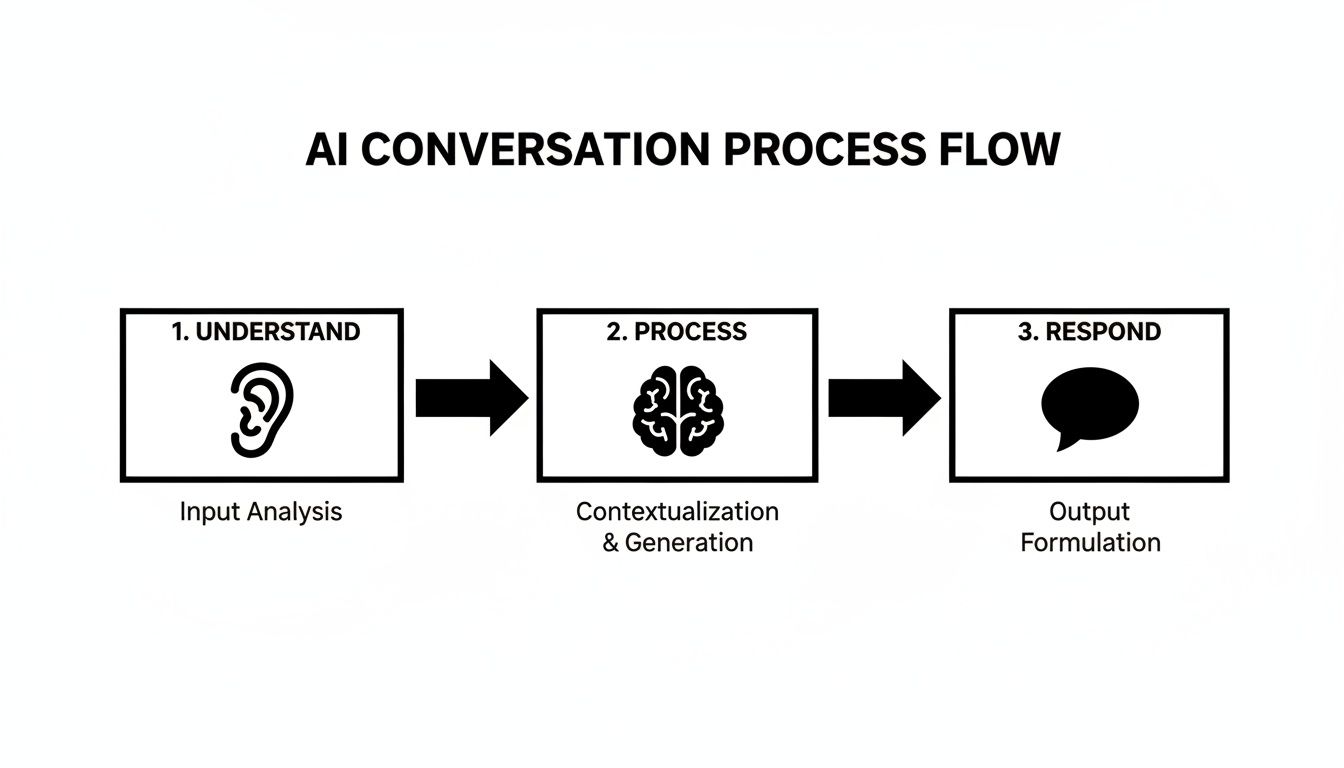
This ability to dynamically understand, process, and respond is what allows conversational AI to handle complex customer issues from start to finish—something a simple chatbot just can't do.
The real magic is its ability to handle unscripted conversation. A chatbot follows a map. Conversational AI can navigate without one, using context and past interactions to find the best route forward.
Comparing Conversational Technologies
To make the distinctions crystal clear, here’s a simple breakdown of how these technologies stack up against each other.
| Feature | Rule-Based Chatbot | Virtual Assistant | Conversational AI |
|---|---|---|---|
| Core Function | Answer specific, scripted FAQs | Perform personal tasks and commands | Solve complex user problems through dialogue |
| Flexibility | Very low; fails on unexpected input | Medium; limited to specific skills | High; adapts to user intent and context |
| Context | No memory of past interactions | Limited context within a single task | Remembers and uses conversation history |
| Ideal Use Case | Answering "What are your hours?" | "Set a timer for 10 minutes." | Guiding a customer through a multi-step support issue |
So, what's the takeaway? The right choice depends entirely on your goal. For simple, repetitive questions, a rule-based chatbot gets the job done. For personal task management, a virtual assistant is your go-to.
But for businesses that need to deliver intelligent, scalable, and genuinely helpful customer experiences, conversational AI is the only way to go.
Putting Conversational AI to Work in Your Business
Knowing how the technology works is one thing, but the real magic happens when you see it driving actual business results. Conversational AI isn't just some far-off idea; it's a practical tool that small teams are putting to work right now to solve everyday headaches, get more done, and boost their bottom line. It's like having a tireless team member who turns theoretical potential into tangible outcomes across your entire operation.
Think about handling customer questions after hours or getting new hires up to speed without tying up your whole team. The applications are both powerful and surprisingly accessible. Let's dig into a few key areas where this tech is really making a difference.
Delivering 24/7 Customer Support That Actually Solves Problems
Probably the most obvious win for any business is offering round-the-clock customer support that works. I'm not talking about a glorified FAQ page. A true AI agent can understand a customer's specific problem, ask smart follow-up questions, and walk them through a solution using the information you've provided it.
This means your human agents stop drowning in repetitive tickets. Instead of answering "Where's my order?" a dozen times a day, they can focus on the tricky, high-value conversations that really need a human touch.
- Slash Ticket Volume: By instantly handling common questions, the AI can deflect a huge chunk of your incoming support requests before they ever hit a human inbox.
- Happier Customers: People love getting immediate answers, day or night, without waiting in a queue. It’s a simple way to build a lot of goodwill.
- A More Effective Team: When your support pros are free to tackle strategic issues, their productivity and job satisfaction get a serious boost.
Acting as a Tireless Sales Assistant
Imagine a sales assistant who never sleeps, greets every single website visitor, and qualifies leads before they even land on your team's radar. That’s exactly what conversational AI can do for your sales process. It can pop up to say hello, ask a few discovery questions, and get a feel for what a visitor actually needs, all in real time.
Based on that chat, it can figure out if someone is a good fit, book a demo right on a salesperson's calendar, or pass them along to the right person. This completely changes the game by making sure your sales team only spends their time talking to genuinely interested prospects, which can shorten the sales cycle dramatically.
In e-commerce, 39% of retailers now consider conversational AI a top priority. This focus is fueling massive growth in the conversational commerce market, which was valued at USD 8.8 billion and is expected to reach USD 32.6 billion by 2035. To see more data on this trend, discover more insights about the conversational AI market.
Streamlining Employee Onboarding and Training
Getting new hires comfortable and productive is a huge challenge, especially for lean teams. Conversational AI can step in as an on-demand training buddy, ready to answer all the questions a new employee might feel shy about asking their manager.
From "How do I submit an expense report?" to "Where do I find our brand guidelines?" the AI gives instant, consistent answers. This self-serve approach empowers new team members to find what they need on their own, helping them get up to speed faster and feel more confident from day one. It takes a massive training load off your senior staff and makes your whole onboarding process much more scalable.
A Practical Guide to Your First AI Implementation

Jumping into your first conversational AI project can feel intimidating, but it doesn't have to be. The secret isn't some complex technical wizardry; it's just starting with a clear, manageable goal instead of trying to build an all-knowing robot from the get-go.
Think about one specific, repetitive task that drives your team crazy. Is it answering the same five support questions every single day? Maybe it’s filtering out unqualified leads from your website chat. By zeroing in on a real pain point, you give the AI a distinct job, which makes it far easier to measure success right away.
Laying the Foundation for Success
Once you know what you want the AI to do, you need to give it the right information to do its job. An AI is only as good as the data it’s trained on, so you’ll need to feed it the content that holds all the answers.
Luckily, you probably already have everything you need. This "training data" is sitting in places like:
- Existing Documentation: Think help center articles, internal knowledge bases, and product guides. These are goldmines.
- Website Content: Your FAQ, service pages, and even blog posts contain a ton of useful information about your business.
- Company Files: Product spec sheets, onboarding guides, and marketing one-pagers can all help build a comprehensive "brain" for your new AI agent.
Modern platforms like BizSage simplify this entire process. You just point it to your website URLs or upload your files, and the system learns everything on its own—no coding required. This step is what makes sure your AI provides accurate answers and sounds like it’s actually part of your team.
Integrating and Measuring Your AI Agent
With your AI trained up, it's time to put it to work and see how it does. A good conversational AI tool should plug right into the systems you already rely on, whether that’s your website, Slack, or helpdesk software. You want it to feel like a natural extension of your workflow, not another isolated app you have to manage.
A successful implementation isn't just about launching an AI; it's about proving its worth. The true value becomes clear when you can see a direct impact on your business operations and customer satisfaction.
To show a real return on your investment, you need to track a few key metrics. These numbers will tell the story of your AI's performance and highlight where you can make it even better.
- Resolution Rate: What percentage of chats does the AI handle completely on its own, without a human ever stepping in? This is your core effectiveness metric.
- Containment Rate: How many support tickets or live chats did the AI prevent from being created in the first place? This shows its direct impact on your team's workload.
- Customer Satisfaction (CSAT): Are people actually happy with the help they're getting? A simple thumbs-up/thumbs-down or "Was this helpful?" survey provides invaluable feedback.
By starting with a focused goal, using the content you already have, and measuring the right things, you can turn the idea of "conversational AI" into a genuine asset for your business.
Common Questions About Conversational AI
Even when you understand the core ideas, it's normal to have some practical questions about what conversational AI actually looks like in the real world. This technology is moving fast, and things like cost, complexity, and what's coming next are on every business owner's mind.
Let's clear up a few of the most common hangups. We'll dig into the real differences between AI types, talk about what it actually costs to get started, and look at how new developments are making these tools more capable than ever.
What Is the Difference Between Standard AI and Conversational AI?
Think of "Artificial Intelligence" as a giant category, like "vehicles." That single word includes everything from skateboards to cargo ships. "Standard AI" is that broad term—it covers everything from the algorithm that suggests what you should watch next on Netflix to complex systems that flag credit card fraud.
Conversational AI is a specific type of vehicle in that fleet, one built for a very particular job: having a human-like conversation. While a standard AI might be great at crunching numbers in a spreadsheet, conversational AI is designed to understand context, follow the give-and-take of a discussion, and reply in a way that makes sense. It’s the difference between a tool that processes data and one that can actually talk with you.
How Is Generative AI Changing the Game?
You’ve probably heard of Generative AI—it’s the engine behind tools like ChatGPT, and it represents a huge jump forward. Before generative models went mainstream, most AI chatbots pulled their answers from a pre-written script or a library of approved responses. They were basically fancy search tools.
Generative AI is a total game-changer because it creates brand-new, original content in real-time. This means it can:
- Craft More Human-Like Responses: It can break down complex ideas, adopt a specific tone (like friendly or professional), and give nuanced answers that feel genuine, not scripted.
- Handle Unexpected Questions: Instead of hitting a wall with "I don't understand," it can piece together information from its knowledge base to form a helpful, logical reply.
- Summarize Information: It can read a long document or a messy conversation thread and give you the highlights, which is a lifesaver for both internal teams and customer support.
This ability to generate instead of just retrieve is what makes conversations feel so much more natural and intelligent.
What Does Conversational AI Cost for a Small Business?
One of the biggest misconceptions is that this kind of tech is only for giant corporations with bottomless budgets. That couldn't be further from the truth today. Cloud computing and user-friendly platforms have made conversational AI surprisingly affordable. Globally, cloud-based systems are set to grab over 75% market share by 2035, mostly because they eliminate the need for expensive, on-site hardware. Sales and marketing teams are jumping on board fastest, with the use of generative AI agents in these areas growing at 25.5% CAGR. You can learn more about conversational AI market findings to see the full trend.
For a small business, this means you no longer need a team of AI developers. Platforms like BizSage use a simple subscription model, letting you get started for a predictable monthly fee that’s often less than what you’d pay a part-time employee.
This approach removes the scary upfront investment and makes powerful AI a realistic tool for any team.
As you start working with conversational AI, it's a good idea to learn which types of prompts get the best results. Exploring some key questions to ask AI can help you get more value out of every interaction and fine-tune its performance over time.
Ready to see how easily conversational AI can work for your business? With BizSage, you can turn your company content into a 24/7 expert agent in minutes. Start deflecting repetitive questions and empowering your team today. Get started with BizSage and build your first AI agent for free.