
Imagine having a team member who never sleeps, answers customer questions in a flash, and qualifies new leads around the clock. That's what an AI chatbot for small business can do for you. This isn't some complex, futuristic technology anymore; it's a practical, tireless assistant built to solve the one problem every small business owner has: a constant lack of time and resources.
Meet Your New Hardest-Working Team Member

As a small business owner, you know every minute is precious. You’re constantly pulled in a dozen directions—managing inventory, running marketing campaigns, and personally handling customer questions. An AI chatbot steps in as your master multitasker, a digital employee who can juggle multiple jobs at once, freeing you up to focus on the bigger picture.
Think of it as your virtual front-desk clerk, your online sales guide, and your internal support specialist, all rolled into one. It’s a single tool that takes over the routine tasks that eat up your day, delivering instant and consistent support to both your customers and your own team.
Bridging the Resource Gap
For years, this kind of automation felt like something only big corporations could afford. That’s not the case anymore. The technology has become far more accessible and affordable, leveling the playing field and giving small businesses a real shot at competing with the giants.
AI adoption isn't just a trend for big companies anymore; it's a competitive necessity for small businesses. Those who embrace tools like AI chatbots are setting themselves up for a huge advantage in efficiency and customer happiness.
The numbers back this up. Small business AI adoption saw a stunning 40% increase in just six months, jumping from 6.3% to 8.8%. What’s more, 96% of small and medium-sized businesses are planning to adopt new technologies, and 71% are looking to increase their AI investment in the next year. You can dig into these small business AI adoption statistics to see just how quickly things are changing.
This guide will break down exactly how an AI chatbot can become a real-world solution for:
- Making your day-to-day operations run smoother
- Creating a better experience for your customers
- Growing your business without having to grow your payroll
How AI Chatbots Actually Grow Your Business
An AI chatbot isn't just some clever widget you add to your website. Think of it as a growth engine that directly impacts three of the most important parts of your business: making customers happier, making your daily work easier, and bringing in more money. It’s not about the fancy tech; it's about getting real, measurable results.
When a customer has a question, they want an answer right now, not hours or a day later. A chatbot delivers that instantly, 24/7. Whether it's a simple query like "What are your hours?" or "Where's my order?", this immediate help builds a ton of trust and shows customers you respect their time.
Streamline Your Day-to-Day Operations
As a small business owner, your time is your most precious resource. An AI chatbot acts like a tireless employee, automating all those repetitive tasks that eat up your team's day—like answering the same handful of questions over and over or gathering basic info from a new lead.
By taking over these routine jobs, the bot frees up you and your staff to concentrate on the work that actually grows the business. We're talking about things like closing a big sale or perfecting a new service offering.
This is a big deal. Globally, generative AI pulled in $33.9 billion in private investment in a single recent year, which just shows how much potential is there. Yet, only 29% of companies with less than $100 million in revenue have started using AI widely. Compare that to the nearly 50% of giant corporations with over $5 billion in revenue. That gap is a massive opportunity for small businesses to get a leg up. You can dig into this more in the 2025 AI Index Report.
Speed Up Your Revenue Growth
Imagine having a sales assistant who works around the clock without ever needing a break. That's your chatbot. It can greet website visitors the second they land on your site, ask a few smart questions to see what they need, and then point them to the perfect product or service. This immediate engagement is crucial for keeping potential customers from clicking away.
A well-designed AI chatbot does more than just answer questions—it actively creates sales opportunities. It turns casual browsers into qualified leads and paying customers, filling your pipeline while you sleep.
Here’s a quick look at what that means in practice:
- Lead Capture: The bot can grab contact details from interested visitors, even at 3 in the morning.
- Appointment Booking: It can sync with your calendar to automatically schedule demos and consultations, no back-and-forth emails required.
- Purchase Guidance: It can answer last-minute product questions and steer people straight to the checkout page.
Chatbots are moving way beyond basic support. They're becoming powerful sales tools in their own right, especially in e-commerce. To see where this is headed, check out this piece on how AI chatbots drive direct sales and are changing the game.
Putting Your Chatbot to Work in the Real World
The theory is nice, but seeing an AI chatbot in action is where things get interesting. These tools are far more than just glorified FAQ pages; they're versatile assistants that can tackle real problems in every corner of your business. This applies whether you're dealing with customers or streamlining how your team works internally.
Let's look at a few practical scenarios where a chatbot can start making a difference right away. Think of these as templates you can easily adapt for your own company, whether you’re running a local shop, an online store, or a service business. Each one shows how a little automation can take repetitive tasks off your plate, giving you more time to focus on the big picture.
The benefits aren't just isolated wins. As you can see below, these practical applications create a positive ripple effect across the business, improving everything from customer happiness to your bottom line.
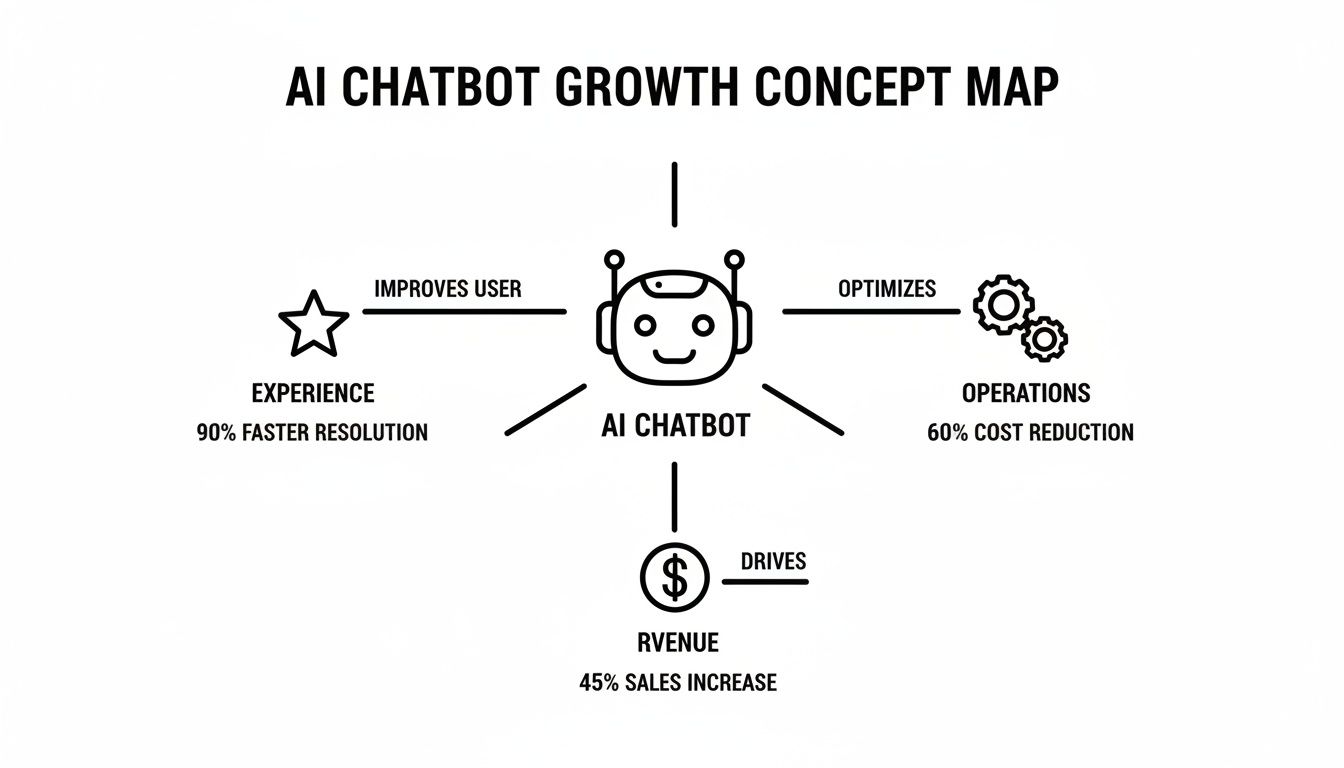
This really drives home the point: a single smart tool can boost customer satisfaction, make your operations run smoother, and directly help you earn more.
A New Front Door for Customer Support
One of the most popular jobs for a chatbot is handling customer support, and for good reason. It can be there 24/7 to provide instant answers. A huge chunk of customer questions are repetitive—things like "What are your hours?" or "How do I track my order?" An AI chatbot can easily resolve 80% or more of these common queries on its own, no human needed.
- Example in Action: Imagine a boutique e-commerce store. Their chatbot handles all return requests. It walks the customer through the steps, generates a shipping label, and clarifies the return policy. What used to be a point of friction becomes a simple, self-service task.
A Sales Assistant That Never Sleeps
Your chatbot can also be your most dedicated salesperson. When someone lands on your website, the bot can greet them, ask a few smart questions to figure out what they need, and then point them to the perfect product or service. That immediate, helpful engagement can be the difference between a lost visitor and a new customer.
This is a powerful way to make sure your sales team is only talking to people who are genuinely interested. To get a better feel for what goes into a sales-focused bot, it’s worth looking into the essential AI Chat features that make this possible.
A Smarter Way to Onboard New Hires
Chatbots aren't just for your customers. They can make a huge impact on your internal processes, too. For new employees, an internal chatbot acts as an on-demand guide for all those first-week questions about company policies, benefits, or how to get IT help.
An internal chatbot gives new team members the power to find answers on their own. This helps them get up to speed faster and feel more confident, all while saving your veteran staff from answering the same questions over and over.
It's a much smoother way to welcome someone to the team. You're essentially giving every new hire a personal concierge for your company from day one.
How to Choose the Right AI Chatbot for Your Needs
With so many AI tools hitting the market, picking the right one can feel overwhelming. It’s easy to get bogged down in technical specs and buzzwords. The trick is to ignore the noise and focus on what your business actually needs to succeed. A little structure can turn a confusing decision into a smart, strategic one.
Before you even start looking, figure out your primary goal. Don't just aim for something vague like "better support." Get specific. A much better goal is "cut down on repetitive customer support emails by 25%." This gives you a concrete benchmark to measure every potential chatbot against, making sure your choice solves a real problem.
Focus on Ease of Use and Setup
As a small business owner, your time is your most precious resource. You can't afford to spend weeks wrestling with complex software or hiring a developer just to get a chatbot running. That’s why no-code chatbot builders are an absolute game-changer.
These tools are built for people who aren't tech wizards. They typically feature simple drag-and-drop interfaces and clear, step-by-step instructions. You should be able to get in, train your bot on your business information, tweak its look, and have it live on your site in minutes, not months. Prioritize platforms that make the setup feel effortless.
Evaluate Integration Capabilities
Your chatbot shouldn’t operate in a silo. To be truly effective, it needs to talk to the other tools you rely on every day. A great ai chatbot for small business will plug right into your existing systems, making your whole operation run smoother.
Think about which connections are most important for you:
- CRM Systems: Can the chatbot create new leads in your HubSpot or Salesforce account automatically?
- E-commerce Platforms: Will it connect to your Shopify store to provide real-time order updates?
- Scheduling Tools: Can customers book appointments directly into your Calendly or Google Calendar without leaving the chat?
Solid integrations elevate your chatbot from a simple Q&A machine to an automated workhorse.
Ensure Strong Customization and Brand Voice
Often, your chatbot is the first "person" a potential customer interacts with. A generic, robotic script can be a major turn-off. The best platforms give you total control over the bot's personality so it sounds like it’s genuinely part of your team.
A great AI chatbot doesn’t just spit out answers; it communicates in your unique brand voice. Customization ensures every interaction feels authentic and builds customer trust, rather than creating a robotic, impersonal experience.
Look for features that let you define its tone—whether that's friendly and casual, formal and professional, or a little bit quirky. This alignment is key to creating a consistent and welcoming experience for everyone who visits your site.
Understand the Pricing Model
Finally, let's talk about cost. The price needs to make sense for your budget, with no nasty surprises down the road. Most providers offer a monthly subscription, but the specifics can differ wildly. When comparing plans, look at what you’re actually getting for your money—things like the number of conversations allowed per month, how many bots you can build, and which advanced features are included.
Find a provider with straightforward, transparent pricing that can grow with your business. A free trial is a fantastic way to test the waters and see for yourself if a platform can deliver on that one specific goal you set from the beginning.
Your Simple 5-Step Plan for a Successful Launch
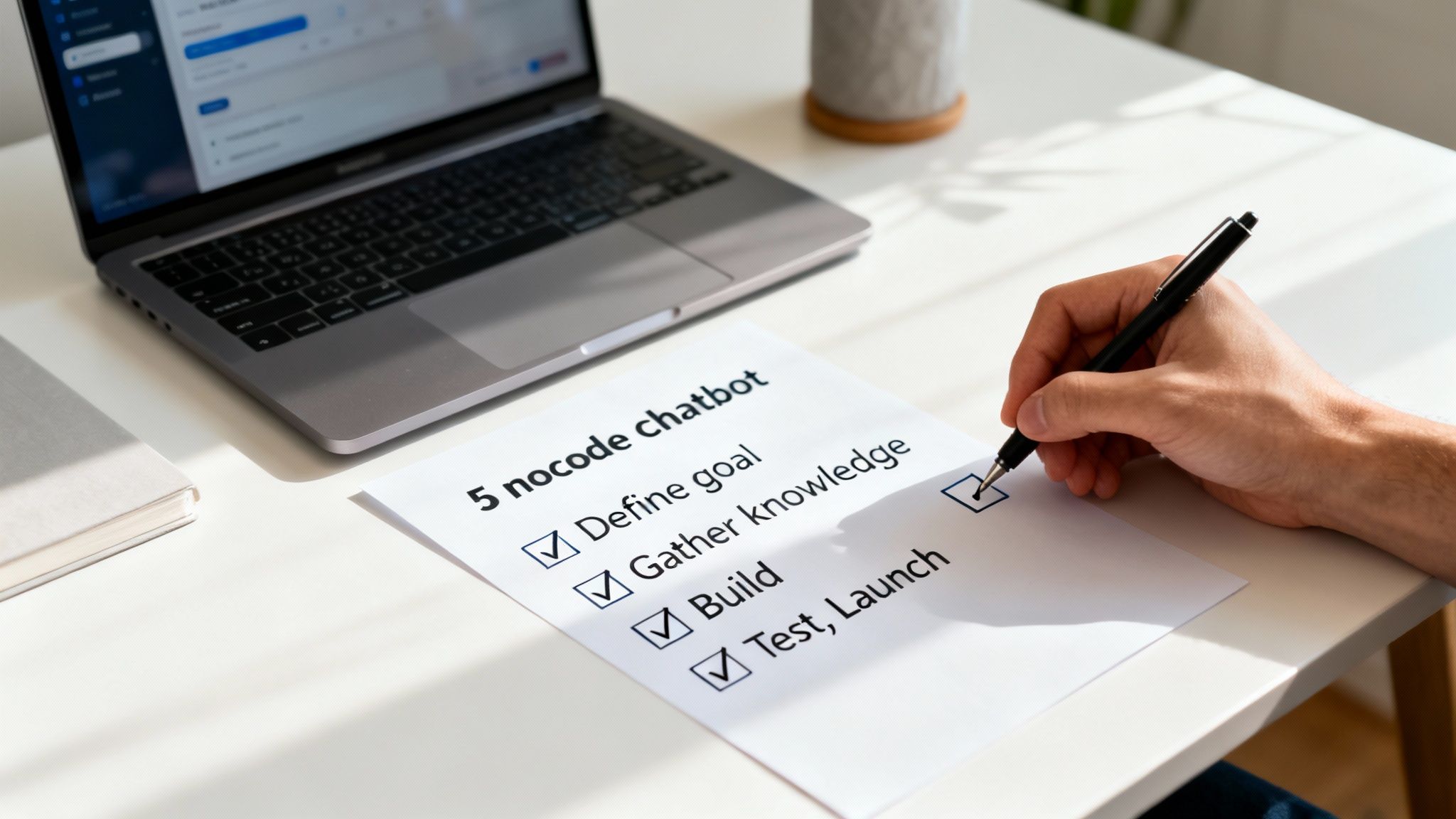
Putting an AI chatbot to work isn't the monumental tech project you might imagine. With today's tools, it’s more of a strategic exercise than a technical one. We've boiled it down to a straightforward five-step plan for busy entrepreneurs, designed to get your bot up and running with confidence—no guesswork required.
Step 1: Define Your Primary Goal
Before you touch a single setting, you need to know why you're doing this. What's the number one problem you want this chatbot to solve? Trying to make it do everything at once is a classic rookie mistake and a surefire way to get frustrated.
Instead, zero in on a specific, measurable objective. Something like, "I want to cut down on emails about order status by 30%" or "I need to automatically book 10 new client consultations a month." This one goal becomes your North Star, guiding every decision and making sure your bot delivers real value right out of the gate.
Step 2: Gather Your Core Knowledge
An AI chatbot is only as smart as the information you feed it. Think of this step as creating a "brain" for your new digital employee. Your job is to compile all the essential information it needs to be helpful.
Start by gathering your most frequently asked questions and the answers you give over and over again. Pull together key documents, product pages, and any existing FAQ sections from your website. This is the foundation your ai chatbot for small business will use to give customers the right answers.
A successful chatbot launch isn't about complex coding; it's about clear goals and quality information. Starting with a focused objective and well-organized knowledge is the secret to a smooth and impactful implementation.
Step 3: Build Your Bot with No-Code Tools
Here's the best part: you don't need to be a developer to build a genuinely powerful chatbot. Platforms like BizSage are designed for business owners, offering simple, no-code interfaces that let you set everything up in minutes.
You literally just upload your documents, paste in links to your website pages, and the AI does the heavy lifting, instantly understanding your content and getting ready to chat.
Step 4: Test Internally with Your Team
Before you unleash your chatbot on the world, let your team have a go at it first. An internal test run is the perfect stress test. It helps you catch any awkward phrasing, find gaps in its knowledge, and make sure its personality actually sounds like your brand.
Encourage your team to be tough on it. Have them ask tricky, unexpected questions to see how the bot handles things it doesn't know. This is where you find the rough edges and smooth them out.
Step 5: Go Live and Listen
Okay, it's time for the big debut. Start small by launching your chatbot on a single, high-traffic spot, like the homepage of your website.
Once it's live, your job shifts from building to listening. The key is to monitor those first conversations and pay close attention to the real questions people are asking. This feedback is pure gold—it shows you exactly how to improve your bot's knowledge base and make it even more helpful over time.
Measuring What Matters for Chatbot Success
Getting your chatbot live is a huge milestone, but the work doesn't stop there. Think of your new bot like a fresh hire—it's smart, but it needs real-world experience and feedback to truly master the job. To make sure it's delivering real value, you need to pay attention to a few key numbers.
This isn't about getting lost in complex spreadsheets. It's about tracking simple, powerful metrics that tell you exactly how your ai chatbot for small business is performing and how it's helping you hit your goals.
Core Metrics for Small Businesses
To start, you don't need to track everything. Just focus on a few Key Performance Indicators (KPIs) that connect directly to the job you hired your chatbot to do. These will give you a clear, honest picture of what's working and where you can tune things up.
Here are the essential metrics to keep an eye on:
- Resolution Rate: What percentage of conversations does your chatbot handle from start to finish without needing a human to jump in? A high resolution rate is a fantastic sign that your bot is successfully solving customer problems and freeing up your team's time.
- Lead Capture Rate: If your chatbot is a sales assistant, this is your money metric. It measures how often the bot successfully collects contact details from a potential customer. This number directly shows how your chatbot is feeding your sales pipeline.
- Customer Satisfaction (CSAT) Score: The simplest way to know if people like your bot is to ask them. A quick post-chat survey ("How would you rate this conversation?") gives you instant insight into the user experience. You're looking for consistently high scores, which means your bot is genuinely helpful, not a source of frustration.
Monitoring your chatbot isn't just about catching errors. It's about finding opportunities. The questions people ask are a goldmine of customer insight, revealing exactly what they need and want from your business.
The real breakthroughs happen when you start digging into the conversation logs. By reviewing what people are asking—especially the questions your bot can't answer yet—you get an unfiltered look into your customers' minds.
This is priceless intelligence. It can show you gaps in your website's FAQ, uncover demand for a new product or service, or even help you refine your marketing messages based on the exact language your customers use.
Key Metrics for Measuring Chatbot ROI
Here’s a quick-glance table summarizing the most important metrics to track. Focusing on these will give you a clear understanding of your chatbot's performance and its direct impact on your business.
| Metric | What It Measures | Why It Matters for a Small Business |
|---|---|---|
| Resolution Rate | The percentage of issues solved without human help. | High rates mean reduced workload for your team and faster answers for customers. |
| Lead Capture Rate | The percentage of chats that result in a new lead. | Directly shows the chatbot's contribution to growing your sales funnel. |
| Customer Satisfaction | How happy users are with the chatbot interaction. | A happy customer is more likely to buy again and recommend your business. |
| First Response Time | The speed at which the bot initially engages a user. | Instantaneous responses meet customer expectations and prevent them from leaving. |
| Escalation Rate | The percentage of chats passed on to a human agent. | Helps you identify complex issues the bot can't handle and where to improve its training. |
By keeping an eye on these numbers, you’re not just managing a piece of software; you’re actively refining a tool that can become one of your most valuable assets for growth and customer happiness.
Common Questions About AI Chatbots
Whenever you're looking at new technology, it’s only natural to have a few questions. For most small business owners, the big ones are usually about brand voice, technical know-how, and of course, the budget. Let's tackle those worries head-on.
The great news is that today’s tools are built specifically to solve these problems, making genuinely helpful AI a reality for pretty much everyone.
Will It Sound Robotic and Hurt My Brand?
This is probably the number one fear, and it's a valid one. We've all dealt with those clunky, frustrating chatbots from a few years ago. But the technology has come a long way since then. A modern AI chatbot for small businesses can be trained to perfectly match your brand’s voice—whether you’re fun and casual, strictly professional, or a little bit quirky. You're in control of the personality.
It all comes down to authenticity. You can give the AI your website pages, your help articles, and even old customer service chats. It soaks all that up to learn your unique style, making sure every conversation feels right. Plus, any good chatbot makes it dead simple for a customer to ask for a human if their problem gets tricky.
Think of your chatbot less like a robot and more like a new team member you're training. It learns your brand's voice to enhance your personal touch by providing instant, helpful answers 24/7.
Do I Need Technical Skills to Build One?
Not anymore. The whole "no-code" movement has been a game-changer here. You absolutely do not need to hire a developer or learn to write a single line of code to get one of these up and running.
Honestly, setting up a chatbot these days is usually as simple as this:
- Give it your content: Just upload a few files or paste in your website URL.
- Set the tone: Tell it to be friendly, professional, or whatever fits your brand.
- Test it out: Ask it a few questions you know your customers ask.
It’s a straightforward process that means you can have a bot live on your site in just a few minutes.
How Much Does an AI Chatbot Cost?
The price tag can be all over the place, but many of the best platforms are designed with small business budgets in mind. You can often find starter plans for around $20-$50 per month. For more powerful AI chatbots that connect with other tools you use, you're more likely looking at $100 to $400 monthly.
My advice? Always look for a free trial. It's the best way to see the value for yourself. When you weigh the monthly cost against the hours you and your team get back—not to mention the new leads it can capture—the return on your investment usually becomes obvious very quickly.
Ready to see how an AI chatbot can work for your business without all the fuss? BizSage turns your company’s content into on-brand answers, 24/7. Start your free trial today and have your new hardest-working team member live in minutes.