
Let’s be honest—the modern agency-client relationship is often a minefield of unspoken assumptions. A client’s idea of a “quick tweak” can easily turn into a week of unplanned work, while your definition of "soon" might be worlds away from their urgent deadline.
These little misalignments seem minor at first, but they’re the real root of most agency headaches. They’re the cracks in the foundation that, left unchecked, can bring the whole partnership crumbling down.
Why Managing Client Expectations Is Your Agency's Superpower
When you don't actively manage expectations, you’re basically setting yourself up for friction. That friction shows up in a few familiar, and frankly, damaging ways:
- The Never-Ending Scope Creep: Those "small," unbilled requests start piling up, absolutely wrecking your project profitability and your team's sanity.
- A Breakdown in Trust: When clients feel like you’re not meeting their unspoken needs, they start to doubt your ability to deliver on anything.
- The Dreaded “Difficult Conversation”: You find yourself constantly on the back foot, having to reactively talk about blown budgets and missed deadlines.
- Inevitable Client Churn: Eventually, a frustrated client will just go find another agency they feel "gets" them better.
The Expectation Gap and Its Impact on Agencies
This gap between what clients expect and what agencies deliver is more than just a feeling—it's a well-documented problem that seems to be getting wider. This table breaks down where the most common disconnects happen and the real damage they cause.
| Area of Misalignment | Common Client Expectation | Typical Agency Reality | Resulting Negative Impact |
|---|---|---|---|
| Communication | 24/7 access, instant replies, proactive updates on everything | Standard business hours, 24-48 hour response times, updates at key milestones | Client feels ignored or unimportant, leading to frustration and micromanagement. |
| Scope & Revisions | "Unlimited" tweaks are included; new ideas can be added on the fly | A set number of revision rounds are budgeted; new ideas require a change order | Scope creep erodes profit margins; team burnout from unbilled work. |
| Timelines | Projects can be rushed; "ASAP" means drop everything and start now | Projects follow a structured timeline with dependencies and resource allocation | Rushed work leads to lower quality; team morale plummets. |
| Reporting & Results | Immediate, dramatic results and daily performance dashboards | Results take time to build; reports are generated weekly or monthly | Client loses faith in the strategy; pressure to deliver unrealistic short-term wins. |
As you can see, these aren't just minor annoyances. They directly impact your bottom line, your team’s well-being, and your ability to retain the clients you’ve worked so hard to win.
The data backs this up, too. A staggering 74% of CMOs admit that client expectations are sky-high, and 65% of customers now have higher service expectations than they did just a few years ago. You can dig into more of these evolving customer experience statistics to see the full picture.
Instead of treating expectation management like a defensive chore, start thinking of it as your single greatest competitive advantage. It's the most powerful tool you have for building loyalty, boosting profits, and creating clients who genuinely enjoy working with you.
When you have a proactive framework, you turn this potential weakness into a real strength. You’re not just preventing problems; you’re building a partnership based on mutual respect from day one. Clients love clarity. They want to know you have a plan.
This is where smart technology can be a game-changer. Tools like BizSage, a client-trained AI, can help you embed and automate key parts of this process. Imagine being able to provide instant, accurate answers to common client questions 24/7, all under your own agency’s brand.
This sets a high bar for responsiveness right from the start, reinforcing your value while freeing up your team to focus on high-level strategy instead of answering the same questions over and over. By mastering this discipline, you stop being just another vendor and become the indispensable partner your clients can't imagine living without.
A Proactive Framework for Setting Expectations from Day One
The first 30 days of a client relationship are make-or-break. This is when the promises you made in the sales pitch collide with the reality of working together. If you don't set firm ground rules right away, you're building on a shaky foundation, and it’s only a matter of time before things start to crumble.
Getting client expectation management right isn't about being rigid or difficult. It’s about creating clarity and building trust from the very first conversation. When clients know exactly what to expect, they feel secure. That security builds the trust you need for them to let your team do their best work, free from the drag of constant check-ins and micromanagement.
The kickoff meeting is your best tool for this. Don't treat it like a formality for team introductions; see it for what it is—a strategic session to define the rules of engagement for the entire project.
Architecting the Perfect Client Kickoff Meeting
Your kickoff agenda needs to be more than a to-do list. Think of it as a structured conversation designed to uncover hidden assumptions and get solid agreements on the most common friction points.
Here are the non-negotiables you absolutely must cover:
- Communication Cadence & Channels: Get specific about how and when you'll talk. Will it be Slack, email, or your project management tool? Set a clear Service Level Agreement (SLA) for response times. Something like, "Our team is committed to responding to all non-urgent messages within 24 business hours." This single rule prevents a client from feeling ignored when their 9 PM email doesn't get an instant reply.
- Defining 'Done' & Success Metrics: This is where you nail down what a successful outcome actually looks like in concrete terms. What specific KPIs will you be tracking? How will everyone know, without a doubt, when a deliverable is complete? This is your defense against the dreaded "I'll know it when I see it" feedback cycle.
- Roles & Responsibilities: Clearly map out the key players. Who is the main point of contact on their side? Who is it on yours? And most importantly, who has the final authority to sign off on deliverables? Answering this upfront saves you from the chaos of conflicting feedback from multiple stakeholders later on.
The gap between what a client expects and what you deliver is where relationships go to die. As you can see below, even a small mismatch early on can quickly snowball into serious friction and lost loyalty.
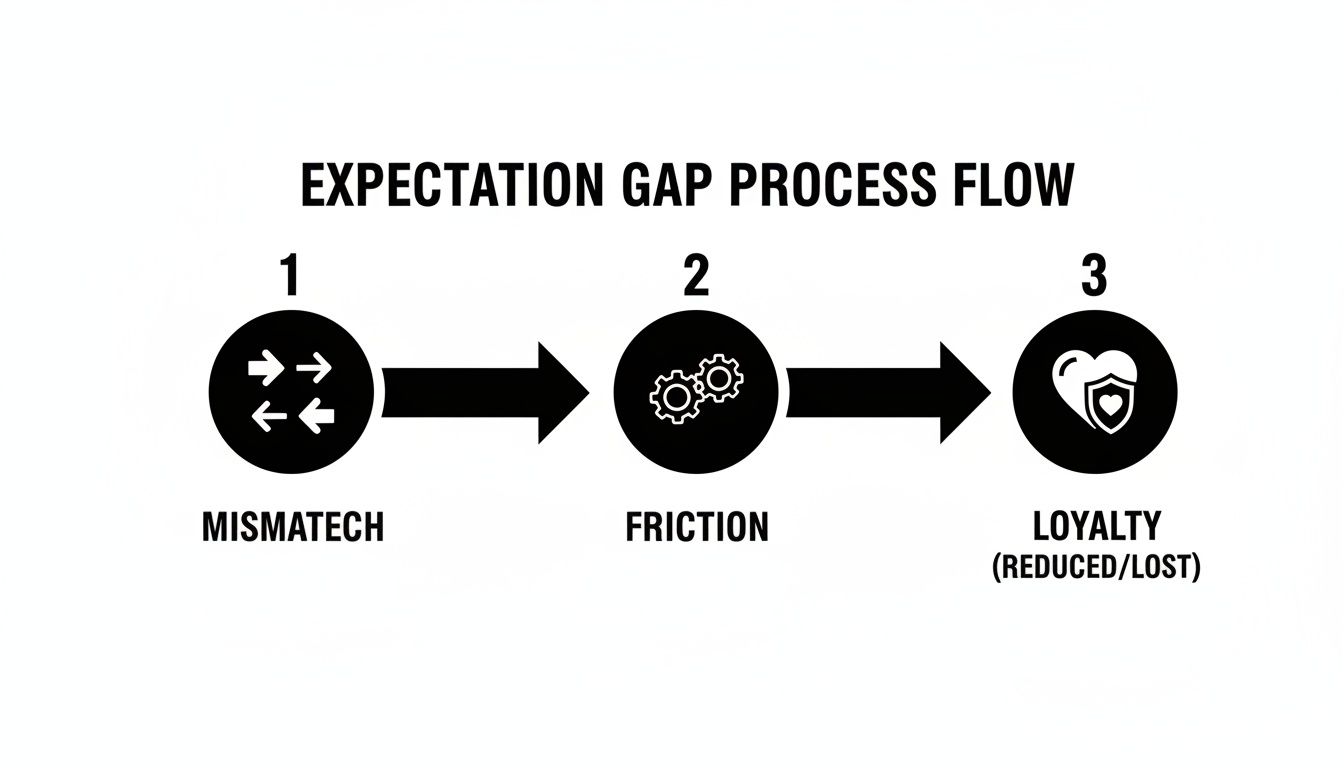
This flow really drives home the point: preventing that initial mismatch is the single most effective way to protect the long-term health of the partnership.
Creating the 'What's In vs. What's Out' List
One of the simplest yet most powerful tools for preventing scope creep is the 'What's In vs. What's Out' list. You create this collaboratively during the kickoff meeting.
Go beyond what’s written in the SOW and spell out foreseeable requests that are not included in the project fee.
Let's say you're on a website design project:
| What's IN | What's OUT |
|---|---|
| Design of up to 5 core page templates. | Logo design or brand guide updates. |
| One round of major design revisions. | Copywriting for blog posts or new pages. |
| Two rounds of minor text/image changes. | Creation of page templates beyond the agreed five. |
| Ongoing website maintenance post-launch. |
By documenting this upfront, you transform a potentially awkward future conversation into a simple, matter-of-fact reference to a past agreement. When the client inevitably asks for a sixth page template, you can say, "That's a great idea! As we covered in our kickoff, new templates are outside the initial scope, but I can get you a quote for that by the end of the day."
Lock in these agreements right after the meeting. Send a detailed recap email summarizing every key decision—from communication SLAs to the 'What's In vs. What's Out' list. Then, ask the client to reply with a simple, "Looks great, thanks!" That email is now your shared source of truth.
Bringing in Tech to Reinforce Your Rules
You can immediately show your commitment to clear communication by introducing smart technology right from the start. This is where a tool like BizSage can become a core part of your expectation-setting strategy.
In the kickoff, introduce your client-trained AI agent as their 24/7 dedicated resource. Don't just mention it; frame it as a premium benefit that shows your dedication to providing immediate support.
You could say something like this:
"We know questions will pop up outside of business hours. To give you instant answers on project status, our processes, or even details about our strategy, we've set up a dedicated AI agent trained specifically on our work together. You can access it anytime right here in our portal, and it's always the fastest way to get information."
This one move accomplishes several things at once. It sets a high bar for responsiveness, teaches the client how to find answers on their own, and filters routine questions away from your team. By using technology to back up your promises, you prove that your framework for managing expectations isn't just a document—it’s a living part of how you deliver outstanding service.
Keeping the Conversation Going: Communication Throughout the Client Lifecycle
Setting expectations in a kickoff meeting is like drawing the map for a road trip—it's absolutely crucial, but it's only the beginning. The real journey, the day-to-day work of managing a great client relationship, happens on the road. And on that road, consistent, clear communication is your fuel.

Without that steady flow of information, even the most perfect plan can veer off course. Clients get nervous and start to micromanage when they feel left in the dark. Meanwhile, your team feels the weight of unspoken demands and growing pressure. This ongoing dialogue is how you actively steer expectations long after that initial kickoff excitement fades.
Create a Rhythm of Proactive Updates
The secret is to establish a communication cadence so predictable that your client never has to wonder, "What's the latest on my project?" They'll already know when the next update is scheduled to hit their inbox.
For Weekly Progress Updates, think beyond a simple task list. Frame everything in terms of progress toward their goals. A simple, scannable email format is often the best way to go.
- Wins from Last Week: Highlight 1-2 key achievements and connect them directly to a project milestone.
- Priorities for This Week: Briefly outline your team's current focus. This builds a sense of momentum and manages their short-term expectations.
- Roadblocks & Needs: Clearly state anything you need from them, like feedback or assets. This puts the ball in their court and makes project dependencies crystal clear.
For Monthly Reporting Calls, make it a strategic conversation, not a data dump. Your job is to connect the dots and explain the "so what?" behind the numbers. Don't just show a 15% increase in website traffic; explain how that traffic is fueling their lead generation and impacting their sales pipeline.
Every single report and update should reinforce the value you’re providing. When you consistently tie your daily activities to the client's bigger business goals, the conversation shifts from "what did you do?" to "look at the results we achieved together."
Handling Tough Conversations with Confidence
Let's be real: no project goes perfectly. A deadline will be missed. A campaign will underperform. How you handle these moments is what separates a disposable vendor from a true, long-term partner. Hiding bad news is the worst possible move.
To build unbreakable trust, you have to lean into solid client communication best practices, which means being radically transparent and solution-focused when things go sideways.
Here's a simple, field-tested script for breaking down an underwhelming result:
- Own It: "Looking at this month's numbers, the lead volume from the new campaign was lower than our forecast. We see it, and we're already on it."
- Explain the 'Why': "Our initial analysis points to the new ad creative not resonating with the target audience as strongly as we'd hoped."
- Present the 'How': "We've already developed two new creative concepts based on what we learned. Our plan is to launch A/B tests by Wednesday to find a version that performs better."
- Reaffirm the Goal: "We're confident we can turn this around. We'll be monitoring the new tests closely to get us back on track toward our quarterly goal."
This approach shows you're taking ownership and have a plan, which keeps your client's confidence intact even when the results aren't perfect.
Using Technology to Get Ahead of Problems
Keeping up this high-touch communication across an entire client roster is a heavy lift. This is where the right tools can give you a massive advantage by helping you spot friction before it becomes a full-blown problem.
Imagine your account managers using a tool like BizSage to review the chat logs from your client-trained AI agents. They might spot a pattern: several people from one client are all asking questions about their "reporting dashboard."
That's a smoke signal. It’s a clear indicator of a hidden expectation or a point of confusion that's simmering under the surface. Armed with that knowledge, the account manager can get out in front of it.
On the next check-in call, they can say, "Hey, I noticed a few questions came through about the reporting dashboard this week. I'd love to walk you through it again to make sure it's giving you all the clarity you need." This transforms a reactive support query into a proactive, trust-building moment that proves you're paying attention.
Let’s be honest: no matter how airtight your onboarding process is, scope creep is going to happen. It's a fact of agency life. It usually starts small, with a client asking for "just one quick thing." But those tiny requests are where your profit margins get eaten alive and your team starts to burn out. Mastering these conversations is a non-negotiable skill for any successful client relationship.
The trick isn’t to be confrontational. A hard 'no' rarely goes over well. Instead, the goal is to have a consistent, repeatable process for gently guiding the conversation back to the agreed-upon scope. This turns a potential point of conflict into a chance to grow the account. That "What's In vs. What's Out" document from your kickoff meeting? It's about to become your best friend.
Turning 'Quick Requests' into Change Orders
When a client asks for something that wasn’t in the original agreement, your response needs to be upbeat but clear. You want to immediately frame it as a new item, not a minor tweak that's already covered. Avoid any language that sounds defensive or puts the client on the back foot.
Your entire goal is to shift their thinking from "this should be included" to "this is a valuable add-on I can choose to purchase."
Here are a few phrases your team can lean on to navigate this without friction:
- "That's a great idea, and I can definitely see how that would add value. It's just outside what we scoped for this phase, but I'd be happy to scope it out and get a quote over to you this afternoon."
- "I love that you're already thinking ahead. Let's add that to our 'parking lot' of future ideas. We can review everything in there next month and prioritize what to tackle in a new project."
- "To do that properly would take about [X hours of design] and [Y hours of development]. That wasn't factored into our initial plan, but if you'd like to move forward, I can draft a quick change order for you to approve."
This approach does two things beautifully: it validates the client's idea while simultaneously reinforcing the boundaries you set on day one. It protects your team’s time and reminds the client that your work has tangible, measurable value.
Addressing Client Dissatisfaction Head-On
Even with the best processes in the world, sometimes a client is just going to be unhappy. A campaign might not hit its numbers, or a deliverable might just miss the mark on their vision. The financial stakes here are massive—US businesses lose $35.3 billion a year from customers leaving over avoidable problems. And with 86% of people ready to walk after just two bad experiences, you absolutely need a plan for de-escalation.
When a client voices frustration, the first move is to listen, not to launch into a defense. Your ability to show empathy in customer service is what will either save the relationship or sink it. It's a critical skill for keeping trust intact when things get rocky.
The most important thing you can do when a client is upset is to make them feel heard. Acknowledge their frustration and repeat their concerns back to them to show you understand. Only after they feel understood should you move toward a solution.
By following a structured process, you can take control of the conversation and steer it toward a productive resolution.
- Acknowledge and Validate: Kick things off with something like, "I understand you're frustrated with the results from the latest report, and I hear your concern that we're not on track. Thank you for bringing this directly to my attention."
- Gather Facts, Not Feelings: Ask pointed questions to get to the root of the problem. "Can you walk me through which specific metrics are most concerning to you? What were you hoping to see instead?"
- Restate the Goal: Circle back to the original objectives you both agreed on. "Our shared goal for this quarter was to increase qualified leads by 15%. Let's refocus on that and figure out where the disconnect is."
- Present a Solution-Oriented Plan: Propose clear, immediate next steps. "Based on your feedback, here's what I propose we do in the next 48 hours…"
This structured approach stops the conversation from spiraling into a blame game. It showcases your professionalism, reinforces your role as a strategic partner, and transforms a tense moment into a powerful opportunity to prove you can solve problems together.
Scaling Expectation Management with AI and Automation
Delivering a white-glove experience for one client is one thing. Doing it for twenty? That's a different beast entirely. The manual processes that feel personal and effective with a handful of accounts start to creak and groan as you grow. Communication gets inconsistent, service quality dips, and your ability to manage expectations starts to unravel.
The problem isn't a lack of effort; it's a lack of time. As your agency scales, your team's focused attention becomes your most precious—and scarce—resource. Without a way to multiply their efforts, they get stretched thin, and believe me, clients notice.
Automating Consistency with a Client-Trained AI
This is where you can get smart with technology. By strategically automating the right pieces of client communication, you can keep your service standards high without burning out your team. A client-trained AI agent, like the one from BizSage, can become a core part of your operational playbook.
Think of it as creating a digital expert that knows each client's business inside and out. This isn't some generic chatbot scraping the public web. You train it on your client’s specific content:
- Their website, from the homepage to the deepest FAQ page
- Internal docs like brand guides, product specs, or sales battle cards
- All the marketing collateral and campaign briefs you’ve created
The AI digests all of this and learns their business, allowing it to provide instant, accurate answers to common questions, 24/7. This immediate feedback loop sets a powerful new standard for clients—they quickly learn they have a reliable resource at their fingertips anytime they need it.
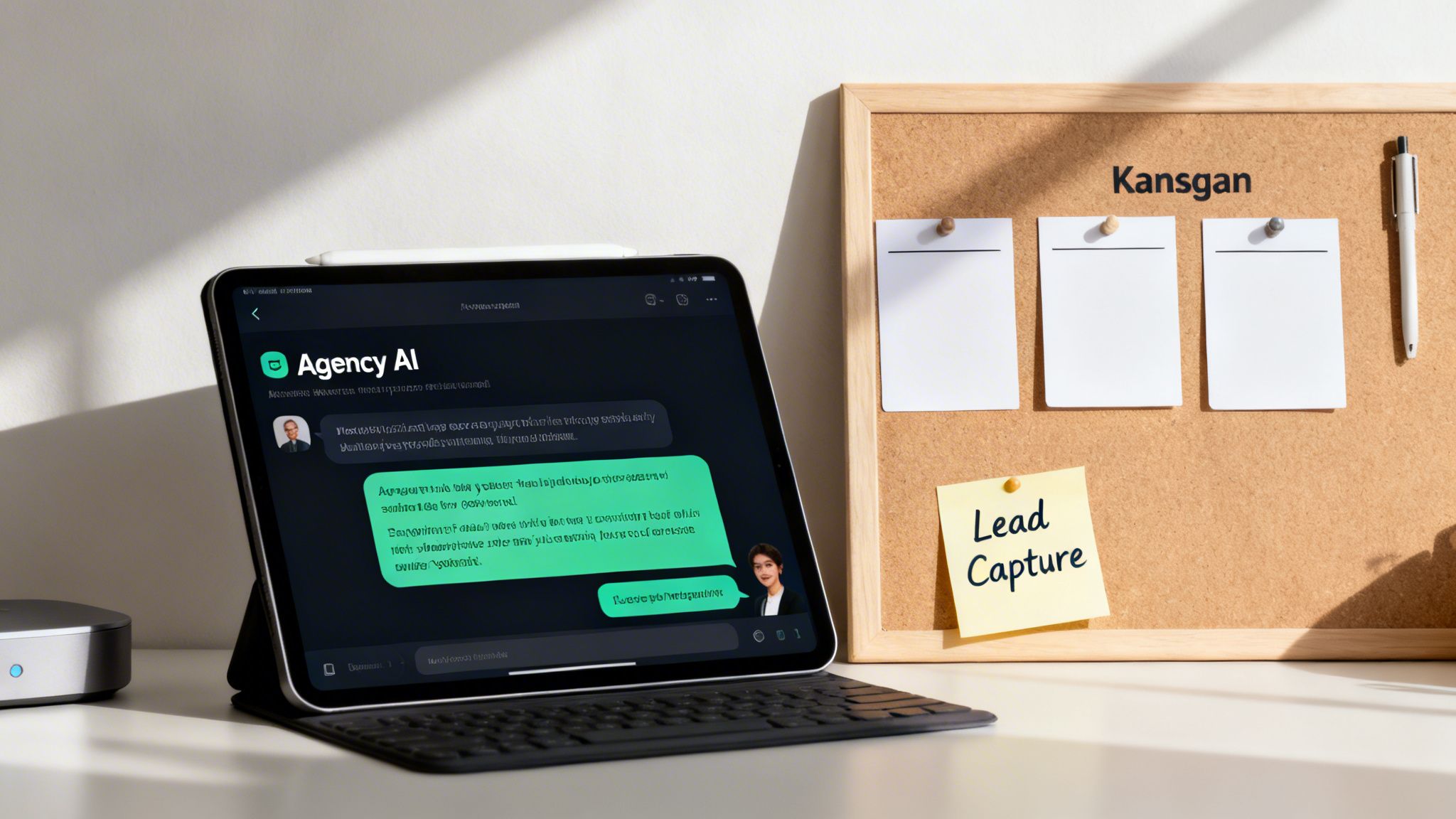
This kind of system frees up your team from the hamster wheel of answering the same low-level questions over and over. Instead of spending their days explaining where to find a report or clarifying a term from the SOW, they can finally dedicate their brainpower to the high-value strategic work that actually moves the needle.
Proactively Guiding the Client Conversation
A well-trained AI does more than just react to questions; it can proactively guide clients toward the answers and resources they need most. By setting up custom conversation starters, you can anticipate their questions and subtly reinforce your established processes.
Picture a client logging into their portal for the first time. Instead of a blinking cursor in an empty chat window, they see helpful prompts like:
- "Where can I find my latest performance report?"
- "What are your business hours and response time SLAs?"
- "Can you walk me through the content approval process?"
This simple tweak immediately manages expectations by pointing them to the systems you've already built. It teaches them how to self-serve, reinforcing the communication protocols you laid out during onboarding. It’s a quiet but incredibly effective way to scale your best practices.
By automating how you deliver foundational information, you guarantee every client gets the same clear guidance, no matter who their account manager is or how slammed your team gets. That level of consistency is just impossible to pull off manually once you start to scale.
Proving ROI with Integrated Lead Capture
One of the best ways to keep expectations grounded and positive is to constantly demonstrate tangible value. Your AI agent can become a direct contributor to your client's business goals, and showing them the data is a total game-changer.
Modern AI tools like BizSage are built for more than just conversation. They can be set up to spot user intent and capture leads right in the chat. When a visitor asks about pricing or wants to see a demo, the agent can pop up a form to grab their info on the spot.
Suddenly, your AI isn't just a support tool; it's a lead-gen machine working for your client. And the best part? You can track everything. A built-in, Kanban-style CRM shows you every single lead the agent captured, giving you concrete ROI to put in your reports.
Imagine walking into your next client meeting and being able to say this:
"On top of our campaign work, the AI agent we set up on your site handled 250 inquiries this month and directly captured 15 qualified leads for your sales team."
That’s how you shift the conversation away from billable hours and deliverables. You're drawing a straight line from your work to their revenue. When clients see your systems actively making them money, their perception of your value skyrockets, making every future conversation about budgets and timelines a whole lot easier.
Answering Your Toughest Questions About Client Expectations
Even with the best framework in place, you're going to have questions. Let's be real—managing client expectations is less of a science and more of an art. It’s dynamic, it’s messy, and practical issues are always going to come up.
So, let's dive into some of the most common hurdles agencies hit when they get serious about building clearer, more durable client partnerships.
What’s the One Thing I Absolutely Can't Mess Up?
If you only get one thing right, make it the scope of work. Nail this down during onboarding, and make it crystal clear. This document is your new best friend—it needs to cover deliverables, timelines, and exactly how you'll communicate. It becomes the true north for the entire relationship.
Without that solid foundation, everything else you try to do is basically built on quicksand.
Putting in the work upfront saves you from a dozen painful, reactive conversations down the line. It’s the anchor you'll point to when a request gets a little fuzzy or a "quick idea" threatens to throw the whole project off course. This single step shifts the relationship from one based on assumptions to one built on clarity.
How Do I Fix Things with a Client When Expectations Are Already a Mess?
This one takes a bit of courage and a whole lot of honesty. You need to schedule a dedicated meeting to essentially "re-kickoff" the project. The key is to frame it as a positive step—a way to strengthen the partnership so you can deliver even better results for them.
Don't go in pointing fingers. Start by talking about what's working and, just as importantly, what isn't. From there, you can introduce a new, clearer framework for how you’ll work together from now on. You'll want to cover the same ground you would with a brand-new client:
- Communication: Get specific about channels and agree on response times. No more guessing.
- Scope: Work together to create a simple "What's In vs. What's Out" list.
- Reporting: Agree on how often you'll send updates and what they'll focus on.
The goal here is collaboration, not confrontation. Be ready to listen and meet them in the middle. You want to walk out of that meeting with a new written agreement that everyone has signed off on. It’s a formal reset that gives you both a fresh start.
Resetting expectations isn't about admitting you failed. It's a sign of a mature partnership where both sides care enough to fix the process for everyone's benefit.
Can AI Actually Help with This, or Is It Just Hype?
Yes, it absolutely can—but you have to be smart about its role. AI, like the client-trained agents we build at BizSage, is a powerhouse for managing the foundational stuff: communication, access to information, and first-line support. It delivers consistency at a scale that humans just can't match.
Think about it: an AI agent can give instant, 24/7 answers to common questions, point clients to the right report, or even qualify a new lead that comes through the website. Clients get that immediate sense of responsiveness and value. The AI handles the "what" and "how" of day-to-day questions with perfect accuracy every single time.
But it’s not a replacement for the human touch. It can’t navigate a sensitive conversation, build genuine rapport, or have a game-changing strategic discussion. What it does do is free up your team to focus on that high-value stuff—the "why" behind the partnership. By letting AI handle the routine, you ensure every client gets the basics right, while your team invests their time in strengthening relationships and driving incredible results.
Ready to scale your agency’s best practices and give every client a consistently amazing experience? BizSage lets you deploy client-trained AI agents that provide instant, accurate answers and capture leads, all under your brand. Find out how to automate the routine and get back to focusing on what really matters.