
If you've ever run an agency, you know the feeling. You're drowning in a sea of spreadsheets, hunting through endless email threads for that one client approval, and trying to piece together reports from three different platforms. It's organized chaos, at best.
Agency client management software is the antidote. Think of it as the central command center for your entire operation, bringing communication, project tracking, and reporting together under one roof. It’s the operational brain that turns scattered data into clear, actionable intelligence.
Unifying Your Agency Operations
For so many growing agencies, fragmentation is the default setting. Client comms are in Gmail, tasks are on a Trello board, performance data is in Google Analytics, and the master client list is a spreadsheet somewhere on a shared drive. This setup isn't just inefficient; it’s a recipe for dropped balls, missed deadlines, and a frustrating experience for both your team and your clients.
Agency client management software is built specifically to fix this. It acts as the single source of truth, creating a connected ecosystem where every client interaction, project update, and performance metric lives in one place.
It’s like the difference between a pit crew where every member has their own separate instruction manual and one where everyone works off a single, synchronized plan. A unified platform gets everyone on the same page, creating a well-oiled machine instead of a jumble of disconnected parts.
Making this shift from manual mess to automated clarity is absolutely essential if you want to scale.
More Than Just a CRM
It's easy to confuse these platforms with a standard CRM, but they're a different breed entirely. A generic CRM is great for tracking sales leads and contacts. But agency client management software is designed for the messy, complex reality of delivering client work. Its job is to manage the entire client journey—from that first onboarding call all the way through project execution, reporting, and long-term retention.
- Centralized Communication: Every email, call note, and meeting summary is logged in one place, giving your whole team a complete history of the relationship.
- Project and Task Visibility: You can tie tasks, deadlines, and milestones directly to specific clients, so there's never any confusion about who's doing what or when it's due.
- Automated Reporting: Forget spending hours every month copying and pasting data. These tools pull information from multiple sources to build consistent, professional-looking reports automatically.
- Scalable Onboarding: Create repeatable templates and workflows to make sure every new client gets the same smooth, impressive introduction to your agency.
The move toward these integrated systems is massive. The global CRM software market, a core component of these platforms, hit USD 44.82 billion in 2024 and is expected to soar to USD 119.39 billion by 2033. This explosion shows just how many agencies are finally ditching their patchwork of manual tools for platforms that can automate their workflows and give them real-time, client-specific insights. You can discover more about these market trends and what they mean for the future of agency operations.
To see what this looks like in practice, here's a quick comparison of the old way versus the new way.
Agency Operations Before and After Management Software
This table breaks down the stark contrast between running an agency on manual processes versus using a dedicated platform.
| Operational Area | The Manual Approach (Without Software) | The Streamlined Approach (With Software) |
|---|---|---|
| Client Communication | Scattered across individual email inboxes, Slack, and call notes. Key details get lost. | All client interactions are logged in a central hub, creating a complete, searchable history for the whole team. |
| Project Management | Tasks tracked on separate spreadsheets or generic tools like Trello. No direct link to client goals. | Projects, tasks, and deadlines are tied directly to client accounts. Everyone sees the full picture. |
| Reporting | A painful, manual process of pulling data from multiple sources and building reports from scratch each month. | Automated reports are generated with a few clicks, pulling in live data for consistent, professional updates. |
| Team Collaboration | Constant "who's handling this?" questions. Information lives in silos, causing delays and duplicate work. | A single source of truth for all client work ensures seamless handoffs and clear ownership of tasks. |
| Client Onboarding | An inconsistent, ad-hoc process that varies with each new client, often leading to a rocky start. | Standardized onboarding workflows and templates ensure every client receives a professional, consistent experience. |
The difference is night and day. One path leads to burnout and stalled growth, while the other opens the door to efficiency, scalability, and happier clients.
This diagram perfectly illustrates how a central hub connects all the critical parts of your agency—projects, clients, and reporting—into a single, cohesive system.
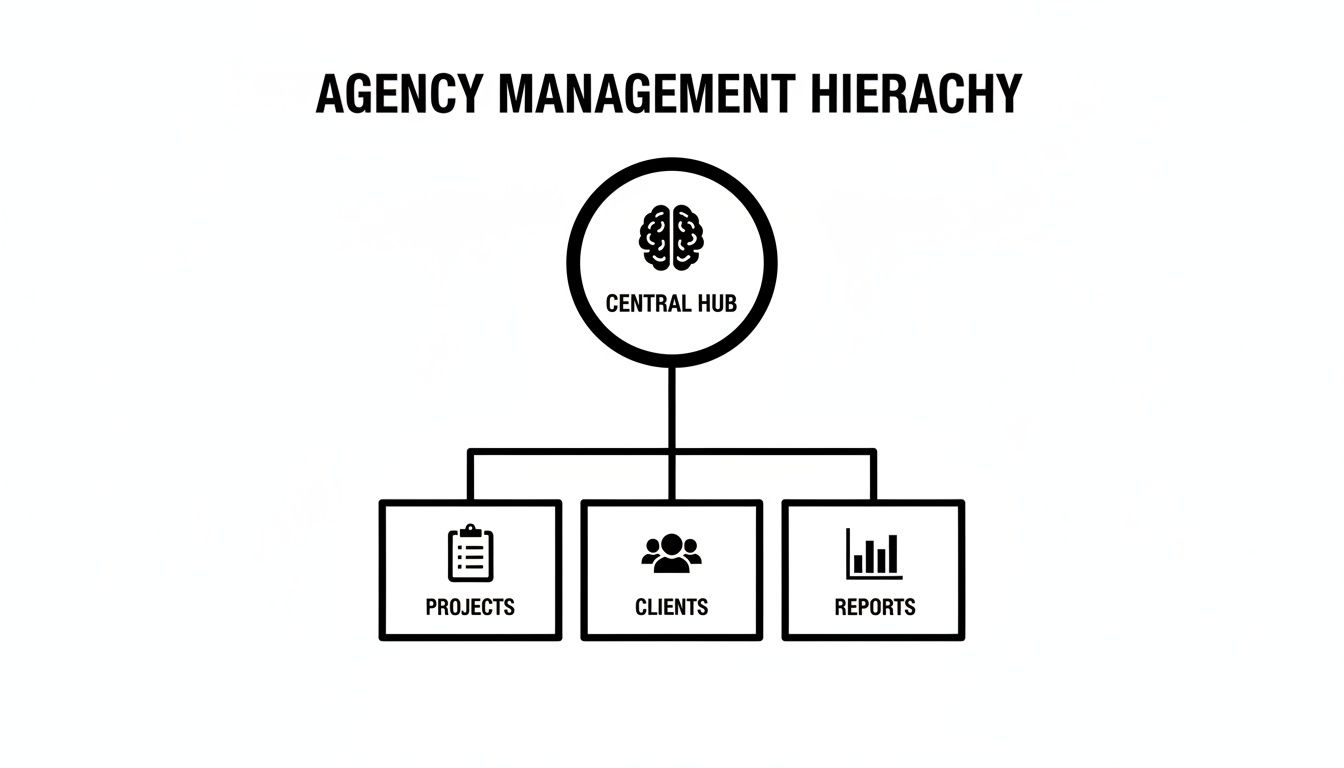
Without that central system, each part of your agency risks becoming an island. And as any agency owner knows, islands don't scale.
Exploring the Core Features Every Agency Needs

When we talk about the features of agency software, we're not just checking boxes on a list. We're talking about the engine that actually drives a modern agency forward. Certain capabilities are absolutely non-negotiable, not because they're trendy, but because they solve the very real, day-to-day headaches of managing multiple clients at scale.
Think of it like this: you could try to build a house with a basic hammer and a handsaw, or you could use a professional toolkit with a nail gun, a power saw, and a laser level. Both get the job done, but one is faster, more precise, and far less frustrating. For agencies, the right software features are that professional toolkit.
Unified Multi-Client Management
The single most critical feature for any agency is a multi-client dashboard. This is your command center. It gives you a complete, at-a-glance view of every client account from one single screen. Without it, you're stuck flipping between endless browser tabs, logging in and out of different accounts, and cross-referencing spreadsheets—a recipe for mistakes and wasted hours.
A unified dashboard means you can instantly check a project's status, see the latest client message, or pull up key performance stats without ever leaving the platform. This big-picture view is essential for knowing where to focus your team's energy and which accounts need attention right now.
True White-Labeling Your Brand Identity
Your agency client management software should feel like it’s yours, not some third-party tool you’re renting. This is where real white-labeling comes in. It’s so much more than just putting your logo on a login page. It’s about creating a totally seamless, branded experience for your clients from start to finish.
True white-labeling means you get:
- Custom Domains: You can set up client portals on a subdomain you own, like
portal.youragency.com. It instantly makes you look more professional and established. - Branded Communication: Every email notification, automated report, and chat interface should carry your branding, not the software company's.
- Visual Customization: You should be able to tweak colors, fonts, and layouts to match your client’s brand identity, making the platform feel like a natural part of their world.
This level of control quietly reinforces your value and builds trust every time a client logs in.
Automated Client Reporting and Communication
Let's be honest: manually building client reports is a soul-crushing task. It’s one of the biggest time-sinks in any agency. A modern platform automates this entire process, pulling data from all your connected sources into clean, professional reports. You can schedule them to go out automatically, freeing up your account managers to focus on high-value strategy instead of copy-pasting data.
The best platforms also act as a single source of truth for all client conversations. Every email, call note, and project decision is logged in one shared, transparent place. This completely eliminates the "Wait, who approved that?" chaos.
To get things started on the right foot, many platforms also offer customizable client onboarding process templates. A structured kickoff process ensures nothing gets missed and sets a professional tone from day one.
Next-Generation AI and Lead Capture
The most innovative platforms are now building client-specific AI and lead generation tools right into the system. These aren't just generic chatbots. They're intelligent agents that you can train on each client's unique data—their website content, support documents, and product info.
Imagine deploying a branded AI agent on your client's website. It can answer visitor questions with perfect accuracy 24/7. But it gets better. It can also detect a user's intent. When someone asks about pricing or services, the AI can immediately present a lead capture form, turning a simple question into a qualified prospect for your client.
This is a complete game-changer. The agency management software market was valued at USD 2.5 billion in 2023 and is expected to rocket to USD 7.24 billion by 2025. Why? Because features like this deliver tangible results. In fact, 45% of companies are prioritizing automation like AI-powered lead capture. This tech turns a client's website from a simple brochure into an active revenue-generating machine—and that’s a powerful way to prove your agency's ROI.
Your Agency Software Evaluation Checklist
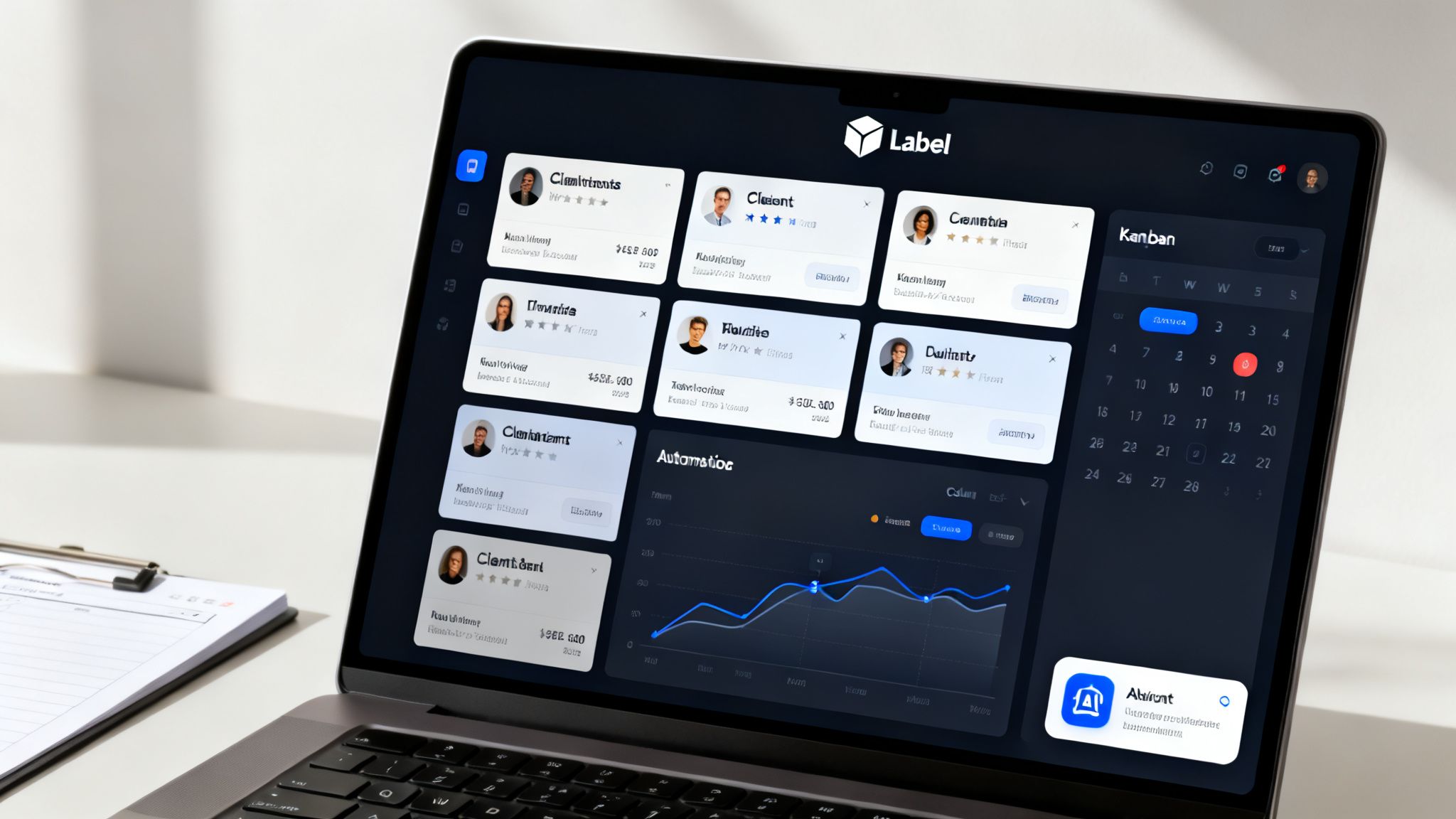
Picking the right software for your agency is a huge deal. It’s not just another subscription to add to the pile; it’s the engine that will power how you scale, serve clients, and ultimately, make money. To get past the slick sales demos and find what really works, you need a solid game plan.
This checklist breaks down the absolute must-haves. Think of it as your guide to asking the tough questions and seeing beyond the feature list to find a platform that actually fits where your agency is headed. As you dig in, it’s also smart to check out expert guides on choosing the right CSM software to make sure your choice lines up with your specific business goals.
Can It Grow With Your Agency?
Scalability isn't just a buzzword—it's about whether a platform can support you with five clients, fifty clients, and then some. A tool that feels great for a small team can quickly turn into a major headache as your agency grows. The agency client management software you choose has to be built to handle more complexity without forcing you to hit the reset button on your entire operation.
When you’re talking to vendors, get specific with your questions:
- Multi-Client Architecture: How does the platform actually handle managing dozens or even hundreds of different client accounts from one central spot?
- Performance Under Load: What happens when you’re juggling tons of active projects and thousands of client messages at the same time? Does it slow to a crawl?
- Pricing Model: Is the pricing straightforward and predictable as you grow, or are you going to get hit with massive, surprise cost increases when you add more clients or team members?
A truly scalable platform should feel like it's growing with you, not holding you back.
How Secure Is Your Clients' Data?
Let’s be clear: you are the gatekeeper of your clients’ sensitive information. A data breach that happens on your watch doesn't just hurt their business—it can permanently destroy your agency's reputation. Security can’t be an afterthought; it has to be a deal-breaker. With reports showing that 95% of agency workers are putting in overtime, rushed mistakes are bound to happen, and that's when security practices can slip.
Your software evaluation has to put security front and center. A single vulnerability can wipe out years of trust you’ve worked so hard to build with your clients.
Look for platforms that take security seriously and have clear policies. Here’s what to ask:
- Data Encryption: Is all data—both when it's stored and when it's being sent—locked down with modern encryption?
- Access Controls: Can you set specific, role-based permissions so team members only see the client data they absolutely need to?
- Compliance Certifications: Is the platform compliant with major data protection laws like GDPR or CCPA?
Does It Offer True White-Labeling?
Your clients hired your agency, not the software you happen to use. The best platforms get this and let you put your brand on everything. This is about more than just slapping your logo on a login screen. It’s about creating an experience so smooth that the software feels like a custom tool you built just for them.
True white-labeling means you’re in complete control of the client experience.
- Custom Domains: Can you host the client portal or chat widget on your own domain (like
portal.youragency.com)? - Branding Control: Can you customize colors to match each client’s brand, and does the "powered by" message point to your agency?
- Seamless Integration: Does the tool blend right into the client's website and workflow, or does it feel like a clunky, third-party plugin?
This level of customization makes you look like an indispensable partner, not just another vendor.
How BizSage Is Built for Modern Agencies
Alright, we’ve covered the theory behind what makes great agency client management software. But let's be honest, theory is one thing—seeing how a tool actually solves your day-to-day problems is what really matters. Now, let’s connect those dots and look at how a platform like BizSage is engineered from the ground up to tackle the real-world challenges marketing, web, and SEO agencies face.
This isn't just about adding another tool to your tech stack. It's about finding a strategic asset designed to make your agency work smarter, scale faster, and deliver the kind of results that keep clients around for the long haul.
Instant Onboarding with Client-Trained AI
What's one of the biggest bottlenecks when you sign a new client? The setup. The endless back-and-forth for information, the manual data entry, the weeks it takes to get everything integrated and running smoothly. It’s a huge time sink.
BizSage turns that entire process on its head, shrinking it from weeks to just a few minutes.
How? It starts with a brilliantly simple one-click domain crawl. You just plug in your new client’s website URL. BizSage’s AI immediately gets to work, reading and learning everything about their business—their services, their case studies, their specific brand voice—and trains a unique AI agent on that content. Almost instantly, you have a working agent ready to test, often before the ink is even dry on the contract.
This is a game-changer for a few reasons:
- Immediate Value: Imagine showing your client a functioning, intelligent, branded AI tool on your very first kickoff call. That’s a powerful first impression.
- Reduced Admin Load: It completely cuts out the tedious hours your team would normally spend gathering and inputting content. They can jump straight to strategy.
- Scalable Growth: The process is identical whether you’re onboarding one new client or ten. Your operational drag doesn't increase, letting you scale your client base without spiraling costs.
Putting Your Agency Brand Front and Center
As we talked about earlier, true white-labeling is non-negotiable. The technology you use should make you look good, not the software provider. This is a core principle behind BizSage, which offers deep customization to make the platform feel like a natural extension of your agency.
The goal is to make your clients feel like you’ve built a custom solution just for them. Every interaction should reinforce your agency's value, and the technology should fade into the background, letting your expertise shine.
This isn’t just about slapping your logo on something. It's about real brand integration:
- Custom Domains: You can host chat pages on your own subdomains (like
chat.clientwebsite.com), giving it a completely professional, in-house feel. - Agency-First Branding: The little "powered by" message? It features your agency's name and a link back to your site, not BizSage's. This constantly reinforces your role as the expert partner.
- Visual Customization: You get full control to tweak widget colors and styles to perfectly match each client's brand guidelines. It looks like it was made for their site because, well, it was.
This level of control means every single client interaction builds your brand authority and strengthens the client relationship.
Turning Conversations into Measurable ROI
At the end of the day, clients stick with agencies that deliver tangible results. BizSage is built to make proving your impact incredibly straightforward by drawing a direct line from conversations to real business outcomes.
The client-trained AI agents do more than just answer questions; they’re designed to spot opportunities. Using intent detection, the agent recognizes when a user is showing buying signals and proactively presents a lead capture form right there in the chat.
From there, every qualified lead is automatically funneled into a built-in, lightweight Kanban-style CRM for that specific client. This creates a crystal-clear, visible pipeline of new business your efforts are generating. You can literally pull up the board and show your client a list of tangible leads captured directly from their website, providing undeniable proof of your ROI.
This integrated approach is becoming more critical by the day. The mobile CRM market is expected to hit $52.4 billion by 2029, a massive signal that instant, on-the-go access to leads and client data is no longer a "nice-to-have." BizSage’s built-in system doesn't just keep up with this trend—it puts your agency ahead of the curve. You can learn more about these evolving CRM market trends to see just how important integrated tools are becoming.
To make this even clearer, let's look at how specific BizSage features address common agency pain points.
Mapping BizSage Features to Agency Needs
| Common Agency Challenge | The BizSage Solution | The Direct Agency Benefit |
|---|---|---|
| Time-consuming client onboarding | One-click domain crawling and instant AI training | Onboard new clients in minutes, not weeks, and show immediate value from day one. |
| Proving marketing ROI | Integrated lead capture forms and a client-specific Kanban CRM | Easily demonstrate a pipeline of qualified leads generated directly from your marketing efforts. |
| Lack of brand visibility in tech stack | Deep white-labeling with custom domains and "Powered by Your Agency" branding | Every client interaction reinforces your agency's brand, building trust and authority. |
| High operational costs for scaling | A standardized, repeatable process for onboarding and managing all clients | Scale your client roster without a proportional increase in administrative overhead. |
| Generic, unhelpful chatbots | AI agents trained specifically on each client's unique website content and brand voice | Deliver highly relevant, accurate, and brand-aligned answers that improve user experience. |
As the table shows, the platform's features aren't just a random assortment of bells and whistles. They are targeted solutions designed to solve the most persistent and costly problems that stand in the way of an agency's growth and profitability.
Making the Switch: A Smooth Rollout Plan for Your New Software
Let's be honest: a shiny new tool is useless if your team doesn't use it. Getting everyone on board with new agency client management software doesn't happen by magic. It takes a solid plan to weave the new system into your daily grind without causing a total meltdown.
Here’s a roadmap to make the transition smooth, minimize the chaos, and actually get your team excited about the change.
Start Small, Win Big: The Pilot Project
Don't try to boil the ocean. Instead of a massive, agency-wide launch on day one, kick things off with a small, controlled pilot project. Pick one or two of your most trusted, tech-friendly clients and use them as your testing ground.
This gives you a low-stakes sandbox. Your team can learn the ropes—from handling conversations to tracking new leads—without the pressure of having every single client breathing down their necks. It’s the perfect way to work out the kinks before you go big.
And while you're in this test phase, it's the ideal time to get your branding just right.
Dial in Your White-Label Settings
Before you even think about showing the new system to a client, you need to make it look and feel like yours. This is where you jump into the white-label settings and erase any trace of the software provider, turning the platform into a natural extension of your agency. A polished, branded experience screams professionalism and reinforces your value every time a client logs in.
Here’s what to focus on first:
- Get Your Custom Domain Live: Set up the client portal or chat widget on a subdomain you own, like
portal.youragency.com. This is non-negotiable for brand consistency. - Nail the Visuals: Tweak the colors and styles of the chat widget and client dashboard. If you can, match them to each client’s brand for a truly bespoke feel.
- Change the “Powered By” Link: Make sure this points back to your agency, not the software company. It’s a tiny detail that constantly reminds clients who their expert partner is.
With your branding locked in, it's time to get your team ready for action.
We see it all the time: agencies get obsessed with the tech but forget about the people. A successful rollout is 10% software and 90% process. If you get the process right, the tech will fall into place.
Train the Team, Then Scale Up
Once your pilot is a success, you'll have a proven workflow and, even better, a few internal champions who are already experts. Have them help you lead a hands-on training session. Don't cover every single feature—focus on the core tasks your team will do every day, like managing conversations and dragging leads across the Kanban board.
When everyone feels comfortable, you can start the full rollout. But don't do it all at once. Onboard your clients in small, manageable groups. This staggered approach lets you give each client the attention they need and answer questions without your team getting completely swamped.
One last pro tip: if your platform has AI agents, test them out on a password-protected staging site first. This lets you fine-tune the AI’s tone and responses in private, making sure it perfectly captures the client's voice before it ever interacts with a real customer. Follow this blueprint, and you'll sidestep the usual adoption headaches and set your agency up for a massive win.
Measuring Success and Proving Your ROI

So, how do you justify the expense of a new piece of software? The answer isn't in fuzzy, feel-good metrics; it's in cold, hard results. Investing in agency client management software is a big move, and you'll need to prove its return on investment (ROI) to make a solid business case. This means looking past the surface-level numbers and focusing on what actually moves the needle for your agency's bottom line.
Think of it like this: counting website visitors is one thing, but tracking how many of those visitors become paying customers tells the real story. In the same way, tracking metrics like "conversations handled" is a start, but proving ROI means you have to draw a straight line from the software to tangible business growth.
Identifying Your Key Performance Indicators
Before you can measure success, you have to define what success actually looks like for your agency. Don't get bogged down in a sea of data. Instead, zero in on a handful of high-impact Key Performance Indicators (KPIs) that directly connect the software to your financial health. These are the numbers that will make sense to everyone, from your team to your accountant.
Here are the primary KPIs you should be watching:
- Reduction in Administrative Hours: This one is huge. Tally up the hours your team gets back from not having to manually build reports, onboard new clients, or answer the same questions over and over. Every hour saved is money back in your pocket.
- Increase in Client Retention: Better communication, faster answers, and slick, professional reporting lead to happier clients. And happy clients don't leave. Keep a close eye on your churn rate before and after you roll out the new system.
- Number of Qualified Leads Generated: If your platform has lead capture tools, this is your gold-star metric. Track exactly how many solid, actionable leads are captured and handed off to your clients.
The most powerful ROI argument is often the simplest. Just compare the total cost of the software to the combined value of the time you saved, the clients you kept, and the new business you brought in. When the value you’ve created dwarfs the cost, the investment speaks for itself.
Calculating a Clear Return on Investment
With your KPIs in hand, you can put together a straightforward ROI calculation. Let’s start with the value of time saved.
Imagine your team claws back 20 administrative hours per month. If your average billable rate is $100/hour, you’ve just created $2,000 in monthly value right there.
Now, let's factor in new business. If the software helps you generate just five qualified leads per month for a client, and each lead is worth $500 to them, you've generated another $2,500 in direct value. Add it all up, and you're at $4,500 per month. Now, stack that number up against the software's monthly subscription fee.
This simple math shifts the conversation entirely. The software is no longer just another "cost"—it’s a revenue-generating "asset." You’ve just built an undeniable business case that proves the right agency client management software isn't just about making things run smoother; it's an engine for growth and profitability.
Frequently Asked Questions
Diving into a new piece of agency software always brings up questions. It's only natural. Let's tackle some of the most common ones we hear from agencies trying to figure out if a platform like this is the right move for them and their clients.
Getting clear answers on these points, from getting started to proving value, will help you make a much more confident decision.
How Difficult Is It to Onboard a New Client?
Honestly, it’s surprisingly fast. With a platform like BizSage, you just plug in your client's website domain. That's it. The system gets to work, automatically crawling the site to train the AI on all of that specific client's content.
This means you can have a functional AI agent ready for testing almost right away. We're talking minutes, not weeks of painstaking manual setup, so you can start showing your client what you’ve built from day one.
Can This Software Truly Look Like Our Agency's Tool?
Absolutely. Full white-labeling is a non-negotiable feature for any serious agency client management software. And I don't just mean slapping your logo on it.
A proper solution like BizSage lets you customize the chat widget colors to blend perfectly with each client's branding, set up your own custom domains (think chat.yourclient.com), and make sure every interaction feels like it's coming from your agency, not some third-party tool.
This is how you maintain brand consistency and deliver a seamless experience that reinforces the value you bring to the table.
How Does an AI-Powered Agent Prove Its ROI?
The proof is in the results you can measure. A smart AI agent is much more than a simple Q&A bot; it's a lead generation machine. It's programmed to detect purchase intent during a conversation and can present an integrated form to capture a person's contact details right then and there.
Platforms like BizSage push these new leads directly into a built-in CRM. You can then walk into a client meeting and show them exactly how many qualified inquiries the agent generated, turning a simple chat into real, tangible business and proving your agency’s direct impact on their growth.
Do I Need a Separate CRM with This Software?
Not necessarily. Many of the best platforms, BizSage included, have a simple, built-in CRM that's designed with agency needs in mind.
You get a clean, Kanban-style board to manage all the leads the AI agent captures for each client. For agencies that don’t need the cost and complexity of a massive system like Salesforce, this integrated approach is perfect. It keeps everything you need to track lead flow and demonstrate value all in one place, without another monthly subscription.
Ready to deploy intelligent, client-trained AI agents across your entire client base in minutes? See how BizSage can help your agency scale smarter, prove its value, and deliver exceptional client results. Explore BizSage today.