
So, what exactly is a white label chat widget? Think of it as a powerful communication tool built by a software company, but designed for your agency to rebrand, package, and sell to clients as your own. You're essentially putting your logo on their technology.
This lets you add sophisticated, AI-driven chat to your clients' websites, all under your agency's trusted brand—not some random software provider's.
An Agency-First Approach to Client Communication
As an agency, your brand is everything. Every tool, report, and interaction should reinforce your value. But when you install a third-party chat tool on a client's site, their logo is front and center, which can dilute your brand and create a disconnected experience.
This is exactly where white labeling makes a world of difference.

Imagine you're a home builder. You don't manufacture the windows or forge the pipes yourself; you bring in specialists. But when you hand the keys to the homeowner, the entire house is presented as your project. A white label chat platform works the same way—it provides the technical "plumbing," while you deliver the finished, branded solution.
Unifying Your Service Offering
This approach completely changes the conversation with your clients. Instead of saying, "We recommend installing this chat tool from X company," you can confidently state, "We're activating our agency's proprietary AI chat service on your website."
It’s a small change in wording, but it has a huge impact. It instantly positions you as a technology partner, not just a service reseller. That chat widget becomes an integrated part of your core offering, not just another line item.
This model is a game-changer for agencies because it lets you:
- Strengthen Your Brand: Every time a client logs in or a customer interacts with the widget, it’s your agency’s brand they see.
- Own the Client Experience: You get to control everything—the colors, the AI’s tone of voice, the automated responses—making sure it all fits perfectly with your client's brand.
- Simplify Your Workflow: Forget juggling dozens of logins for different client accounts across multiple platforms. You manage everything from one central agency dashboard.
A white label solution turns a simple tool into a strategic asset. It empowers your agency to deliver a seamless, branded experience that deepens client relationships and creates new revenue opportunities without the overhead of building software from scratch.
When you really break it down, the difference between a standard tool and a white label solution is about control and positioning.
Standard Chat Tool vs White Label Agency Solution
| Feature | Standard Chat Widget | White Label Chat Widget |
|---|---|---|
| Branding | Displays the software provider’s logo and branding. | Displays your agency's branding, reinforcing your value. |
| Client Perception | Client sees it as a third-party tool you’ve installed. | Client sees it as your proprietary technology. |
| Management | Separate login and account for each client, often messy. | Centralized multi-client dashboard for streamlined management. |
| Pricing Model | You pay a retail subscription; reselling is complicated. | Designed for resale with agency-friendly pricing and billing. |
| Support | Client may contact the software provider directly, bypassing you. | You are the first point of contact, strengthening your relationship. |
Ultimately, a standard tool is just something you use; a white label tool is something you offer.
Adopting a white label chat widget powered by client-specific AI is a strategic move. It elevates your agency from a service provider that simply executes tasks to a genuine growth partner that delivers integrated solutions.
Why Your Agency Needs a Branded Chat Service
Let's be honest, adding another tool to your agency's tech stack can feel like a chore. But a white-label chat widget isn't just another tool—it’s a strategic move that fundamentally changes how clients see you. It's about shifting from a simple service provider to an essential technology partner.
Every time a customer uses that chat widget on your client's site, it's your brand they see. That subtle, constant reinforcement builds your authority and makes you look like the expert you are. If you want to go deeper on this, there’s a fantastic ultimate guide to white label branding that really breaks down how this works.
Solidify Your Brand and Become Indispensable
Think about it: when you install a generic chat tool on a client's website, you're essentially giving free advertising to another software company. A white-label solution completely flips that script.
Suddenly, the chat widget is "Powered by Your Agency." That simple communication tool is now a powerful branding asset. This positions you as the creator of the technology, not just some installer. You become a core part of their digital foundation, making your services that much harder to replace.
Increase Client Stickiness and Reduce Churn
Every agency owner knows the sting of client churn. A branded chat service is one of the best retention tools you can have in your corner. Once that widget is plugged into your client's website and lead generation workflow, it becomes a critical part of their daily operations.
Ripping it out would mean disrupting their entire customer engagement process and turning off a lead source. Not many businesses are willing to do that. This "stickiness" is what builds long-term, stable partnerships. The more your branded services are woven into their business, the higher the switching costs, which naturally keeps them with you.
By embedding your brand directly into your client's daily operations, you create a symbiotic relationship. Their success with the tool becomes a direct reflection of your agency's value, making your partnership indispensable.
Create a New High-Margin Recurring Revenue Stream
This is where it gets really good. A white-label chat widget lets you build a brand-new, scalable revenue stream from scratch. You're essentially buying the technology wholesale and then reselling it to clients at a markup, often bundled right into your existing service packages.
You can add huge value to your SEO, PPC, or web design retainers with a tangible product that brings in predictable monthly income—all without having to hire more people. The demand is definitely there. In fact, the market for white-label marketing services is projected to hit USD 99 billion by 2026 as more and more agencies resell branded tech to keep up with client needs.
Finding the Right Chat Widget: What Your Agency Actually Needs
Not all white-label chat widgets are created equal. Far from it. While plenty of tools can handle a basic back-and-forth chat, a platform truly built for an agency needs to do much more. It needs features designed specifically for managing a whole roster of clients efficiently while making you look like the hero.
Picking the right solution means digging deeper. You have to look for the tools that will actually support your agency's brand, streamline your workflow, and ultimately, boost your bottom line.
Absolute Branding Control
Let's start with the most fundamental piece: total branding control. And I don't just mean changing the widget's color scheme. Your agency needs the power to completely remove the provider's logo and replace it with your own. You should be able to customize the "powered by" message to showcase your agency's name, not theirs.
Every single visual element should be tweakable to perfectly match each client's website. This is what creates a seamless, professional experience that reinforces your agency as the one providing the tech. Without this level of control, you're not white-labeling; you're just reselling. A true white-label tool becomes your proprietary offering.
Effortless Multi-Client Management
Juggling a dozen clients should feel just as easy as managing one. This is where a centralized, multi-client dashboard becomes non-negotiable. Think of it as your agency's mission control for every single client chat you manage.
From this one screen, your team should be able to:
- Deploy New Widgets: Onboard a new client and get their chat widget up and running in minutes.
- Monitor Conversations: Jump into chat logs for any client across your portfolio without the nightmare of logging in and out of separate accounts.
- Adjust Settings: Fine-tune the AI's behavior or update the branding for any client, all from the same place.
This unified approach is the key to scaling your services. Trying to manage separate logins for every client is a surefire way to burn time and make mistakes. A single dashboard saves your team countless hours, freeing them up to focus on high-value strategy and delivering results instead of getting bogged down in administrative tasks.
A great white-label chat widget is built for the agency first. It understands that your primary job is managing a portfolio, and it provides the tools to do so with clarity and speed, turning a complex task into a simple, repeatable process.
Intelligent and Trainable AI
The "brain" inside the widget is every bit as important as how it looks. A generic, one-size-fits-all AI just won't cut it for your clients, who all have their own unique products, services, and brand voices. The platform you choose has to offer an AI that can be trained on individual client data.
For instance, a platform like BizSage gets this right. You can train its AI by simply feeding it a client's website URL. The system crawls the site, absorbs the details of that specific business, and learns to give answers that are actually accurate and relevant. This is what separates a genuinely helpful tool from a frustrating gimmick. You need an AI that can handle detailed questions about your client's specific return policy or product specs, not just spit out generic FAQs.
The ability to train the AI on specific documents, web pages, and knowledge bases is what allows you to deliver a truly custom and valuable service to every business you work with.
Lead Capture and Integrated CRM
At the end of the day, your clients care about one thing: results. A modern chat widget needs to be more than just a Q&A bot; it has to be a lead generation machine. This means having smart lead capture mechanics built right into the conversation.
The AI should be savvy enough to recognize when a user is showing real interest—like asking for a demo or inquiring about pricing—and automatically prompt them to share their contact information. But capturing the lead is only half the battle. That data needs to land somewhere useful. The best platforms include a simple, built-in CRM that neatly organizes all the captured leads for each specific client.
This creates a closed-loop system where you can confidently show your client, "Our chat service generated 15 qualified leads for you this month." That’s how you prove tangible ROI.
Agency Checklist for Evaluating White-Label Chat Vendors
Choosing a partner is a big decision, and it helps to have a scorecard. Use this checklist to systematically evaluate potential white-label chat providers and see how they stack up against the features that truly matter for an agency's success.
| Feature Category | Key Capabilities | Why It Matters for Agencies |
|---|---|---|
| Branding & Customization | Remove provider logo, custom "powered by," full CSS/visual control. | Reinforces your agency's brand, creating a seamless and professional client experience. |
| Multi-Client Management | Centralized dashboard, one-click client switching, global settings. | Drastically reduces administrative overhead and makes scaling your services profitable and efficient. |
| AI & Training | Trainable on client websites, documents, and knowledge bases. | Delivers accurate, relevant answers that reflect each client's unique business, increasing value. |
| Lead Generation | Automatic lead capture forms, intent recognition. | Turns the chat widget from a simple support tool into a measurable revenue driver for clients. |
| Analytics & Reporting | Per-client dashboards, conversation tracking, lead reports. | Provides the hard data needed to prove your service's ROI and justify your agency's fees. |
| Privacy & Security | GDPR/CCPA compliance, data isolation between clients. | Protects you and your clients from legal risks and builds trust in your service. |
When you find a vendor that checks all these boxes, you're not just buying a tool. You're investing in a platform that will help you deliver better results, operate more efficiently, and grow your agency.
Deploying and Managing Chatbots Across Your Client Roster
If you’re going to offer a white-label chat widget service, you need a simple, repeatable workflow. Without one, trying to manage dozens of client accounts will descend into chaos. Fast.
Thankfully, the best platforms are built specifically for agencies. They've boiled the entire lifecycle down into four clear, manageable stages, making it easy to scale your services without losing your sanity. This framework helps you move a client from initial setup to ongoing performance management smoothly, all from a single dashboard.
The Four Stages of Agency Chatbot Management
Getting a client’s chatbot up and running isn’t a one-time setup. It’s a continuous cycle of building, branding, deploying, and refining. Here’s a look at how it actually works in practice.
1. Instant Onboarding: First things first, you need to create the client’s unique AI. Modern platforms have made this incredibly simple. You just feed it the client’s website URL, and the system automatically crawls the site. In a few minutes, it digests all their content and builds a foundational AI agent that’s already trained on their business.
2. Brand Customization: Now, you make the widget look like it truly belongs on your client's site. This is where you dial in the brand identity—adjusting colors to match their palette, uploading their logo, and even tweaking the AI's personality. You can make it sound professional, casual, or even a little quirky, whatever fits their voice.
3. Simple Deployment: Getting the widget live is the easiest part. It usually comes down to copying a single snippet of code and pasting it into the website’s backend. There's no heavy-duty coding needed, which means you can get a new client launched the same day you sign them.
4. Ongoing Management: Once the widget is live, your work shifts to monitoring and improving. From your central agency dashboard, you can keep an eye on everything. Review conversation logs, see how many leads were captured, and update the AI’s knowledge base to sharpen its answers over time. This is how you provide real, continuous value.
This agency-first process hinges on a few core components working together: total brand control, a unified client dashboard, and intelligent AI.
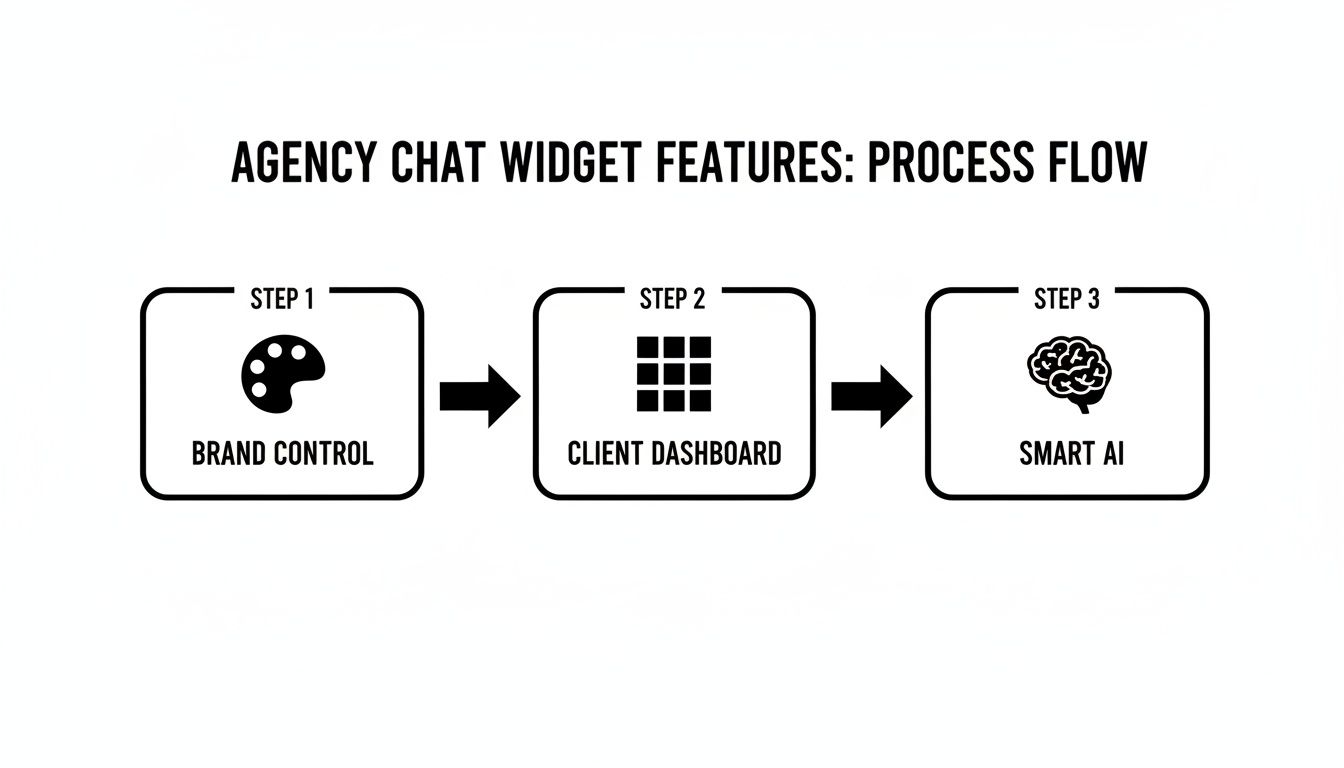
This flow isn't just a series of steps; it's a blueprint for a scalable service that you can manage efficiently.
The Power of a Centralized Dashboard
The secret weapon for managing a whole roster of clients without burning out your team is a centralized dashboard. Think of it as your mission control. No more juggling a dozen different logins or tracking performance in messy spreadsheets.
A centralized model is a genuine game-changer for agency efficiency. It turns what could be a scattered, time-sucking chore into a streamlined operation. You can deliver better service to more clients without having to expand your team.
This demand for scalable, branded tools is why the market is exploding. The global chatbot market was valued at USD 7.8 billion in 2024 and is expected to hit USD 27.3 billion by 2030, with agencies being a major driver of that growth. You can dive deeper into the white-label chatbot market dynamics to see how other agencies are getting in on the action.
Turning AI Conversations Into Qualified Leads
A conversation is just a conversation—until it turns into a customer. This is the critical shift your agency can provide by reframing the chat widget from a simple Q&A tool into a proactive lead generation engine for your clients. It’s about connecting the dots between casual inquiries and tangible business results.
A smart AI doesn't just sit back and wait for a visitor to ask for a quote. It's trained to recognize purchase intent during a conversation. When a user starts asking about pricing, availability, or specific features, the AI flags this as a buying signal and can present a lead capture form at just the right moment.
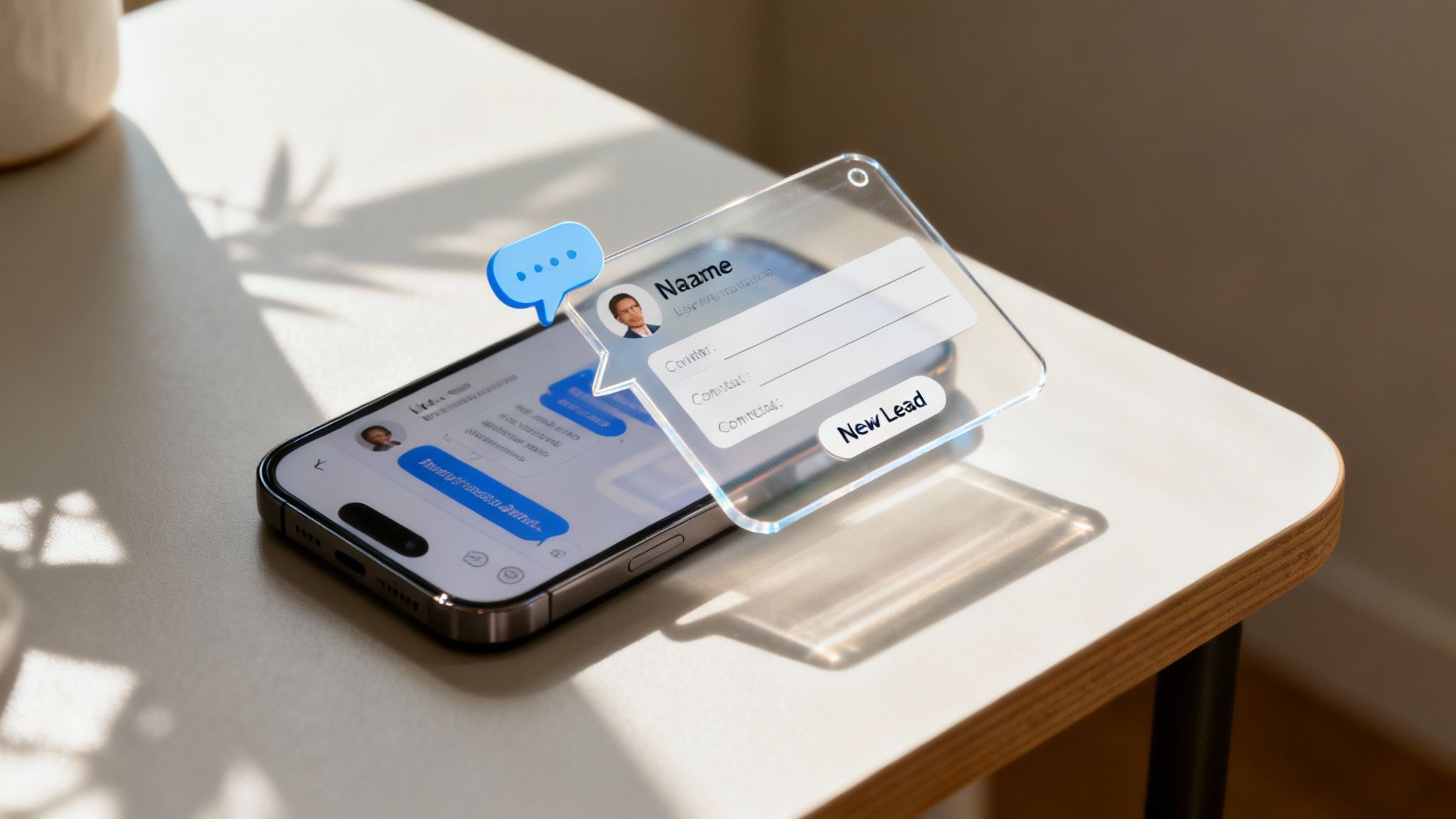
That seamless transition from chat to lead is exactly what your clients are paying for. Instead of a passive support tool, you're delivering an active sales assistant that works for them 24/7.
From Chat to Closed-Loop ROI
The real power comes from what happens after the contact information is collected. The best white-label chat widget platforms include a lightweight, built-in CRM for each client. This creates a closed-loop system that makes demonstrating your value incredibly simple.
Here’s what that workflow looks like in practice:
- A visitor starts a chat on your client’s website.
- The AI answers their questions and identifies strong interest.
- It prompts the user to enter their name, email, and phone number.
- That new contact automatically appears as a qualified lead in a Kanban-style pipeline, visible only to you and your client.
This closed-loop visibility is your agency's proof of performance. You can log in with your client and show them a board full of new leads, each one generated directly by the branded chat service you provide.
This capability is at the heart of some serious market growth. Conversational AI is completely changing customer service, with the market expected to expand from USD 12.64 billion in 2026 to USD 22.57 billion by 2031. For agencies, intent detection is the key to proving ROI.
For agencies looking to get ahead of this trend, knowing how to integrate these tools is a must. Exploring resources on building an AI-powered marketing team can really help amplify your lead qualification efforts. By proving tangible results month after month, you justify your fees and solidify your role as an indispensable growth partner.
How to Choose the Right White Label Partner
Picking a white label partner isn't just another software purchase—it's a massive business decision. The platform you choose becomes an extension of your agency, directly affecting your team's workflow, your profit margins, and, most importantly, how happy your clients are.
You have to look past the flashy feature list and really dig into whether a provider is built to help your agency grow. It's about finding a partner that gives you more than just a tool; they should be giving you the foundation for a whole new, scalable service you can offer with confidence.
Vetting Potential Providers
When you're sitting on a demo call or scrolling through a provider's website, your questions need to be sharp and specific. Think about the day-to-day reality of juggling multiple clients. The answers you get will quickly tell you if you're looking at a true agency-first platform or just a standard business tool with an "agency plan" slapped on.
Here's what you need to grill them on:
Scalability and Pricing: Can you actually make money reselling this? Look for pricing models designed for agencies, like tiered plans or bulk discounts that leave you with a healthy margin. Don't be shy; ask them straight up, "How does your pricing help us scale profitably as we bring on more clients?"
AI Intelligence: Just how smart is this thing? A chatbot that gives generic answers is worse than useless. Ask, "Can we train the AI specifically on our client's website content and internal documents? We need it to give accurate, brand-specific answers."
Multi-Client Management: Picture yourself managing 10, 20, or even 50 clients in their system. Ask for a live walkthrough of their multi-client dashboard. If it looks clunky or confusing, it's going to become a major time-suck for your team and kill your efficiency.
Choosing a partner is really about forming a strategic alliance. You want a provider whose success depends on your ability to resell their product under your own brand.
The Agency Support Question
This might be the most crucial part. What happens after you sign up? You need to ask about their support structure specifically for agencies.
Do they offer a dedicated account manager? Will they help you onboard your first few clients? Do they provide any sales collateral or co-marketing materials you can rebrand? A real partner invests in your success because they know it's their success, too. They’ll give you the resources you need to sell the service, not just operate it.
By asking these tough questions, you can cut through the marketing fluff and find a white label chat widget that's a genuine growth engine for your agency—one that truly aligns with your goals for profitability and killer client service.
Got Questions? We've Got Answers
Stepping into a new service like this always brings up a few questions. Let's tackle the most common ones we hear from agencies so you can move forward with confidence.
How Much Should We Charge for This?
Figuring out your pricing is crucial, and honestly, it's easier than you think. The goal is to create simple, value-packed tiers that make sense for different client sizes.
A tiered model works wonders here:
- Starter Package: Think of this as your foot-in-the-door offer. It includes a simple setup, basic branding, and lead capture. It's perfect for smaller clients or as an easy "yes" add-on to an existing contract.
- Pro Package: This should be your sweet spot and the one most clients go for. You’ll include more advanced AI training (using their own documents), performance reports, and better support. It's the ideal balance of features and price.
- Enterprise Package: Save this for your high-rollers. These are clients who need the works—custom integrations, a dedicated account manager tuning the AI, and deep-dive strategy calls every month.
As a rule of thumb, take what the white-label provider charges you and mark it up by 3x to 5x. That margin isn't just profit; it covers your time for management, support, and the value of your strategic oversight.
How Technical is the Setup for Our Clients?
This is the best part: it's not technical at all. You don't need to be a developer or hire one to get this running. The platforms are built specifically for agencies, which means they're designed to be fast and painless.
Getting a client's chat widget live really comes down to one simple step. You just copy a small piece of code from your dashboard and paste it into their website's header. If you've ever embedded a YouTube video or a Google Analytics tracker, you already know how to do this. It’s that simple, which makes it incredibly easy to scale.
Can This AI Actually Understand My Client's Business?
Absolutely, and that's what makes it so powerful. This isn't one of those old-school chatbots that just follows a rigid, pre-written script. A modern white label chat widget is trained on your client's actual business data.
It learns directly from the content on their website, their internal knowledge base, product descriptions, and any other documents you provide.
What does this mean in practice? The AI gives answers that are genuinely helpful, accurate, and completely on-brand. It speaks with your client's unique voice, not some generic robot's. It becomes a true digital expert for their business, building trust with every visitor it interacts with.
Ready to start offering a powerful, branded AI chat service that your clients will love? With BizSage, you can deploy AI agents trained on each client's unique data, manage everyone from a single dashboard, and track every lead captured. It's time to add a new, scalable revenue stream to your agency. Get started by visiting https://bizsage.io.